US Unveils Tariffs on France Over Tech Tax

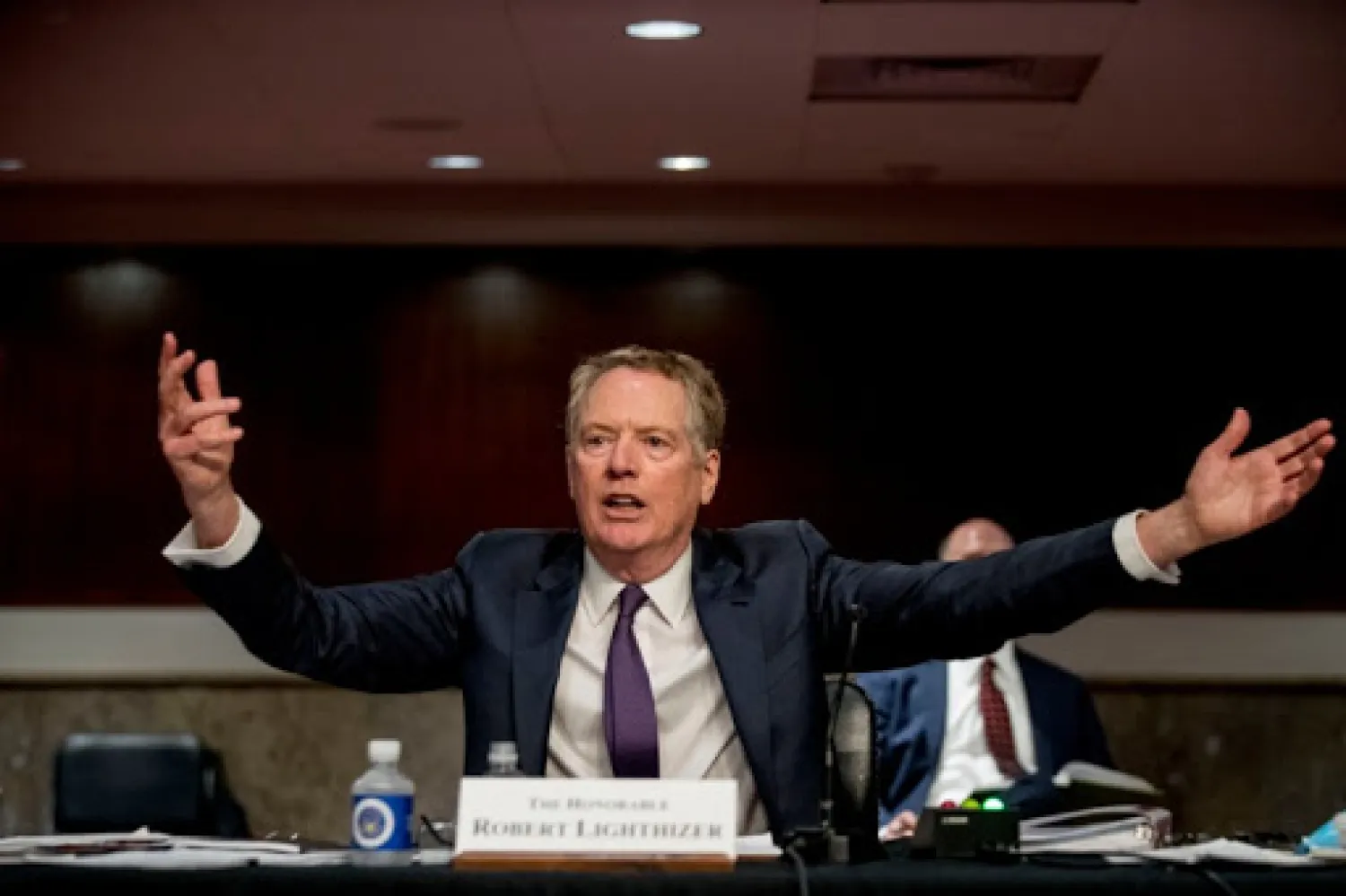
US Trade Representative Robert Lighthizer said Washington 'won't tolerate' taxes in France or elsewhere that target US firms | AFP
TT

US Unveils Tariffs on France Over Tech Tax

US Trade Representative Robert Lighthizer said Washington 'won't tolerate' taxes in France or elsewhere that target US firms | AFP

The United States on Friday unveiled heavy import duties on France in retaliation for the country's tax on American tech giants, but will hold off on collecting the fees to allow time for the dispute to be resolved.

The office of US Trade Representative Robert Lighthizer found France's digital services tax was discriminatory and "unfairly targets US digital technology companies," and will impose 25 percent punitive duties on $1.3 billion in French products.

However, it will suspend the tariffs until January 6, 2021 while discussions continue over the disagreement.

France approved the tax last summer on tech firms like Facebook, Amazon, Apple and Google, which were accused of moving their profits offshore to evade taxes.

But in January, Paris suspended collection of the tax through the end of the year.

French cosmetics and handbags will be subject to the US tariffs, but champagne, camembert and Roquefort were spared, according to the final product list after USTR collected thousands of public comments on the retaliation plans.

The sides have been trying to a negotiate a deal through the Organisation for Economic Co-operation and Development that would address the policy dilemma of taxing profits earned in one country by a company based in another with a more favorable tax policy.

But the talks have not made much headway and were suspended due to the coronavirus pandemic. Meanwhile, more countries are considering following France's example.

Lighthizer said Thursday that the US "won't tolerate" unfair treatment, although he acknowledged that there is a problem with multinational corporations offshoring profits to avoid paying taxes.

But he said the French tax "didn't even do a clever job of veiling the fact that they were just trying to get into the pocket of US companies."

A USTR investigation in January ruled the tax was "unreasonable" and threatened 100 percent duties on a potential list of $2.4 billion in French goods.

Vitor Gaspar, head of the IMF's fiscal affairs department, told AFP on Friday that there is "a perception that firms that are extremely profitable, that act in the global sphere, are not paying their fair share of taxation," and called for an international agreement.

"It's very important to avoid trade wars, it's very important to avoid tax wars," Gaspar said in an interview.

A "cooperative approach is in the best interest of everybody," he said, noting it would be "a signal of the capacity of the global community to work together if a deal on international corporate taxation would be struck."

Matt Schruers, the president of the Computer and Communications Industry Association, welcomed the US move.

"Today's action sends a strong message that discriminatory taxes aimed at US companies are not a path to modernizing the global tax system," Schruers said in a statement.

"Changes to international tax rules must be negotiated in good faith through a consensus-based approach at the OECD that addresses the changes of the digitalized global economy."


Aramco Bolsters Global Oil Market Stability Amid Rising Regional Tensions

Aramco's oil field in the Empty Quarter, Shaybah, Saudi Arabia, January 12, 2024. (Reuters)
TT

Aramco Bolsters Global Oil Market Stability Amid Rising Regional Tensions

Aramco's oil field in the Empty Quarter, Shaybah, Saudi Arabia, January 12, 2024. (Reuters)

Amid growing logistical challenges facing the energy sector, operational moves by Saudi Aramco are emerging as a stabilizing factor in global oil supply. The company has offered additional crude shipments on the spot market, a step analysts see as aimed at absorbing supply shocks and ensuring the continued flow of oil through key energy corridors.

The move aligns with Saudi Arabia’s long-standing role as a leading global producer and is intended to limit price volatility and maintain balance between supply and demand at a time of heightened geopolitical uncertainty.

Reuters reported that Aramco has offered more than 4 million barrels of Saudi crude through rare spot tenders, as tensions between the United States and Iran disrupt Middle Eastern exports.

Mohammad Al-Sabban, former senior adviser to the Saudi energy minister, said the current surge in oil prices does not necessarily reflect an immediate shortage of supply. Instead, it is largely driven by what energy markets call a “geopolitical risk premium.”

Speaking to Asharq Al-Awsat, Al-Sabban said prices remaining above $100 per barrel reflect global anxiety that the conflict could expand and threaten future supply security.

He noted that higher prices, while boosting short-term revenues and fiscal surpluses for oil-exporting countries, also bring hidden costs. These include increased spending on security measures to protect oil infrastructure — costs that rise in a volatile regional environment where Gulf states face mounting security pressures.

Al-Sabban also pointed out that spot market sales are currently generating greater returns than long-term futures contracts. The uncertainty surrounding the conflict has led buyers to pay premiums for immediate deliveries, making spot transactions more attractive during the current crisis.

Strategic chokepoint

Shipping through the Strait of Hormuz, which carries roughly 20 percent of global oil supply, remains central to the crisis.

Al-Sabban warned that even a temporary closure of the waterway would inevitably reduce available supplies, potentially triggering panic in markets and forcing countries to draw from strategic reserves.

He recalled historical precedents, noting that during the Iran-Iraq war, energy markets became a hub for speculation, with negative economic consequences emerging later.

Asked whether the conflict represents a short-term economic opportunity or a broader risk for regional economies, Al-Sabban said the reality is a mix of both. High prices may offer temporary gains as long as oil remains above $100 a barrel, but a prolonged conflict could ultimately impose heavier economic burdens through rising logistical and security costs.

Flexible response

Financial and economic adviser Hussein Al-Attas said Aramco’s decision to release additional cargoes on the spot market reflects significant flexibility in managing supply and responding quickly to market shifts amid rising demand and concerns about potential shortages.

He told Asharq Al-Awsat that the move sends an important signal to global markets that Saudi Arabia continues to play the role of a swing producer, capable of intervening to maintain market balance and ease fears about supply security.

Al-Attas added that the recent surge in oil prices is largely tied to geopolitical tensions in a region that represents the heart of global energy supply.

While Brent crude could remain above $100 in the short term if supply concerns persist, he noted that history shows price spikes driven by political tensions are often temporary unless they lead to a prolonged disruption in supply.

Higher oil prices naturally increase revenues for exporting countries, potentially strengthening fiscal balances and enabling governments to finance spending and development projects, Al-Attas remarked.

Gulf states, particularly Saudi Arabia and the United Arab Emirates, may therefore benefit financially in the short term.

However, he cautioned that such gains are usually temporary rather than structural. Prolonged high energy prices can slow global economic growth by fueling inflation, which may eventually reduce demand for oil. As a result, the current price surge may represent a temporary financial opportunity rather than a lasting shift in oil revenues.

Ultimately, Al-Attas said the crisis carries two opposing dynamics: Gulf countries may benefit financially in the short term, but any wider regional conflict could pose greater risks to economic and commercial stability.

For that reason, he added, the region’s strategic interest ultimately lies in stable energy markets and uninterrupted oil flows, which are essential for sustaining global demand and supporting long-term economic growth.


Egypt Raises Fuel Prices by up to 30 Percent

A gas station in the Egyptian capital, Cairo. (Reuters)
TT

Egypt Raises Fuel Prices by up to 30 Percent

A gas station in the Egyptian capital, Cairo. (Reuters)

Egypt raised domestic fuel prices by up to 30 percent on Tuesday, blaming "exceptional" global energy pressures caused by the Middle East war, which has disrupted oil supplies and shipping routes.

The increases, announced by the petroleum ministry, apply to gasoline, diesel and natural gas used in vehicles.

In a statement, the ministry said the adjustments were driven by "disruptions in supply chains, rising risk levels and higher maritime shipping and insurance costs", which have pushed petroleum product prices to "levels not seen in years".

Oil prices briefly surged above $119 a barrel on Monday before plunging to around $84 after US President Donald Trump said the US-Israel war with Iran would end soon.

Diesel, one of Egypt's most widely used fuels, rose by three Egyptian pounds, or about 17.1 percent, to 20.50 pounds ($0.38) per liter, up from 17.50 pounds.

Prices for 80-octane gasoline rose by about 16.9 percent, to 20.75 pounds per liter, while 92-octane gasoline increased by roughly 15.6 percent to 22.25 pounds.

Prices for 95-octane climbed by about 14.3 percent to 24 pounds, the ministry said.

Natural gas used for vehicles saw the largest hike, jumping 30 percent to 13 pounds per cubic meter.

Egypt has raised fuel prices four times over the past two years under an $8 billion loan program from the International Monetary Fund.

An October increase of up to 13 percent was expected to be the last under the plan.


Oil Falls as Trump Predicts Middle East De-escalation

Wells at the San Ardo Oil Field in San Ardo, Calif., Monday, March 9, 2026. (AP Photo/Nic Coury)
TT

Oil Falls as Trump Predicts Middle East De-escalation

Wells at the San Ardo Oil Field in San Ardo, Calif., Monday, March 9, 2026. (AP Photo/Nic Coury)

Oil prices fell on Tuesday after hitting a more than three-year high in the previous session as US President Donald Trump predicted the war in the Middle East could end soon, easing concerns about prolonged disruptions to global oil supplies.

Brent futures fell $6.28, or 6.3%, to $92.68 a barrel at 0715 GMT, while US West Texas Intermediate (WTI) crude was down $6.19, or 6.5%, to $88.58 a barrel, reported Reuters.

Both contracts fell as much as 11% earlier before paring some losses. Oil surged past $100 a barrel on Monday to the highest since mid-2022, as ‌supply cuts ‌by Saudi Arabia and other producers during the expanding US-Israeli war ‌on ⁠Iran stoked fears ⁠of major disruptions to global supplies.

Prices later retreated after Russian President Vladimir Putin held a call with Trump and shared proposals aimed at a quick settlement to the war, according to a Kremlin aide, easing concerns about supply.

Trump said on Monday in a CBS News interview that he thought the war against Iran was "very complete" and Washington was "very far ahead" of his initial four- to five-week estimated time frame.

"Clearly Trump's comments about a short-lived war have calmed ⁠markets. While there was an overreaction to the upside yesterday, we ‌think there is an overreaction to the downside today," ‌said Suvro Sarkar, energy sector team lead at DBS Bank, adding that the market was ‌underappreciating risks at these levels for Brent.

"Murban and Dubai grades are still well above $100 ‌per barrel, so practically nothing much has changed in terms of ground realities," he added, referring to benchmark Middle Eastern oil grades.

In response to Trump, Iran's Revolutionary Guards Corps (IRGC) said they would "determine the end of the war," and Tehran would not allow "one liter of oil" to be exported ‌from the region if US and Israeli attacks continued, state media reported on Tuesday, citing the IRGC's spokesperson.

Prices, however, remain under ⁠pressure as Trump ⁠considers easing oil sanctions on Russia and releasing emergency crude stockpiles as part of a package of options aimed at curbing spiking global oil prices, according to multiple sources.

"Discussions around easing sanctions on Russian oil, comments from Donald Trump hinting that the conflict could eventually de-escalate, and the possibility of G7 countries tapping strategic oil reserves all pointed to the same message - that oil barrels will somehow continue to reach the market," Priyanka Sachdeva, a Phillip Nova analyst, said in a note on Tuesday.

"Once traders sensed that supply routes could still be maintained, the initial 'panic premium' that had pushed prices above the $100 mark yesterday started to fade, and oil prices quickly pulled back."

G7 nations had said on Monday they were prepared to implement "necessary measures" in response to surging global oil prices but stopped short of committing to the release of emergency reserves.