


Trump Looks to Scale Back Environmental Reviews for Projects

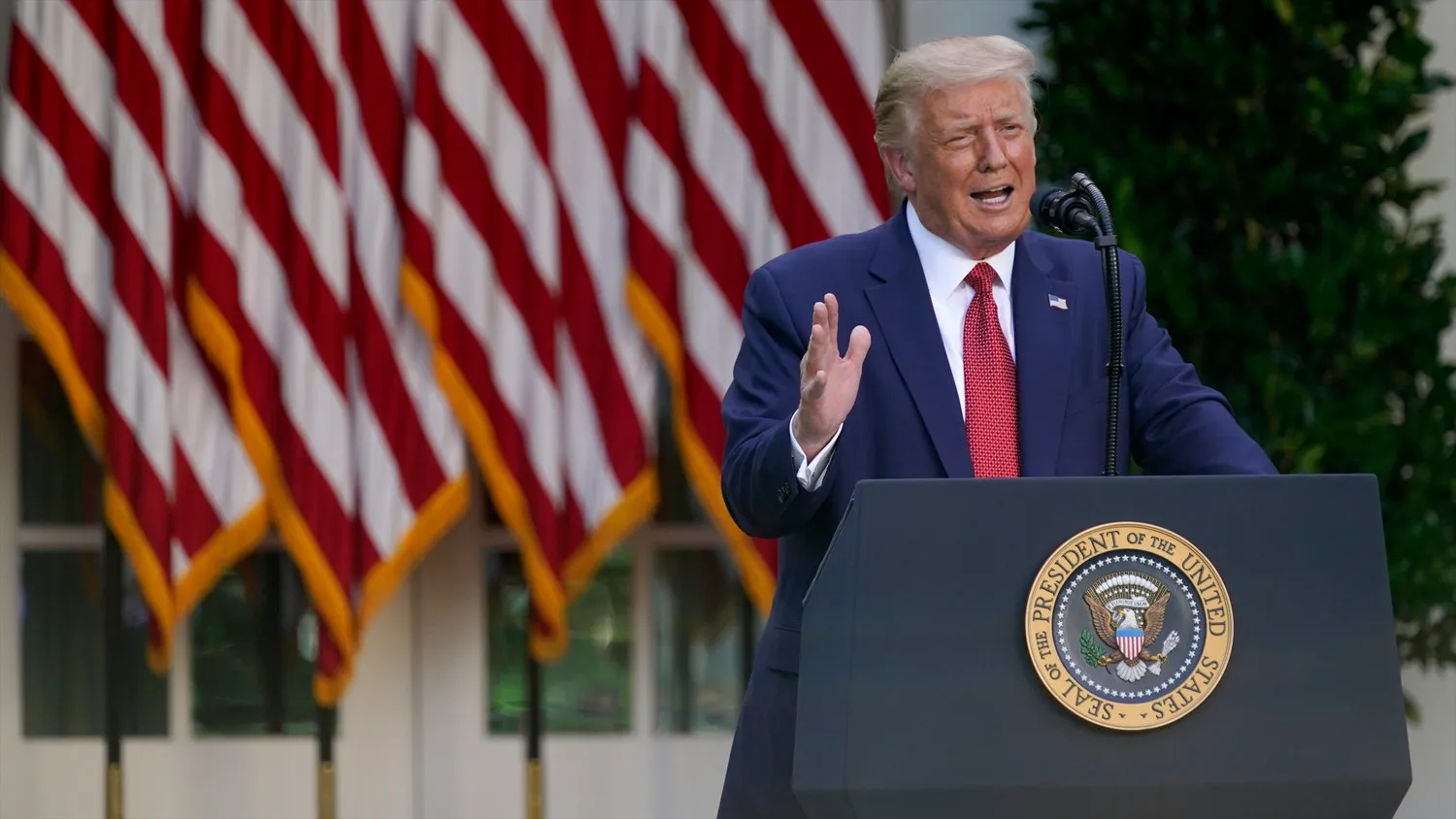
President Donald Trump speaks during a news conference in the Rose Garden of the White House, Tuesday, July 14, 2020, in Washington. (AP Photo/Evan Vucci)
TT

Trump Looks to Scale Back Environmental Reviews for Projects

President Donald Trump speaks during a news conference in the Rose Garden of the White House, Tuesday, July 14, 2020, in Washington. (AP Photo/Evan Vucci)

President Donald Trump is expected to announce a new federal rule to speed up the environmental review process for proposed highways, gas pipelines and other major infrastructure, a move that critics are describing as the dismantling of a 50-year-old environmental protection law.

Trump will travel to Atlanta on Wednesday to announce the federal rule as he seeks to make it easier to meet some of the country's infrastructure needs. When he first announced the effort in January, the administration set a two-year deadline for completing full environmental impact reviews while less comprehensive assessments would have to be completed within one year. The White House said the final rule will promote the rebuilding of America.

Critics call the Republican president's efforts a cynical attempt to limit the public´s ability to review, comment on and influence proposed projects under the National Environmental Policy Act, one of the country´s bedrock environmental protection laws.

"This may be the single biggest giveaway to polluters in the past 40 years," said Brett Hartl, government affairs director at the Center for Biological Diversity, an environmental group that works to save endangered species.

Trump has made slashing government regulation a hallmark of his presidency and held it out as a way to boost jobs. But environmental groups say the regulatory rollbacks threaten public health and make it harder to curb global warming. With Congress and the administration divided over how to boost infrastructure investment, the president is relying on his deregulation push to demonstrate progress.

"The United States can´t compete and prosper if a bureaucratic system holds us back from building what we need," Trump said when first announcing the sweeping rollback of National Environmental Policy Act rules.

Georgia is emerging as a key swing state in the general election. Trump won the Republican-leaning state by 5 percentage points in 2016, but some polls show him trailing former Vice President Joe Biden, the presumptive Democratic nominee. This will be Trump´s ninth trip to Georgia and his sixth visit to Atlanta during his presidency.

The president's trip also comes as the state has seen coronavirus cases surge and now has tallied more than 12,000 confirmed cases and more than 3,000 deaths.

Jon Ossoff, a Democrat who is running against incumbent Republican Sen. David Perdue, said Trump´s decision to come to Georgia to discuss infrastructure as the state's coronavirus crisis worsens demonstrates that the president is "in denial and out of control."

"Coming here for a routine photo-op is, frankly, bizarre, surreal against this unprecedented health and economic crisis," Ossoff said.

Judd Deere, a White House spokesman, said that if Ossoff views a major policy announcement to expedite critical infrastructure projects as anything other than about job growth and economic expansion, then it might explain why he lost an election two years ago.

The White House said the administration´s efforts will expedite the expansion of Interstate 75 near Atlanta, an important freight route where traffic can often slow to a crawl. The state will create two interstate lanes designed solely for commercial trucks. The state announced last fall, before the White House unveiled its proposed rule, that it was moving up the deadline for substantially completing the project to 2028.

Thousands of Americans on both sides of the new federal rule wrote to the Council on Environmental Quality to voice their opinions.

The US Chamber of Commerce cited a North Carolina bridge in its letter as an example of unreasonable delays, saying the bridge that connected Hatteras Island to Bodie Island took 25 years to complete, but only three years to build. "The failure to secure timely approval for projects and land management decisions is also hampering economic growth," the business group wrote.

The Natural Resources Defense Council said that when Congress passed the National Environmental Policy Act 50 years ago, it did so with the understanding that environmental well-being is compatible with economic well-being. The proposed rule, it said, would lead federal agencies to make decisions with significant environmental impacts without ever considering those impacts in advance.

"At the end of the day, it would lead to poor decision, increased litigation and less transparency," said Sharon Buccino, a senior director at the environmental group.

Trump's trip to Georgia comes one day after Biden announced an infrastructure plan that places a heavy emphasis on improving energy efficiency in buildings and housing as well as promoting conservation efforts in the agriculture industry. In the plan, Biden pledges to spend $2 trillion over four years to promote his energy proposals.

Trump´s push to use regulatory changes to boost infrastructure development also comes as the House and Senate pursue starkly different efforts. The Democratic-controlled House passed a $1.5 trillion plan that goes beyond roads and bridges and would fund improvements to schools, housing, water and sewer, and broadband. A GOP-controlled Senate panel passed a bill last year setting aside $287 billion for roads and bridges, but other committees are still working on the measure, including how to pay for it.



US State Dept Approves $151 Mn Arms Sale to Israel

US State Department in Washington, D.C. (Reuters)
TT

US State Dept Approves $151 Mn Arms Sale to Israel

US State Department in Washington, D.C. (Reuters)

The US State Department approved the sale of $151.8 million worth of munitions to Israel on Friday as the countries engage Iran in an escalating Middle East war, said AFP.

The sale of 12,000 requested 1,000-pound (470-kilogram) bomb bodies was approved by the State Department's Bureau of Political-Military Affairs, according to a press release.

"The proposed sale will improve Israel's capability to meet current and future threats, strengthen its homeland defense, and serve as a deterrent to regional threats," the bureau said in a statement.


Explosions Rock Iran's Capital, and More Attacks Target Israel as US Warns Bombing Will Intensify

Smoke columns in the sky of the Iranian capital Tehran after the bombing operations (AFP)
TT

Explosions Rock Iran's Capital, and More Attacks Target Israel as US Warns Bombing Will Intensify

Smoke columns in the sky of the Iranian capital Tehran after the bombing operations (AFP)

Explosions sent up clouds of dark smoke in the Iranian capital city early Saturday, and Tehran retaliated by firing missiles at Israel as the United States warned of a forthcoming bombing campaign that officials said would be the most intense yet in the weeklong conflict.

There was no foreseeable end to the fighting. US President Donald Trump's administration approved a new $151 million arms sale to Israel after Trump said he would not negotiate with Iran without its “unconditional surrender.” Iran's UN ambassador said the country would “take all necessary measures” to defend itself.

Associated Press video showed explosions flashing and smoke rising over western Tehran as Israel said it had begun a broad wave of strikes. Also early Saturday, loud booms sounded in Jerusalem and incoming missiles from Iran had people heading to bomb shelters across Israel.

There were no immediate reports of casualties by Israel’s emergency services.

In a sign of the widening nature of the conflict, sirens sounded early Saturday in Bahrain as Iranian attacks targeted the island kingdom. And Saudi Arabia said it destroyed drones headed toward its vast Shaybah oil field and shot down a ballistic missile launched toward Prince Sultan Air Base, which hosts US forces.

The US and Israel have battered Iran with strikes, targeting its military capabilities, leadership and nuclear program. The stated goals and timelines for the war have repeatedly shifted, as the US has at times suggested it seeks to topple Iran’s government or elevate new leadership from within.

Meanwhile, Russia has provided Iran with information that could help Tehran strike the US military, according to two officials familiar with US intelligence on the matter. Russian President Vladimir Putin had a call Friday with Iranian President Masoud Pezeshkian, expressing his condolences over the killing of Iranian Supreme Leader Ali Khamenei, the Kremlin said.

In other developments, evidence emerged suggesting that an explosion that killed scores of Iranian students at a school was likely caused by US airstrikes that also hit an adjacent compound associated with the regime’s Revolutionary Guard.

Qatar’s energy minister, Saad al-Kaabi, warned in an interview with the Financial Times that the war could “bring down the economies of the world,” predicting a widespread shutdown of Gulf energy exports that could send oil to $150 a barrel.

The price for a barrel of benchmark US crude rose above $90 on Friday for the first time in more than two years.

Russia is providing information to Iran, officials say Russia has provided Iran with information that could help Tehran strike American warships, aircraft and other assets in the region, according to two officials familiar with US intelligence on the matter.

The people, who were not authorized to comment publicly and spoke on the condition of anonymity, cautioned that the US intelligence has not uncovered that Russia is directing Iran on what to do with the information.

Still, it’s the first indication that Moscow has sought to get involved in the war.

Trump says US will help rebuild Iran once it has ‘ACCEPTABLE’ leaders

In a social media post Friday, Trump said “There will be no deal with Iran except UNCONDITIONAL SURRENDER!" After a surrender, “and the selection of a GREAT & ACCEPTABLE Leader(s),” he wrote, the US and its allies will help rebuild Iran, making it “economically bigger, better, and stronger than ever before.”

Those comments were likely to raise further questions about the endgame of the war. The fighting has killed at least 1,230 people in Iran, more than 200 in Lebanon and around a dozen in Israel, according to officials in those countries. Six US troops have been killed.

Iranian President Masoud Pezeshkian wrote on social media that “some countries” had begun mediation efforts, without elaborating.

Trump has also told media outlets that he should be involved in choosing a replacement for Khamenei, who was killed in the opening strikes of the war. Trump spoke dismissively of Khamenei’s son, Mojtaba Khamenei — a front-runner to replace his father — calling him “a lightweight.”

Iran’s UN ambassador, Amir Saeid Iravani, condemned Trump's statement and said Iran "does not accept and will never allow any foreign power to interfere in its internal affairs.”

Iranian state television reported Friday that a leadership council had started discussing how to convene the country’s Assembly of Experts, which will select the new supreme leader.

US official warns that ‘biggest bombing’ is coming

US Treasury Secretary Scott Bessent said in a television interview that the “biggest bombing campaign” of the war was still to come.

Israel has said that over the past week it has heavily bombed an extensive underground bunker that Iranian leaders had planned to use during the hostilities.

New information surfaced suggesting that a deadly Feb. 28 explosion at a school in the Iranian city of Minab, some 1,100 kilometers (680 miles) southeast of Tehran, was likely caused by US airstrikes. The information included satellite images, expert analysis, a US official and public information released by US and Israeli military forces.

Iranian state media has said more than 165 people were killed in the blast, most of them of children.

Iran has blamed Israel and the US for the explosion. Neither country has accepted responsibility, though Defense Secretary Pete Hegseth has said the US is investigating.

Fighting with Israeli troops reported in eastern Lebanon

The Iranian-backed militant group Hezbollah said its fighters clashed with an Israeli force that landed late Friday in the mountains of eastern Lebanon. The Lebanese Health Ministry said at least three people were killed.

Israel did not acknowledge the fighting, and its military did not immediately respond to requests for comment.

Israel has carried out waves of airstrikes on the southern suburbs of Beirut, where Hezbollah has a large presence, but which is also home to hundreds of thousands of civilians.

Lebanon's Health Ministry said at least 217 people have been killed by Israeli strikes since Monday and 798 wounded.

Roads in the Lebanese capital were choked with evacuating traffic as smoke rose over the city’s southern districts. Two hospitals evacuated patients and staff.

“What can we do? We prayed here under the tree. During the night, we slept in the car because there is no place to stay,” Jihan Shehadeh, one of the tens of thousands of displaced, said.


Israel Army Says Iran Using Cluster Munitions

An Iranian missile with cluster munitions flies towards Israel, amid the US-Israeli conflict with Iran, in central Israel, March 5, 2026. (Reuters)
TT

Israel Army Says Iran Using Cluster Munitions

An Iranian missile with cluster munitions flies towards Israel, amid the US-Israeli conflict with Iran, in central Israel, March 5, 2026. (Reuters)

Israel's military Friday said that Iran had launched cluster bombs "multiple times" since the start of the war that began with a US-Israeli attack on the country last week.

"They (the Iranians) are using cluster munitions", military spokesman Lieutenant Colonel Nadav Shoshani said during a press briefing, without providing details on when and where those munitions were launched.

"They've used it multiple times, which is a war crime when it's directed towards civilians and we're tracking that situation," Shoshani added.

Neither Iran nor Israel are among more than a hundred countries that are party to the 2008 Convention on Cluster Munitions, which prohibits the use, transfer, production and storage of cluster bombs.

AFP footage from Thursday evening showed a swarm of flaming projectiles falling in the darkened sky over central Israel.

Police did not comment on the sighting, but a military expert who reviewed the footage for AFP identified them as a part of a cluster bomb.

Israel's police had said Wednesday that bomb disposal experts found evidence of cluster munitions after incoming missiles from Iran were detected.

Due to military censorship rules in place in Israel since the start of its war with Iran, impact sites are generally closed to the public including journalists until they are cleared of Iranian missile debris and unexploded ordnances.

Police on Friday also published a public service announcement in which one of its bomb disposal technicians explained the dangers of cluster bombs.

"During the current war, the home front is facing a variety of threats, whether missiles, UAVs (drones), or rockets. I will talk to you about a threat that is a bit less known, but no less dangerous: the cluster munition threat," the technician said in the video.

During Israel's 12-day war with Iran in June 2025, the NGO Amnesty International reported Tehran’s use of widely banned cluster munitions.

The organization had said it analyzed photos and videos showing cluster munitions that, according to media reports, struck inside the Gush Dan metropolitan area around Tel Aviv on June 19.

The southern city of Beersheva on June 20 and Rishon LeZion to the south of Tel Aviv on June 22 were also "struck with ordnance that left multiple impact craters consistent with the submunitions seen in Gush Dan", Amnesty said.

Cluster munitions explode in mid-air and scatter bomblets.

Some of them may not explode on impact and can cause casualties over time, particularly among children.