
Zinedine Zidane Finds His Ultimate Fulfilment After Real Madrid's Title

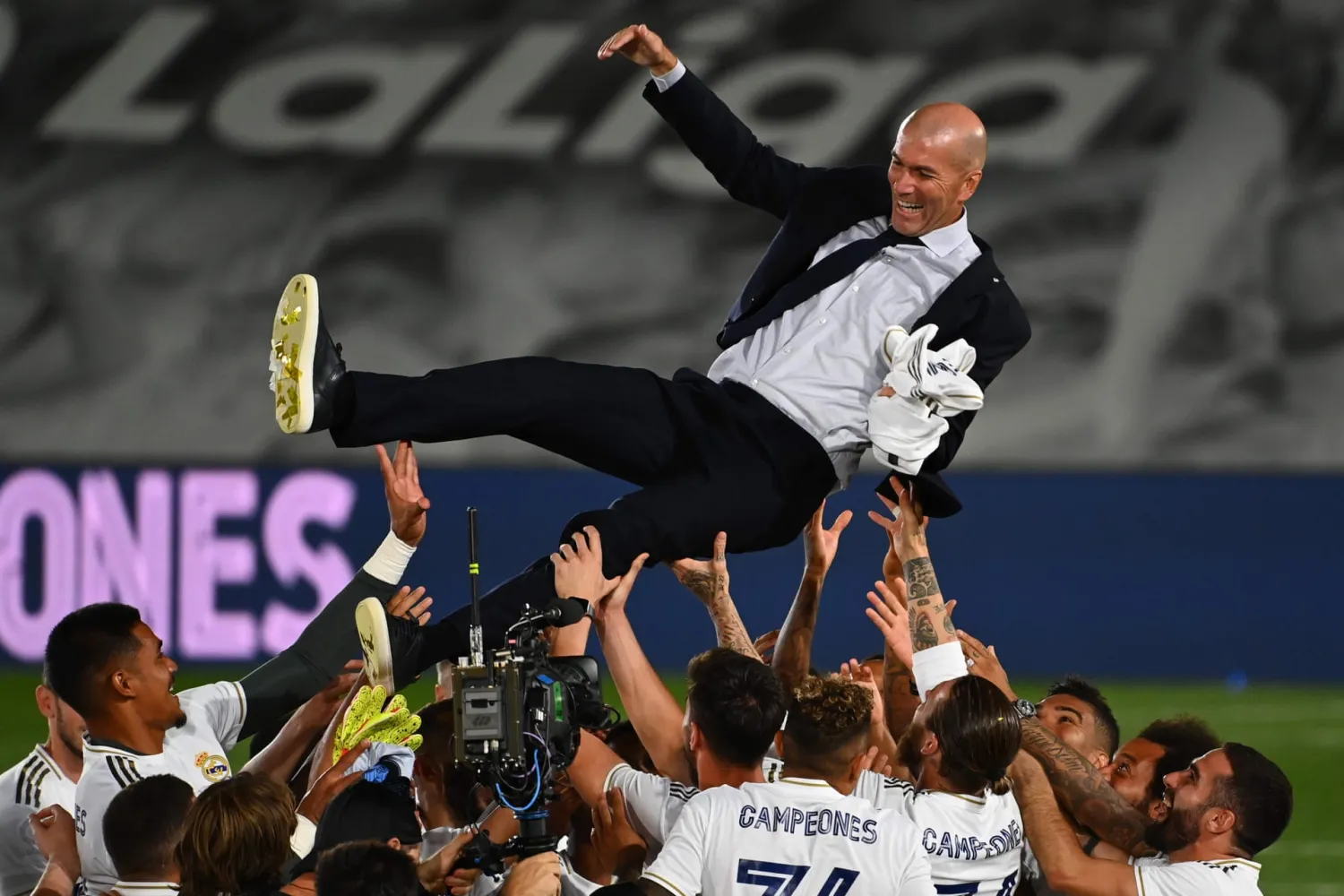
Real Madrid’s player toss coach Zinedine Zidane in the air after winning the Spanish title. | Gabriel Bouys/AFP/Getty Images
TT

Zinedine Zidane Finds His Ultimate Fulfilment After Real Madrid's Title

Real Madrid’s player toss coach Zinedine Zidane in the air after winning the Spanish title. | Gabriel Bouys/AFP/Getty Images

Just before 11pm on Thursday night, two months after the title race was supposed to finish and a few seconds after it actually had, two men working for the local council climbed up the statue of the goddess Cibeles, tied a Real Madrid scarf around her neck, draped a flag over her shoulders and climbed back down. Wearing hi-vis shirts, wellies and waders, they were the only ones who got close. Cars passed by beeping but on the street there were more police than people. Usually the scene of celebration, thousands gathering, this time fans had been asked to stay away and the men who had won the league weren’t coming either.

They were 15km north-east. “We would have liked be there at Cibeles with the fans, but there will be time for that and they’ll be happy watching at home,” Zinedine Zidane said. Around him, the floor was soon covered in confetti and his players wore commemorative T-shirts. We Are The Champions boomed around and a celebratory banquet was prepared, burger and chips the dinner of champions. But this was their training ground, not the Santiago Bernabéu, and when Sergio Ramos lifted the trophy only a couple of hundred people were there to see it: staff, ballboys, six reporters and Villarreal standing politely to applaud. It was, the manager said: “Strange for everyone.” It had been that kind of season.

Yet if there had been no wild celebration, no open-topped bus on the day that Spain paid tribute to almost 30,000 victims of coronavirus and figures brought fears of a more outbreaks and renewed restrictions, there was nothing empty in the embraces. Madrid’s manager felt fulfilled, more than ever before. “I don’t have the words; I feel huge emotion,” he said. He also described it as one of the most significant days of his life. For the man who has won a trophy every 19 games, the day he won La Liga stood above all those European Cups, not last because of how far they had come. The longest season had ended with Madrid’s third league in 12 years, just as he had hoped it would.

“Our season will be good, I’m convinced,” Zidane had said almost exactly a year ago. Which might sound standard enough, the usual pre-season optimism soon bitten by reality, but that was in New York where his side had just let in seven against Atlético Madrid. “One great team and one set of ruins,” judged one front cover; there was “no football, no fight, no plan.” Only there was, and from the rubble came the champions, the hint of a new culture emerging at a club where Europe had eclipsed all else. “Zidane built the plan; the league was our objective from the start,” said Thibaut Courtois on Thursday night.

It wasn’t smooth and it wasn’t always sparkling, but slowly something was building even if it wasn’t with the tools Zidane had in mind. Paul Pogba hadn’t arrived, while James Rodríguez and Gareth Bale hadn’t gone, their moves blocked after the defeat to Atlético. They were destined to play minor roles – unlike the men in whom Zidane trusted when others didn’t, club included. This is not a new side, at least not when it comes to the names. Eight players have started more than 20 league games and all of them were there already. Sergio Ramos and Luka Modric are 34, Marcelo and Karim Benzema 32, Kroos 30. Between them, they have 54 seasons at the club; some didn’t want them to have any more. If earlier in the season it so often felt like Madrid relied on the dynamic presence of Fede Valverde, and while Vinicius was decisive in the clásico, ultimately this feels like the success of the old guard, trusted and revived by Zidane.

Built around a spine of seven+two that have almost always played – Courtois, Carvajal, Ramos, Raphaël Varane, Mendy/Marcelo, Casemiro, Kroos, Modric/Valverde and Benzema – Madrid have won a league in which they’ve had minimal contributions from their new arrivals (Mendy apart) and even less from their four most expensive players, including their two most costly signings ever and four of the all-time top six. Bale, Hazard, Jovic and Rodríguez cost €336m for an average of 8.75 games and 1.5 goals. With Hazard struggling with injuries, Benzema has led, scoring 21 league goals; that’s more than all the other forwards put together. The second top scorer is Ramos, on 10.

And yet at every step, there have been key contributions at key moments. Twenty-one different men have scored: of the outfield players, only Éder Militão and Brahim Díaz (39 minutes) have not. They went top at Valladolid in January, Nacho Fernández heading in the only goal and Zidane talking about the significance of set plays. The week before Casemiro scored both against Sevilla. At Getafe, Varane scored two from set plays. At Alavés, Dani Carvajal and Ramos scored. All that in a seven-week run than included 0-0 draws at Athletic and Barcelona and a 95th-minute equaliser at Valencia, scored when Courtois went up for a corner.

There were glimpses of something more expansive – Eibar, Leganés – but that idea was taking shape. There was variety in their formations – 4-3-3, 4-5-1 4-4-2 – they pressed higher than before and the ball was brought out cleaner now, while there was also a tighter structure than in Zidane’s first spell. Solidity and seriousness were the foundation stone, an idea more pronounced after the pandemic but there from the start. When Madrid dropped points in week two, giving the ball away, Zidane complained that they should have just booted the bloody thing. In week five he did something even he hadn’t done before: took a Madrid team to the Sanchez Pizjuán and won 1-0, the word solidarity a recurring theme afterwards. Two weeks after, they drew the derby 0-0, Courtois responding to suggestions of conservatism by saying: “We weren’t going to go mad.” “Solidity is very important; it’s what gives you life,” Zidane added. “If we’re defensively strong, OK. We’ll do something in attack.”

Not that it was perfect. Beaten by Mallorca in the autumn, there were doubts. And had they lost in Istanbul in October, Zidane might not have survived. They came through those and went top when they defeated Barcelona in March, but that was their only win in four league games. Out of the Copa del Rey, they lost to Manchester City in Europe too. The week after the clásico, they lost at Betis and Barcelona were leaders again, the situation delicate. And then everything stopped.

When it restarted, it was something else. Not so much two halves as two different things clumsily welded together, like From Dusk Til Dawn. Barcelona had never really convinced even when they led, the team desperately trying to keep the club’s crisis at bay, and now they started to collapse, dropping eight of the last 30 points on course to finish with their fewest points in over a decade. Meanwhile, Madrid got stronger, the new context suiting them. If Zidane had changed Madrid’s culture, it is also true that something shifted when the league became more like the Champions League, the target within touching distance, a sole focus. Five weeks to get through and nothing else, 11 games to glory. Or 10, as it turned out.

“Lockdown was good for us, to react and take the return super seriously: there was no margin for error in our minds,” Ramos admitted. “What makes now different is that after lockdown when they came back they wanted to do great things; you could see it in the training sessions; they wanted to do more, and that tells you everything,” Zidane revealed. Everything else stripped away – the noise, the tension, the intangibles, all those elements that bring equality – they were too strong. “When their fifth sub is Kroos …” Athletic manager Gaizka Garitano said. The former Madrid manager Bernd Schuster even suggested that it might even have been good for them to play behind closed doors, away from the pressure of the Bernabéu, where those tight games are a problem, not a pathway. One that led inevitably to the title, with 10 wins from 10, just four goals let in.

Since the restart Madrid have never been behind, let alone beaten. They started two points behind and finished seven points in front; it wasn’t always brilliant – although the second half against Valencia and the first in Granada were superb – but it brokered little argument. They didn’t even need all their games. Zidane insisted that the title race would run until the last day but for once he was wrong. Victory against Villarreal meant that Madrid won the league with a game to spare.

After everything that happened, everything he believes in, all the doubts that he knows are there – even from within own club, even from within his own mind – this was the competition Zidane wanted most of all. No one had appreciated Barcelona’s titles like him, which is why no one appreciated this quite like him. The league was the true test, he kept insisting, the proof that you’re the best, reason enough to visit Cibeles, even if that has to be some other day. “The Champions League is the Champions League,” Zidane said late on Thursday, “but, the Spanish league, pfff … the Spanish league is the dog’s bollocks.”

(The Guardian)


IOC Boss Coventry Hails Milano Cortina Games a Success

 20 February 2026, Italy, Milan: President of the International Olympic Committee (IOC) Kirsty Coventry holds a press conference. (dpa)
20 February 2026, Italy, Milan: President of the International Olympic Committee (IOC) Kirsty Coventry holds a press conference. (dpa)
TT

IOC Boss Coventry Hails Milano Cortina Games a Success

 20 February 2026, Italy, Milan: President of the International Olympic Committee (IOC) Kirsty Coventry holds a press conference. (dpa)
20 February 2026, Italy, Milan: President of the International Olympic Committee (IOC) Kirsty Coventry holds a press conference. (dpa)

The Milano Cortina Olympics exceeded expectations despite a shaky build-up, IOC President Kirsty Coventry said on Friday, hailing the first spread-out Winter Games a success.

"These Games are truly ... successful in a new way of doing things, in a sustainable way of doing things, in a way that I think many people thought maybe we couldn't do, or couldn't be done well, and it's been done extremely well, and it's surpassed everyone's expectations," Coventry told a press conference.

It was the International Olympic Committee chief's clearest endorsement yet of a format that split events across several Alpine clusters rather than concentrating them in one host city.

Her assessment came after two weeks in which organizers sought to prove that a geographically dispersed Games could still deliver a consistent athlete experience.

The smooth delivery ‌comes after years ‌of logistical and political challenges, including construction delays at Milan’s Santagiulia Arena ‌and ⁠controversy over building ⁠a new sliding center in Cortina against IOC advice.

Organizers have also faced isolated disruptions during the Games, such as suspected sabotage on rail lines and protests in Milan over housing and environmental issues.

Transport concerns across the dispersed venues have been mitigated by limited cross-regional travel among spectators, though some competitors had to walk to the Cortina Curling Olympic Stadium in heavy snowfall that stopped traffic.

Central to the success of the Games, Coventry argued, was the effort to standardize conditions across multiple athlete villages despite the distances separating venues from Cortina d’Ampezzo to ⁠Livigno and Bormio.

Italian athletes’ performances also helped ticket sales, which amounted to ‌about 1.4 million.

"And the athletes are extremely happy. And they're happy ‌because the experiences that the MiCo (Milano Cortina) team and my team delivered to them have been the same," she ‌said.

Mixed relay silver medalist Tommaso Giacomel did, however, lament the fact there was no Olympic village near ‌the Antholz-Anterselva Biathlon Arena and that competitors were dotted around different hotels near the venue instead of in one place.

TWO OPENING CEREMONIES

Two opening ceremonies were held - the main one at Milan’s San Siro stadium and a more low-key parade on Cortina d’Ampezzo's Corso Italia, where athletes and spectators were within touching distance.

Feedback from competitors suggested the more intimate ‌settings had in some cases enhanced the Olympic atmosphere, Coventry said, taking the Cortina opening ceremony as an example.

The Zimbabwean, presiding over her first Games ⁠as IOC chief after elections in ⁠2025, framed Milano Cortina as proof of concept for future hosts grappling with rising costs and climate constraints, while acknowledging adjustments would follow.

"It allows us to really look at ourselves and look at the things that we have in place and how we're then going to make certain adjustments for the future," she said.

Beyond logistics, Coventry pointed to the broader impact of the Games, highlighting gender balance - with women making up 47% of competitors - and global engagement as marks of progress.

"But it's been an incredible experience and we're all very proud to have gender equity playing a big role in the delivery of the Games," she said, describing a "tremendous Games" in which athletes have "come together and shared in their passion".

With the closing ceremony in Verona approaching, Coventry said the focus would soon shift to a formal evaluation process, but insisted the headline conclusion was already clear.

"So we look forward to doing that and to learning from all the incredible experiences that I think all of the stakeholders have had across these Games, across these past two weeks," she said.


‘A Huge Mistake.’ Kompany Hits Out at Mourinho for Vinícius Júnior Comments

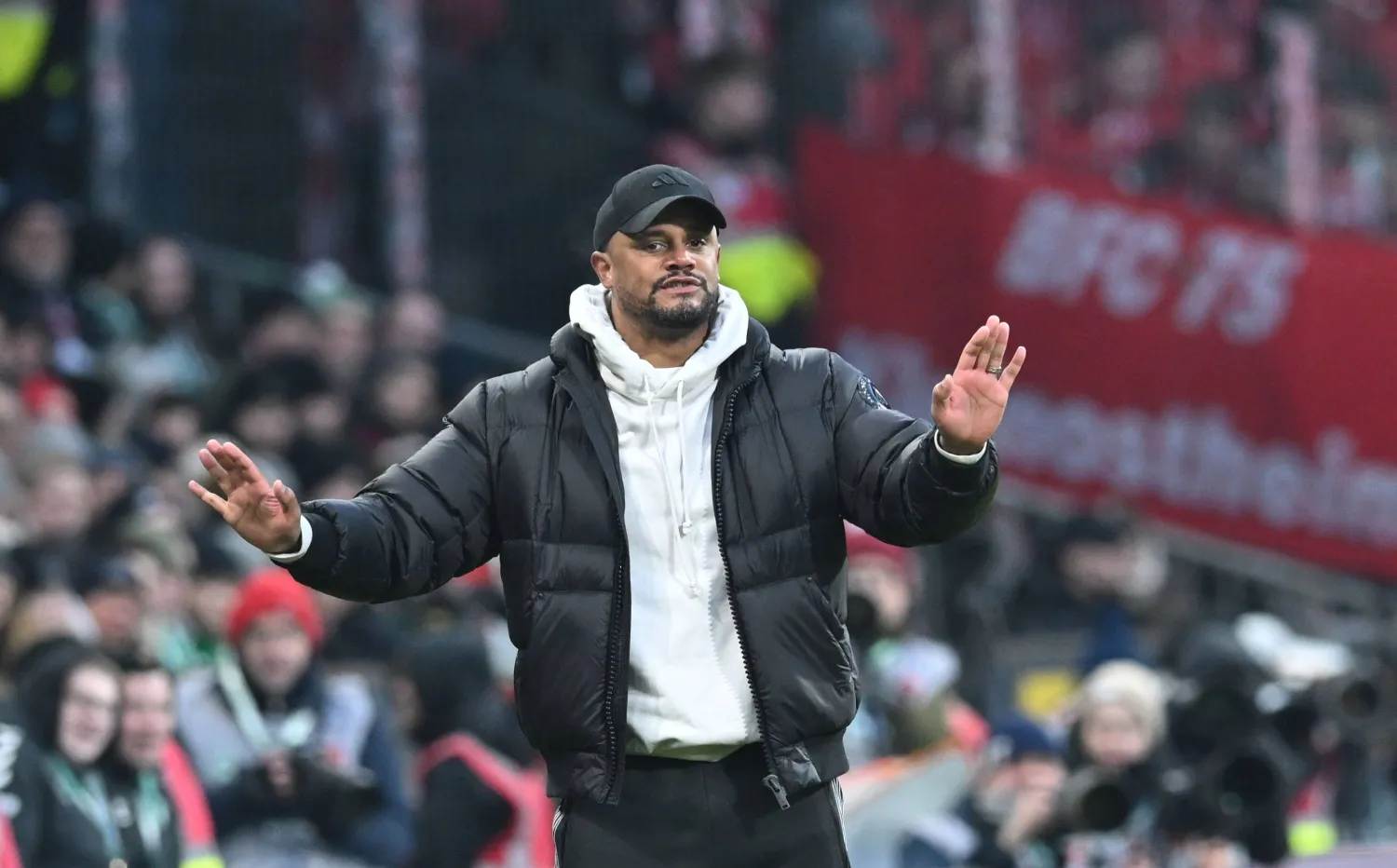
14 February 2026, Bremen: Bayern Munich coach Vincent Kompany gestures during the German Bundesliga soccer match between Werder Bremen and Bayern Munich at Weserstation. (dpa)
TT

‘A Huge Mistake.’ Kompany Hits Out at Mourinho for Vinícius Júnior Comments

14 February 2026, Bremen: Bayern Munich coach Vincent Kompany gestures during the German Bundesliga soccer match between Werder Bremen and Bayern Munich at Weserstation. (dpa)

Bayern Munich coach Vincent Kompany has criticized José Mourinho for attacking the character of Vinícius Júnior after the Real Madrid star accused an opponent of racially insulting him during a Champions League match.

Benfica coach Mourinho suggested that Brazil forward Vinícius had incited Benfica's players with his celebrations after scoring the only goal in Tuesday's playoff match.

Vinícius accused Benfica's Gianluca Prestianni of calling him "monkey" during a confrontation after his goal.

Mourinho also questioned why Vinícius, who is Black and has been subjected to repeated racist insults in Spain, was so frequently targeted.

"There is something wrong because it happens in every stadium," Mourinho said. "The stadium where Vinícius played something happened. Always."

Speaking on Friday, Kompany condemned Mourinho's comments.

"So after the game you have the leader of an organization, José Mourinho, who attacks the character of Vinícius Júnior by bringing in the type of celebration to discredit what Vinícius is doing in this moment," Kompany said. "And for me in terms of leadership, it’s a huge mistake and it’s something that we should not accept."

Mourinho’s celebrations

UEFA appointed a special investigator on Wednesday to gather evidence about what happened in Lisbon in Madrid’s 1-0 win in the first leg of the Champions League playoffs. Madrid said it had sent "all available evidence" of the alleged incident to European soccer's governing body.

Referring to Vinícius' celebrations after curling a shot into the top corner, Mourinho said he should "celebrate in a respectful way."

Kompany pointed out Mourinho's own history of exuberant celebrations — such as when he ran down the sideline to cheer when his Porto team beat Manchester United in the Champions League.

Kompany said Mourinho's former players "love him" and added "I know he’s a good person."

"I don’t need to judge him as a person, but I know what I’ve heard. I understand maybe what he’s done, but he’s made a mistake and it’s something that hopefully in the future won’t happen like this again," he said.

Prestianni denied racially insulting Vinícius. Benfica said the Argentine player was the victim of a "defamation campaign."

‘Right thing to do’

Kompany said Vinícius' reaction "cannot be faked."

"You can see it — his reaction is an emotional reaction. I don’t see any benefit for him to go to the referee and put all this misery on his shoulders," he said. "There is absolutely no reason for Vini Junior to go and do this.

"I think in his mind he’s doing it more because it’s the right thing to do in that moment."

Kompany added: "You have a player who’s complaining. You have a player who says he didn’t do it. And I think unless the player himself comes forward, it’s difficult. It’s a difficult case."


FIFA to Lead $75m Palestinian Soccer Rebuilding Fund

President of FIFA Gianni Infantino attended the inaugural meeting of US President Donald Trump's 'Board of Peace'. CHIP SOMODEVILLA / GETTY IMAGES NORTH AMERICA/AFP
TT

FIFA to Lead $75m Palestinian Soccer Rebuilding Fund

President of FIFA Gianni Infantino attended the inaugural meeting of US President Donald Trump's 'Board of Peace'. CHIP SOMODEVILLA / GETTY IMAGES NORTH AMERICA/AFP

FIFA will spearhead a $75 million fund to rebuild soccer facilities in Gaza that were destroyed by the war between Israel and Hamas, President Donald Trump and the sport's governing body said Thursday.

Trump made the announcement in Washington at the first meeting of his "Board of Peace," an amorphous institution that features two dozen of the US president's close allies and is initially focused on rebuilding the Gaza strip, said AFP.

"I'm also pleased to announce that FIFA will be helping to raise a total of $75 million for projects in Gaza," said Trump.

"And I think they're soccer related, where you're doing fields and you're getting the greatest stars in the world to go there -- people that are bigger stars than you and I, Gianni," he added, referring to FIFA president Gianni Infantino, who was present at the event.

"So it's really something. We'll soon be detailing the announcement, and if I can do I'll get over there with you," Trump said.

Later Thursday, FIFA issued a statement providing more details, including plans to construct a football academy, a new 20,000-seat national stadium and dozens of pitches.

The FIFA communique did not mention Trump's $75 million figure, and said funds would be raised "from international leaders and institutions."

Infantino has fostered close ties with Trump, awarding him an inaugural FIFA "Peace Prize" at the World Cup draw in December.

At Thursday's meeting, the FIFA president donned a red baseball cap emblazoned with "USA" and "45-47," the latter a reference to Trump's two terms in the White House.

In FIFA's statement, Infantino hailed "a landmark partnership agreement that will foster investment into football for the purpose of helping the recovery process in post conflict areas."

The "Board of Peace" came together after the Trump administration, teaming up with Qatar and Egypt, negotiated a ceasefire in October to halt two years of devastating war in Gaza.

The United States says it is now focused on disarming Hamas -- the Palestinian group whose unprecedented October 7, 2023, attack on Israel triggered the massive offensive.