


Monica Seles – Warrior Queen Whose Reign Was Shattered

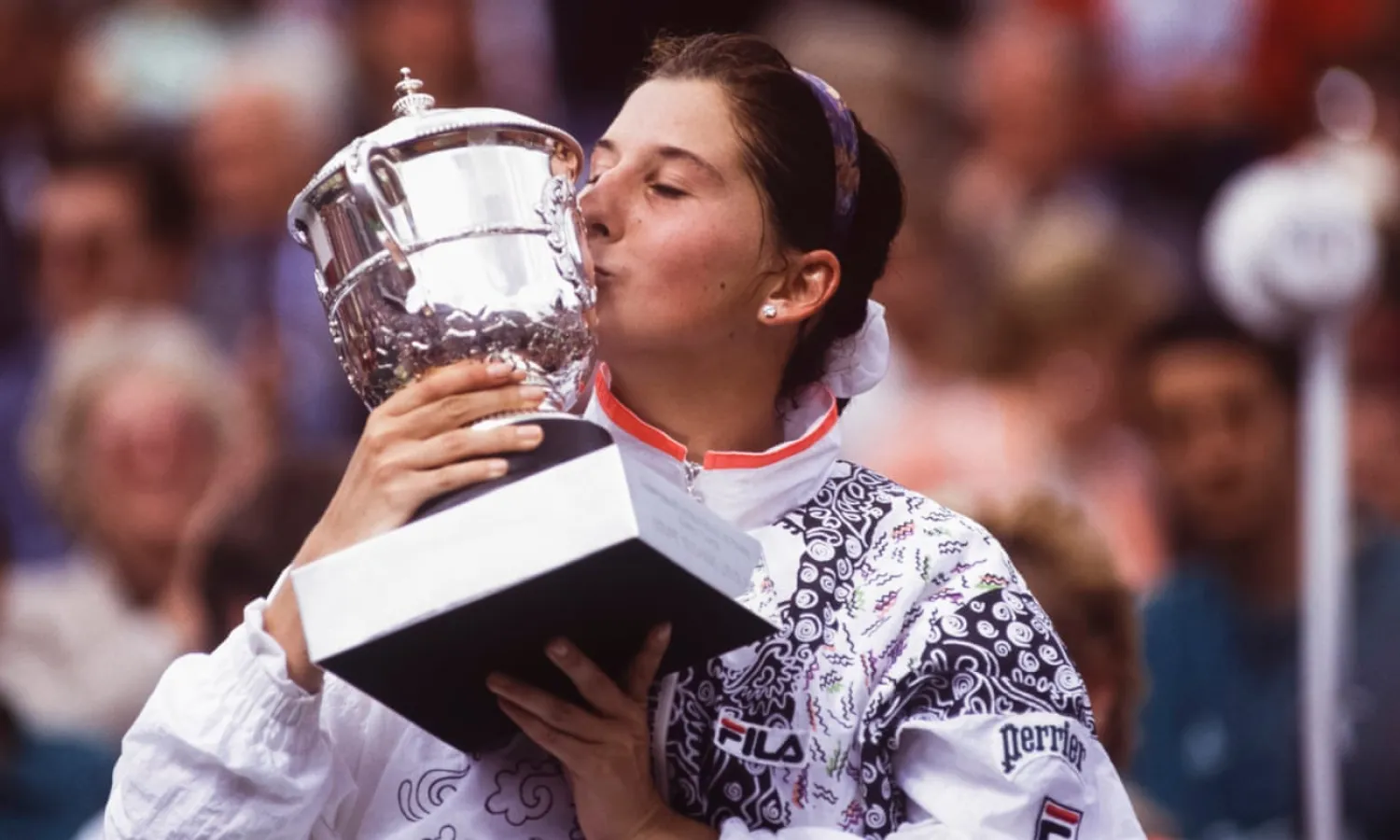
 Monica Seles after winning the French Open in 1992. She was statistically the greatest teenager in history. Photograph: Pool BOLCINA/SAMPERS/Gamma-Rapho/Getty Images
Monica Seles after winning the French Open in 1992. She was statistically the greatest teenager in history. Photograph: Pool BOLCINA/SAMPERS/Gamma-Rapho/Getty Images
TT

Monica Seles – Warrior Queen Whose Reign Was Shattered

 Monica Seles after winning the French Open in 1992. She was statistically the greatest teenager in history. Photograph: Pool BOLCINA/SAMPERS/Gamma-Rapho/Getty Images
Monica Seles after winning the French Open in 1992. She was statistically the greatest teenager in history. Photograph: Pool BOLCINA/SAMPERS/Gamma-Rapho/Getty Images

Shortly before his death in 1990, the tennis fashion designer, historian and author Ted Tinling, whose immersion in the women’s game began as Suzanne Lenglen’s personal umpire in the 1920s and who knew all the greats from Helen Wills Moody to Steffi Graf, delivered an extraordinary prophecy.

“Monica Seles is the most electric happening in tennis since Lenglen,” he said. “She lights up the court and can hit the ball harder than anyone I have ever seen.”

Seles was 16 and had yet to win a grand slam but Tinling knew his tennis and with every murderous double-fisted forehand and malicious double-handed backhand the teenager quickly set about proving him right.

Martina Navratilova was the first exalted player to succumb to Seles’s power in the 1990 Italian Open final when she was thumped 6-1, 6-1. Navratilova likened the experience to being “run over by a truck”. And with good reason: Seles’s brand of heavy metal tennis featured 37 winners and only six unforced errors.

A month later Seles became the youngest winner in the history of the French Open by beating Graf 7‑6, 6‑4. The German had won nine of the 10 previous grand slams behind a huge serve and forehand, while such was her lung capacity that scientists once predicted she could have been a European 1500m champion on the track.

Yet Seles refused to be intimidated. Her forceful returns blunted Graf’s serve, the quality of her groundstrokes pinned her opponent back and her astonishing mental fortitude – another of her many skills – enabled her to save four set points in the first set tie-break before fending off her illustrious opponent to win the match.

Soon winning became second nature. Incredibly from 1991 to 1993 Seles won seven of the eight grand slam tournaments in which she played, posting a 55-1 record, and also reached the finals of 33 out of 34 tournaments. And then – in one of the most shocking moments in sports history – the 19-year-old was stabbed in the back by a deranged Graf fan while playing in Hamburg.

She was never the same player again. How could she be, when she was out for more than two years? And when stepping on the court felt like returning to the scene of the crime? As Seles admitted to the Observer’s Tim Adams in 2009: “I had grown up on a tennis court – it was where I felt most safe, most secure – and that day everything was taken away from me. My innocence. My rankings, all my income, endorsements – they were all cancelled.”

Seles’s biggest battles were no longer between the tramlines. Depression hit her hard and she was diagnosed with post-traumatic stress disorder. On top of that, her father – who would endlessly watch her hit balls in a car park as a child with a net strung between two vehicles – was diagnosed with cancer. In her moving autobiography, Seles talks of how she began to binge on chocolate pretzels, crisps, Pop-Tarts and ice cream – a problem that often led to her weight ballooning after she returned to the tour in 1995.

She was still an excellent player, winning a final grand slam title in 1996 and an Olympic bronze medal in 2000, but she no longer hit the very highest notes.

Yet if the wheels of history had spun in a different direction we could be easily talking of Seles as the most successful player of all time. She was statistically the greatest teenager in history, having raced to eight grand slams barely a month after turning 19. To put that number in context her nearest rival, Graf, had won six by the time she was 20. Margaret Court had four, Chris Evert two. Serena and Venus Williams had only one between them, while Navratilova was yet to get off the mark.

Who could have stopped Seles motoring along at a similar rate for another six or seven years by which point she would have raced past Court’s record of 24? Not the Williams sisters: as great as they are they only started winning slams around the turn of the millennium. And while Graf would have remained a major threat, in their seven encounters between 1990 and 1993 Seles had the edge, winning four.

It’s also highly likely Seles would have kicked on again in her early 20s. As her former coach Nick Bollettieri once put it: “She will not accept that she can’t do something and she’ll spend 40, 50, 70 hours working just to get one shot. I used to tell her: ‘Your boyfriend is your Prince ball machine’, she spent so much time with the thing … I find it very difficult to pick out any weakness in her or her game.”

Perhaps volleying was one area that needed honing and sharpening. When she beat Navratilova in a Wimbledon classic in 1992, for instance, she made only one volley winner. Not that it mattered given she hit 48 successful passing shots. That year she reached the final at SW19 despite the British tabloids hounding her over grunting. Peter Ustinov cruelly joked: “I pity Monica’s neighbours on her wedding night.” Imagine being a teenager and hearing that?

Seles ended her career ranked eighth on the list of grand slam winners. Navratilova believes that, without the horrific stabbing incident, “we’d be talking about Monica with the most grand slam titles. This guy changed the course of tennis history, no doubt about that.”

It’s hard to argue. At her peak Seles had dynamite on her strings and ice in her veins – and was undoubtedly tennis’s original warrior queen.

The Guardian Sport


Shakhtar Boss Pays Ukrainian Racer $200,000 After Games Disqualification

Ukrainian President Volodymyr Zelenskiy holds helmet as he meets with a Ukrainian skeleton racer Vladyslav Heraskevych , who was disqualified from the Olympic skeleton competition over his "helmet of remembrance" depicting athletes killed since Russia's invasion and his father and coach, Mykhailo Heraskevych, amid Russia's attack on Ukraine, in Munich, Germany February 13, 2026. (Ukrainian Presidential Press Service/Handout via Reuters)
TT

Shakhtar Boss Pays Ukrainian Racer $200,000 After Games Disqualification

Ukrainian President Volodymyr Zelenskiy holds helmet as he meets with a Ukrainian skeleton racer Vladyslav Heraskevych , who was disqualified from the Olympic skeleton competition over his "helmet of remembrance" depicting athletes killed since Russia's invasion and his father and coach, Mykhailo Heraskevych, amid Russia's attack on Ukraine, in Munich, Germany February 13, 2026. (Ukrainian Presidential Press Service/Handout via Reuters)

The owner of ‌Ukrainian football club Shakhtar Donetsk has donated more than $200,000 to skeleton racer Vladyslav Heraskevych after the athlete was disqualified from the Milano Cortina Winter Games before competing over the use of a helmet depicting Ukrainian athletes killed in the war with Russia, the club said on Tuesday.

The 27-year-old Heraskevych was disqualified last week when the International Bobsleigh and Skeleton Federation jury ruled that imagery on the helmet — depicting athletes killed since Russia invaded Ukraine in 2022 — breached rules on athletes' expression at ‌the Games.

He ‌then lost an appeal at the Court ‌of ⁠Arbitration for Sport hours ⁠before the final two runs of his competition, having missed the first two runs due to his disqualification.

Heraskevych had been allowed to train with the helmet that displayed the faces of 24 dead Ukrainian athletes for several days in Cortina d'Ampezzo where the sliding center is, but the International Olympic Committee then ⁠warned him a day before his competition ‌started that he could not wear ‌it there.

“Vlad Heraskevych was denied the opportunity to compete for victory ‌at the Olympic Games, yet he returns to Ukraine a ‌true winner," Shakhtar President Rinat Akhmetov said in a club statement.

"The respect and pride he has earned among Ukrainians through his actions are the highest reward. At the same time, I want him to ‌have enough energy and resources to continue his sporting career, as well as to fight ⁠for truth, freedom ⁠and the remembrance of those who gave their lives for Ukraine," he said.

The amount is equal to the prize money Ukraine pays athletes who win a gold medal at the Games.

The case dominated headlines early on at the Olympics, with IOC President Kirsty Coventry meeting Heraskevych on Thursday morning at the sliding venue in a failed last-minute attempt to broker a compromise.

The IOC suggested he wear a black armband and display the helmet before and after the race, but said using it in competition breached rules on keeping politics off fields of play. Heraskevych also earned praise from Ukraine President Volodymyr Zelenskiy.


Speed Skating-Italy Clinch Shock Men’s Team Pursuit Gold, Canada Successfully Defend Women’s Title

 Team Italy with Davide Ghiotto, Andrea Giovannini, Michele Malfatti, celebrate winning the gold medal on the podium of the men's team pursuit speed skating race at the 2026 Winter Olympics, in Milan, Italy, Tuesday, Feb. 17, 2026. (AP)
Team Italy with Davide Ghiotto, Andrea Giovannini, Michele Malfatti, celebrate winning the gold medal on the podium of the men's team pursuit speed skating race at the 2026 Winter Olympics, in Milan, Italy, Tuesday, Feb. 17, 2026. (AP)
TT

Speed Skating-Italy Clinch Shock Men’s Team Pursuit Gold, Canada Successfully Defend Women’s Title

 Team Italy with Davide Ghiotto, Andrea Giovannini, Michele Malfatti, celebrate winning the gold medal on the podium of the men's team pursuit speed skating race at the 2026 Winter Olympics, in Milan, Italy, Tuesday, Feb. 17, 2026. (AP)
Team Italy with Davide Ghiotto, Andrea Giovannini, Michele Malfatti, celebrate winning the gold medal on the podium of the men's team pursuit speed skating race at the 2026 Winter Olympics, in Milan, Italy, Tuesday, Feb. 17, 2026. (AP)

An inspired Italy delighted the home crowd with a stunning victory in the Olympic men's team pursuit final as

Canada's Ivanie Blondin, Valerie Maltais and Isabelle Weidemann delivered another seamless performance to beat the Netherlands in the women's event and retain their title ‌on Tuesday.

Italy's ‌men upset the US who ‌arrived ⁠at the Games ⁠as world champions and gold medal favorites.

Spurred on by double Olympic champion Francesca Lollobrigida, the Italian team of Davide Ghiotto, Andrea Giovannini and Michele Malfatti electrified a frenzied arena as they stormed ⁠to a time of three ‌minutes 39.20 seconds - ‌a commanding 4.51 seconds clear of the ‌Americans with China taking bronze.

The roar inside ‌the venue as Italy powered home was thunderous as the crowd rose to their feet, cheering the host nation to one ‌of their most special golds of a highly successful Games.

Canada's women ⁠crossed ⁠the line 0.96 seconds ahead of the Netherlands, stopping the clock at two minutes 55.81 seconds, and

Japan rounded out the women's podium by beating the US in the Final B.

It was only Canada's third gold medal of the Games, following Mikael Kingsbury's win in men's dual moguls and Megan Oldham's victory in women's freeski big air.


Lindsey Vonn Back in US Following Crash in Olympic Downhill 

Milano Cortina 2026 Olympics - Alpine Skiing - Women's Downhill 3rd Official Training - Tofane Alpine Skiing Centre, Belluno, Italy - February 07, 2026. Lindsey Vonn of United States in action during training. (Reuters)
TT

Lindsey Vonn Back in US Following Crash in Olympic Downhill 

Milano Cortina 2026 Olympics - Alpine Skiing - Women's Downhill 3rd Official Training - Tofane Alpine Skiing Centre, Belluno, Italy - February 07, 2026. Lindsey Vonn of United States in action during training. (Reuters)

Lindsey Vonn is back home in the US following a week of treatment at a hospital in Italy after breaking her left leg in the Olympic downhill at the Milan Cortina Games.

“Haven’t stood on my feet in over a week... been in a hospital bed immobile since my race. And although I’m not yet able to stand, being back on home soil feels amazing,” Vonn posted on X with an American flag emoji. “Huge thank you to everyone in Italy for taking good care of me.”

The 41-year-old Vonn suffered a complex tibia fracture that has already been operated on multiple times following her Feb. 8 crash. She has said she'll need more surgery in the US.

Nine days before her fall in Cortina d'Ampezzo, Italy, Vonn ruptured the ACL in her left knee in another crash in Switzerland.

Even before then, all eyes had been on her as the feel-good story heading into the Olympics for her comeback after nearly six years of retirement.
