


Space Tour in Virgin Galactic's Cabin to Cost $250,000

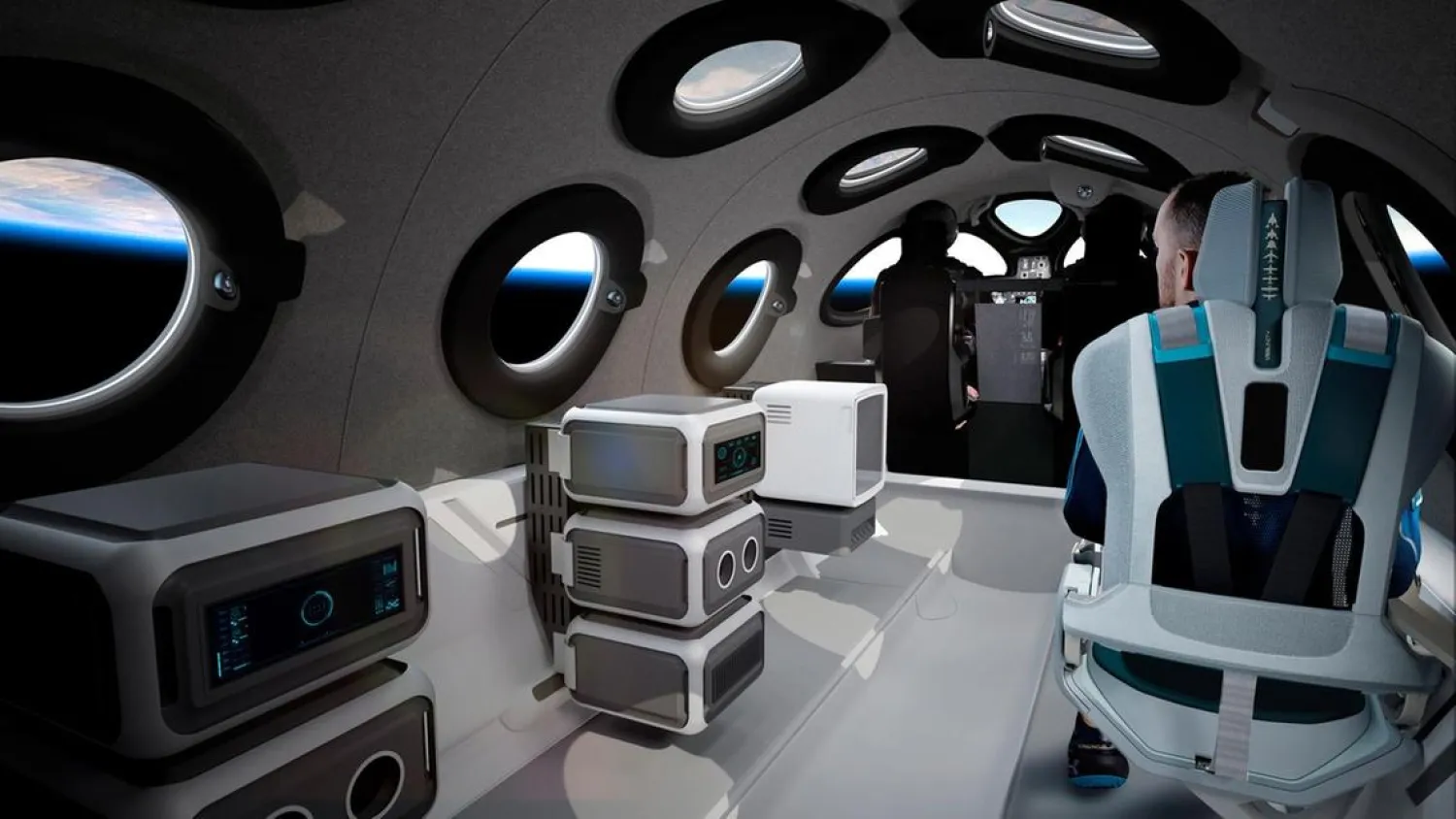
The interior cabin of space tourism firm Virgin Galactic's SpaceShipTwo is seen in an artist's rendition released July 28, 2020. Virgin Galactic/AP
TT

Space Tour in Virgin Galactic's Cabin to Cost $250,000

The interior cabin of space tourism firm Virgin Galactic's SpaceShipTwo is seen in an artist's rendition released July 28, 2020. Virgin Galactic/AP

Virgin Galactic, which was established to organize space tourism trips, has unveiled the space cabin where passengers will one day gaze at Earth after paying $250,000 (£175,000) for a ticket to space.

Revealed for the first time during an online event on Tuesday, the design features an "unrestricted astronaut float zone" for zero-gravity jaunts, according to The Sun.

Billionaire Sir Richard Branson, the owner of Virgin, said the cabin was designed "to allow thousands of people... to achieve the dream of spaceflight safely."

Branson unveiled the plans, which include individually sized reclining seats and automated mood lighting, during a virtual tour live-streamed to YouTube.

Virgin Galactic also said the cabin included soft surfaces and window edges to allow passengers to float out of their seats unharmed. There are plans for a large circular mirror which would allow customers to view themselves floating in zero gravity. Twelve cameras will provide high-definition footage of the flight, while passengers will soak up views of Earth through the cabin's 17 windows.

After the plans were announced, Sir Richard said: "When we created Virgin Galactic, we started with what we believed would be an optimal customer experience and then built the spaceship around it.”

“We will continue with that ethos as we expand our fleet, build our operations and underpin Virgin Galactic's position as the space center for Earth."


Reintroduction of Wildlife Species at Saudi Arabia’s Hegra Reserve to Enhance Ecological Balance

The initiative forms part of RCU's strategy to rehabilitate wildlife and achieve environmental sustainability.
TT

Reintroduction of Wildlife Species at Saudi Arabia’s Hegra Reserve to Enhance Ecological Balance

The initiative forms part of RCU's strategy to rehabilitate wildlife and achieve environmental sustainability.

The Royal Commission for AlUla (RCU), in cooperation with the National Center for Wildlife, has reintroduced 37 wildlife species at the Hegra Nature Reserve in AlUla as part of its efforts to enhance ecological balance and preserve the region's natural biodiversity.

The initiative forms part of RCU's strategy to rehabilitate wildlife and achieve environmental sustainability.

It also supports eco-tourism by increasing the presence of wildlife species and enriching visitors' natural experiences, in line with AlUla's vision to develop its natural resources and strengthen its environmental values.


WHO Reaffirms No Link between Vaccines and Autism

The logo of the World Health Organization is seen at the WHO headquarters in Geneva, Switzerland, January 28, 2025. REUTERS/Denis Balibouse/File Photo
TT

WHO Reaffirms No Link between Vaccines and Autism

The logo of the World Health Organization is seen at the WHO headquarters in Geneva, Switzerland, January 28, 2025. REUTERS/Denis Balibouse/File Photo

The World Health Organization's vaccine safety committee said on Thursday that new reviews of scientific evidence found no link between vaccines and autism spectrum disorder, reaffirming conclusions reached more than two decades ago.

The WHO Global Advisory Committee on Vaccine Safety assessed two systematic reviews covering studies published between 2010 and August 2025, according to Reuters.

The reviews examined vaccines in general and those containing thiomersal, a mercury-based preservative that has long been accused by critics of contributing to autism - a claim repeatedly dismissed by scientific studies.

A causal link between vaccines and health outcomes is considered only when several high-quality studies consistently show a statistical association, the committee said.

Twenty out of 31 studies found no evidence of an association between vaccines and autism, according to the WHO.

Eleven studies that suggested a possible link were deemed to have major methodological flaws and a high risk of bias, the committee said.

Last month, US Health Secretary Robert F. Kennedy Jr. said in an interview with the New York Times that he had personally instructed the US Centers for Disease Control and Prevention to change its long-standing position that vaccines do not cause autism.


Vietnam's Capital Chokes Through Week of Toxic Smog

This picture shows vehicles driving on a highway amid heavy air pollution conditions in Hanoi on December 11, 2025. (Photo by NHAC NGUYEN / AFP)
TT

Vietnam's Capital Chokes Through Week of Toxic Smog

This picture shows vehicles driving on a highway amid heavy air pollution conditions in Hanoi on December 11, 2025. (Photo by NHAC NGUYEN / AFP)

Toxic smog has blanketed Vietnam's capital for more than a week, blotting out the skyline and leaving residents wheezing as Hanoi's air quality dipped to among the world's worst on Thursday.

The city of nine million ranked second only to India's New Delhi on IQAir's ranking of most polluted cities on Thursday morning, improving slightly in the afternoon.

According to the Swiss monitoring company, levels of PM2.5 pollutants -- cancer-causing microparticles small enough to enter the bloodstream through the lungs -- were vastly higher than the World Health Organization's recommended daily exposure limit.

"I have experienced difficulty in breathing out on the streets these days," resident Dang Thuy told AFP on Thursday, adding she had bought two new air purifiers for her apartment.

Hanoi authorities, in an administrative order made public Thursday, urged people to limit time outdoors and said schools can close if the situation deteriorates.

The order instructed officials to crack down on illegal waste burning and take measures to control the dispersion of dust at construction sites, including covering trucks and spraying water to keep tiny particles from becoming airborne.

However, AFP reporters observed construction sites operating normally, with trucks arriving and departing without the required coverings.

"Authorities have been quite active on paper only. Nothing has worked yet and the terribly toxic air remains in our city," said Thuy.

According to the WHO, a number of serious health conditions, including strokes, heart disease and lung cancer, are linked to air pollution exposure.

Experts say pollution in Hanoi is a result of widespread construction, as well as emissions from the huge number of motorbikes and cars that criss-cross the capital every day.

Emissions from coal plants to the north and agricultural burning exacerbate the problem.

Authorities have announced plans to ban gas motorbikes from central Hanoi during certain hours starting in July next year.
