


Eusebio Leal, who Oversaw Renewal of Old Havana, Dies at 77

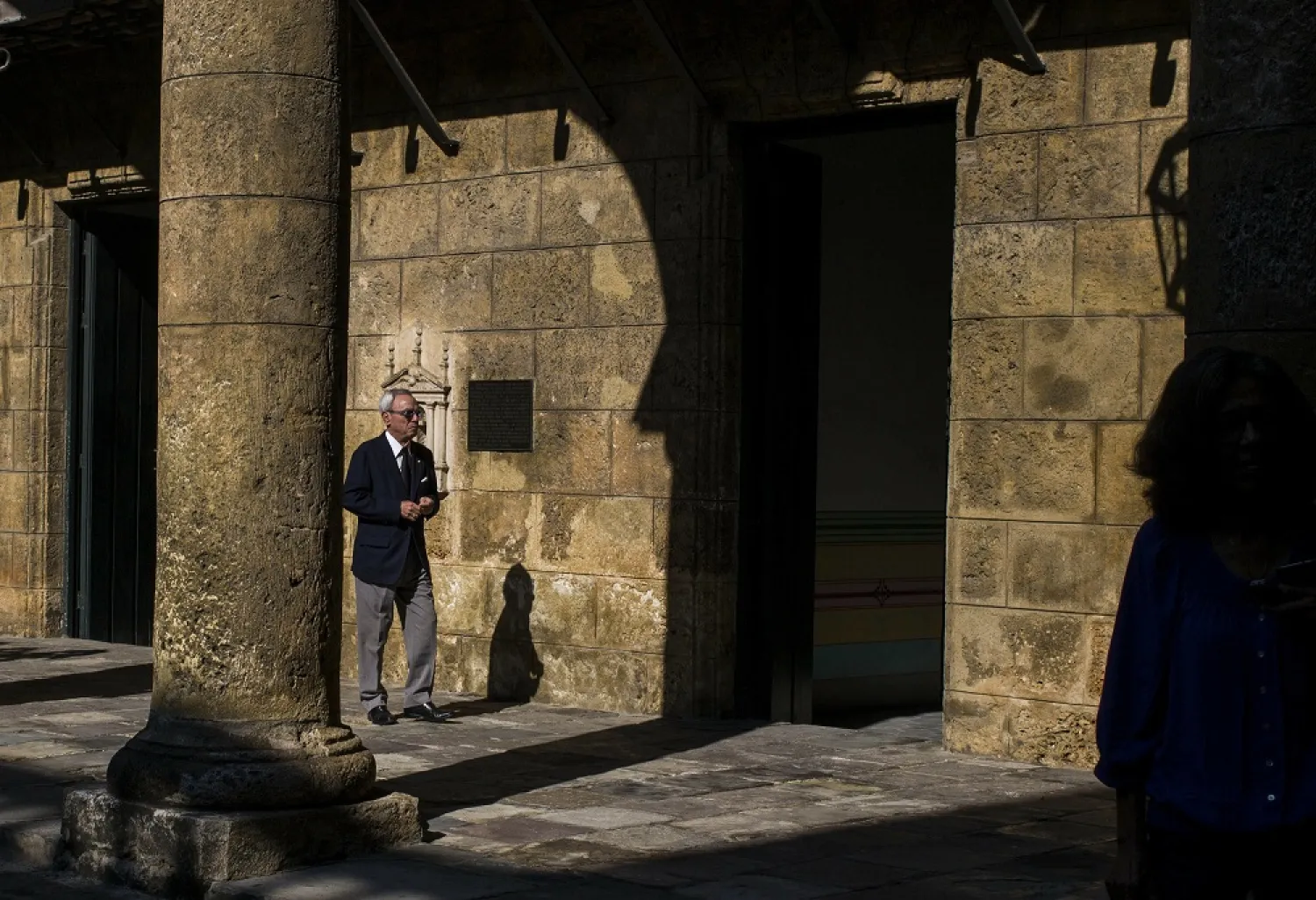
In this Nov. 23, 2018 file photo, Havana City Historian Eusebio Leal Spengler walks in the courtyard of the City Museum in Havana, Cuba. (AP)
TT

Eusebio Leal, who Oversaw Renewal of Old Havana, Dies at 77

In this Nov. 23, 2018 file photo, Havana City Historian Eusebio Leal Spengler walks in the courtyard of the City Museum in Havana, Cuba. (AP)

Eusebio Leal Spengler, who oversaw the transformation of crumbling Old Havana to an immaculately restored colonial tourist attraction, becoming the de-facto mayor of the historic city center and one of the nation’s most prominent public intellectuals, has died. He was 77.

He had been fighting cancer.

Leal and his restoration efforts became so famous along the crowded streets of Havana that it often felt like he was holding court when he appeared in public, usually in his trademark, simple gray dress shirts and slacks.

Elderly women would tell Leal that the water that had stopped working in their apartment was back on thanks to him. Others would lodge complaints about their living situation or praise him for reviving Old Havana.

“To call it reconstruction of something that seemed dead and buried may draw dirty looks and dismissals that ours is a romantic crusade,” Leal wrote in a city bulletin in 2010. “But if that were the case, we wouldn’t feel embarrassed to be seen as romantics in times that are so apocalyptic.”

Born in Havana on Sept. 11, 1942, Leal earned a doctorate in historical sciences from the University of Havana, honing his skills as an intellectual entrepreneur who recognized that the resurrection of the city’s historic district could be a moneymaker. That became especially important when communist Cuba embraced foreign tourism en masse after the disbanding of the Soviet Union and the loss of its billions of dollars in annual subsidies to the island brought the economy to the brink of total collapse.

After a series of nationwide economic reforms and the Dec. 2014 declaration of detente with the US, Leal’s government-driven restoration of Old Havana gained momentum with the opening of hundreds of private businesses from elegant restaurant to art galleries that filled with tourists as visits to the country soared.

The boom raised worries about gentrification as expatriate Cubans or those with ties to foreign capital bought out longtime residents and turned their homes into businesses.

Leal spoke little about the new phenomenon, but consistently argued for respecting Old Havana’s past without being trapped by it.

“I’ve always spoken out against the mummification of the city,” he said in 2016. “It wouldn’t be wise to show off the past under glass.”

In 1967, Leal became city historian, replacing his mentor, Emilio Roig de Leushenring. He oversaw the reconstruction of the old municipal government building on the stately Plaza de Armas, then used a mix of charisma and diplomacy to get all of Old Havana designated as a UNESCO world heritage site in 1982.

That distinction brought international funding to revitalize the area, but Leal was also granted unprecedented autonomy by government superiors, allowing him to levy taxes in the neighborhood and keep the profits his projects generated to reinvest in new rebuilding efforts.

Leal was a member of Cuba’s parliament, but enjoyed more power serving on the Central Committee of the Communist Party. It was not uncommon for him to travel to the airport to greet arriving foreign heads of state, as well as oversee public political and cultural events.

By February 2008, Leal’s name was mentioned as a candidate for major promotion when Raul Castro succeeded Fidel as Cuba’s president — especially given the city historian’s generally moderate political views.

Instead, Leal stayed at the helm of Old Havana, the heart of a city founded in 1519 by the Spanish. Once ringed by a city wall, the historic district is a mix of Baroque and neoclassical monuments, crammed up against colonial-style homes and apartment buildings with balconies and courtyards — most of which was decaying since Castro’s government couldn’t afford the upkeep.

Before Leal’s work, Old Havana had become a tangled collection of dark streets, winding past buildings in ruins, many propped up by poles to prevent their collapse. While pockets of open decay can still be found, they are now outnumbered by the regally restored plazas and colonial structures.

Leal rebuilt tourist-friendly sites such as El Floridita, frequented by Ernest Hemingway, and another famous watering hole, El Bodeguita del Medio. He oversaw restoration of some of the faded facade of the Malecon, the city’s famous seawall, and El Morro, the Spanish fort that guards the entrance to Havana Harbor.

Leal’s office also returned many restored buildings to their original functions, such as refurbished docks and tourist sites focused on specific themes — like the El Conde de Villanueva, a hotel that caters to cigar aficionados. Today, Old Havana’s cobblestone streets are jammed with art galleries and museums, churches, shady parks and alleyways reminiscent of Rome or Barcelona.

Leal’s office refurbished more than 300 buildings, and maintenance crews ensure restored structures don’t lose their splendor despite unrelenting tropical sunlight, sea-air humidity and coastal flooding that punishes all Havana infrastructure. Leal won many international awards, including Spain’s International Queen Sofia Prize for restoration in 2007.

One of his largest projects was the restoration of the domed Capitol building to become the seat of the Cuban parliament as it was before Cuba’s 1959 revolution.

Part of the rebuilding effort also created nursing homes and dining rooms for government workers, as well as daycare centers, schools and drug rehabilitation clinics. Thousands of Cubans were forced from their tenament-like homes to make room for rehabilitation projects, but Leal said none were displaced without being offered comparable places to live.

But the on-the-surface charm of Leal’s efforts belied the problems of Cubans who live in grinding poverty mere blocks from tourist areas.

Indeed, islanders call Old Havana “the Vatican” since the streets are kept especially clean and free of petty thefts and small crime so as not to spook tourists. Even the power lines have been laid underground, meaning the neighborhood is spared many of the frequent power outages that plague the rest of the city.

When the New York Times wrote a largely favorable 2007 article saying that Leal’s work had far more aesthetic benefits than real value for Old Havana residents, a visibly angry city historian organized a press conference to denounce the article, the reporter who wrote it and the newspaper.

“The question is, ‘Isn’t culture a positive? Isn’t the state of (Cuban) culture a positive?’” Leal demanded to know.



Coffee Regions Hit by Extra Days of Extreme Heat, Say Scientists 

17 April 2012, North Rhine-Westphalia, Vluyn: A general view of Arabica Coffee beans. (dpa)
TT

Coffee Regions Hit by Extra Days of Extreme Heat, Say Scientists 

17 April 2012, North Rhine-Westphalia, Vluyn: A general view of Arabica Coffee beans. (dpa)

The world's main coffee-growing regions are roasting under additional days of climate change-driven heat every year, threatening harvests and contributing to higher prices, researchers said Wednesday.

An analysis found that there were 47 extra days of harmful heat per year on average in 25 countries representing nearly all global coffee production between 2021 and 2025, according to independent research group Climate Central.

Brazil, Vietnam, Colombia, Ethiopia and Indonesia -- which supply 75 percent of the world's coffee -- experienced on average 57 additional days of temperatures exceeding the threshold of 30C.

"Climate change is coming for our coffee. Nearly every major coffee-producing country is now experiencing more days of extreme heat that can harm coffee plants, reduce yields, and affect quality," said Kristina Dahl, Climate Central's vice president for science.

"In time, these impacts may ripple outward from farms to consumers, right into the quality and cost of your daily brew," Dahl said in a statement.

US tariffs on imports from Brazil, which supplies a third of coffee consumed in the United States, contributed to higher prices this past year, Climate Central said.

But extreme weather in the world's coffee-growing regions is "at least partly to blame" for the recent surge in prices, it added.

Coffee cultivation needs optimal temperatures and rainfall to thrive.

Temperatures above 30C are "extremely harmful" to arabica coffee plants and "suboptimal" for the robusta variety, Climate Central said. Those two plant species produce the majority of the global coffee supply.

For its analysis, Climate Central estimated how many days each year would have stayed below 30C in a world without carbon pollution but instead exceeded that level in reality -- revealing the number of hot days added by climate change.

The last three years have been the hottest on record, according to climate monitors.


Dog Gives Olympics Organizers Paws for Thought

A dog wanders on the ski trail during the women's team cross country free sprint qualification event of the Milano Cortina 2026 Winter Olympic Games at Tesero Cross-Country Skiing Stadium in Lago di Tesero (Val di Fiemme), on February 18, 2026. (Photo by Anne-Christine POUJOULAT / AFP)
TT

Dog Gives Olympics Organizers Paws for Thought

A dog wanders on the ski trail during the women's team cross country free sprint qualification event of the Milano Cortina 2026 Winter Olympic Games at Tesero Cross-Country Skiing Stadium in Lago di Tesero (Val di Fiemme), on February 18, 2026. (Photo by Anne-Christine POUJOULAT / AFP)

A dog decided he would bid for an unlikely Olympic medal on Wednesday as he joined the women's cross country team free sprint in the Milan-Cortina Games.

The dog ran onto the piste in Tesero in northern Italy and gamely, even without skis, ran behind two of the competitors, Greece's Konstantina Charalampidou and Tena Hadzic of Croatia.

He crossed the finishing line, his moment of glory curtailed as he was collared by the organizers and led away -- his owner no doubt will have a bone to pick with him when they are reunited.


Olives, Opera and a Climate-Neutral Goal: How a Mural in Greece Won ‘Best in the World’ 

A building with the mural entitled “Kalamata” depicting opera legend Maria Callas by artist Kleomenis Kostopoulos is seen in Kalamata town, about 240 kilometers (150 miles) southwest of Athens, Monday, Feb. 9, 2026. (AP) 
TT

Olives, Opera and a Climate-Neutral Goal: How a Mural in Greece Won ‘Best in the World’ 

A building with the mural entitled “Kalamata” depicting opera legend Maria Callas by artist Kleomenis Kostopoulos is seen in Kalamata town, about 240 kilometers (150 miles) southwest of Athens, Monday, Feb. 9, 2026. (AP) 

Long known for its olives and seaside charm, the southern Greek city of Kalamata has found itself in the spotlight thanks to a towering mural that reimagines legendary soprano Maria Callas as an allegory for the city itself.

The massive artwork on the side of a prominent building in the city center has been named 2025’s “Best Mural of the World” by Street Art Cities, a global platform celebrating street art.

Residents of Kalamata, approximately 240 kilometers (150 miles) southwest of Athens, cultivate the world-renowned olives, figs and grapes that feature prominently on the mural.

That was precisely the point.

Vassilis Papaefstathiou, deputy mayor of strategic planning and climate neutrality, explained Kalamata is one of the few Greek cities with the ambitious goal of becoming climate-neutral by 2030. He and other city leaders wanted a way to make abstract concepts, including sustainable development, agri-food initiatives, and local economic growth, more tangible for the city’s nearly 73,000 residents.

That’s how the idea of a massive mural in a public space was born.

“We wanted it to reflect a very clear and distinct message of what sustainable development means for a regional city such as Kalamata,” Papaefstathiou said. “We wanted to create an image that combines the humble products of the land, such as olives and olive oil — which, let’s be honest, are famous all over the world and have put Kalamata on the map — with the high-level art.”

“By bringing together what is very elevated with ... the humbleness of the land, our aim was to empower the people and, in doing so, strengthen their identity. We want them to be proud to be Kalamatians.”

Southern Greece has faced heatwaves, droughts and wildfires in recent years, all of which affect the olive groves on which the region’s economy is hugely dependent.

The image chosen to represent the city was Maria Callas, widely hailed as one of the greatest opera singers of the 20th century and revered in Greece as a national cultural symbol. She may have been born in New York to Greek immigrant parents, but her father came from a village south of Kalamata. For locals, she is one of their own.

This connection is also reflected in practice: the alumni association at Kalamata’s music school is named for Callas, and the cultural center houses an exhibition dedicated to her, which includes letters from her personal archive.

Artist Kleomenis Kostopoulos, 52, said the mural “is not actually called ‘Maria Callas,’ but ‘Kalamata’ and my attempt was to paint Kalamata (the city) allegorically.”

Rather than portraying a stylized image of the diva, Kostopoulos said he aimed for a more grounded and human depiction. He incorporated elements that connect the people to their land: tree branches — which he considers the above-ground extension of roots — birds native to the area, and the well-known agricultural products.

“The dress I create on Maria Callas in ‘Kalamata’ is essentially all of this, all of this bloom, all of this fruition,” he said. “The blessed land that Kalamata itself has ... is where all of these elements of nature come from.”

Creating the mural was no small feat. Kostopoulos said it took around two weeks of actual work spread over a month due to bad weather. He primarily used brushes but also incorporated spray paint and a cherry-picker to reach all edges of the massive wall.

Papaefstathiou, the deputy mayor, said the mural has become a focal point.

“We believe this mural has helped us significantly in many ways, including in strengthening the city’s promotion as a tourist destination,” he said.

Beyond tourism, the mural has sparked conversations about art in public spaces. More building owners in Kalamata have already expressed interest in hosting murals.

“All of us — residents, and I personally — feel immense pride,” said tourism educator Dimitra Kourmouli.

Kostopoulos said he hopes the award will have a wider impact on the art community and make public art more visible in Greece.

“We see that such modern interventions in public space bring tremendous cultural, social, educational and economic benefits to a place,” he said. “These are good springboards to start nice conversations that I hope someday will happen in our country, as well.”