

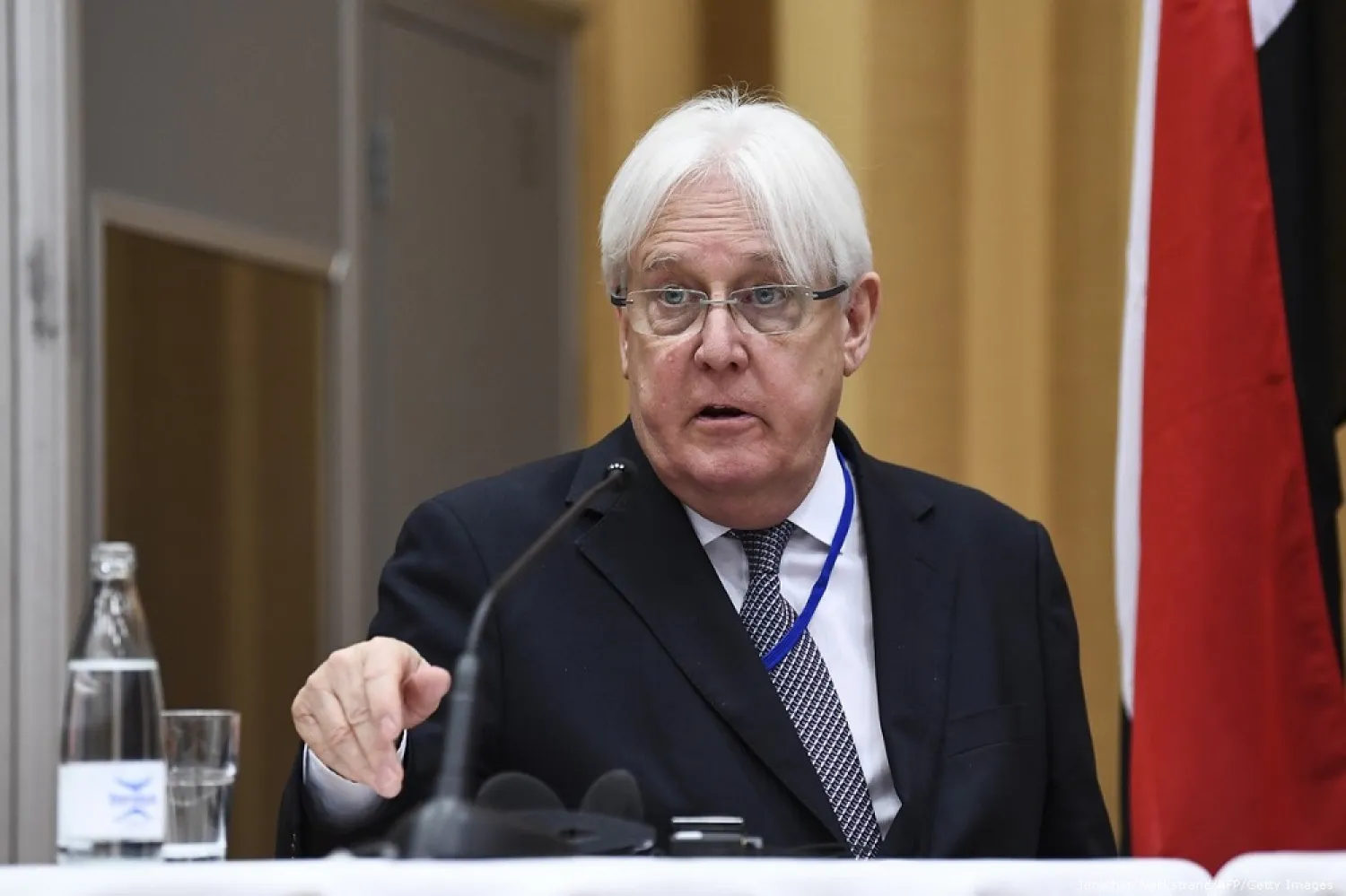

Griffiths in Riyadh Next Week to Discuss Amendments to Joint Declaration

UN special envoy to Yemen Martin Griffiths in Sweden, on December 13, 2018. (Getty Images)
TT

Griffiths in Riyadh Next Week to Discuss Amendments to Joint Declaration

UN special envoy to Yemen Martin Griffiths in Sweden, on December 13, 2018. (Getty Images)

United Nations special envoy for Yemen, Martin Griffiths, is expected to visit Riyadh next week to meet with the Yemeni government and discuss recent amendments on a Joint Declaration draft plan for a comprehensive solution between the legitimacy and Iran-backed Houthis militias, a diplomatic source said Thursday.

The envoy will work on discussing details of this draft plan with the government and to dissipate the legitimacy’s reservations, British Ambassador to Yemen Michael Aron told Asharq Al-Awsat, adding that this plan would be the last as the two warring sides are close to reaching a final solution on Yemen.

Griffiths will add the government’s views to this last draft plan because parties are close to reaching a final solution, Aron said.

Griffiths is leading UN-brokered negotiations between the Yemeni government and Houthis, to reach a Joint Declaration that will include a nationwide ceasefire, economic and humanitarian measures, and the resumption of the political process to comprehensively resolve the conflict in the country.

In mid-July, the legitimate government rejected proposals submitted by the envoy, saying they undermine the government’s sovereignty and are biased towards the Houthis.

Meanwhile, the people are awaiting the formation of a new government that can rebuild state institutions and provide security and services. The cabinet is also expected to merge all armed formations in the Defense and Interior Ministries.

Late last month, the Southern Transitional Council abandoned its declaration of self-rule and pledged to implement the Riyadh Agreement signed with the legitimate government.

The deal calls for appointing a governor and security director for Aden Governorate, and assigning the Yemeni Prime Minister to form a government of political competencies within 30 days.

“The new government has a priority of rebuilding state institutions and controlling resources,” presidential advisor Abdul-Aziz al-Maflahi told Asharq Al-Awsat.

He said Yemenis now have a chance to present themselves in a different manner because their agreement is supported by the regional and international community.

Maflahi praised the important role played by Saudi Arabia's Deputy Minister of Defense Prince Khalid bin Salman to accelerate the implementation of the Riyadh Agreement.

Advisor to the Yemeni President Dr. Mohammed al-Ameri told Asharq Al-Awsat that the new government must first normalize the situation in the liberated areas and remove any tensions left recently by the conflict.

“Security is the basis for everything. Without it, the government is incapable of completing its mission and enforcing the rule of state institutions in the liberated areas,” he said.



17th Century Wreck Reappears from Stockholm Deep

The remains of a 17th century shipwreck is pictured after resurfacing in Stockholm, Sweden, on February 17, 2026. (Photo by Jonathan NACKSTRAND / AFP)
TT

17th Century Wreck Reappears from Stockholm Deep

The remains of a 17th century shipwreck is pictured after resurfacing in Stockholm, Sweden, on February 17, 2026. (Photo by Jonathan NACKSTRAND / AFP)

A 17th century Swedish Navy shipwreck buried underwater in central Stockholm for 400 years has suddenly become visible due to unusually low Baltic Sea levels.

The wooden planks of the ship's well-preserved hull have since early February been peeking out above the surface of the water off the island of Kastellholmen, providing a clear picture of its skeleton.

"We have a shipwreck here, which was sunk on purpose by the Swedish Navy," Jim Hansson, a marine archeologist at Stockholm's Vrak - Museum of Wrecks, told AFP.

Hansson said experts believe that after serving in the navy, the ship was sunk around 1640 to use as a foundation for a new bridge to the island of Kastellholmen.

Archeologists have yet to identify the exact ship, as it is one of five similar wrecks lined up in the same area to form the bridge, all dating from the late 16th and early 17th centuries.

"This is a solution, instead of using new wood you can use the hull itself, which is oak" to build the bridge, Hansson said.

"We don't have shipworm here in the Baltic that eats the wood, so it lasts, as you see, for 400 years," he said, standing in front of the wreck.

Parts of the ship had already broken the surface in 2013, but never before has it been as visible as it is now, as the waters of the Baltic Sea reach their lowest level in about 100 years, according to the archaeologist.

"There has been a really long period of high pressure here around our area in the Nordics. So the water from the Baltic has been pushed out to the North Sea and the Atlantic," Hansson explained.

A research program dubbed "the Lost Navy" is underway to identify and precisely date the large number of Swedish naval shipwrecks lying on the bottom of the Baltic.


Dammam Airport Launches Saudi Arabia’s First Category III Automatic Landing System  

Prince Saud bin Naif bin Abdulaziz, Governor of the Eastern Region, inaugurates the General Aviation Terminal and the upgraded automatic landing system at King Fahd International Airport in Dammam. (SPA)
TT

Dammam Airport Launches Saudi Arabia’s First Category III Automatic Landing System  

Prince Saud bin Naif bin Abdulaziz, Governor of the Eastern Region, inaugurates the General Aviation Terminal and the upgraded automatic landing system at King Fahd International Airport in Dammam. (SPA)

Prince Saud bin Naif bin Abdulaziz, Governor of Saudi Arabia’s Eastern Region, inaugurated on Monday two major aviation projects at King Fahd International Airport in Dammam: a dedicated General Aviation Terminal for private flights and the Kingdom’s first Category III Instrument Landing System (ILS), which enables fully automatic aircraft landings in low-visibility conditions.

The ceremony was attended by Minister of Transport and Logistics Services and Chairman of the General Authority of Civil Aviation (GACA) Saleh bin Nasser Al-Jasser and President of GACA and Chairman of the Saudi Airports Holding Company Abdulaziz bin Abdullah Al-Duailej.

Prince Saud said the projects represent a qualitative leap in strengthening the aviation ecosystem in the Eastern Region, boosting the airport’s operational readiness and its regional and international competitiveness.

The introduction of a Category III automatic landing system for the first time in Saudi Arabia reflects the advanced technological progress achieved by the national aviation sector and its commitment to the highest international standards, he stressed.

The General Aviation Terminal marks a significant upgrade to airport infrastructure. Spanning more than 23,000 square meters, the facility is designed to ensure efficient operations and fast passenger processing.

The main terminal covers 3,935 square meters, while aircraft parking areas extend over 12,415 square meters with capacity to accommodate four aircraft simultaneously. An additional 6,665 square meters are allocated to support services and car parking, improving traffic flow and delivering a premium travel experience for private aviation users.

The upgraded Category III ILS, considered among the world’s most advanced air navigation systems, allows aircraft to land automatically during poor visibility, ensuring flight continuity while enhancing safety and operational efficiency.

The project includes rehabilitation of the western runway, extending 4,000 meters, along with a further 4,000 meters of aircraft service roads. More than 3,200 lighting units have been installed under an integrated advanced system to meet modern operational requirements and support all aircraft types.

Al-Jasser said the inauguration of the two projects translates the objectives of the Aviation Program under the National Transport and Logistics Strategy into concrete achievements.

The developments bolster airport capacity and efficiency, support the sustainability of the aviation sector, and strengthen the competitiveness of Saudi airports, he added.

Al-Duailej, for his part, said the initiatives align with Saudi Vision 2030 by positioning the Kingdom as a global logistics hub and a leading aviation center in the Middle East.

The new terminal reflects high standards of privacy and efficiency for general aviation users, he remarked, noting the selection of Universal Aviation as operator of the general aviation terminals in Dammam and Jeddah.

Dammam Airports Company operates three airports in the Eastern Region: King Fahd International Airport, Al-Ahsa International Airport, and Qaisumah International Airport.


Saudi Arabia to Launch Real Estate Indicators, Expand ‘Market Balance’ Program Nationwide

The Minister of Municipalities and Housing addresses attendees during the government press conference (Asharq Al-Awsat). 
TT

Saudi Arabia to Launch Real Estate Indicators, Expand ‘Market Balance’ Program Nationwide

The Minister of Municipalities and Housing addresses attendees during the government press conference (Asharq Al-Awsat). 

Saudi Arabia will roll out real estate market indicators in the first quarter of this year and expand the Real Estate Market Balance program to all regions of the Kingdom, following its initial implementation in Riyadh, Minister of Municipalities and Housing Majed Al-Hogail announced on Monday.

Al-Hogail, who also chairs the General Real Estate Authority, made the remarks during a government press conference in Riyadh attended by Minister of Media Salman Al-Dossary, President of the Saudi Data and Artificial Intelligence Authority (SDAIA) Abdullah Alghamdi, and other senior officials.

Al-Hogail said the housing and social ecosystem now includes more than 313 non-profit organizations supported by over 345,000 volunteers working alongside the public and private sectors.

He highlighted tangible outcomes, including housing assistance for 106,000 social security beneficiaries and the prevention of housing loss in 200,000 cases.

Development Initiatives

He noted that the non-profit sector is driving impact through more than 300 development initiatives and over 1,000 services, while empowering 100 non-profit entities and activating supervisory units across 17 municipalities.

Among key programs, Al-Hogail highlighted the Rental Support Program, which assisted more than 6,600 families last year, expanding the reach of housing aid.

He also traced the growth of the “Jood Eskan” initiative, which began by supporting 100 families and has since evolved into a nationwide program that has provided homes to more than 50,000 families across the Kingdom.

Since its launch, the initiative has attracted more than 4.5 million donors, with total contributions exceeding SAR 5 billion ($1.3 billion) since 2021.

Al-Hogail added that the introduction of electronic signatures has reduced the homeownership process from 14 days to just two.

In 2025 alone, more than 150,000 digital transactions were completed, and the needs of over 400,000 beneficiary families were assessed through integrated national databases. A mobile application for “Jood Eskan” is currently being deployed to further streamline services.

International Support and Economic Growth

Minister of Media Salman Al-Dossary said the Saudi Program for the Development and Reconstruction of Yemen launched 28 new development projects and initiatives worth SAR 1.9 billion ($506.6 million), including fuel grants for power generation and support for health, energy, education, and transport sectors across Yemeni governorates.

He also reported strong growth in the communications and information technology sector, which created more than 406,000 jobs by the end of 2025, up from 250,000 in 2018, an 80 percent cumulative increase. The sector’s market size reached nearly SAR 190 billion ($50.6 billion) in 2025.

Industry, Localization, and Philanthropy

In the industrial sector, investments exceeded SAR 9 billion ($2.4 billion), alongside five new renewable energy projects signed under the sixth phase of the National Renewable Energy Program.

Industrial and logistics investments worth more than SAR 8.8 billion ($2.34 billion) were also signed by the Saudi Authority for Industrial Cities and Technology Zones.

Al-Dossary said the Kingdom now hosts nearly 30,000 operating industrial facilities with total investments of about SAR 1.2 trillion ($320 billion), while the Saudi Export-Import Bank has provided SAR 115 billion ($30.6 billion) in credit facilities since its establishment.

On workforce development, nearly 100,000 social security beneficiaries were empowered through employment, training, and productive projects by late 2025, with localization rates in several specialized professions reaching as high as 70 percent.

Alghamdi said total donations through the “Ehsan” platform have reached SAR 14 billion ($3.7 billion) across 330 million transactions, reflecting the rapid growth of digital philanthropy in the Kingdom.