


Abandoned by State After Explosion, Lebanese Help Each Other

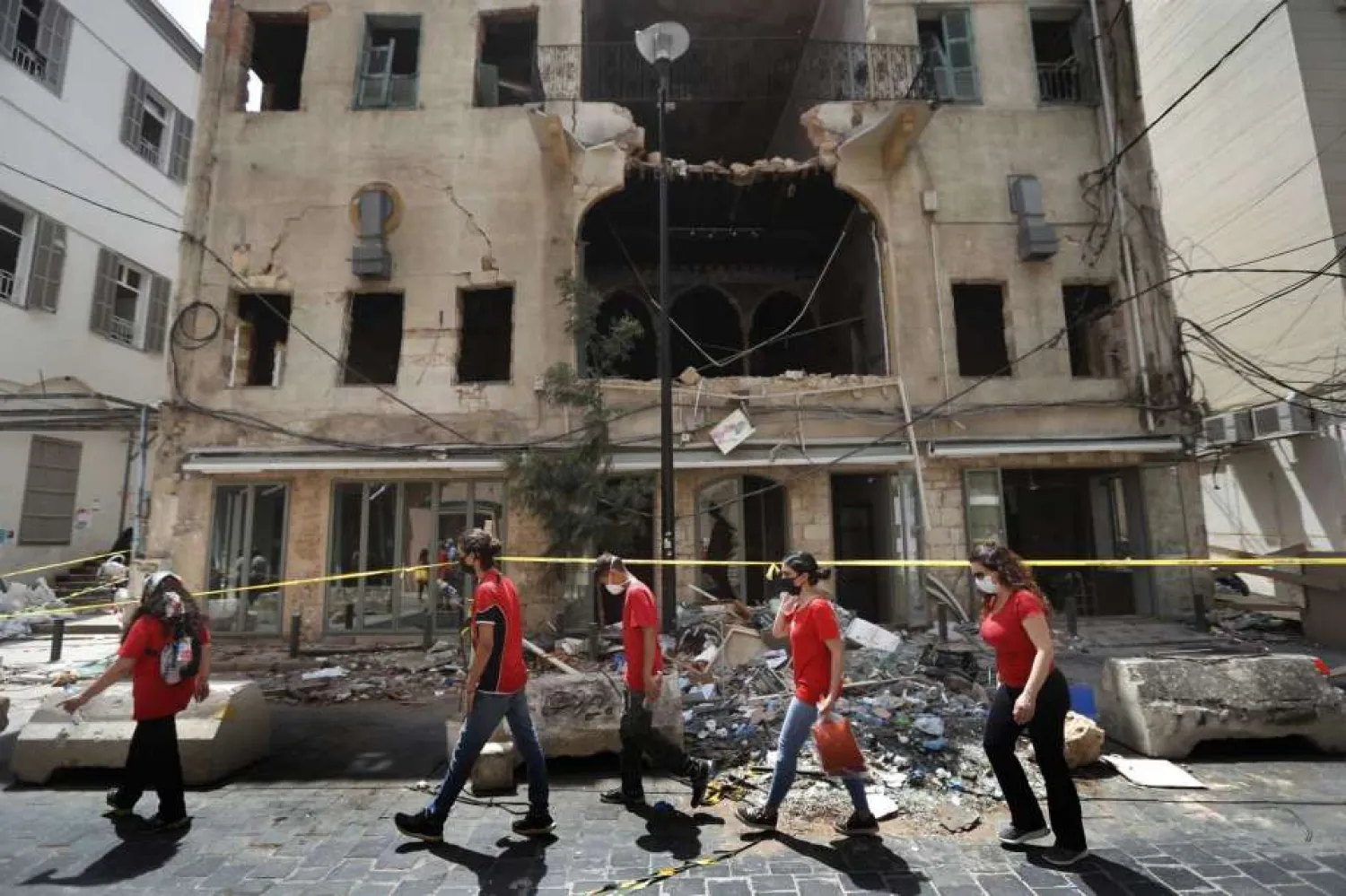
University students who volunteered to help clean damaged homes and give other assistance, pass in front of a building that was damaged by last week's explosion, in Beirut, Lebanon, Tuesday, Aug. 11, 2020. The explosion that tore through Beirut left around a quarter of a million people with homes unfit to live in. But there are no collective shelters, or people sleeping in public parks. That's because in the absence of the state, residents of Beirut opened their homes to relatives, friends and neighbors. (AP Photo/Hussein Malla)
TT

Abandoned by State After Explosion, Lebanese Help Each Other

University students who volunteered to help clean damaged homes and give other assistance, pass in front of a building that was damaged by last week's explosion, in Beirut, Lebanon, Tuesday, Aug. 11, 2020. The explosion that tore through Beirut left around a quarter of a million people with homes unfit to live in. But there are no collective shelters, or people sleeping in public parks. That's because in the absence of the state, residents of Beirut opened their homes to relatives, friends and neighbors. (AP Photo/Hussein Malla)

In the southern Lebanese town of Haris, a newlywed couple is living in one of Safy Faqeeh´s apartments for free. He´s never met them before, and they aren´t on a honeymoon. Their apartment in Beirut was wrecked when last week´s massive explosion wreaked destruction across the capital.

Faqeeh is one of hundreds of Lebanese who have opened their homes to survivors of the Aug. 4 blast.

The explosion, which was centered on Beirut´s port and ripped across the capital, left around a quarter of a million people with homes unfit to live in. But they have not had to crowd into collective shelters or sleep in public parks.

That´s because in the absence of the state, Lebanese have stepped up to help each other.

Some have let relatives, friends and neighbors stay with them. Others like Faqeeh extended a helping hand even farther, taking to social media to spread the word that they have a room to host people free of charge.

The couple saw Faqeeh´s offer on Facebook for a free apartment he owns in Haris, some 50 miles (80 kilometers) south of Beirut. They can stay as long as they need to, the 29-year-old Faqeeh said, and he has a second apartment available for anyone else in need. "This is not help, it is a duty," he said.

When he was a teenager, Faqeeh's family home was damaged in the 2006 war between Israel and Hezbollah, and they had to stay in a house in Tripoli, clear on the other end of Lebanon. Now he´s paying it forward. "We have experienced several wars and they (people) hosted us," Faqeeh said.

The help that Lebanese are giving goes beyond a place to stay. Armed with helmets and brooms, hundreds of volunteers have circulated through Beirut´s heavily damaged neighborhoods, cleaning up people´s homes and doing free basic repairs, often enough to enable the residents to stay there.

The explosion left entire blocks in shambles, with streets blanketed in broken glass, twisted metal, broken brickwork. Yet within days, some streets were clean, the debris neatly sorted in piles. That was thanks to volunteers, often using social media to organize where to target.

In some places, they were sweeping streets and hauling away wreckage while security forces or soldiers stood nearby, watching.

That has only reinforced for Lebanese their government´s failure to provide basic services, much less respond to the disaster. Many already blame the government and the broader ruling elite´s incompetence, mismanagement and corruption for the explosion. Authorities allowed 2,750 tons of explosive ammonium nitrate to sit in a warehouse at the port unmonitored for seven years, despite multiple warnings of the danger, until it exploded when touched off by a fire. The blast killed more than 170 people, injured thousands and wreaked chaos across the city.

The government almost completely left the public on its own to deal with the aftermath. Outside the demolished port, there have been no government clean-up crews in the streets and little outreach from officials to help beyond promises of compensation to those whose homes or businesses were damaged.

The list of services people are offering keeps expanding. It now includes free glass for cars damaged in the blast, free maintenance of electrical appliances and free cosmetic surgery for people with face injuries. On Facebook, a group called Rebuild Beirut quickly sprung up. Its volunteers are working at full speed, helping clean up homes and link survivors with donors who will cover the expenses of repairs.

The individual acts of solidarity have been even more striking because Lebanon was already in the middle of a worsening economic crisis that has thrown hundreds of thousands into poverty and left households and businesses with little or no excess cash.

"I am so proud of the Lebanese people," said Kim Sacy, a 19-year-old university student. "There is no state, there is nobody, there is nothing ... we are the ones doing everything in the field."

Sacy is studying at a French university and was supposed to be on a program in Sweden this year but the coronavirus pandemic grounded her in Lebanon. She was outside Beirut driving home when the blast took place. She didn´t feel the explosion but when she reached her neighborhood of Achrafieh, she found it shattered. "This is where I lived my whole life," she said.

Sacy's family home was damaged, but she still wanted to help others. "It is not important. I consider myself lucky," she said. "It is the people who make the home." She said some of her family members were injured in the blast but are doing fine now.

Sacy began collecting food and other items to give to those in need. Around 25 families have reached out to her to donate, some she knows, but half are strangers. For the past week, she has been circulating around Beirut in her car to pick up donated furniture, first aid kits, bed sheets, and kitchen utensils that she gives to a local non-governmental organization to distribute. When not doing that, she has been cleaning in the streets, including cleaning a fire station.

The self-help spirit has roots in the long civil war, when central authority collapsed and Lebanese had to depend on themselves to get by. In more recent years, waves of anti-government protests have emphasized volunteerism and civic duty - boosted by social media that made connections bypassing the state easier.

The shock of the explosion and the trauma of seeing loved ones injured or a home wrecked has exacted an emotional burden on Beirutis - especially with financial woes already weighing on people.

The Beit Insan well-being center is offering free services to help people overcome the trauma that the blast may have caused. It is also encouraging people with money to "pay it forward" and cover costs for people to get psychological help.

"We know since all the events that have been happening, that less and less people have money for mental health," said Dr. Samar Zebian, co-founder and co-director of the center. "We are a social business."



Egypt’s Prime Minister and FM Head to Washington for Trump Peace Council Meeting

Egyptian Foreign Minister Badr Abdelatty speaks during a joint press conference with Kenyan Prime Cabinet Secretary/Cabinet Secretary for Foreign Diaspora Affairs Musalia Mudavadi in Nairobi, Kenya, Monday, Feb. 16, 2026. (AP)
TT

Egypt’s Prime Minister and FM Head to Washington for Trump Peace Council Meeting

Egyptian Foreign Minister Badr Abdelatty speaks during a joint press conference with Kenyan Prime Cabinet Secretary/Cabinet Secretary for Foreign Diaspora Affairs Musalia Mudavadi in Nairobi, Kenya, Monday, Feb. 16, 2026. (AP)

Egypt's Prime Minister Mostafa Madbouly headed to Washington on Tuesday ‌to ‌participate in ‌the inaugural ⁠meeting of a "Board of Peace" established by US President Donald ⁠Trump, the ‌cabinet ‌said.

Madbouly is ‌attending ‌on behalf of President Abdel ‌Fattah al-Sisi and is accompanied by ⁠Foreign ⁠Minister Badr Abdelatty.

Foreign Minister Gideon Saar will represent Israel at the inaugural meeting, his office said on Tuesday.

Hamas, meanwhile, called on the newly-formed board to pressure Israel to halt what it described as ongoing violations of the ceasefire in Gaza.

The Board of Peace, of which Trump is the chairman, was initially designed to oversee the Gaza truce and the territory's reconstruction after the war between Hamas and Israel.

But its purpose has since morphed into resolving all sorts of international conflicts, triggering fears the US president wants to create a rival to the United Nations.

Saar will first attend a ministerial level UN Security Council meeting in New York on Wednesday, and on Thursday he "will represent Israel at the inaugural session of the board, chaired by Trump in Washington DC, where he will present Israel's position", his office said in a statement.

It was initially reported that Prime Minister Benjamin Netanyahu might attend the gathering, but his office said last week that he would not.

Ahead of the meeting, Hamas spokesman Hazem Qassem told AFP that the Palestinian movement urged the board's members "to take serious action to compel the Israeli occupation to stop its violations in Gaza".

"The war of genocide against the Strip is still ongoing -- through killing, displacement, siege, and starvation -- which have not stopped until this very moment," he added.

He also called for the board to work to support the newly formed Palestinian technocratic committee meant to oversee the day-to-day governance of post-war Gaza "so that relief and reconstruction efforts in Gaza can commence".

Announcing the creation of the board in January, Trump also unveiled plans to establish a "Gaza Executive Board" operating under the body.

The executive board would include Turkish Foreign Minister Hakan Fidan and Qatari diplomat Ali Al-Thawadi.

Netanyahu has strongly objected to their inclusion.

Since Trump launched his "Board of Peace" at the World Economic Forum in Davos in January, at least 19 countries have signed its founding charter.


Palestinian Child Dies After Stepping on Mine in West Bank

Israeli troops conduct a military raid in the village of Al-Yamoun, west of Jenin, West Bank, 17 February 2026. (EPA)
TT

Palestinian Child Dies After Stepping on Mine in West Bank

Israeli troops conduct a military raid in the village of Al-Yamoun, west of Jenin, West Bank, 17 February 2026. (EPA)

A Palestinian child died after stepping on a mine near an Israeli military camp in the occupied West Bank on Tuesday, the Palestinian Red Crescent said, with an Israeli defense ministry source confirming the death.

"Our crews received the body of a 13-year-old child who was killed after a mine exploded in one of the old camps in Jiftlik in the northern Jordan Valley," the Red Crescent said in a statement.

A source at COGAT, the Israeli defense ministry's agency in charge of civilian matters in the Palestinian territories, confirmed the death to AFP and identified the boy as Mohammed Abu Dalah, from the village of Jiftlik.

Israel's military had previously said in a statement that three Palestinians were injured "as a result of playing with unexploded ordnance", without specifying their ages.

It added that the area of the incident, Tirzah, is "a military camp in the area of the Jordan Valley", near Jiftlik and close to the Jordanian border.

"This area is a live-fire zone and entry into it is prohibited," the military said.

Jiftlik village council head Ahmad Ghawanmeh told AFP that three children, the oldest of whom was 16, were collecting herbs near the military base when they detonated a mine.

Jiftlik as well as the nearby Tirzah base are located in the Palestinian territory's Area C, which falls under direct Israeli control.

Israel has occupied the West Bank since 1967.

Much of the area near the border with Jordan -- which Israel signed a peace deal with in 1994 -- remains mined.

In January, Israel's defense ministry said it had begun demining the border area as part of construction works for a new barrier it says aims to stem weapons smuggling.


Hezbollah Rejects Disarmament Plan and Government’s Four-Month Timeline

29 July 2024, Iran, Tehran: Then Hezbollah deputy leader Sheikh Naim Qassem is pictured during a meeting in Tehran. (Iranian Presidency/dpa)
TT

Hezbollah Rejects Disarmament Plan and Government’s Four-Month Timeline

29 July 2024, Iran, Tehran: Then Hezbollah deputy leader Sheikh Naim Qassem is pictured during a meeting in Tehran. (Iranian Presidency/dpa)

Hezbollah rejected on Tuesday the Lebanese government's decision to grant the army at least four months to advance the second phase of a nationwide disarmament plan, saying it would not accept what it sees as a move serving Israel.

Lebanon's cabinet tasked the army in August 2025 with drawing up and beginning to implement a plan to bring all armed groups' weapons under state control, a bid aimed primarily at disarming Hezbollah after its devastating ‌war with ‌Israel in 2024.

In September 2025 the cabinet formally ‌welcomed ⁠the army's plan to ⁠disarm the Iran-backed Shiite party, although it did not set a clear timeframe and cautioned that the military's limited capabilities and ongoing Israeli strikes could hinder progress.

Hezbollah Secretary-General Sheikh Naim Qassem said in a speech on Monday that "what the Lebanese government is doing by focusing on disarmament is a major mistake because this issue serves the goals of Israeli ⁠aggression".

Lebanon's Information Minister Paul Morcos said during a press ‌conference late on Monday after ‌a cabinet meeting that the government had taken note of the army's monthly ‌report on its arms control plan that includes restricting weapons in ‌areas north of the Litani River up to the Awali River in Sidon, and granted it four months.

"The required time frame is four months, renewable depending on available capabilities, Israeli attacks and field obstacles,” he said.

Hezbollah lawmaker Hassan ‌Fadlallah said, "we cannot be lenient," signaling the group's rejection of the timeline and the broader approach to ⁠the issue of ⁠its weapons.

Hezbollah has rejected the disarmament effort as a misstep while Israel continues to target Lebanon, and Shiite ministers walked out of the cabinet session in protest.

Israel has said Hezbollah's disarmament is a security priority, arguing that the group's weapons outside Lebanese state control pose a direct threat to its security.

Israeli officials say any disarmament plan must be fully and effectively implemented, especially in areas close to the border, and that continued Hezbollah military activity constitutes a violation of relevant international resolutions.

Israel has also said it will continue what it describes as action to prevent the entrenchment or arming of hostile actors in Lebanon until cross-border threats are eliminated.