


Families of Lebanese Blast Victims Plead for Outside Inquiry

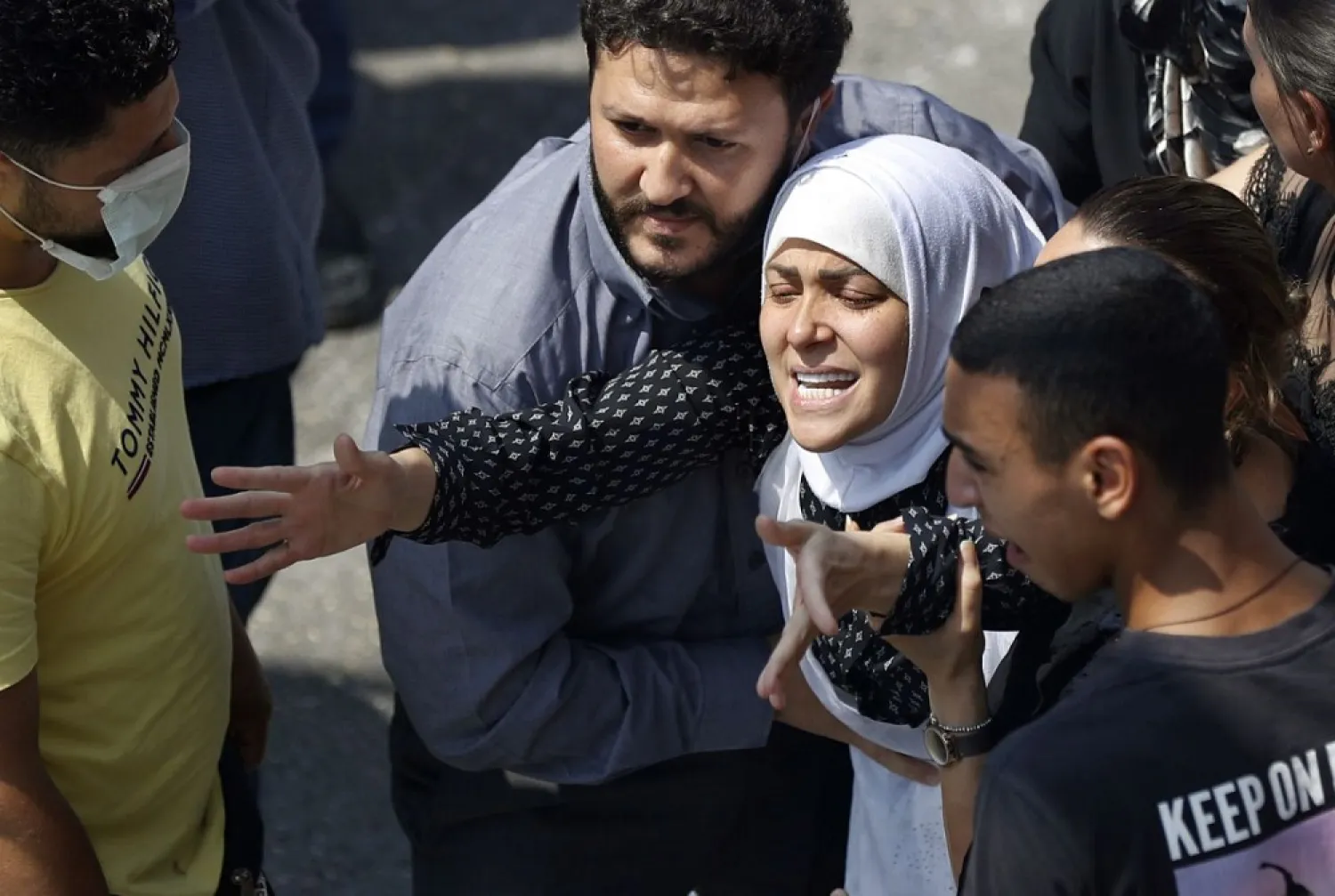
The wife of Rami Kaaki, one of ten firefighters who were killed in the blast, tries to reach her husband's coffin during his funeral, at the firefighter headquarters in Beirut, Lebanon, Aug. 11, 2020. (AP)
TT

Families of Lebanese Blast Victims Plead for Outside Inquiry

The wife of Rami Kaaki, one of ten firefighters who were killed in the blast, tries to reach her husband's coffin during his funeral, at the firefighter headquarters in Beirut, Lebanon, Aug. 11, 2020. (AP)

Lebanon’s judicial investigation of the Beirut port explosion started with political wrangling over the naming of a lead investigator, military threats to jail leakers and doubts over whether a panel appointed along sectarian lines could be fully impartial.

So for many Lebanese, their greatest hope for credible answers about the blast that wrecked much of their capital may lie with outsiders. Families of the dead and survivors on Friday asked the UN Security Council for an international investigation. Others pin their hopes on the French forensic police who have joined the probe and FBI investigators are expected to take part.

“We are not lawyers or politicians, we are families and people, our appeal today is to the people of the international community," said Paul Najjar, a survivor of the explosion. “Is it acceptable today that people would find their homes shattered, their families killed, their hopes and their dreams killed as well, with no justice, in all impunity?”

French teams have pressed ahead at their work, sending divers into the underwater crater, taking explosives samples and preparing recommendations for both French and Lebanese magistrates. Among the French judicial police on the case are men and women who responded after the 2004 tsunami in Japan, the 2010 earthquake in Haiti, and the November 2015 and Bastille Day 2016 terror attacks in France.

The Beirut explosion lies at the crossroads of a disastrous accident and a crime scene. It still was not known what sparked the fire that ignited nearly 3,000 tons of ammonium nitrate that were stored for years in Beirut’s port next to densely populated residential areas. Documents have emerged that show the country’s top leadership and security officials were aware of the stockpile.

Search and rescue crews flew in from around the world in the immediate aftermath and found themselves looking at a scene that was both familiar and yet strangely alien.

“In an earthquake, it’s easier because we can understand ... how it moves. But in this case, we didn’t have enough elements to understand what happened,” said Alberto Boanini, a member of the Italian rescue team. The team has seen its share of quakes and forest fires, but nothing quite like the port in Beirut, where he said it was hard to fathom what could level it so completely.

Many Lebanese want the probe taken out of the hands of their own government, having learned from past experience that the long-entrenched political factions, notorious for corruption, won’t allow any results damaging to their leadership to come to light. The explosion killed more than 175 people, injured at least 6,000 and left tens of thousands homeless.

Paris sent judicial police because a French architect was among the dead, and French law gives jurisdiction for an investigation if a citizen dies abroad under questionable circumstances.

But the French investigators work only at the invitation of the Lebanese, and their orders are confidential.

French officials say they have the access they need but will not say whether their inquiry extends to questioning witnesses or requesting documents. They hand over their findings to the Lebanese, but keep a mirror copy for a French inquiry. The FBI is also joining at Lebanese authorities’ invitation.

Top Lebanese officials, including President Michel Aoun, have rejected calls for an independent probe, describing it as “a waste of time” and suggesting it would be politicized. Nonetheless, Nada Abdelsater-Abusamra, a lawyer representing victims, said a letter was submitted to the UN Security Council asking for an international investigation.

In its last decision before resigning under pressure, six days after the explosion, Prime Minister Hassan Diab’s government referred the port explosion case to the Higher Judicial Council, Lebanon’s highest justice authority, to carry out the investigation.

An argument then ensued with the outgoing justice minister over the investigation’s lead judge. After public wrangling, they compromised on Judge Fadi Sawwan, a former military investigating judge.

The Council itself is made up of 10 people, eight of whom are appointed according to the interests of the various political factions and religious sects in line with Lebanon’s sectarian power-sharing system.

The authorities have so far arrested at least 19 people, including the head of the Customs Department and his predecessor, as well as the head of the port.

Lebanese say they want to see investigations into top officials who knew about the ammonium nitrate.

“They will blame the small guys while the ones who are really responsible will get away with their crime, that’s what will happen,” said Jad, a 38-year-old computer engineer who declined to give his full name in line with his company’s regulations not to discuss politics.

“If this time there is no credible, serious investigation that will lead to the punishment of everyone responsible for this disaster, it is goodbye Lebanon. No one will ever want to live in this country again,” he said, standing on a bridge overlooking the decimated port.

Lebanese forensics expert Omar Nachabe said the public infighting about the name of the lead investigator is a bad sign that casts doubt on the credibility of any local investigation.

“If I am a Lebanese citizen, my capital (city) has been destroyed. I want a quick and serious investigation, yet the government has not shown until now that it is up to the task,” he told the local channel LBCI.

Explosions have marked a grim timeline in Lebanon’s modern history and have killed presidents, prime ministers and countless journalists and activists during the country’s 1975-90 civil war and beyond.

Almost none of the perpetrators were ever arrested or tried, and the truth was invariably buried. Lebanese had high hopes that the UN-backed tribunal investigating the 2005 killing of Prime Minister Rafik Hariri would be a chance to end impunity in Lebanon. But it took 15 years and was marred by doubts, politics and more deaths. The tribunal is to issue verdicts Tuesday.

International involvement in the investigation might bring some truth, but bringing justice is more complicated. Dov Jacobs, an international legal scholar based in the Netherlands, said the shooting down of Malaysia Airlines Flight 17 over eastern Ukraine six years ago might be the closest analogy.

In that case, international experts had full access to the site, and international prosecutors charged three Russians and a Ukrainian with involvement in bringing down the plane and the murder of all on board. The men are on trial in a Dutch court in absentia, since none have been extradited.

But in Lebanon, Jacobs said, “the investigation itself is a tool of political influence. It’s one of those frustrating moments where immediate calls for justice are faced with a wall which is the political reality on the ground.”



Rafah Crossing Traffic Lags Two Weeks after Reopening

Humanitarian and relief aid crosses Rafah Crossing (Egyptian Red Crescent)
TT

Rafah Crossing Traffic Lags Two Weeks after Reopening

Humanitarian and relief aid crosses Rafah Crossing (Egyptian Red Crescent)

Despite nearly two weeks since the reopening of the Rafah crossing in both directions, the number of people and humanitarian aid entering the Gaza Strip falls short of what was agreed under the “Gaza ceasefire agreement,” according to an official from the Egyptian Red Crescent in North Sinai.

The daily movement of individuals to and from Gaza does not exceed 50 people, Khaled Zayed, head of the Egyptian Red Crescent in North Sinai, told Asharq Al-Awsat. He said this figure represents only one-third of what was agreed upon in the ceasefire deal.

He added that truck traffic stands at about 100 per day, despite Gaza’s population requiring the entry of around 600 trucks daily.

On Feb. 2, Israel reopened the Rafah crossing on the Palestinian side for individual travel, allowing Palestinians to leave and return to the enclave. Indicators show that most of those departing Gaza are patients and wounded individuals, who are being received at Egyptian hospitals.

This comes as Egyptian Foreign Minister Badr Abdelatty stressed the need to “ensure the unhindered delivery of humanitarian aid and not obstruct movement through the Rafah crossing.”

In his remarks during a ministerial Security Council session on developments in the Middle East on Wednesday, he underscored the importance of “halting all measures aimed at displacing residents or altering the demographic character of the occupied Palestinian territories.”

Israel took control of the Rafah border crossing in May 2024, about nine months after the outbreak of the war in Gaza. The reopening of the crossing was part of the first phase of the ceasefire agreement that entered into force last October, though the deal remains fragile.

The Egyptian Red Crescent announced the departure of the 14th group of wounded, sick, and injured Palestinians arriving and leaving through the crossing.

In a statement on Thursday, it said humanitarian efforts to receive and see off Palestinians include a comprehensive package of relief services, psychological support for children, distribution of suhoor and iftar meals, and heavy clothing, in addition to providing “return bags” for those heading back to Gaza.

At the same time, the Red Crescent dispatched the 142nd “Zad Al-Ezza” convoy, which includes 197,000 food parcels and more than 235 tons of flour as part of the “Iftar for One Million Fasters” campaign in Gaza.

The convoy also carries more than 390 tons of medicines, relief, and personal care supplies, as well as about 760 tons of fuel, according to the organization’s statement.

Zayed said the daily number of individuals crossing through Rafah over the past two weeks does not compare with what was stipulated in the ceasefire agreement.

With the reopening of the Rafah crossing on the Palestinian side, Israel’s Arabic-language public broadcaster Makan reported that 150 people were expected to leave Gaza, including 50 patients, while 50 people would be allowed to enter the enclave.

Despite what he described as Israeli obstacles, Zayed said allowing the movement of individuals and the wounded represents “an unsatisfactory breakthrough in the humanitarian situation in Gaza,” stressing the need to fulfill the ceasefire’s obligations and advance early recovery efforts inside the territory.

The total number of Palestinians who have left through the Rafah crossing since it reopened on both sides does not exceed 1,000, according to Salah Abdel Ati, head of the International Commission to Support Palestinian Rights.

He said around 20,000 wounded and sick Palestinians require urgent evacuation, and that Israeli restrictions are hindering access to medical care, adding that the humanitarian situation requires continued pressure by mediators on Israel.

Abdelatty told Asharq Al-Awsat he was counting on the outcome of the first meeting of the Board of Peace to adopt easing measures, including lifting Israeli restrictions and establishing guarantees for the ceasefire in the Palestinian territories, as well as securing the funding needed for Gaza’s early recovery, in line with US President Donald Trump’s peace plan for the enclave.

According to a statement by the Egyptian Red Crescent, Egypt continues relief efforts at all logistical hubs to facilitate the entry of humanitarian aid, which has exceeded 800,000 tons, with the participation of more than 65,000 volunteers from the Egyptian Red Crescent.


US Slaps Sanctions on Sudan’s RSF Commanders over El-Fasher Killings

FILE - A Sudanese child, who fled el-Fasher city with family after Sudan's RSF attacked the western Darfur region, receives treatment at a camp in Tawila, Sudan, Nov. 2, 2025. (AP Photo/Mohammed Abaker, File)
TT

US Slaps Sanctions on Sudan’s RSF Commanders over El-Fasher Killings

FILE - A Sudanese child, who fled el-Fasher city with family after Sudan's RSF attacked the western Darfur region, receives treatment at a camp in Tawila, Sudan, Nov. 2, 2025. (AP Photo/Mohammed Abaker, File)

The United States announced sanctions on Thursday on three Sudanese Rapid Support Forces (RSF) commanders over their roles in the "horrific campaign" of the siege and capture of El-Fasher.

The US Treasury said the RSF carried out "ethnic killings, torture, starvation, and sexual violence" in the operation.

Earlier Thursday, the UN's independent fact-finding mission on Sudan said the siege and seizure of the city in Darfur bore "the hallmarks of genocide."

Its investigation concluded that the seizure last October had inflicted "three days of absolute horror," and called for those responsible to be brought to justice.

"The United States calls on the Rapid Support Forces to commit to a humanitarian ceasefire immediately," US Treasury Secretary Scott Bessent said in a statement.

"We will not tolerate this ongoing campaign of terror and senseless killing in Sudan."

The Treasury noted that the three sanctioned individuals were part of the RSF's 18-month siege of and eventual capture of El-Fasher.

They are RSF Brigadier General Elfateh Abdullah Idris Adam, Major General Gedo Hamdan Ahmed Mohamed and field commander Tijani Ibrahim Moussa Mohamed.

Bessent warned that Sudan's civil war risks further destabilizing the region, "creating conditions for terrorist groups to grow and threaten the safety and interests of the United States."

The UN probe into the takeover of El-Fasher -- after the 18-month siege -- concluded that thousands of people, particularly from the Zaghawa ethnic group, "were killed, raped or disappeared."


Israel's Netanyahu Says No Reconstruction of Gaza before Demilitarization

Israel’s Prime Minister Benjamin Netanyahu - File Photo/AFP
TT

Israel's Netanyahu Says No Reconstruction of Gaza before Demilitarization

Israel’s Prime Minister Benjamin Netanyahu - File Photo/AFP

Israeli Prime Minister Benjamin Netanyahu said on Thursday there would be no reconstruction of war-shattered Gaza before the disarmament of Hamas, as the "Board of Peace" convened for its inaugural meeting in Washington.

Around two dozen world leaders and senior officials met for the first meeting of the board, which was set up after the United States, Qatar and Egypt negotiated a ceasefire in October to halt two years of war in the Gaza Strip.

"We agreed with our ally the US there will be no reconstruction of Gaza before the demilitarization of Gaza," Netanyahu said during a televised speech at a military ceremony on Thursday, AFP reported.

The meeting in Washington will also look at how to launch the International Stabilization Force (ISF) that will ensure security in Gaza.

One of the most sensitive issues before the board is the future of the Islamist movement Hamas, which fought the war with Israel and still exerts influence in the territory.

Disarmament of the group is a central Israeli demand and a key point in negotiations over the ceasefire's next stage.

US officials including Steve Witkoff, Trump's friend and roving negotiator, have insisted that solid progress is being made and that Hamas is feeling pressure to give up weapons.

Israel has suggested sweeping restrictions including seizing small personal rifles from Hamas.

It remains unclear whether, or how, the Palestinian technocratic committee formed to handle day-to-day governance of Gaza will address the issue of demilitarization.

The 15-member National Committee for the Administration of Gaza (NCAG) will operate under the supervision of the "Board of Peace", and its head, Ali Shaath, is attending the meeting in Washington on Thursday.