


Iraqi PM Says Country Still Needs US Help

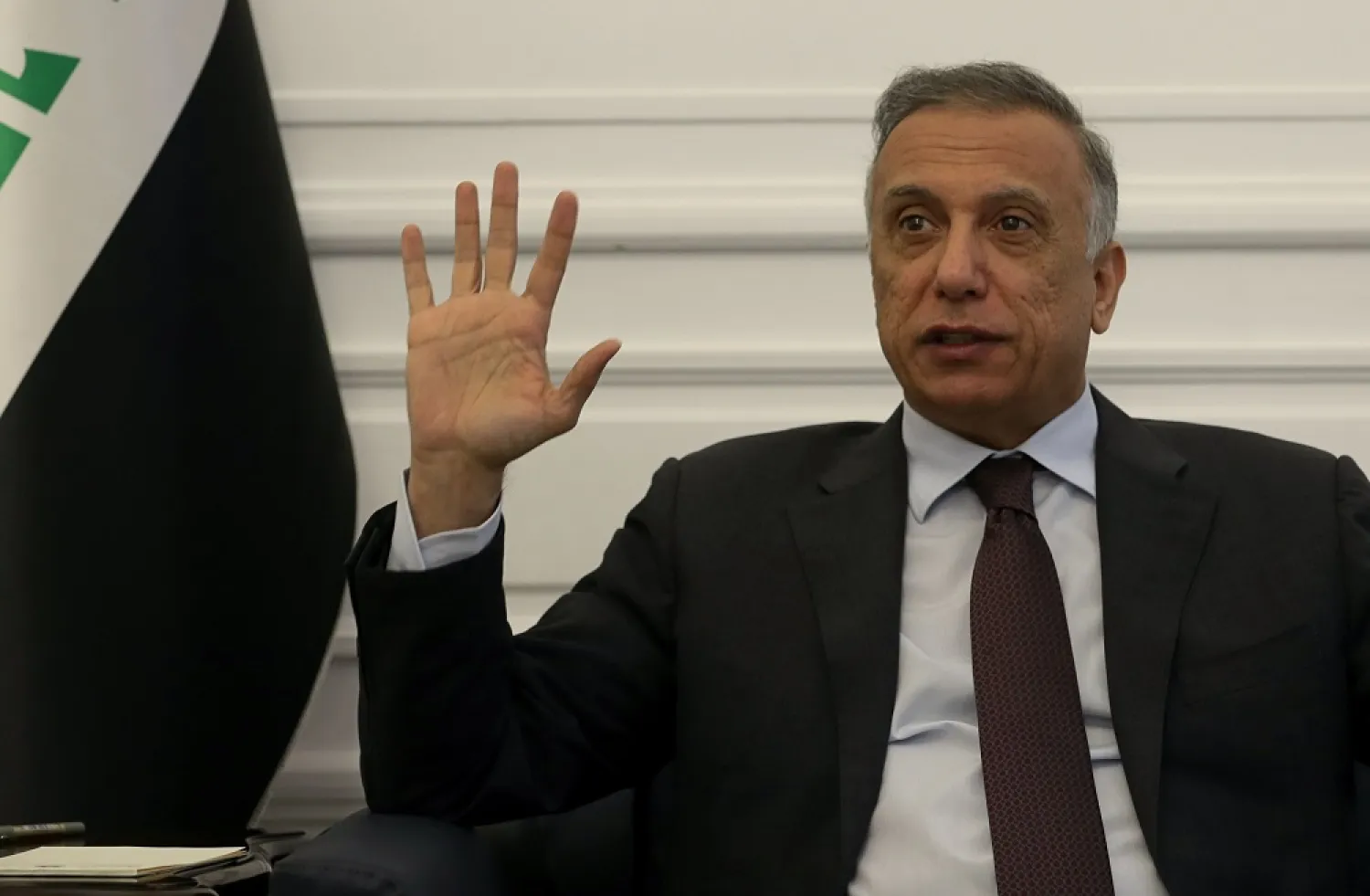
Iraqi Prime Minister Mustafa al-Kadhimi speaks during an interview with The Associated Press in Baghdad, Iraq, Monday, Aug. 17, 2020. (AP)
TT

Iraqi PM Says Country Still Needs US Help

Iraqi Prime Minister Mustafa al-Kadhimi speaks during an interview with The Associated Press in Baghdad, Iraq, Monday, Aug. 17, 2020. (AP)

Iraqi Prime Minister Mustafa al-Kadhimi said Monday ahead of a much anticipated trip to Washington that his country still needs US assistance to counter the threat posed by the ISIS group and that his administration is committed to introducing security sector reforms as rogue militia groups stage near-daily attacks against the seat of his government.

Kadhimi said in an exclusive interview with The Associated Press that Iraq currently does not need direct military support on the ground, and that the levels of help will depend on the changing nature of the threat.

Kadhimi is slated to meet with President Donald Trump in Washington this week to conclude a strategic dialogue launched in June to reconfigure US-Iraq ties.

Kadhimi, who is backed by the United States, assumed office in May when Baghdad’s relations with Washington were precarious. The January killing of Iranian Gen. Qassem Soleimani and a top Iraqi militia leader, Abu Mahdi al-Muhandis, in an American drone strike in Baghdad prompted demands by Shiite lawmakers that US forces leave Iraq.

Three years since Iraq declared victory over ISIS, sleeper cells continue to stage attacks across the country’s north. Meanwhile, the US-led coalition has been carrying out a planned drawdown this year as Iraqi security forces take the lead in combat and air raids.

“In the end, we will still need cooperation and assistance at levels that today might not require direct and military support, and support on the ground,” Kadhimi said. He said the cooperation “will reflect the changing nature of terrorism’s threat,” including continued training and weapons support.

Kadhimi has often had to walk a tightrope amid the US-Iran rivalry. Asked if he was bringing any messages from Tehran following a recent visit there, he said: “We do not play the role of postman in Iraq.”

Sworn in as premier in the wake of historic mass anti-government protests, Kadhimi’s administration inherited a myriad of crises. State coffers in the crude-dependent country were slashed following a severe drop in oil prices, adding to the woes of an economy already struggling with the aftershocks of the global coronavirus pandemic.

State violence used to quell the mass protests that erupted in October brought public trust in the government to a new low. Tens of thousands of Iraqis marched decrying rampant government corruption, poor services and unemployment, leading to the resignation of the previous premier, Adel Abdul Mahdi.

Kadhimi’s administration set a lofty agenda that included enacting economic reform, battling corruption, avenging protesters and bringing arms under the authority of the state. The latter has pitted his government against rogue Iranian-backed militia groups.

Three months in, his administration suffered setbacks. Protests by pensioners stymied plans to cut state salaries as revenues from oil dwindled. Virus cases continue to reach record highs. Militia groups taunt his government with near daily rocket attacks targeting Iraqi bases and the heavily fortified Green Zone, home to the US Embassy, though they rarely cause casualties.

The recent assassination of prominent Iraqi commentator Hisham al-Hashemi and the kidnapping of German art curator Hella Mewis have led many to question the limits of his leadership. Many believe militias are behind those attacks.

Kadhimi said these were perpetrated by those with an interest in profiting from chaos.

“These criminal acts are the result of many years of conflict,” he said, blaming poor policies and improper management by his predecessors for undermining the authority of the state. “It is not surprising then that criminals work here and there to destabilize security.”

“We are committed to reforming the security establishment and enhancing its ability to deal with these kinds of challenges and holding accountable those who fail to protect civilians and put an end to these outlawed groups,” he said.

He said protection of diplomatic missions in the Green Zone and for the US-led coalition had been fortified in response to the repeated rocket fire.

Still, holding to account Hashemi’s killers remains a key test of his government. The investigation “continues, the case is open,” and “many clues found,” he said, but it remains confidential.

“My government has pledged to pursue the killers. It has made some progress in uncovering the killers of the demonstrators and has gained popular confidence in its aim to establish the truth,” he said. “We will not stop until it is revealed.”

Kadhimi’s rise, following months of political bickering and deadlock, did not pacify the demands of protesters. But he made it a point to portray himself as their champion: He selected civil activists among his close advisers, set next year as the date for early elections — a key demand of demonstrators — and when two protesters were killed recently he promised them justice within 72 hours.

Making good on a vow to investigate protester deaths, his office produced a number of total lives lost at 560, most under fire from Iraqi security forces.

Critics still say Kadhimi’s response falls short. A raid on Iranian-backed Kataib Hezbollah, under suspicion of launching the rocket attacks in late June, ended with the release of all but one of those detained. An investigation into slain protesters did not make explicit who their killers actually were. Meanwhile, corruption is widespread.

But Kadhimi has plans to face even his toughest detractors.

To deal with the economic crisis his government is working on a “white paper” to produce reforms.

“We are preparing to form a supreme committee linked to the prime minister to follow up on major corruption cases, in addition to major crimes and assassinations.”



Egypt’s Prime Minister and FM Head to Washington for Trump Peace Council Meeting

Egyptian Foreign Minister Badr Abdelatty speaks during a joint press conference with Kenyan Prime Cabinet Secretary/Cabinet Secretary for Foreign Diaspora Affairs Musalia Mudavadi in Nairobi, Kenya, Monday, Feb. 16, 2026. (AP)
TT

Egypt’s Prime Minister and FM Head to Washington for Trump Peace Council Meeting

Egyptian Foreign Minister Badr Abdelatty speaks during a joint press conference with Kenyan Prime Cabinet Secretary/Cabinet Secretary for Foreign Diaspora Affairs Musalia Mudavadi in Nairobi, Kenya, Monday, Feb. 16, 2026. (AP)

Egypt's Prime Minister Mostafa Madbouly headed to Washington on Tuesday ‌to ‌participate in ‌the inaugural ⁠meeting of a "Board of Peace" established by US President Donald ⁠Trump, the ‌cabinet ‌said.

Madbouly is ‌attending ‌on behalf of President Abdel ‌Fattah al-Sisi and is accompanied by ⁠Foreign ⁠Minister Badr Abdelatty.

Foreign Minister Gideon Saar will represent Israel at the inaugural meeting, his office said on Tuesday.

Hamas, meanwhile, called on the newly-formed board to pressure Israel to halt what it described as ongoing violations of the ceasefire in Gaza.

The Board of Peace, of which Trump is the chairman, was initially designed to oversee the Gaza truce and the territory's reconstruction after the war between Hamas and Israel.

But its purpose has since morphed into resolving all sorts of international conflicts, triggering fears the US president wants to create a rival to the United Nations.

Saar will first attend a ministerial level UN Security Council meeting in New York on Wednesday, and on Thursday he "will represent Israel at the inaugural session of the board, chaired by Trump in Washington DC, where he will present Israel's position", his office said in a statement.

It was initially reported that Prime Minister Benjamin Netanyahu might attend the gathering, but his office said last week that he would not.

Ahead of the meeting, Hamas spokesman Hazem Qassem told AFP that the Palestinian movement urged the board's members "to take serious action to compel the Israeli occupation to stop its violations in Gaza".

"The war of genocide against the Strip is still ongoing -- through killing, displacement, siege, and starvation -- which have not stopped until this very moment," he added.

He also called for the board to work to support the newly formed Palestinian technocratic committee meant to oversee the day-to-day governance of post-war Gaza "so that relief and reconstruction efforts in Gaza can commence".

Announcing the creation of the board in January, Trump also unveiled plans to establish a "Gaza Executive Board" operating under the body.

The executive board would include Turkish Foreign Minister Hakan Fidan and Qatari diplomat Ali Al-Thawadi.

Netanyahu has strongly objected to their inclusion.

Since Trump launched his "Board of Peace" at the World Economic Forum in Davos in January, at least 19 countries have signed its founding charter.


Palestinian Child Dies After Stepping on Mine in West Bank

Israeli troops conduct a military raid in the village of Al-Yamoun, west of Jenin, West Bank, 17 February 2026. (EPA)
TT

Palestinian Child Dies After Stepping on Mine in West Bank

Israeli troops conduct a military raid in the village of Al-Yamoun, west of Jenin, West Bank, 17 February 2026. (EPA)

A Palestinian child died after stepping on a mine near an Israeli military camp in the occupied West Bank on Tuesday, the Palestinian Red Crescent said, with an Israeli defense ministry source confirming the death.

"Our crews received the body of a 13-year-old child who was killed after a mine exploded in one of the old camps in Jiftlik in the northern Jordan Valley," the Red Crescent said in a statement.

A source at COGAT, the Israeli defense ministry's agency in charge of civilian matters in the Palestinian territories, confirmed the death to AFP and identified the boy as Mohammed Abu Dalah, from the village of Jiftlik.

Israel's military had previously said in a statement that three Palestinians were injured "as a result of playing with unexploded ordnance", without specifying their ages.

It added that the area of the incident, Tirzah, is "a military camp in the area of the Jordan Valley", near Jiftlik and close to the Jordanian border.

"This area is a live-fire zone and entry into it is prohibited," the military said.

Jiftlik village council head Ahmad Ghawanmeh told AFP that three children, the oldest of whom was 16, were collecting herbs near the military base when they detonated a mine.

Jiftlik as well as the nearby Tirzah base are located in the Palestinian territory's Area C, which falls under direct Israeli control.

Israel has occupied the West Bank since 1967.

Much of the area near the border with Jordan -- which Israel signed a peace deal with in 1994 -- remains mined.

In January, Israel's defense ministry said it had begun demining the border area as part of construction works for a new barrier it says aims to stem weapons smuggling.


Hezbollah Rejects Disarmament Plan and Government’s Four-Month Timeline

29 July 2024, Iran, Tehran: Then Hezbollah deputy leader Sheikh Naim Qassem is pictured during a meeting in Tehran. (Iranian Presidency/dpa)
TT

Hezbollah Rejects Disarmament Plan and Government’s Four-Month Timeline

29 July 2024, Iran, Tehran: Then Hezbollah deputy leader Sheikh Naim Qassem is pictured during a meeting in Tehran. (Iranian Presidency/dpa)

Hezbollah rejected on Tuesday the Lebanese government's decision to grant the army at least four months to advance the second phase of a nationwide disarmament plan, saying it would not accept what it sees as a move serving Israel.

Lebanon's cabinet tasked the army in August 2025 with drawing up and beginning to implement a plan to bring all armed groups' weapons under state control, a bid aimed primarily at disarming Hezbollah after its devastating ‌war with ‌Israel in 2024.

In September 2025 the cabinet formally ‌welcomed ⁠the army's plan to ⁠disarm the Iran-backed Shiite party, although it did not set a clear timeframe and cautioned that the military's limited capabilities and ongoing Israeli strikes could hinder progress.

Hezbollah Secretary-General Sheikh Naim Qassem said in a speech on Monday that "what the Lebanese government is doing by focusing on disarmament is a major mistake because this issue serves the goals of Israeli ⁠aggression".

Lebanon's Information Minister Paul Morcos said during a press ‌conference late on Monday after ‌a cabinet meeting that the government had taken note of the army's monthly ‌report on its arms control plan that includes restricting weapons in ‌areas north of the Litani River up to the Awali River in Sidon, and granted it four months.

"The required time frame is four months, renewable depending on available capabilities, Israeli attacks and field obstacles,” he said.

Hezbollah lawmaker Hassan ‌Fadlallah said, "we cannot be lenient," signaling the group's rejection of the timeline and the broader approach to ⁠the issue of ⁠its weapons.

Hezbollah has rejected the disarmament effort as a misstep while Israel continues to target Lebanon, and Shiite ministers walked out of the cabinet session in protest.

Israel has said Hezbollah's disarmament is a security priority, arguing that the group's weapons outside Lebanese state control pose a direct threat to its security.

Israeli officials say any disarmament plan must be fully and effectively implemented, especially in areas close to the border, and that continued Hezbollah military activity constitutes a violation of relevant international resolutions.

Israel has also said it will continue what it describes as action to prevent the entrenchment or arming of hostile actors in Lebanon until cross-border threats are eliminated.