



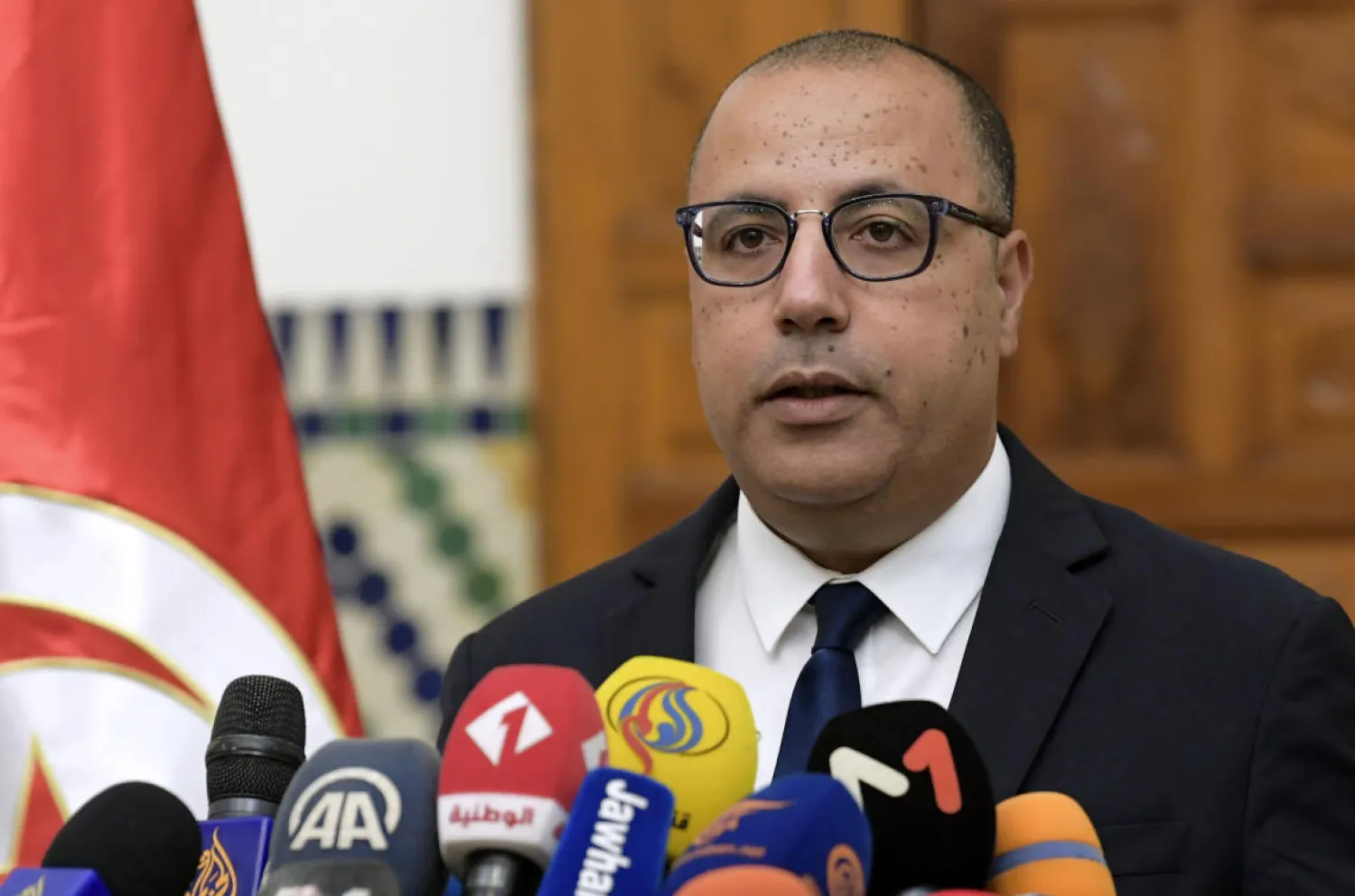

Tunisia’s Prime Minister-designate Hichem Mechichi announced on Monday a cabinet of independent technocrats without parties, seeking to distance the government from political conflicts and focus on reviving the ailing economy.
Mechichi, 46, is an independent, who was interior minister in the government of Elyes Fakhfakh. Tunisian President Kais Saied last month appointed Mechichi the new prime minister after Fakhfakh resigned over allegations of a conflict of interest.
Under plans to revamp the government and revive the economy, Mechichi gathered the ministries of finance, investment and economy into a single department led by liberal economist Ali Kooli, CEO of Arab Banking Corporation (ABC Bank) in Tunisia.
Mechichi needs to win a confidence vote in parliament in the next few days or face the dissolution of parliament by the president and another election, deepening instability.
On Monday, the Democratic Current political party, which is part of the government coalition led by the Ennahda Movement, said it will not support the cabinet proposed by Mechichi.
It vowed to continue to exercise its supervisory role in forming a constructive and responsible opposition.
The party, which is allied to the People's Movement within the Democratic Bloc in parliament, stressed it had dealt “positively” with Mechichi from the first moment he was charged with forming the government.
It also voiced its readiness “to support any government that carries a vision and a political proposal capable of saving the country.”
It expressed shock at Mechichi’s choice of proposing a non-political technocratic government, and his reliance on “mock consultations marred by ambiguity”.
It drew attention to the dangers of forming a technocratic government, saying it undermines the nascent democratic process in Tunisia and the will of voters in the last parliamentary elections.
In contrast to the Democratic Current’s position, head of the People’s Movement, Khaled Krichi, said that his party gave preliminary confidence to Mechichi’s proposed cabinet.
Krichi said that despite the People’s Movement and Democratic Current belonging to the same parliamentary bloc, the latter has no control over the Movement’s opinions and decisions.
He, however, reaffirmed that the two parties remain political partners and that negotiations are ongoing between them.
“The political situation in Tunisia resembles moving sands and there are no constants or final stances—the Democratic Current can possibly review its decision on not supporting the proposed government,” Krichi said.
The Dignity Coalition, led by Seifeddine Makhlouf, confirmed that it will not grant confidence to Mechichi’s government and that it will continue to oppose to protect democracy.
Ennahda Movement and parliament Speaker Rached Ghannouchi also expressed his rejection of the formation of a technocratic government.
Authorities have been struggling to defuse constant protests over widespread unemployment, lack of investment for development and poor health, electricity and water services.
Since their 2011 popular revolution, many Tunisians have grown frustrated over economic stagnation, a decline in living standards and decay in public services while political parties often seem more focused on staying in office instead of tackling problems.
Mechichi said earlier this month his government would focus on rescuing public finances and easing social hardships, saying that while political turmoil had dragged out, “some Tunisians have not found drinking water”.
Tunisia’s tourism-dependent economy shrank 21.6 percent in the second quarter of 2020, compared to the same period last year, due to the coronavirus crisis.


