Suicide Bomber Revives Fears of Terrorist Sleeper Cells in Lebanon

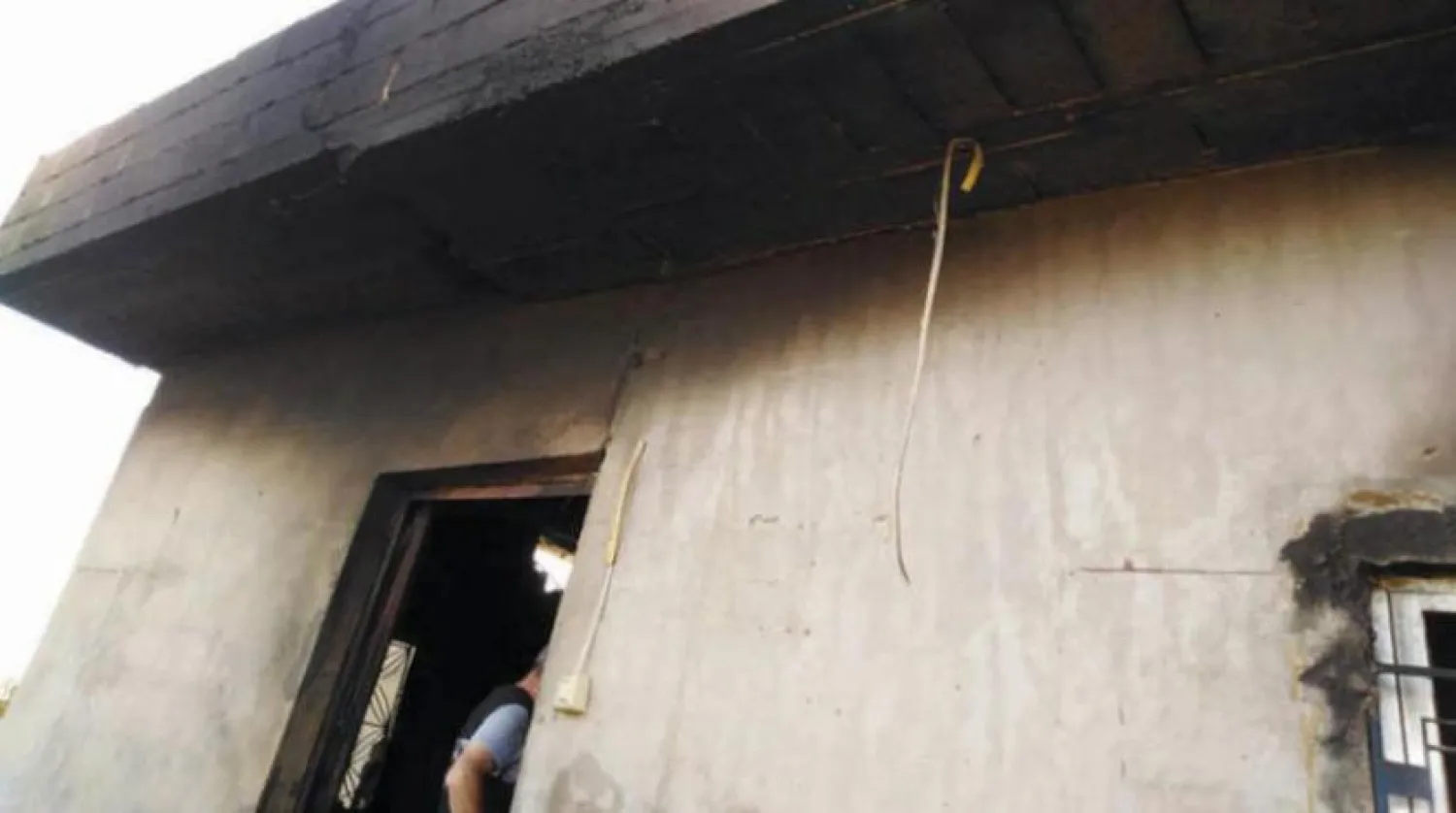
The apartment in a northern Lebanese town, where a suspect blew himself up to prevent the ISF from arresting him (NNA).
TT

Suicide Bomber Revives Fears of Terrorist Sleeper Cells in Lebanon

The apartment in a northern Lebanese town, where a suspect blew himself up to prevent the ISF from arresting him (NNA).

A suicide bombing carried out by a suspect in a security incident that killed three people in the town of Kaftoun in northern Lebanon last week renewed fears of sleeper cells belonging to extremist organizations that could exploit the tense situation in the country to revive their activities.

Those fears, however, are rejected by security sources, who stressed that the “success achieved by the Lebanese authorities in terms of proactive security is still effective and possesses the full ability to maintain stability.”

On the night of Aug. 21, four people driving a car without a license plate opened fire at three members of the municipal guard in the northern town of Kaftoun, killing them instantly, before fleeing to an unknown destination.

Subsequently, the joint security force in the Beddawi Palestinian refugee in northern Lebanon handed over one of the wanted people to the Lebanese authorities at dawn on Sunday.

On Monday, a force from the Intelligence Bureau of the Internal Security Forces raided an apartment occupied by displaced Syrians in an area in the North, with the aim to arrest a suspect in the crime. But the wanted man detonated himself with explosives before the forces could arrest him.

The National News Agency (NNA) reported that the ISF cordoned off the area and confiscated two laptop computers from the apartment. It added that a number of people were arrested during raids in several refugee camps across the North.

Judicial sources told Asharq Al-Awsat that the wanted person who blew himself up was a 40-year-old Syrian, who had previously served a prison sentence on charges of belonging to ISIS.

“The other suspect, who was handed over to the Lebanese authorities at dawn on Sunday, also had extremist tendencies,” according to the sources.

They added that the investigations into the Kaftoun crime showed the presence of two other vehicles that accompanied the suspects’ car. One of those cars transported the perpetrators to a safe place. The sources asserted that they “were planning to carry out a terrorist act before they clashed with the municipal guards, who prevented them from executing their operation.”

Head of the Middle East Center for Studies, Dr. Hisham Jaber, said sleeper cells were usually “present, and they wake up when they find opportunity or a security vacuum.”

But he asserted that these factors “are not available in Lebanon, due to the constant vigilance of the services.”

Jaber, a retired Lebanese Army brigadier general, noted that Lebanon “has succeeded since 2014 in proactive security,” referring to the concerted efforts by “the security services to exchange information in an integrated manner.”


One Dead as Israel Strikes South Lebanon

A person inspects the site a day after a series of Israeli airstrikes struck a large piece of industrial machinery in the southern Lebanese village of Al-Marwanieh, Lebanon, on 31 January 2026. (EPA)
TT

One Dead as Israel Strikes South Lebanon

A person inspects the site a day after a series of Israeli airstrikes struck a large piece of industrial machinery in the southern Lebanese village of Al-Marwanieh, Lebanon, on 31 January 2026. (EPA)

Lebanon said one person was killed and several others wounded in Israeli strikes in the country's south on Sunday, as Israel said it struck Hezbollah targets.

Despite a November 2024 truce that sought to end more than a year of hostilities including two months of all-out war between Israel and the Iran-backed group, Israel has kept up regular strikes on Lebanon and has maintained troops in five areas it deems strategic.

Lebanon's health ministry said one person was killed and three others wounded, including a 16-year-old boy, in an Israeli strike in Ebba in the Nabatiyeh district, which is located in the country's south.

The state-run National News Agency said the strike targeted a vehicle whose driver was killed, reporting a boy was among the wounded when his family's car passed at the time of the raid and crashed.

The Israeli military said it struck a Hezbollah operative in the Doueir area, near Ebba, "in response to Hezbollah's repeated violations of the ceasefire understandings".

Earlier Sunday the health ministry said a strike on Qanarit in the Sidon district, far from the Israeli border, wounded one person.

The NNA said the strike targeted a bulldozer "while it was working to remove rubble" from the site of a previous Israeli attack.

The Israeli army said it struck "several Hezbollah engineering vehicles" but said they were located in an area of south Lebanon it identified as Mazraat Aboudiyeh.

"The vehicles were struck while being used by Hezbollah terrorists to reestablish terror infrastructure sites in the area," the statement added.

Israel's military has previously targeted bulldozers, excavators and prefabricated houses in south Lebanon, while Lebanese officials have accused Israel of seeking to prevent reconstruction work in the heavily damaged south.

More than 360 people have been killed by Israeli fire in Lebanon since the ceasefire, according to an AFP tally of health ministry reports.


Sudan’s War-Torn Capital Sees Second Commercial Flight Land Since Conflict Began

Family and friends rush on the tarmac to greet the domestic Sudan Airways flight arriving from Port Sudan, after landing at Khartoum International Airport, following the war between Sudan's army and the paramilitary Rapid Support Forces, in Khartoum, Sudan, Sunday, Feb. 1, 2026. (AP)
TT

Sudan’s War-Torn Capital Sees Second Commercial Flight Land Since Conflict Began

Family and friends rush on the tarmac to greet the domestic Sudan Airways flight arriving from Port Sudan, after landing at Khartoum International Airport, following the war between Sudan's army and the paramilitary Rapid Support Forces, in Khartoum, Sudan, Sunday, Feb. 1, 2026. (AP)

A commercial flight landed in the Sudanese capital Sunday for the second time since a devastating war broke out in the northeastern African country nearly three years ago. 

The domestic flight, operated by the national flag carrier SUDANAIR, landed at the Khartoum International Airport Sunday afternoon, according to the state-run SUNA news agency. 

The flight took off Sunday morning from the eastern Red Sea city of Port Sudan, which had served as an interim seat for the government until the administration moved back to Khartoum earlier this year, SUNA said. 

The reopening of the Khartoum International Airport was a crucial step in the government’s efforts to normalize life in the capital, which has been wrecked during the ongoing war between the military and the paramilitary Rapid Support Forces. 

Sunday’s flight was the second commercial flight to arrive in Khartoum since a flight operated by the privately owned Badr Airlines landed in the airport in October last year. At the time the RSF launched drones at the airport to disrupt the government's efforts to reopen the facility. The miliary retook Khartoum from the RSF earlier last year. 

The war in Sudan began in April 2023 when a power struggle between the military and the RSF exploded into open fighting in Khartoum and elsewhere in the country. The airport was severely damaged in the first weeks of the war. 

The devastating war has killed more than 40,000 people, according to UN figures, but aid groups say that is an undercount and the true number could be many times higher. 

It created the world’s largest humanitarian crisis with over 14 million people forced to flee their homes. It fueled disease outbreaks and pushed parts of the country into famine. 


Iraq Parliament Delays Presidential Vote Again

29 January 2026, Iraq, Baghdad: A supporter of former Iraqi prime minister Nouri al-Maliki chants in front of al-Maliki portrait during a protest against US President Donald Trump near the US embassy in Baghdad. Photo: Ameer Al-Mohammedawi/dpa
TT

Iraq Parliament Delays Presidential Vote Again

29 January 2026, Iraq, Baghdad: A supporter of former Iraqi prime minister Nouri al-Maliki chants in front of al-Maliki portrait during a protest against US President Donald Trump near the US embassy in Baghdad. Photo: Ameer Al-Mohammedawi/dpa

Iraq's parliament has again postponed the election of the country's new president, state media reported on Sunday, amid intense political horse-trading and US pressure over the new prime minister.

It was the second time parliament has delayed the presidential vote, which had first been due last week.

An AFP correspondent in the parliament said the required quorum was not reached on Sunday.

The vote was therefore delayed, according to the official INA press agency, which did not say whether a new date had been agreed.

The parliament's media office said the speaker will now meet the heads of party blocs to set a final date.

By convention, a Shiite Muslim holds the powerful post of prime minister, the parliament speaker is a Sunni and the largely ceremonial presidency goes to a Kurd.

The two main Kurdish parties have yet to settle on a presidential candidate, and the largest Shiite alliance -- despite backing Nouri al-Maliki for next premier -- faces US threats to end all support for Iraq if he takes up the post.

In Iraq, a country with chronically volatile politics driven by internal disputes and foreign pressure mostly from the United States and Iran, key decisions are often delayed beyond constitutional deadlines.

On Saturday, the Coordination Framework, an alliance of Shiite groups with varying degrees of links to Iran that has emerged as the main ruling coalition, said it "reiterates its support for its nominee", Maliki.

On Tuesday, US President Donald Trump declared Maliki a "very bad choice", and said that if Maliki was elected Washington "will no longer help Iraq".

Iraq's only two-term prime minister fell out with the United States during his premiership between 2006 and 2014 over growing ties with Iran.

Sources close to the Coordination Framework said that Shiite leaders are divided, with some wanting Maliki to stand aside, fearing US sanctions if he returns to office.

On the presidential front, Kurdish parties have yet to agree on a candidate, who must be endorsed by other blocs and win a two-thirds majority in parliament.

The presidency is usually held by the Patriotic Union of Kurdistan (PUK). This year, the rival Kurdistan Democratic Party (KDP) named its own candidate, Foreign Minister Fuad Hussein.