

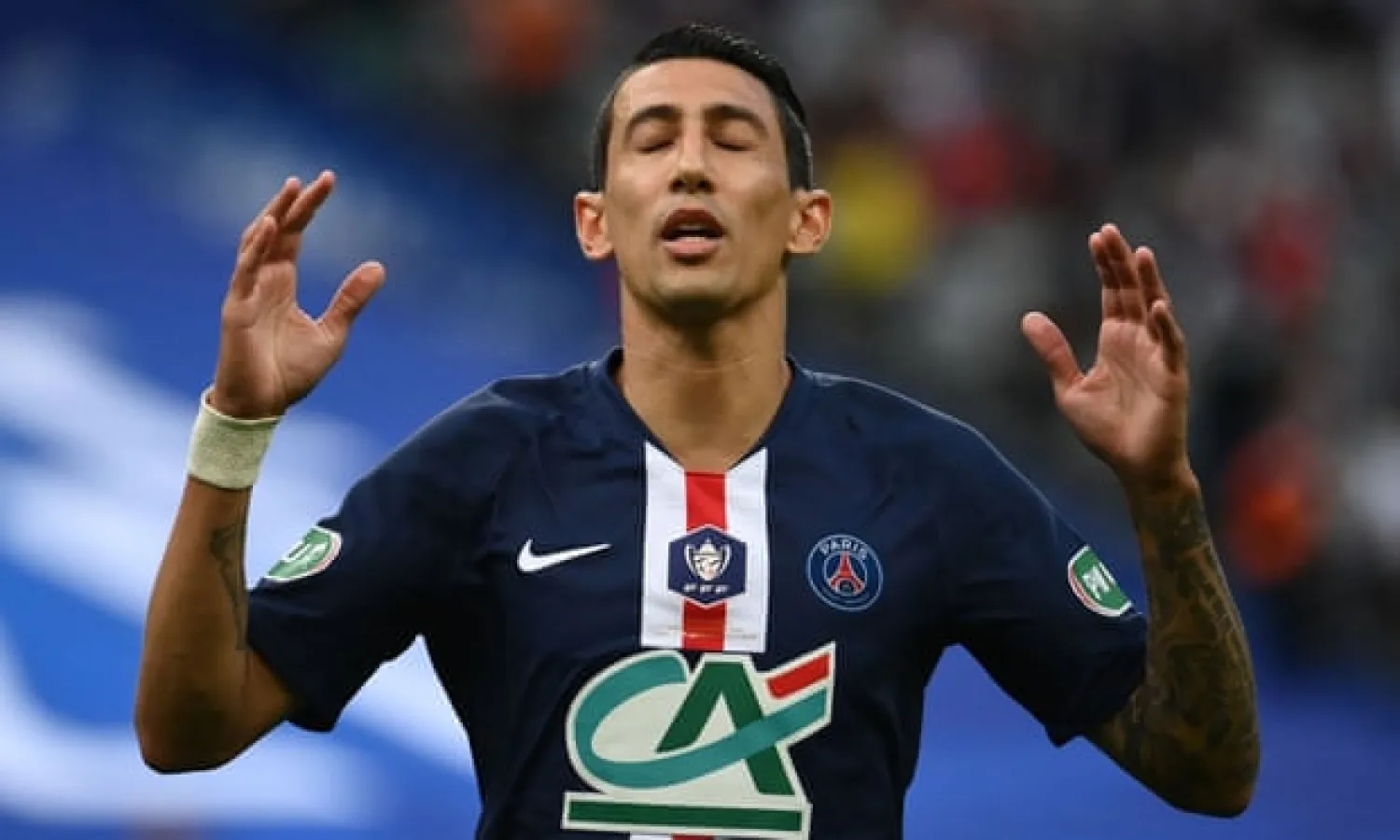

Ángel Di María a Tactical Schemer Focused More on Structure Than Star Quality

 Ángel Di María tasted Champions League glory with Real Madrid in 2014 and has shown his value to this PSG side in Portugal. Photograph: Franck Fife/AFP/Getty Images
Ángel Di María tasted Champions League glory with Real Madrid in 2014 and has shown his value to this PSG side in Portugal. Photograph: Franck Fife/AFP/Getty Images
TT

Ángel Di María a Tactical Schemer Focused More on Structure Than Star Quality

 Ángel Di María tasted Champions League glory with Real Madrid in 2014 and has shown his value to this PSG side in Portugal. Photograph: Franck Fife/AFP/Getty Images
Ángel Di María tasted Champions League glory with Real Madrid in 2014 and has shown his value to this PSG side in Portugal. Photograph: Franck Fife/AFP/Getty Images

The critical moment of Lionel Messi’s international career, perhaps, came a little after 1.30pm on a Saturday afternoon in Brasília. Argentina led Belgium 1-0 in their 2014 World Cup quarter‑final. They were in control, playing well. The forward line, as usual, felt a mismatch of extremely talented but not particularly complementary players, but with a solid and well-balanced midfield, it didn’t really seem to matter. Then Ángel Di María pulled his hamstring.

Di María had a vital role in Alejandro Sabella’s side. Javier Mascherano mopped up in front of the back four. Lucas Biglia scuttled around alongside him. And to the left of the three Di María shuttled to the forward line, the vital link between two otherwise disparate units. His role wasn’t glamorous. He was easily overlooked. But once he was gone, his importance became obvious. Enzo Pérez, a far more defensive presence, replaced him. Argentina won the game and went on to reach the final, but in the five hours of football they played at that World Cup after Di María’s injury, they didn’t score another goal.

In football’s modern world of glitz and glamour, when it feels as though the super-clubs prefer to sign celebrities rather than submit to the rigours of following a coherent tactical plan, there is an irony in Di María finally beginning to be appreciated at the club that, for so long, was the market leader in placing star quality over structure – and the reverse of that is also true: Di María’s increasing prominence is evidence of PSG’s growing maturity. If they are to win the Champions League, it will almost certainly require Di María to keep Joshua Kimmich quiet and to exploit Bayern Munich’s aggressively high line.

For years, it seems, Di María has been underappreciated. Perhaps it’s because he doesn’t look much like a footballer (although he does, from certain angles, bear a striking resemblance to Franz Kafka). He does not have the eye-catching footwork or goals return of many of his teammates. But he does have a remarkable capacity to link one line of a team to another, starting either as a forward or in midfield, and functioning as a bridge from one to the other.

In Tuesday’s 3-0 semi-final victory over RB Leipzig, he set up two goals with impeccable crosses and scored the other. But more than that was what he ensured didn’t happen. Against Atalanta, when he had been suspended, a gulf had opened between the front three and the other seven outfielders. Against RB Leipzig, PSG pressed more and the team was far more compact.

But this wasn’t even the first Champions League semi-final Di María has dominated. In the second leg in 2014, it was, as much as anything else, his countering ability, his intuition of when to carry the ball and when to offload it, that allowed Real Madrid to unpick Bayern as they won 4-0 at the Allianz.

He was the Uefa man of the match in the victory over Atlético in the final as well. Di María had made decisive contributions to the last two games as Madrid clinched la décima, and yet that summer he left. The club has always claimed it was because of the excessive demands of his agent – but that agent is Jorge Mendes, which made Di María’s continued presence at Madrid problematic after the departure the previous summer of José Mourinho, who had lobbied hard for his signing in 2010. Before the final, Madrid asked him not to risk his hamstring as they wanted to sell him to make way for the more obviously marketable James Rodríguez, who bears no resemblance to any gloomy Bohemian modernist.

So, having few options, Di María ended up at Manchester United, where he had never really wanted to go. The tendency is to remember Di María’s loss of form and the acrimony that surrounded his departure. But he started the season well and, in 20 league starts, registered three goals and a remarkable 10 assists. The downturn was perhaps in part caused by his frustration at the restrictions placed on him by Louis van Gaal, followed by a break-in at his home that left him fearing for the safety of his family. Di María is naturally introspective and that, combined with struggles with the language, contributed to a general loss of confidence and morale.

With Argentina, the situation is more complicated. Di María has won more than 100 caps, some achievement given the wealth of attacking options available to them, but he has undoubtedly been tainted by the years of failure, and the strangely stodgy football a concatenation of brilliant attacking talent habitually produces. There’s no obvious reason that the front three of Lionel Messi, Sergio Agüero and Di María that won Olympic gold in 2008 shouldn’t have brought similar success in the senior game, but it never quite has.

While manager after manager has seen Di María and his versatility as part of the solution, there’s a constituency of fans and journalists who have begun to wonder if he’s actually part of the problem. And perhaps he is, but it’s also the case that his unflashy style makes it harder instantly to recall a goal or a run or a pass that could be entered as evidence for the defense.

And so to France, where PSG’s resources so dwarf everybody else’s that statistics become so distorted as to be meaningless. Di María’s goals return has shot up from one every seven games in the rest of his career to one in every three – but so it should. But far more significant is his less conspicuous contribution.

Di María is one of the very few to have played with Messi, Cristiano Ronaldo and Neymar. He has thrived with each of them. He is unselfish, makes covering runs, creates space and compensates for their sporadic approach to pressing. It is easy to see why coaches, other than Van Gaal, appreciate an industrious player who naturally balances a side. Then, every now and again, he has a game like he did against Leipzig, and offers a reminder that he’s also an exceptional talent in his own right. To borrow from John Milton, they also serve, who only run about lots in tactically intelligent and selfless patterns.

The Guardian Sport


Shakhtar Boss Pays Ukrainian Racer $200,000 After Games Disqualification

Ukrainian President Volodymyr Zelenskiy holds helmet as he meets with a Ukrainian skeleton racer Vladyslav Heraskevych , who was disqualified from the Olympic skeleton competition over his "helmet of remembrance" depicting athletes killed since Russia's invasion and his father and coach, Mykhailo Heraskevych, amid Russia's attack on Ukraine, in Munich, Germany February 13, 2026. (Ukrainian Presidential Press Service/Handout via Reuters)
TT

Shakhtar Boss Pays Ukrainian Racer $200,000 After Games Disqualification

Ukrainian President Volodymyr Zelenskiy holds helmet as he meets with a Ukrainian skeleton racer Vladyslav Heraskevych , who was disqualified from the Olympic skeleton competition over his "helmet of remembrance" depicting athletes killed since Russia's invasion and his father and coach, Mykhailo Heraskevych, amid Russia's attack on Ukraine, in Munich, Germany February 13, 2026. (Ukrainian Presidential Press Service/Handout via Reuters)

The owner of ‌Ukrainian football club Shakhtar Donetsk has donated more than $200,000 to skeleton racer Vladyslav Heraskevych after the athlete was disqualified from the Milano Cortina Winter Games before competing over the use of a helmet depicting Ukrainian athletes killed in the war with Russia, the club said on Tuesday.

The 27-year-old Heraskevych was disqualified last week when the International Bobsleigh and Skeleton Federation jury ruled that imagery on the helmet — depicting athletes killed since Russia invaded Ukraine in 2022 — breached rules on athletes' expression at ‌the Games.

He ‌then lost an appeal at the Court ‌of ⁠Arbitration for Sport hours ⁠before the final two runs of his competition, having missed the first two runs due to his disqualification.

Heraskevych had been allowed to train with the helmet that displayed the faces of 24 dead Ukrainian athletes for several days in Cortina d'Ampezzo where the sliding center is, but the International Olympic Committee then ⁠warned him a day before his competition ‌started that he could not wear ‌it there.

“Vlad Heraskevych was denied the opportunity to compete for victory ‌at the Olympic Games, yet he returns to Ukraine a ‌true winner," Shakhtar President Rinat Akhmetov said in a club statement.

"The respect and pride he has earned among Ukrainians through his actions are the highest reward. At the same time, I want him to ‌have enough energy and resources to continue his sporting career, as well as to fight ⁠for truth, freedom ⁠and the remembrance of those who gave their lives for Ukraine," he said.

The amount is equal to the prize money Ukraine pays athletes who win a gold medal at the Games.

The case dominated headlines early on at the Olympics, with IOC President Kirsty Coventry meeting Heraskevych on Thursday morning at the sliding venue in a failed last-minute attempt to broker a compromise.

The IOC suggested he wear a black armband and display the helmet before and after the race, but said using it in competition breached rules on keeping politics off fields of play. Heraskevych also earned praise from Ukraine President Volodymyr Zelenskiy.


Speed Skating-Italy Clinch Shock Men’s Team Pursuit Gold, Canada Successfully Defend Women’s Title

 Team Italy with Davide Ghiotto, Andrea Giovannini, Michele Malfatti, celebrate winning the gold medal on the podium of the men's team pursuit speed skating race at the 2026 Winter Olympics, in Milan, Italy, Tuesday, Feb. 17, 2026. (AP)
Team Italy with Davide Ghiotto, Andrea Giovannini, Michele Malfatti, celebrate winning the gold medal on the podium of the men's team pursuit speed skating race at the 2026 Winter Olympics, in Milan, Italy, Tuesday, Feb. 17, 2026. (AP)
TT

Speed Skating-Italy Clinch Shock Men’s Team Pursuit Gold, Canada Successfully Defend Women’s Title

 Team Italy with Davide Ghiotto, Andrea Giovannini, Michele Malfatti, celebrate winning the gold medal on the podium of the men's team pursuit speed skating race at the 2026 Winter Olympics, in Milan, Italy, Tuesday, Feb. 17, 2026. (AP)
Team Italy with Davide Ghiotto, Andrea Giovannini, Michele Malfatti, celebrate winning the gold medal on the podium of the men's team pursuit speed skating race at the 2026 Winter Olympics, in Milan, Italy, Tuesday, Feb. 17, 2026. (AP)

An inspired Italy delighted the home crowd with a stunning victory in the Olympic men's team pursuit final as

Canada's Ivanie Blondin, Valerie Maltais and Isabelle Weidemann delivered another seamless performance to beat the Netherlands in the women's event and retain their title ‌on Tuesday.

Italy's ‌men upset the US who ‌arrived ⁠at the Games ⁠as world champions and gold medal favorites.

Spurred on by double Olympic champion Francesca Lollobrigida, the Italian team of Davide Ghiotto, Andrea Giovannini and Michele Malfatti electrified a frenzied arena as they stormed ⁠to a time of three ‌minutes 39.20 seconds - ‌a commanding 4.51 seconds clear of the ‌Americans with China taking bronze.

The roar inside ‌the venue as Italy powered home was thunderous as the crowd rose to their feet, cheering the host nation to one ‌of their most special golds of a highly successful Games.

Canada's women ⁠crossed ⁠the line 0.96 seconds ahead of the Netherlands, stopping the clock at two minutes 55.81 seconds, and

Japan rounded out the women's podium by beating the US in the Final B.

It was only Canada's third gold medal of the Games, following Mikael Kingsbury's win in men's dual moguls and Megan Oldham's victory in women's freeski big air.


Lindsey Vonn Back in US Following Crash in Olympic Downhill 

Milano Cortina 2026 Olympics - Alpine Skiing - Women's Downhill 3rd Official Training - Tofane Alpine Skiing Centre, Belluno, Italy - February 07, 2026. Lindsey Vonn of United States in action during training. (Reuters)
TT

Lindsey Vonn Back in US Following Crash in Olympic Downhill 

Milano Cortina 2026 Olympics - Alpine Skiing - Women's Downhill 3rd Official Training - Tofane Alpine Skiing Centre, Belluno, Italy - February 07, 2026. Lindsey Vonn of United States in action during training. (Reuters)

Lindsey Vonn is back home in the US following a week of treatment at a hospital in Italy after breaking her left leg in the Olympic downhill at the Milan Cortina Games.

“Haven’t stood on my feet in over a week... been in a hospital bed immobile since my race. And although I’m not yet able to stand, being back on home soil feels amazing,” Vonn posted on X with an American flag emoji. “Huge thank you to everyone in Italy for taking good care of me.”

The 41-year-old Vonn suffered a complex tibia fracture that has already been operated on multiple times following her Feb. 8 crash. She has said she'll need more surgery in the US.

Nine days before her fall in Cortina d'Ampezzo, Italy, Vonn ruptured the ACL in her left knee in another crash in Switzerland.

Even before then, all eyes had been on her as the feel-good story heading into the Olympics for her comeback after nearly six years of retirement.
