

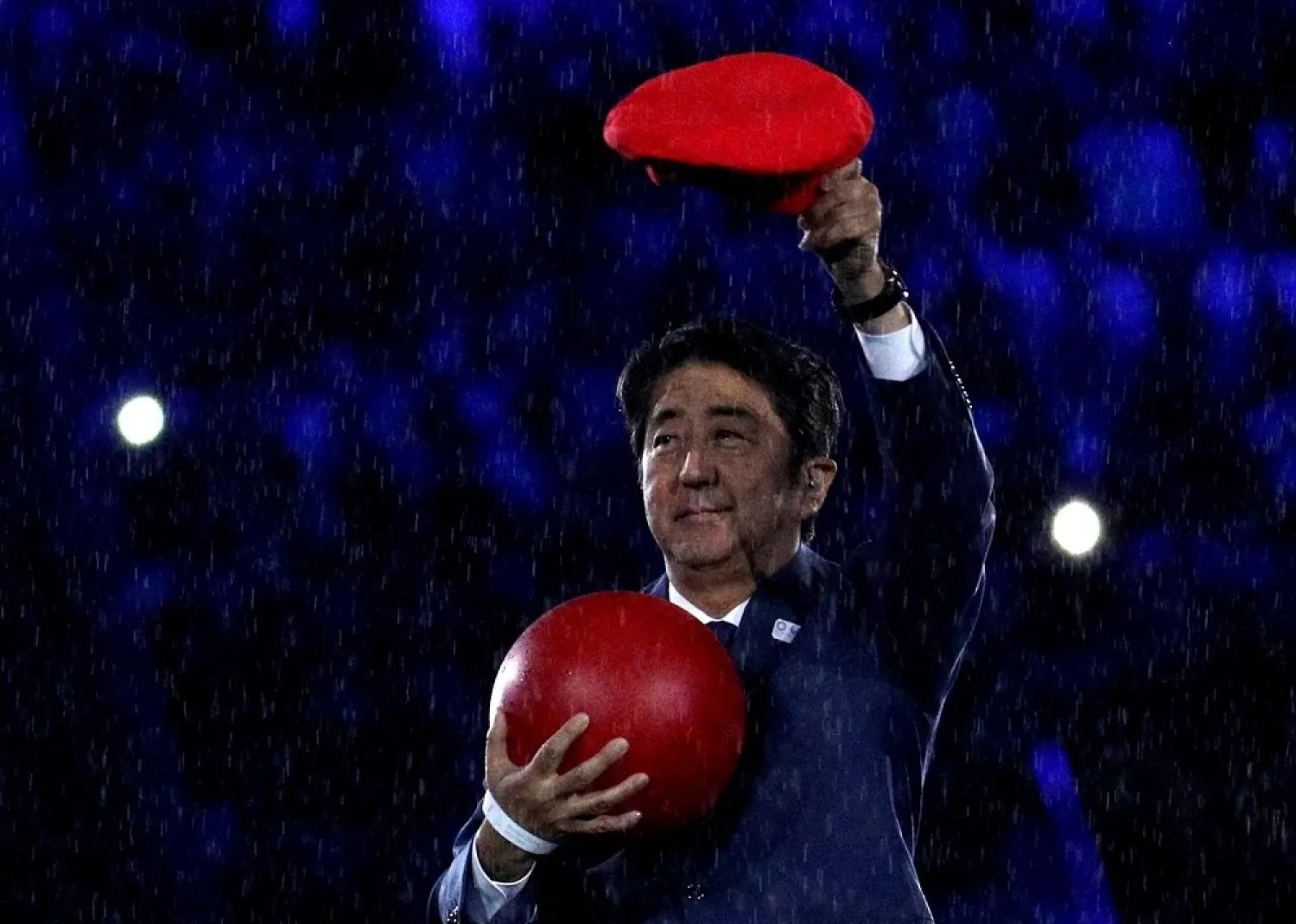

Shinzo Abe -- aka 'Super Mario' -- Loses out on Olympics

Japanese Prime Minister Shinzo Abe takes part in the closing ceremony of the 2016 Rio de Janeiro Olympics. (Reuters)
TT

Shinzo Abe -- aka 'Super Mario' -- Loses out on Olympics

Japanese Prime Minister Shinzo Abe takes part in the closing ceremony of the 2016 Rio de Janeiro Olympics. (Reuters)

Japanese Prime Minister Shinzo Abe was a star at the closing ceremony of the 2016 Rio de Janeiro Olympics, parading before a sellout crowd at the Maracana Stadium as Nintendo game character Super Mario.

Abe's humorous invitation to the next Olympics in Tokyo was a big hit among Brazilian fans, and to a worldwide television audience.

It turns out that Abe won't be around — at least not in an official capacity — when the postponed Olympics are set to open on July 23, 2021. He announced on Friday he intends to step down because of a chronic health problem.

Ironically, Japan's longest serving prime minister would have been in the VIP box alongside International Olympic Committee president Thomas Bach had the games opened as scheduled a month ago and not fallen victim to the COVID-19 pandemic.

“I think this won't make much difference,” Jeff Kingston, who teaches Japanese politics at Temple University in Tokyo, wrote in an email. “The Olympics benefited from his backing but now the situation is beyond the prime minister's control. His successor might not care as much, but so much depends on the IOC, the Tokyo organizing committee, and sports federations around the world.”

Abe called in “gut wrenching” to leave with so many plans unfinished. The most visible one — at least to the public outside Japan — was the Olympics.

Abe was in the front row in 2013 in Buenos Aires when then-IOC president Jacques Rogge opened an envelope to announce Tokyo as the 2020 host, beating out Istanbul in the final vote.

It was Abe who assured IOC members at the time that the meltdown of three nuclear reactors in 2011 from an earthquake and tsunami was “under control.” In fact, it was not entirely and Japan is still dealing with the disaster in the northern Fukushima prefecture.

“I think this likely is heartbreaking for Abe,” David Leheny, who teaches politics at Tokyo's Waseda University, wrote in an email.

Leheny said Abe leaves without any signature breakthroughs on women's issues, amending the constitution, or economic policy.

“I think the Olympics would have been the one major thing he could point to and say — ‘yes’ — I did that. I made that happen. He still might, and I think whoever the next prime minister is will ensure Abe has a prominent place at the Olympics, but it won't be the same as his being in charge to welcome people.”

There is no guarantee the Olympics will even take place. The IOC and organizers have said it will, but so far, they have not said how it can happen. There are questions about quarantines, fans being allowed, vaccines — and the logistics of getting 15,400 Olympic and Paralympic athletes safely into Tokyo. Add to this thousands of officials, staff and media — and the fact the control of the outbreak is so different in countries or territories represented by 206 national Olympic committees.

Local Tokyo organizers have stopped holding regular news conferences to update progress, and few details are expected until the fall and into 2021.

“It is with great sadness that I learned about the resignation of Prime Minister Abe,” said Bach, who credited Abe with getting the Olympics back to Japan after the 1964 Tokyo Games, 1972 Winter Olympics in Sapporo and 1998 Winter Games in Nagano.

“All the Japanese athletes and the athletes of the entire world are very grateful to him,” Bach said.

Yoshiro Mori, a former Japanese prime minister and the president of the Tokyo Olympic organizing committee, also credited Abe.

“We look forward to the prime minister's guidance during the remainder of his time in office, and hope to receive his generous support in the future regardless of his official position," Mori said in a statement.

A poll this month of almost 13,000 Japanese companies showed 53.6% want the games canceled or postponed again. The IOC has said if the Olympics can't happen in 2021, they will be canceled.

A poll in July found that two-thirds of the public also favors another postponement or cancellation.

Tokyo organizers say they are officially spending $12.6 billion to hold the Olympics, although a national audit board says it’s twice that much. In addition, local estimates say the bill for the delay could add on several billion more. Organizers and the IOC have yet to give a detailed breakdown of the new costs.



Sinner Sees off Popyrin to Reach Doha Quarters

 Italy's Jannik Sinner greets the fans after defeating Australia's Alexei Popyrin in their men's singles match at the Qatar Open tennis tournament in Doha on February 18, 2026. (AFP)
Italy's Jannik Sinner greets the fans after defeating Australia's Alexei Popyrin in their men's singles match at the Qatar Open tennis tournament in Doha on February 18, 2026. (AFP)
TT

Sinner Sees off Popyrin to Reach Doha Quarters

 Italy's Jannik Sinner greets the fans after defeating Australia's Alexei Popyrin in their men's singles match at the Qatar Open tennis tournament in Doha on February 18, 2026. (AFP)
Italy's Jannik Sinner greets the fans after defeating Australia's Alexei Popyrin in their men's singles match at the Qatar Open tennis tournament in Doha on February 18, 2026. (AFP)

Jannik Sinner powered past Alexei Popyrin in straight sets on Wednesday to reach the last eight of the Qatar Open and edge closer to a possible final meeting with Carlos Alcaraz.

The Italian, playing his first tournament since losing to Novak Djokovic in the Australian Open semi-finals last month, eased to a 6-3, 7-5 second-round win in Doha.

Sinner will play Jakub Mensik in Thursday's quarter-finals.

Australian world number 53 Popyrin battled gamely but failed to create a break-point opportunity against his clinical opponent.

Sinner dropped just three points on serve in an excellent first set which he took courtesy of a break in the sixth game.

Popyrin fought hard in the second but could not force a tie-break as Sinner broke to grab a 6-5 lead before confidently serving it out.

World number one Alcaraz takes on Frenchman Valentin Royer in his second-round match later.


Ukraine's Officials to Boycott Paralympics over Russian Flag Decision

Milano Cortina 2026 Winter Olympics - Skeleton - Interview with Ukraine Youth and Sports minister Matvii Bidnyi - N H Hotel, Milan, Italy - February 12, 2026 Ukraine Youth and Sports Minister Matvii Bidnyi speaks after the disqualification of Ukrainian skeleton racer Vladyslav Heraskevych from the Winter Games. REUTERS/Kevin Coombs
TT

Ukraine's Officials to Boycott Paralympics over Russian Flag Decision

Milano Cortina 2026 Winter Olympics - Skeleton - Interview with Ukraine Youth and Sports minister Matvii Bidnyi - N H Hotel, Milan, Italy - February 12, 2026 Ukraine Youth and Sports Minister Matvii Bidnyi speaks after the disqualification of Ukrainian skeleton racer Vladyslav Heraskevych from the Winter Games. REUTERS/Kevin Coombs

Ukrainian officials will boycott the Paralympic Winter Games, Kyiv said Wednesday, after the International Paralympic Committee allowed Russian athletes to compete under their national flag.

Ukraine also urged other countries to shun next month's Opening Ceremony in Verona on March 6, in part of a growing standoff between Kyiv and international sporting federations four years after Russia invaded.

Six Russians and four Belarusians will be allowed to take part under their own flags at the Milan-Cortina Paralympics rather than as neutral athletes, the Games' governing body confirmed to AFP on Tuesday.

Russia has been mostly banned from international sport since Moscow invaded Ukraine. The IPC's decision triggered fury in Ukraine.

Ukraine's sports minister Matviy Bidny called the decision "outrageous", and accused Russia and Belarus of turning "sport into a tool of war, lies, and contempt."

"Ukrainian public officials will not attend the Paralympic Games. We will not be present at the opening ceremony," he said on social media.

"We will not take part in any other official Paralympic events," he added.

Ukrainian Foreign Minister Andriy Sybiga said he had instructed Kyiv's ambassadors to urge other countries to also shun the opening ceremony.

"Allowing the flags of aggressor states to be raised at the Paralympic Games while Russia's war against Ukraine rages on is wrong -- morally and politically," Sybiga said on social media.

The EU's sports commissioner Glenn Micallef said he would also skip the opening ceremony.

- Kyiv demands apology -

The IPC's decision comes amid already heightened tensions between Ukraine and the International Olympic Committee, overseeing the Winter Olympics currently underway.

The IOC banned Ukrainian skeleton racer Vladyslav Heraskevych for refusing to ditch a helmet depicting victims of the war with Russia.

Ukraine was further angered that the woman chosen to carry the "Ukraine" name card and lead its team out during the Opening Ceremony of the Games was revealed to be Russian.

Media reports called the woman an anti-Kremlin Russian woman living in Milan for years.

"Picking a Russian person to carry the nameplate is despicable," Kyiv's foreign ministry spokesman Georgiy Tykhy said at a briefing in response to a question by AFP.

He called it a "severe violation of the Olympic Charter" and demanded an apology.

And Kyiv also riled earlier this month at FIFA boss Gianni Infantino saying he believed it was time to reinstate Russia in international football.

- 'War, lies and contempt' -

Valeriy Sushkevych, president of the Ukrainian Paralympic Committee told AFP on Tuesday that Kyiv's athletes would not boycott the Paralympics.

Ukraine traditionally performs strongly at the Winter Paralympics, coming second in the medals table four years ago in Beijing.

"If we do not go, it would mean allowing Putin to claim a victory over Ukrainian Paralympians and over Ukraine by excluding us from the Games," said the 71-year-old in an interview.

"That will not happen!"

Russia was awarded two slots in alpine skiing, two in cross-country skiing and two in snowboarding. The four Belarusian slots are all in cross-country skiing.

The International Paralympic Committee (IPC) said earlier those athletes would be "treated like (those from) any other country".

The IPC unexpectedly lifted its suspension on Russian and Belarusian athletes at the organisation's general assembly in September.


'Not Here for Medals', Nakai Says after Leading Japanese Charge at Olympics

Ami Nakai of Japan competes during the women's short program figure skating at the 2026 Winter Olympics, in Milan, Italy, Tuesday, Feb. 17, 2026. (AP Photo/Ashley Landis)
TT

'Not Here for Medals', Nakai Says after Leading Japanese Charge at Olympics

Ami Nakai of Japan competes during the women's short program figure skating at the 2026 Winter Olympics, in Milan, Italy, Tuesday, Feb. 17, 2026. (AP Photo/Ashley Landis)

Ami Nakai entered her first Olympics insisting she was not here for medals — but after the short program at the Milano Cortina Games, the 17-year-old figure skater found herself at the top, ahead of national icon Kaori Sakamoto and rising star Mone Chiba.

Japan finished first, second, and fourth on Tuesday, cementing a formidable presence heading into the free skate on Thursday. American Alysa Liu finished third.

Nakai's clean, confident skate was anchored by a soaring triple Axel. She approached the moment with an ease unusual for an Olympic debut.

"I'm not here at this Olympics with the goal of achieving a high result, I'm really looking forward to enjoying this Olympics as much as I can, till the very last moment," she said.

"Since this is my first Olympics, I had nothing to lose, and that mindset definitely translated into my results," she said.

Her carefree confidence has unexpectedly put her in medal contention, though she cannot imagine herself surpassing Sakamoto, the three-time world champion who is skating the final chapter of her competitive career. Nakai scored 78.71 points in the short program, ahead of Sakamoto's 77.23.

"There's no way I stand a chance against Kaori right now," Nakai said. "I'm just enjoying these Olympics and trying my best."

Sakamoto, 25, who has said she will retire after these Games, is chasing the one accolade missing from her resume: Olympic gold.

Having already secured a bronze in Beijing in 2022 and team silvers in both Beijing and Milan, she now aims to cap her career with an individual title.

She delivered a polished short program to "Time to Say Goodbye," earning a standing ovation.

Sakamoto later said she managed her nerves well and felt satisfied, adding that having three Japanese skaters in the top four spots "really proves that Japan is getting stronger". She did not feel unnerved about finishing behind Nakai, who also bested her at the Grand Prix de France in October.

"I expected to be surpassed after she landed a triple Axel ... but the most important thing is how much I can concentrate on my own performance, do my best, stay focused for the free skate," she said.

Chiba placed fourth and said she felt energised heading into the free skate, especially after choosing to perform to music from the soundtrack of "Romeo and Juliet" in Italy.

"The rankings are really decided in the free program, so I'll just try to stay calm and focused in the free program and perform my own style without any mistakes," said the 20-year-old, widely regarded as the rising all-rounder whose steady ascent has made her one of Japan's most promising skaters.

All three skaters mentioned how seeing Japanese pair Riku Miura and Ryuichi Kihara deliver a stunning comeback, storming from fifth place after a shaky short program to capture Japan's first Olympic figure skating pairs gold medal, inspired them.

"I was really moved by Riku and Ryuichi last night," Chiba said. "The three of us girls talked about trying to live up to that standard."