


For Lebanese, Recovery Too Heavy to Bear a Month After Blast

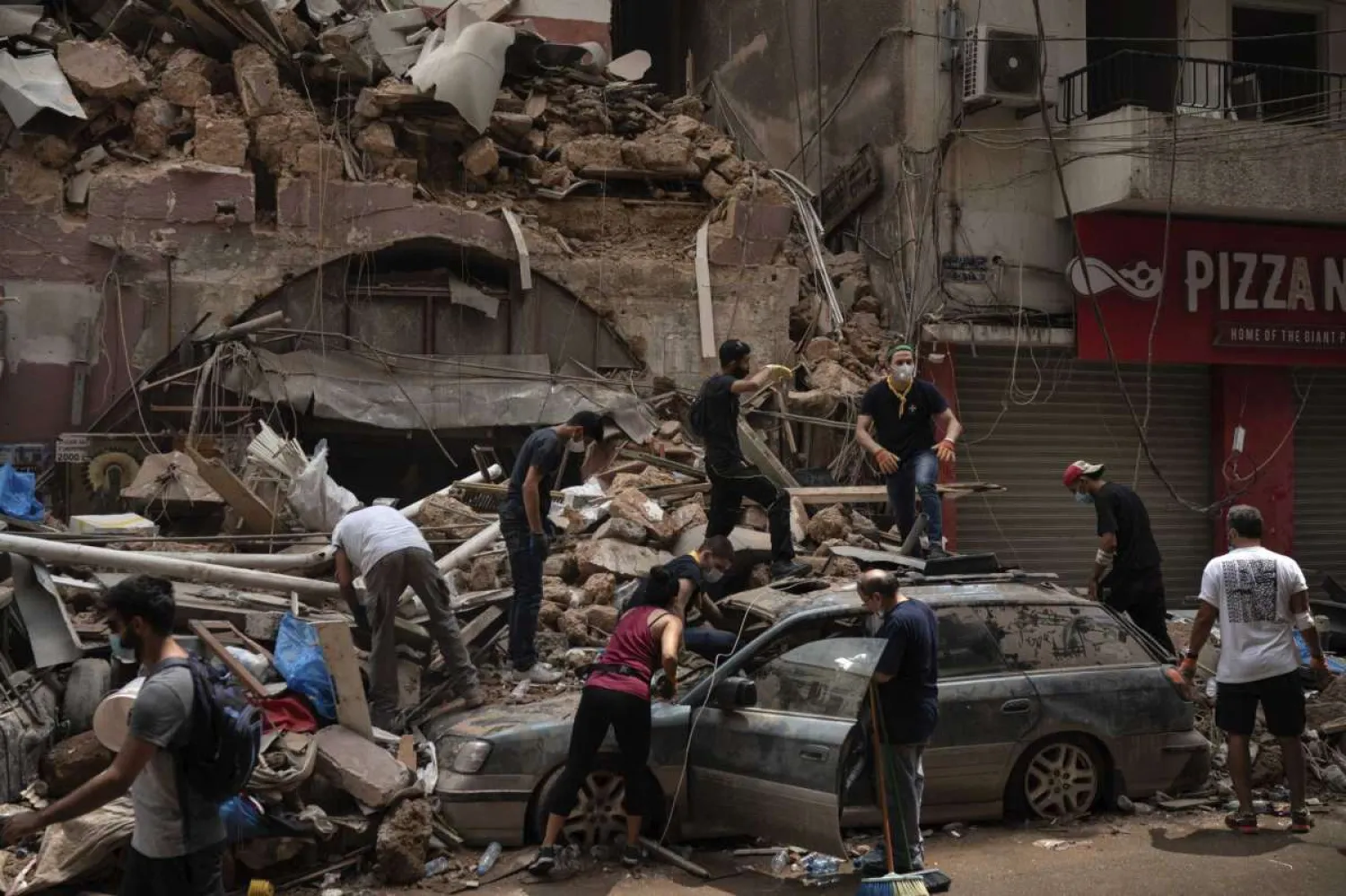
In this Friday, Aug. 7, 2020 file photo, people remove debris from a house damaged by the Aug. 4 explosion that hit the seaport of Beirut, Lebanon. It was 20 minutes before 6:08 p.m. when the Beirut fire brigade received the call from an employee at the nearby port reporting a big fire. Ten firefighters, including a female paramedic, piled into a fire engine and an ambulance and raced toward the scene, and their ultimate death. (AP Photo/Felipe Dana, File)
TT

For Lebanese, Recovery Too Heavy to Bear a Month After Blast

In this Friday, Aug. 7, 2020 file photo, people remove debris from a house damaged by the Aug. 4 explosion that hit the seaport of Beirut, Lebanon. It was 20 minutes before 6:08 p.m. when the Beirut fire brigade received the call from an employee at the nearby port reporting a big fire. Ten firefighters, including a female paramedic, piled into a fire engine and an ambulance and raced toward the scene, and their ultimate death. (AP Photo/Felipe Dana, File)

A month after Beirut´s devastating explosion, Ghassan Toubaji still sits under a gaping hole in his ceiling - he can look up through the dangling plaster, wires and metal struts, and the broken brick roof and see a bit of sky.

The 74-year-old survived the Aug. 4 blast with bruises, but his fall from its impact worsened his heart and blood circulation diseases. Between that and Lebanon´s crumbled economy, he can´t go back to work.

According to the Associated Press, he used the last of the dollars his wife had been hoarding - a precious commodity as the local currency´s value evaporates - to fix the windows shattered by the explosion.

Teams of volunteers, a symbol of the help-each-other spirit that´s grown up from the failures of Lebanon´s corrupt political class, came by his apartment and assessed the damage. They put plastic on the windows and promised glass for free eventually. Four weeks later they hadn´t come back.

With a sweet patient smile, he said he appreciated how well-meaning the young volunteers were. But he couldn´t wait - with humidity reaching 80% some days and the summer sun directed all day into his apartment, he had to do something.

"Our house is hot as hell," he told the AP, sitting in baggy shorts and a tank top as he watched the news in the room with the hole overhead.

Lebanese families are still struggling with rebuilding in the wake of the massive explosion centered at Beirut´s port. Many, already unable to make ends meet because of the country´s economic meltdown, now can´t bear costs of making homes livable. Frustration is high, with the state almost nowhere to be seen and promised international help slow in coming.

With winter and the rainy season only weeks away, aid groups are concerned they may not have time or resources for the mammoth job of repairing and rebuilding.

Around 200,000 housing units, approximately 40,000 buildings, were damaged in the blast, 3,000 of them so severely they are currently uninhabitable, according to UN estimates.

The loss of homes is just one of the indignities from the explosion, the result of nearly 3,000 tons of improperly stored and rotting ammonium nitrates igniting at the port. The blast, one of the strongest non-nuclear explosions ever recorded, killed more than 190 and injured thousands.

A month later, Beirut is still a wounded, grieving city struggling with the calamity that abruptly altered so many lives. Tall buildings still face the port with blown-up facades. Hundreds-year old stone buildings have gaping holes and missing balconies. Features of small streets parallel to the port have been totally erased. Residents walk around with patched up eyes, bandaged arms, or on crutches.

Social media are still awash with people sharing their stories and videos and recounting their persisting trauma. Pictures of the dead are plastered in neighborhoods. "He is a victim, not a martyr," read one poster, rebuffing authorities´ attempts to give the dead that esteemed label of self-sacrifice for a cause, seen as a way to water down their own responsibility.

The United Nations appealed for $344.5 million in emergency funds to last until November, and a donor conference was co-hosted by France and the UN days after the blast. But so far only 16.3% of the funds have been received.

Of the total pledges, $84.5 million is meant for securing and repairing shelter, but only $1.9 million has been dispersed, said Elena Dikomitis, advocacy adviser for Norwegian Refugees Council for Lebanon.

Aid groups worry the funds are not robust enough.

"The cold and rain could start as early as October," she said. "For sure, tens of thousands of houses can´t be repaired in time. That we know for sure, even with all the ongoing efforts."

The NRC is working in two of the hardest-hit neighborhoods, Karantina and Mar Mikhail. It is targeting 12,400 people for help with shelter and 16,800 for water, sanitation, and hygiene interventions before March 2021, she said.

Lebanon already has highly vulnerable populations that need help for shelter in winter, including more than 1 million Syrian refugees, the majority of whom live in substandard conditions and now risk being overlooked. "On top of those people ... you also now have all the new homeless of Beirut," Dikomitis said.

The international community, aware of public anger in Lebanon over rampant corruption, has said it would funnel money away from government institutions and work only through international organizations and the UN.

Many Beirutis say they are sick of hearing about aid on the way, as they struggle to stay above water in the financial crisis.

The currency has crashed in value to the dollar, and banks locked down dollar accounts to prevent capital flight. Prices have skyrocketed, and imports are limited in a country that imports nearly everything. Unable to access their money, even the most able are struggling to secure materials for repairs.

"Nobody has helped us with even a nail," said Robert Hajj, owner of a scooter center wrecked in the blast. "Each day´s delay is deteriorating our companies ... Our money is blocked in the banks."

"They made us give up," he said.

With little to no safety net, elderly like Toubaji are hit hard.

He has no pension, no social or medical insurance, so he and his wife, both over 70, had to keep working. Toubaji worked charging fees from people to get papers signed for them at the Finance Ministry, wading through the bureaucracy.

He was forced to stay home by the slump and the ensuing nationwide protests that began in October. His wife, a seamstress, is also virtually out of work.

They have been eating away at the 30 million Lebanese pounds in their bank account. Overnight in the financial crisis, their savings´ value dropped from $20,000 to just above $3,000. His wife had kept some dollars at home, away from the banks, but that went into fixing their windows.

"You know how much the meter of glass costs? $160," Toubaji said.

If the ceiling is not fixed, rain will come in. Or worse - a few days ago brick from a neighbor´s damaged house hit his roof and knocked a chunk more of the broken ceiling down onto a sofa. His home's main wooden door also remains damaged, its splintered shards glued back in place.

"I don´t have a leader that I follow to chase and secure money," Toubaji said, referring to Lebanon´s sectarian-based patronage system that fills the place of the absent state.

When the blast happened, Toubaji fell on his face, and shattered glass covered his back. He now walks slowly, worried his knees cannot keep him up straight.

He said Lebanon, too, had fallen because of violence and conflict before and every time, it managed to stand up "and good people came to help."

This time, he is not so sure.

Politicians "have robbed the country and the banks are broke. Who would help the country get up on its feet this time?"


Indonesia Slams 'Unacceptable' Peacekeeper Casualties in Lebanon

FILE PHOTO: UNIFIL vehicles drive on a main road in Qlayaa, amid escalating hostilities between Israel and Hezbollah, as the US-Israel conflict with Iran continues, in Qlayaa, southern Lebanon, March 27, 2026. REUTERS/Karamallah Daher/File Photo
TT

Indonesia Slams 'Unacceptable' Peacekeeper Casualties in Lebanon

FILE PHOTO: UNIFIL vehicles drive on a main road in Qlayaa, amid escalating hostilities between Israel and Hezbollah, as the US-Israel conflict with Iran continues, in Qlayaa, southern Lebanon, March 27, 2026. REUTERS/Karamallah Daher/File Photo

The Indonesian government on Saturday slammed as "unacceptable" an explosion that injured three of its peacekeepers in Lebanon within days of three other blue helmets from the Southeast Asian nation being killed.

The United Nations Interim Force in Lebanon (UNIFIL) said three peacekeepers were wounded in a blast that occurred inside a UN facility near Adaisseh on Friday afternoon, and rushed to hospital.

Two were seriously wounded.

The UN Information Center in Jakarta said the "origin of the explosion" was unknown but identified the injured soldiers as Indonesian.

"Repeated attacks or incidents of this kind are unacceptable," the Indonesian foreign ministry said in a statement.

"Regardless of their cause, these events underscore the urgent need to strengthen protection for UN peacekeeping forces amid an increasingly dangerous conflict situation."

The government urged the UN Security Council to investigate the events and "to immediately convene a meeting of troop-contributing countries to UNIFIL to conduct a review and take measures to enhance the protection of personnel serving with UNIFIL".

Friday's incident came just days after an Indonesian peacekeeper died when a projectile exploded on March 29 in southern Lebanon, where Israel and Hezbollah have been fighting since Lebanon was drawn into the Middle East war.

A UN security source told AFP on condition of anonymity Tuesday that fire from an Israeli tank was responsible for that attack.

A day later, two more Indonesian peacekeepers died after an explosion struck a UNIFIL logistics convoy, also in southern Lebanon.

The father of one of the two fallen soldiers, 33-year-old Zulmi Aditya Iskandar, said this week he was shocked that peacekeepers were losing their lives in the conflict.

"We were really sad and regretful, because this is a UN troop, a peacekeeping troop, not deployed for war," 60-year-old Iskandarudin told reporters at his house in West Java province.

The bodies of the three peacekeepers are scheduled to arrive in Jakarta on Saturday evening, according to the military.

The Indonesian National Armed Forces has said it will deploy more than 750 personnel to Lebanon next month as part of the scheduled UNIFIL peacekeeping troop rotation.


Strike Kills One Iraqi Fighter near Syria Border

Mourners attend the funeral of members of Iraq's Hashed al-Shaabi, who were killed in an airstrike in the town of al‑Qaim near the Syrian border, amid heightened regional tensions due to the US-Israel conflict with Iran, in Baghdad, Iraq, March 12, 2026. REUTERS/Stringer
TT

Strike Kills One Iraqi Fighter near Syria Border

Mourners attend the funeral of members of Iraq's Hashed al-Shaabi, who were killed in an airstrike in the town of al‑Qaim near the Syrian border, amid heightened regional tensions due to the US-Israel conflict with Iran, in Baghdad, Iraq, March 12, 2026. REUTERS/Stringer

An attack killed one fighter from the former paramilitary coalition Hashed al-Shaabi on Saturday, the alliance said, blaming the US and Israel.

Iraq has been dragged into the war between the United States, Israel and Iran, with strikes targeting both US interests and pro-Iran groups in the country, reported AFP.

"This treacherous attack resulted in the martyrdom of one PMF fighter and the wounding of four others, as well as a member of the ministry of defense," said a short statement from the group, which is also known as the Popular Mobilization Forces (PMF), adding it was a "Zionist-American attack".

The PMF is a coalition of armed groups -- formed in 2014 to fight extremists-- that is now part of Iraq's regular army, but also contains pro-Iran factions who have a reputation for acting independently.

PMF positions have been repeatedly targeted since the outbreak of war, with the group consistently blaming the attacks on the US and Israel.

According to the group's statement, the latest attack targeted a position in western Anbar province of the 45th Brigade, which belongs to the US-blacklisted, pro-Iran Kataeb Hezbollah group.

Kataeb Hezbollah is part of the umbrella movement known as the Islamic Resistance in Iraq, which has been claiming daily attacks since the start of the war on US interests in Iraq and the region.

The Pentagon has said helicopters have carried out strikes against pro-Iran armed groups in Iraq during the war.

Washington has strongly denied claims it has targeted Iraqi security forces.


Houthis Threaten ‘Gradual Escalation’ after Fourth Attack on Israel

Houthi gunmen during a rally in Sanaa called by their leader (AFP) 
TT

Houthis Threaten ‘Gradual Escalation’ after Fourth Attack on Israel

Houthi gunmen during a rally in Sanaa called by their leader (AFP) 

Yemen’s Houthi group has threatened “gradual escalation” after claiming a fourth attack on Israel, about a week after entering the war alongside Iran as part of the Tehran-led “axis of resistance.”

The move comes as Yemen’s internationally recognized government steps up rhetoric, saying a decisive battle to retake the state from Houthi control is nearing. Israel, for its part, said it is consulting Washington on how to respond to the Houthi attacks, despite their limited impact compared with sustained fire from Iran and Hezbollah.

In a televised statement late Thursday, Houthi military spokesman Yahya Saree said the group launched “a salvo of ballistic missiles” at “vital Israeli targets in the occupied Jaffa area.” He claimed the operation was carried out in coordination with Iran and Hezbollah and had “successfully achieved its objectives.”

The Houthis said their intervention in what they described as a “major and exceptional battle” would be incremental, adding they would adjust their actions depending on “the enemy’s escalation or de-escalation.”

The latest strike marks the fourth since the group announced direct involvement in the regional confrontation, underscoring growing coordination among Iran-backed actors, including Hezbollah and armed Iraqi factions.

Limited effect

The Houthis had claimed a third attack a day earlier. The Israeli military said it intercepted a missile launched from Yemen “without casualties or damage,” adding early detection allowed it to neutralize the threat.

Analysts say such attacks are unlikely to do more than stretch Israel’s air defenses, already under pressure from multiple fronts, including Iran and Hezbollah.

In his first appearance since announcing the escalation, Houthi leader Abdul Malik al-Houthi said the group had shifted from political and media backing of Iran to “direct operational engagement.”

He framed the attacks as part of “joint operations of the axis of resistance,” describing the confrontation as “a duty that transcends geographical borders.” He also defended joining the war, saying neutrality “is not an option,” despite growing concern inside Yemen over the economic and security risks.

Al-Houthi urged supporters to maintain weekly pro-Iran rallies and step up mobilization, including sending school students to summer camps—long used by the group for recruitment.

Government signals offensive

Tareq Saleh, a member of Yemen’s Presidential Leadership Council, said “the battle to end the Houthi coup is approaching,” adding national forces would act “as one team.”

State media reported his remarks during a visit to forces on Yemen’s west coast, where he praised troops as “a safety valve for the republic,” signaling confidence in their ability to regain the initiative.

Saleh also pointed to the regional dimension, saying Iranian actions against Gulf states and Jordan show Tehran’s project is “destructive” and “has never truly been directed at Israel.”

Rejecting Houthi claims, he said the group “pretends to confront Israel” while using that narrative to justify violence against Yemenis, noting the conflict with the Houthis dates back to 2004, well before current regional tensions.
