

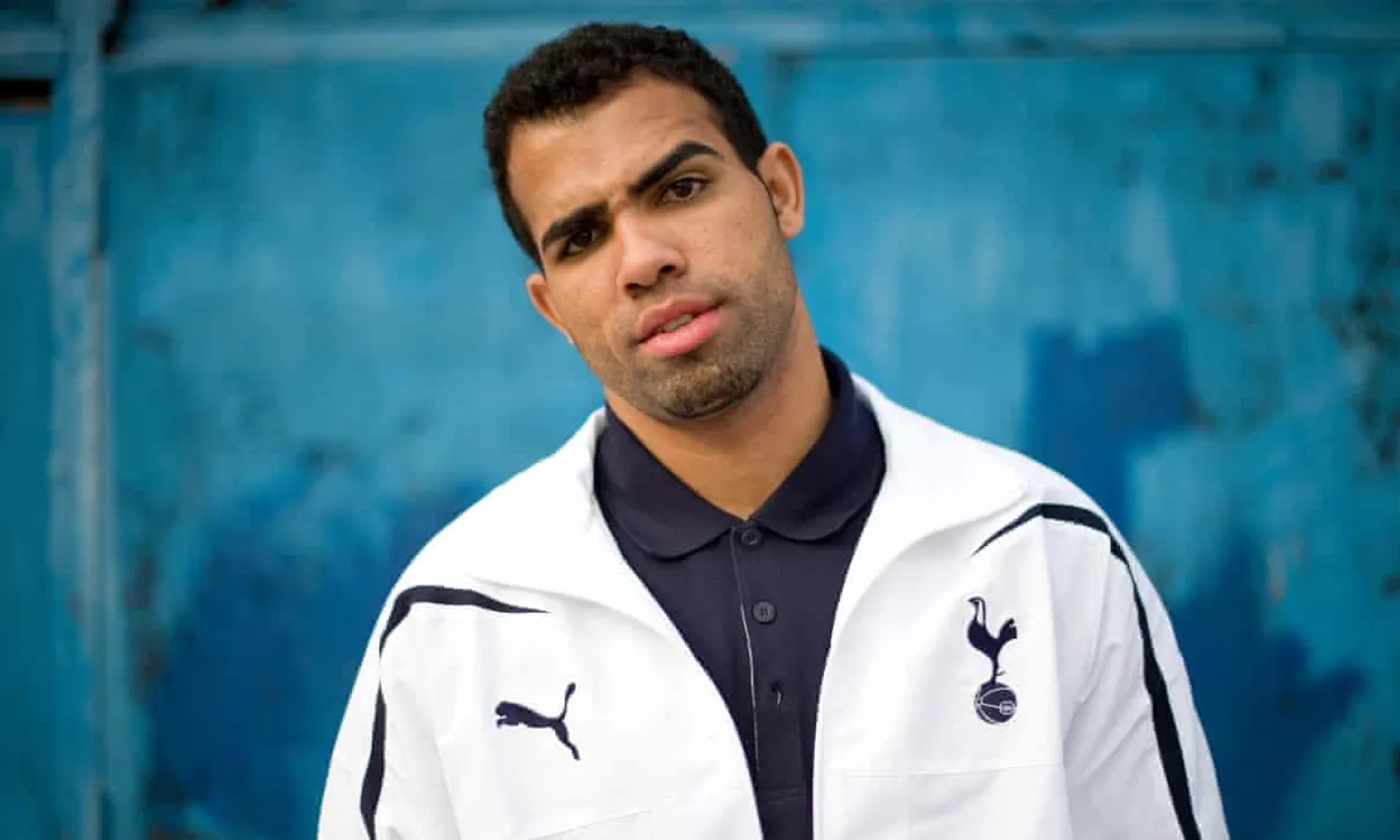

Sandro: 'It Was a Privilege to Play for Spurs. Leaving Is My Biggest Regret'

Sandro in his days as a Spurs played in 2015. Photograph: Tom Jenkins/The Guardian
TT

Sandro: 'It Was a Privilege to Play for Spurs. Leaving Is My Biggest Regret'

Sandro in his days as a Spurs played in 2015. Photograph: Tom Jenkins/The Guardian

After 10 years in Europe that took in seven clubs, a lot of ups and more than his fair share of downs, Sandro is back in Brazil. Still only 31, he has fuel left to burn. The coronavirus crisis has given him time to mull over his time on the other side of the Atlantic, bask in what was and ruminate on what might have been. Having spent lockdown at his parents’ farm – where he was busy looking after his young children, riding his horse and strumming his guitar – he is in a reflective mood.

Now back at his home in Goiânia, where he plays for Série A club Goiás, he describes Tottenham and English football in glowing terms, calling the club “sensational” and the Premier League “the best in the world”. He laughs as he recalls the good times under Harry Redknapp and André Villas-Boas. Yet there is discernible melancholy in his voice as he discusses the injuries – psychological blows as much as physical ones, he says – and the move to QPR, which he calls the “biggest regret” of his career.

In 2010, Sandro had just won the Copa Libertadores with Internacional and was already a full Brazil international. Daniel Levy, the Tottenham chairman, made a huge effort to sign him, flying to the south of Brazil twice to convince Internacional directors to accept a £10m offer. When Sandro arrived in London, he found a group of players who had qualified for the Champions League. “That team was sensational,” he says. It is an adjective he uses a lot to describe Spurs. “You had Bale, Modric, Van der Vaart. Aaron Lennon, Peter Crouch, Gallas, Gomes in goal. They were players who really made the difference.”

As a 21-year-old who spoke no English, he was not expected to excel immediately. But after a few months and a helping hand from Heurelho Gomes – a fellow Brazilian who he cites as a mentor – Sandro took off. “I was destroying it,” he remembers. “I scored against Chelsea and stood out in the Champions League.” His positive personality helped. “I’m a happy guy, spontaneous. Even without being able to speak English, I joked and laughed with everyone.”

Being thrown into the Premier League with a hands-off manager such as Redknapp could have come as a culture shock. Apparently not. “’Arry Redknapp”, Sandro says with a chuckle in his best cockney accent. “It was incredible working with him. Regardless of a player’s reputation, he would take them off at the start of the second half. He’d make the three substitutions early, change things if he saw the team was playing badly. He was a big character. At the start he’d talk to me: ‘Sandro, calm. Take your time. Get used to it.’ Then I started playing regularly. And he really loved me.”

The fondness is genuine and he laughs more as he recalls one of the first big Premier League games Redknapp he started, against Chelsea at Stamford Bridge. “He was talking a lot about his nephew. ‘Sandro, you have to be careful with Lampard, be careful with Lampard. You can’t push up too much.’ At one point I went forward, got the ball from Van de Vaart, controlled it and stuck in the angle – right in the top corner. Petr Cech is still looking for that one now. I went over to celebrate and [Redknapp] was having a go at me. He was telling me to get back, to defend, telling me to worry about Lampard. I was thinking: ‘Man, I scored. What is this guy talking about?’”

Spurs reached the Champions League quarter-finals in Sandro’s first season at the club, beating Milan in the last 16. It was his European debut, but Sandro was not overawed. He was singled out for praise by his manager after the first game at White Hart Lane and was man of the match at San Siro. “Those were the games where people really started to admire me. That was my moment.”

Roberto Mancini was suitably impressed and wanted to take him to Manchester. “It wasn’t just City. There were other clubs. But it was City that came in with an official offer. In the end, I stepped back. I have a really special affection for Tottenham and I didn’t want to lose what I’d built. I thought about having to go again, to earn my place.” Mancini’s side went on to win the league that season but Sandro does not feel as if he missed out. “I don’t regret not signing for City. In my heart, I am so happy for what I experienced with Tottenham. It was a privilege to have played there and to have had such a good relationship with the fans. I regret going to QPR much more, that’s for sure.”

Sandro left Spurs in the summer of 2014, when Mauricio Pochettino had just been appointed, and he rues it to this day. “That’s the biggest regret of my career, completely. I wish I could have played with Pochettino. He improved the players. He took Tottenham to another level. We take decisions in our lives that, if we knew what was going to happen, we wouldn’t take. I got it wrong. I got it wrong and I regret it.

“I could have gone to a Russian club for a lot of money and that made me open my eyes [to how much I could earn]. Then QPR [came in]. I went there because of [Redknapp], he made up my mind. But he left quickly. I injured my medial ligament, was out for three months and when I came back, he’d already been sacked, unfortunately. Then there was an issue with my visa. It was really bad for me psychologically. It was a real blow.”

By then, knee injuries had become something of a recurring theme. Those three months out at QPR were not even the lowest point in England. That came in January 2013 with his first ruptured ligament and the resulting reconstructive surgery.

He had won the Olympic silver medal with the Seleção at London 2012 and, upon his return to Spurs, had a “phenomenal” start to the season. “August 2012 until to January 2013. That period is my favorite memory [of England]. If I had managed to maintain that level…” He does not finish the sentence, but the implication is clear. “Then there was my injury. After that it fell away. That was the worst moment. After that I got a bit disheartened. It took a long time to come back.”

Still, he is content to recall the times he shared with those “sensational” teammates. “There was so, so much talent. I just ran around to the dirty work for those guys to play. Modric had incredible class. Sometimes you’d fire a duff pass into him, under pressure, and he’d transform it into a beautiful bit of play. Bale was lightning. He is [still] fast, but back then he was out of this world. I thought he was going to win a Ballon d’Or. He had everything. Harry Kane was just getting started. He was in the reserves. But I saw his transformation. He was a machine in training. I’m happy to have seen that. I give advice to the young attackers, I say: ‘Look at Harry Kane, one of the best forwards in the world.’ He sniffed out goals in training and was so dedicated.”

Sandro still follows Spurs from afar. Despite a difficult season for his old club, he is hopeful for what is to come. “Mourinho always wins. Even when he doesn’t deliver what is expected of him, which is the very, very top, he manages to win something. Like at United. He didn’t win the Champions League or Premier League, but they won the Europa League and League Cup. I believe that with him, Tottenham will win titles, building on the excellent work of Pochettino.”

While football has returned in much of Europe, uncertainty still reigns in Brazil, where coronavirus infections and deaths continue to rise at an alarming rate. Sandro is back in training with Goiás. “I feel safe because the doctors, directors, and club president are doing great work. There are proper control measures. I don’t want to opine on whether the games should start now. The numbers need to start [to stabilize] to have games, to travel. If the logistics are safe, I would agree [to play]. If we are going to travel, maybe we’ll need a private jet for each club. The away trips are going to be difficult because of the transport.”

Whenever the time does come, Sandro will be ready. He has been free of injury for a year and is hoping to reach that irresistible peak he experienced in London. “There’ll be no lack of effort and dedication,” he says. “I want all this to pass so we can get back to playing and enjoying it.”

(The Guardian)


Shakhtar Boss Pays Ukrainian Racer $200,000 After Games Disqualification

Ukrainian President Volodymyr Zelenskiy holds helmet as he meets with a Ukrainian skeleton racer Vladyslav Heraskevych , who was disqualified from the Olympic skeleton competition over his "helmet of remembrance" depicting athletes killed since Russia's invasion and his father and coach, Mykhailo Heraskevych, amid Russia's attack on Ukraine, in Munich, Germany February 13, 2026. (Ukrainian Presidential Press Service/Handout via Reuters)
TT

Shakhtar Boss Pays Ukrainian Racer $200,000 After Games Disqualification

Ukrainian President Volodymyr Zelenskiy holds helmet as he meets with a Ukrainian skeleton racer Vladyslav Heraskevych , who was disqualified from the Olympic skeleton competition over his "helmet of remembrance" depicting athletes killed since Russia's invasion and his father and coach, Mykhailo Heraskevych, amid Russia's attack on Ukraine, in Munich, Germany February 13, 2026. (Ukrainian Presidential Press Service/Handout via Reuters)

The owner of ‌Ukrainian football club Shakhtar Donetsk has donated more than $200,000 to skeleton racer Vladyslav Heraskevych after the athlete was disqualified from the Milano Cortina Winter Games before competing over the use of a helmet depicting Ukrainian athletes killed in the war with Russia, the club said on Tuesday.

The 27-year-old Heraskevych was disqualified last week when the International Bobsleigh and Skeleton Federation jury ruled that imagery on the helmet — depicting athletes killed since Russia invaded Ukraine in 2022 — breached rules on athletes' expression at ‌the Games.

He ‌then lost an appeal at the Court ‌of ⁠Arbitration for Sport hours ⁠before the final two runs of his competition, having missed the first two runs due to his disqualification.

Heraskevych had been allowed to train with the helmet that displayed the faces of 24 dead Ukrainian athletes for several days in Cortina d'Ampezzo where the sliding center is, but the International Olympic Committee then ⁠warned him a day before his competition ‌started that he could not wear ‌it there.

“Vlad Heraskevych was denied the opportunity to compete for victory ‌at the Olympic Games, yet he returns to Ukraine a ‌true winner," Shakhtar President Rinat Akhmetov said in a club statement.

"The respect and pride he has earned among Ukrainians through his actions are the highest reward. At the same time, I want him to ‌have enough energy and resources to continue his sporting career, as well as to fight ⁠for truth, freedom ⁠and the remembrance of those who gave their lives for Ukraine," he said.

The amount is equal to the prize money Ukraine pays athletes who win a gold medal at the Games.

The case dominated headlines early on at the Olympics, with IOC President Kirsty Coventry meeting Heraskevych on Thursday morning at the sliding venue in a failed last-minute attempt to broker a compromise.

The IOC suggested he wear a black armband and display the helmet before and after the race, but said using it in competition breached rules on keeping politics off fields of play. Heraskevych also earned praise from Ukraine President Volodymyr Zelenskiy.


Speed Skating-Italy Clinch Shock Men’s Team Pursuit Gold, Canada Successfully Defend Women’s Title

 Team Italy with Davide Ghiotto, Andrea Giovannini, Michele Malfatti, celebrate winning the gold medal on the podium of the men's team pursuit speed skating race at the 2026 Winter Olympics, in Milan, Italy, Tuesday, Feb. 17, 2026. (AP)
Team Italy with Davide Ghiotto, Andrea Giovannini, Michele Malfatti, celebrate winning the gold medal on the podium of the men's team pursuit speed skating race at the 2026 Winter Olympics, in Milan, Italy, Tuesday, Feb. 17, 2026. (AP)
TT

Speed Skating-Italy Clinch Shock Men’s Team Pursuit Gold, Canada Successfully Defend Women’s Title

 Team Italy with Davide Ghiotto, Andrea Giovannini, Michele Malfatti, celebrate winning the gold medal on the podium of the men's team pursuit speed skating race at the 2026 Winter Olympics, in Milan, Italy, Tuesday, Feb. 17, 2026. (AP)
Team Italy with Davide Ghiotto, Andrea Giovannini, Michele Malfatti, celebrate winning the gold medal on the podium of the men's team pursuit speed skating race at the 2026 Winter Olympics, in Milan, Italy, Tuesday, Feb. 17, 2026. (AP)

An inspired Italy delighted the home crowd with a stunning victory in the Olympic men's team pursuit final as

Canada's Ivanie Blondin, Valerie Maltais and Isabelle Weidemann delivered another seamless performance to beat the Netherlands in the women's event and retain their title ‌on Tuesday.

Italy's ‌men upset the US who ‌arrived ⁠at the Games ⁠as world champions and gold medal favorites.

Spurred on by double Olympic champion Francesca Lollobrigida, the Italian team of Davide Ghiotto, Andrea Giovannini and Michele Malfatti electrified a frenzied arena as they stormed ⁠to a time of three ‌minutes 39.20 seconds - ‌a commanding 4.51 seconds clear of the ‌Americans with China taking bronze.

The roar inside ‌the venue as Italy powered home was thunderous as the crowd rose to their feet, cheering the host nation to one ‌of their most special golds of a highly successful Games.

Canada's women ⁠crossed ⁠the line 0.96 seconds ahead of the Netherlands, stopping the clock at two minutes 55.81 seconds, and

Japan rounded out the women's podium by beating the US in the Final B.

It was only Canada's third gold medal of the Games, following Mikael Kingsbury's win in men's dual moguls and Megan Oldham's victory in women's freeski big air.


Lindsey Vonn Back in US Following Crash in Olympic Downhill 

Milano Cortina 2026 Olympics - Alpine Skiing - Women's Downhill 3rd Official Training - Tofane Alpine Skiing Centre, Belluno, Italy - February 07, 2026. Lindsey Vonn of United States in action during training. (Reuters)
TT

Lindsey Vonn Back in US Following Crash in Olympic Downhill 

Milano Cortina 2026 Olympics - Alpine Skiing - Women's Downhill 3rd Official Training - Tofane Alpine Skiing Centre, Belluno, Italy - February 07, 2026. Lindsey Vonn of United States in action during training. (Reuters)

Lindsey Vonn is back home in the US following a week of treatment at a hospital in Italy after breaking her left leg in the Olympic downhill at the Milan Cortina Games.

“Haven’t stood on my feet in over a week... been in a hospital bed immobile since my race. And although I’m not yet able to stand, being back on home soil feels amazing,” Vonn posted on X with an American flag emoji. “Huge thank you to everyone in Italy for taking good care of me.”

The 41-year-old Vonn suffered a complex tibia fracture that has already been operated on multiple times following her Feb. 8 crash. She has said she'll need more surgery in the US.

Nine days before her fall in Cortina d'Ampezzo, Italy, Vonn ruptured the ACL in her left knee in another crash in Switzerland.

Even before then, all eyes had been on her as the feel-good story heading into the Olympics for her comeback after nearly six years of retirement.
