Tunisian Opposition Parties Call for ‘National Salvation Conference’

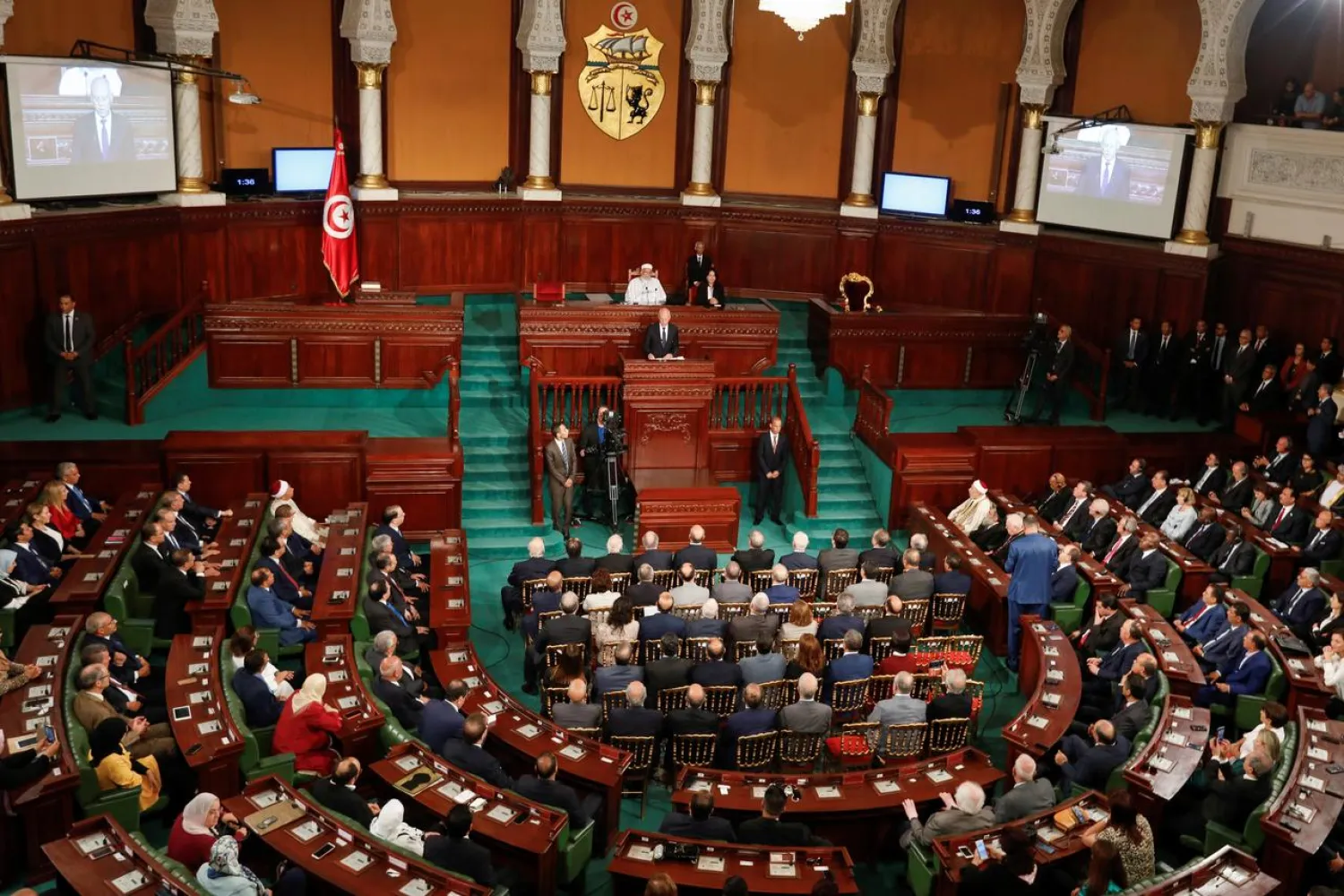
Tunisian President Kais Saied speaks during his swearing-in ceremony at the Assembly of People's Representatives in Tunis, Tunisia. Reuters file photo
TT

Tunisian Opposition Parties Call for ‘National Salvation Conference’

Tunisian President Kais Saied speaks during his swearing-in ceremony at the Assembly of People's Representatives in Tunis, Tunisia. Reuters file photo

A number of Tunisian opposition parties have called for a "national salvation conference" to unite efforts in confronting the country’s economic and social crises.

They said the conference should be organized by President Kais Said, who was elected by the majority of the people. However, the president has not yet made an announcement.

The political initiative is led by the parliamentary National Reform bloc, headed by Hassouna Nasfi, and the People's Movement of Zouhair Maghzaoui.

They stressed the importance of overcoming sharp differences, especially that Ennahda Movement seeks to control the government to serve its narrow interests.

Maghzaoui indicated that the president has an opportunity to bring political parties closer as part of a national dialogue that would help end tensions among them.

Maghzaoui strongly criticized the Heart of Tunisia party for supporting the government of Hichem Mechichi, and for joining a parliamentary coalition led by Ennahda.

A number of political parties are forming a parliamentary bloc against the alliance led by Ennahda.

Maghzaoui said that the main purpose of the new alliance is to provide an alternative to the prevailing political division between Islamist political figures and parties of the old regime, in reference to the Free Destourian Party.

He revealed that this front supports the government even if they disagree on several positions and priorities.

The call for a national salvation conference is also supported by Mashrou Tounes movement, Beni Watani party, al-Amal party, and the Democratic party.


Rafah Crossing Traffic Lags Two Weeks after Reopening

Humanitarian and relief aid crosses Rafah Crossing (Egyptian Red Crescent)
TT

Rafah Crossing Traffic Lags Two Weeks after Reopening

Humanitarian and relief aid crosses Rafah Crossing (Egyptian Red Crescent)

Despite nearly two weeks since the reopening of the Rafah crossing in both directions, the number of people and humanitarian aid entering the Gaza Strip falls short of what was agreed under the “Gaza ceasefire agreement,” according to an official from the Egyptian Red Crescent in North Sinai.

The daily movement of individuals to and from Gaza does not exceed 50 people, Khaled Zayed, head of the Egyptian Red Crescent in North Sinai, told Asharq Al-Awsat. He said this figure represents only one-third of what was agreed upon in the ceasefire deal.

He added that truck traffic stands at about 100 per day, despite Gaza’s population requiring the entry of around 600 trucks daily.

On Feb. 2, Israel reopened the Rafah crossing on the Palestinian side for individual travel, allowing Palestinians to leave and return to the enclave. Indicators show that most of those departing Gaza are patients and wounded individuals, who are being received at Egyptian hospitals.

This comes as Egyptian Foreign Minister Badr Abdelatty stressed the need to “ensure the unhindered delivery of humanitarian aid and not obstruct movement through the Rafah crossing.”

In his remarks during a ministerial Security Council session on developments in the Middle East on Wednesday, he underscored the importance of “halting all measures aimed at displacing residents or altering the demographic character of the occupied Palestinian territories.”

Israel took control of the Rafah border crossing in May 2024, about nine months after the outbreak of the war in Gaza. The reopening of the crossing was part of the first phase of the ceasefire agreement that entered into force last October, though the deal remains fragile.

The Egyptian Red Crescent announced the departure of the 14th group of wounded, sick, and injured Palestinians arriving and leaving through the crossing.

In a statement on Thursday, it said humanitarian efforts to receive and see off Palestinians include a comprehensive package of relief services, psychological support for children, distribution of suhoor and iftar meals, and heavy clothing, in addition to providing “return bags” for those heading back to Gaza.

At the same time, the Red Crescent dispatched the 142nd “Zad Al-Ezza” convoy, which includes 197,000 food parcels and more than 235 tons of flour as part of the “Iftar for One Million Fasters” campaign in Gaza.

The convoy also carries more than 390 tons of medicines, relief, and personal care supplies, as well as about 760 tons of fuel, according to the organization’s statement.

Zayed said the daily number of individuals crossing through Rafah over the past two weeks does not compare with what was stipulated in the ceasefire agreement.

With the reopening of the Rafah crossing on the Palestinian side, Israel’s Arabic-language public broadcaster Makan reported that 150 people were expected to leave Gaza, including 50 patients, while 50 people would be allowed to enter the enclave.

Despite what he described as Israeli obstacles, Zayed said allowing the movement of individuals and the wounded represents “an unsatisfactory breakthrough in the humanitarian situation in Gaza,” stressing the need to fulfill the ceasefire’s obligations and advance early recovery efforts inside the territory.

The total number of Palestinians who have left through the Rafah crossing since it reopened on both sides does not exceed 1,000, according to Salah Abdel Ati, head of the International Commission to Support Palestinian Rights.

He said around 20,000 wounded and sick Palestinians require urgent evacuation, and that Israeli restrictions are hindering access to medical care, adding that the humanitarian situation requires continued pressure by mediators on Israel.

Abdelatty told Asharq Al-Awsat he was counting on the outcome of the first meeting of the Board of Peace to adopt easing measures, including lifting Israeli restrictions and establishing guarantees for the ceasefire in the Palestinian territories, as well as securing the funding needed for Gaza’s early recovery, in line with US President Donald Trump’s peace plan for the enclave.

According to a statement by the Egyptian Red Crescent, Egypt continues relief efforts at all logistical hubs to facilitate the entry of humanitarian aid, which has exceeded 800,000 tons, with the participation of more than 65,000 volunteers from the Egyptian Red Crescent.



US Slaps Sanctions on Sudan’s RSF Commanders over El-Fasher Killings

FILE - A Sudanese child, who fled el-Fasher city with family after Sudan's RSF attacked the western Darfur region, receives treatment at a camp in Tawila, Sudan, Nov. 2, 2025. (AP Photo/Mohammed Abaker, File)
TT

US Slaps Sanctions on Sudan’s RSF Commanders over El-Fasher Killings

FILE - A Sudanese child, who fled el-Fasher city with family after Sudan's RSF attacked the western Darfur region, receives treatment at a camp in Tawila, Sudan, Nov. 2, 2025. (AP Photo/Mohammed Abaker, File)

The United States announced sanctions on Thursday on three Sudanese Rapid Support Forces (RSF) commanders over their roles in the "horrific campaign" of the siege and capture of El-Fasher.

The US Treasury said the RSF carried out "ethnic killings, torture, starvation, and sexual violence" in the operation.

Earlier Thursday, the UN's independent fact-finding mission on Sudan said the siege and seizure of the city in Darfur bore "the hallmarks of genocide."

Its investigation concluded that the seizure last October had inflicted "three days of absolute horror," and called for those responsible to be brought to justice.

"The United States calls on the Rapid Support Forces to commit to a humanitarian ceasefire immediately," US Treasury Secretary Scott Bessent said in a statement.

"We will not tolerate this ongoing campaign of terror and senseless killing in Sudan."

The Treasury noted that the three sanctioned individuals were part of the RSF's 18-month siege of and eventual capture of El-Fasher.

They are RSF Brigadier General Elfateh Abdullah Idris Adam, Major General Gedo Hamdan Ahmed Mohamed and field commander Tijani Ibrahim Moussa Mohamed.

Bessent warned that Sudan's civil war risks further destabilizing the region, "creating conditions for terrorist groups to grow and threaten the safety and interests of the United States."

The UN probe into the takeover of El-Fasher -- after the 18-month siege -- concluded that thousands of people, particularly from the Zaghawa ethnic group, "were killed, raped or disappeared."


Israel's Netanyahu Says No Reconstruction of Gaza before Demilitarization

Israel’s Prime Minister Benjamin Netanyahu - File Photo/AFP
TT

Israel's Netanyahu Says No Reconstruction of Gaza before Demilitarization

Israel’s Prime Minister Benjamin Netanyahu - File Photo/AFP

Israeli Prime Minister Benjamin Netanyahu said on Thursday there would be no reconstruction of war-shattered Gaza before the disarmament of Hamas, as the "Board of Peace" convened for its inaugural meeting in Washington.

Around two dozen world leaders and senior officials met for the first meeting of the board, which was set up after the United States, Qatar and Egypt negotiated a ceasefire in October to halt two years of war in the Gaza Strip.

"We agreed with our ally the US there will be no reconstruction of Gaza before the demilitarization of Gaza," Netanyahu said during a televised speech at a military ceremony on Thursday, AFP reported.

The meeting in Washington will also look at how to launch the International Stabilization Force (ISF) that will ensure security in Gaza.

One of the most sensitive issues before the board is the future of the Islamist movement Hamas, which fought the war with Israel and still exerts influence in the territory.

Disarmament of the group is a central Israeli demand and a key point in negotiations over the ceasefire's next stage.

US officials including Steve Witkoff, Trump's friend and roving negotiator, have insisted that solid progress is being made and that Hamas is feeling pressure to give up weapons.

Israel has suggested sweeping restrictions including seizing small personal rifles from Hamas.

It remains unclear whether, or how, the Palestinian technocratic committee formed to handle day-to-day governance of Gaza will address the issue of demilitarization.

The 15-member National Committee for the Administration of Gaza (NCAG) will operate under the supervision of the "Board of Peace", and its head, Ali Shaath, is attending the meeting in Washington on Thursday.