Houthis Accused of Manipulating Case of Yemeni Youth Who Was Tortured to Death

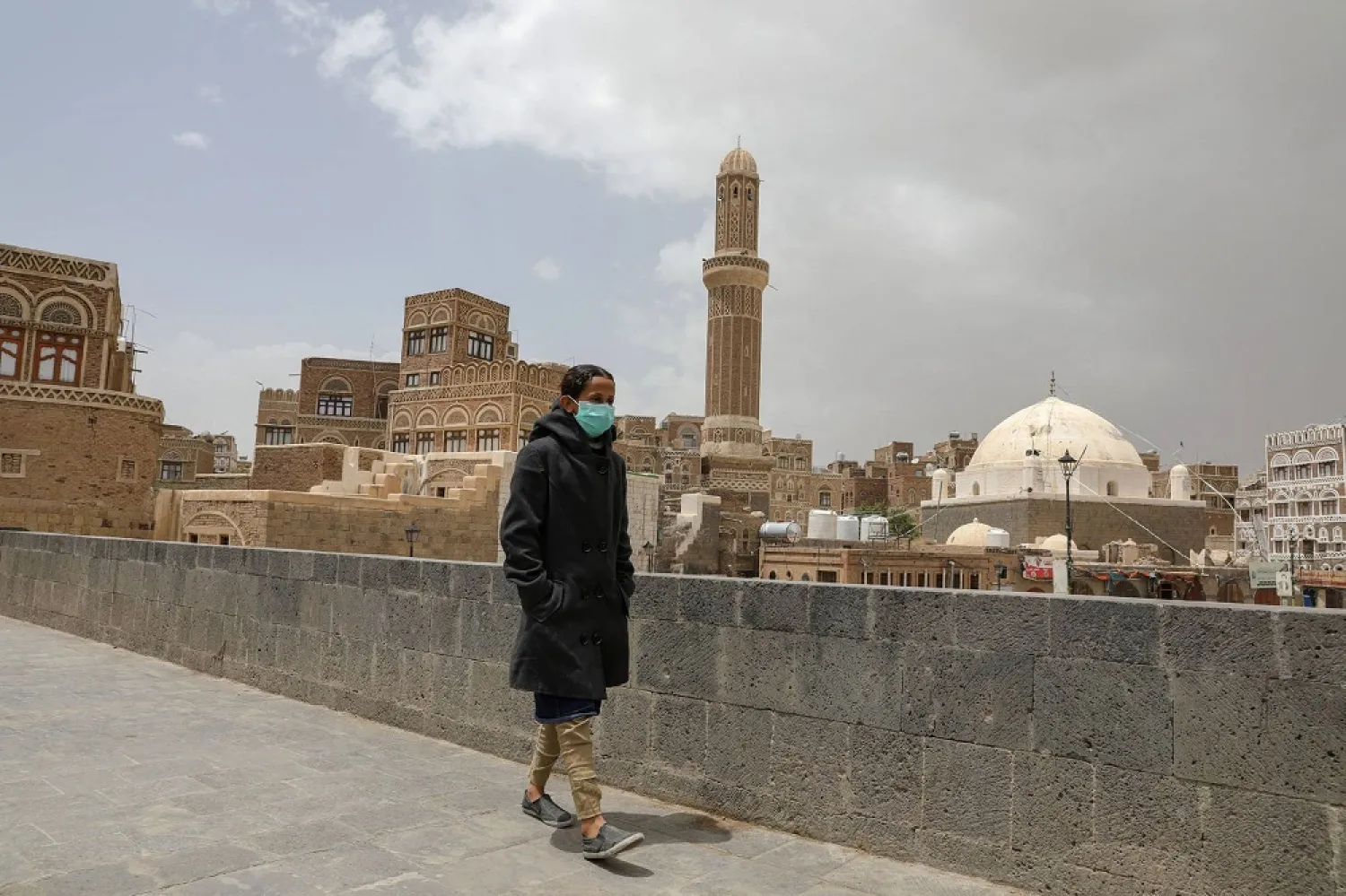
A girl wears a protective face mask amid fears of the spread of the coronavirus disease (COVID-19) in Sanaa, Yemen March 17, 2020. (Reuters)
TT

Houthis Accused of Manipulating Case of Yemeni Youth Who Was Tortured to Death

A girl wears a protective face mask amid fears of the spread of the coronavirus disease (COVID-19) in Sanaa, Yemen March 17, 2020. (Reuters)

Protests erupted in the Yemeni capital Sanaa on Saturday to demand the Iran-backed Houthi authorities, who control the city, to speed up trials of five suspects accused of torturing and killing a Yemeni youth.

Suspicions have arisen, however, that the Houthis may manipulate the case in order to acquit suspects who are close to the militias.

Abdullah al-Aghbari’s case came to light after footage showed the five suspects taking turns in beating and torturing him for five hours until he died. The video was circulated on social media on Wednesday, sparking outrage in the country. The footage was shot by a surveillance camera at a mobile phone shop where the suspects work.

Saturday’s rally began at the Houthi-controlled Justice Ministry and ended at the crime scene. Demonstrators have demanded that the suspects be punished for their crime.

Different stories have emerged over the motives of the crime. Some people have speculated that the murder was aimed at covering up honor killings committed by the Houthis with the five suspects. The suspects had allegedly used the backroom at the store where al-Aghbari was beaten as a “center” to blackmail women and photograph them in indecent positions after stealing their personal photos from their mobile phones. The victims are reportedly forced to join the Houthi movement or sexually abused by powerful militiamen.

After coming under popular pressure, the Houthis released redacted confessions of four of the suspects. It released the redacted confession of the final suspect on Saturday in what was seen as an attempt to manipulate the crime and cover up its real motives, said rights sources in Sanaa.

A source close to al-Aghbari’s family told Asharq Al-Awsat that he started to work at the mobile phone shop, which is owned by one of the suspects, some two weeks before his murder.

Yemeni activists revealed that influential tribal officials, who are loyal to the Houthis, had been seeking to pay for the family’s silence over the case. The emergence of the video, however, brought the case out in the open.

The Houthis have since then launched a probe at police station that is controlled by them. Lawyers involved in the case revealed that pro-Houthi prosecutors barred them from attending the investigations, which was slammed by rights officials as illegal. They saw it as a sign that the Houthis were beginning to manipulate the case, hide evidence and avoid any responsibility in the crime.

Aghbari’s case has brought to mind the numerous crimes the Houthis have committed against the Yemeni people, including the dozens of cases related to the kidnapping, sexual abuse and extortion of women.


Israeli Forces Raid Town of Suspected Palestinian Gunman

Israeli forces take part in a raid in the Palestinian town of Biddu, in the Israeli-occupied West Bank, September 21, 2026. REUTERS/Mohammed Torokman
TT

Israeli Forces Raid Town of Suspected Palestinian Gunman

Israeli forces take part in a raid in the Palestinian town of Biddu, in the Israeli-occupied West Bank, September 21, 2026. REUTERS/Mohammed Torokman

Israeli forces on Monday raided the hometown of a Palestinian man suspected of shooting dead an Israeli settler in the occupied West Bank the day before, local authorities said.

Sunday's shooting occurred near the Israeli settlement of Neveh Tzuf, north of Ramallah, on the eve of the Jewish holiday of Yom Kippur, with the suspected assailant apprehended by soldiers after being located at a hospital.

Israel's military told AFP on Sunday that its troops had raided the home of the attacker's family in the Palestinian village of Biddu, northwest of Jerusalem in the West Bank.

The Jerusalem Governorate, the Palestinian local authority for the area, said Israeli forces then raided Biddu at dawn on Monday and "carried out a large-scale arrest campaign targeting dozens of young men".

"The raid was accompanied by searches, vandalism, and the smashing of property inside a number of homes, as well as physical assaults on several residents," it said, adding that the raid was ongoing.

When asked by AFP, the Israeli military said it was checking the reports.

An AFP photographer saw Israeli forces in the town on Monday morning.

Biddu's mayor, Nazmi Mansour, told AFP that the military had stormed the town after midnight with "dozens of military jeeps and hundreds of soldiers".

"The soldiers began house-to-house searches and set up field interrogation centers in buildings they had taken control of," he said, adding that dozens of people were questioned.

"The army is still present in the town and has closed off its entrances, and all commercial shops are shut," he told AFP by telephone.

Israel's army chief Lieutenant General Eyal Zamir said at the site of the attack Sunday that the military remained "on high alert".

"We will impose a closure on the village and conduct investigations, through which we will reach everyone who assisted the terrorist," Zamir said.

Far-right National Security Minister Itamar Ben Gvir called for the attacker to be the first person executed under a recently approved death penalty law.

The new law imposes the death penalty by default on Palestinians from the West Bank convicted on terror charges for deadly attacks.

Israel has occupied the West Bank since 1967 and violence there has surged since Hamas's October 7, 2023 attack on Israel which sparked the Gaza war.


Lebanon Seeks UNIFIL Mandate Extension amid Lack of Agreement on Alternative

Jordan’s King Abdullah II, French President Emmanuel Macron and Lebanese President Joseph Aoun pose for a photo before an Aqaba Process meeting in support of the Lebanese Armed Forces at Les Invalides in Paris. (AFP)
TT

Lebanon Seeks UNIFIL Mandate Extension amid Lack of Agreement on Alternative

Jordan’s King Abdullah II, French President Emmanuel Macron and Lebanese President Joseph Aoun pose for a photo before an Aqaba Process meeting in support of the Lebanese Armed Forces at Les Invalides in Paris. (AFP)

Lebanon is intensifying international and Arab diplomatic efforts to avert a security vacuum in the south when the mandate of the United Nations Interim Force in Lebanon (UNIFIL), tasked by the UN Security Council with implementing Resolution 1701, expires at the end of the year.

President Joseph Aoun raised the issue at a summit with French President Emmanuel Macron and Jordan’s King Abdullah II on the sidelines of a preparatory conference in Paris to support the Lebanese Army and Internal Security Forces.

The matter is also expected to top Prime Minister Nawaf Salam’s agenda during his meetings in New York, where he is leading Lebanon’s delegation to the 81st UN General Assembly, and later in Washington, where he is due to meet US Secretary of State Marco Rubio.

Lebanon is placing importance on peace talks in New York and on a meeting with Rubio to prevent a security vacuum in the south if UNIFIL withdraws, amid a lack of agreement on an international body to replace it.

UNIFIL commander Major General Diodato Abagnara warned of the issue, questioning which authority would take over from the mission, saying that “more than half of our positions in southern Lebanon are under Israeli control.”

A ministerial source said Aoun raised concerns about a potential vacuum during his talks with Macron and King Abdullah.

The source told Asharq Al-Awsat that both leaders shared those concerns and promised to contact US President Donald Trump to seek his approval, at Aoun’s request, for extending UNIFIL’s mandate by six months to a year.

Such an extension, the source added, could help activate the “framework agreement” and expand “pilot zones” where the Lebanese Army could deploy with UNIFIL support.

Macron and King Abdullah are also counting on Trump’s commitment to help Lebanon implement the agreement under UNIFIL supervision or that of any UN force that might replace it, according to the source.

European Union countries understand Lebanon’s concerns and are working to formulate a proposal before the end of October that would preserve an international presence in the south to accompany a phased Israeli withdrawal if efforts to persuade Trump to extend UNIFIL’s mandate fail.

The source stressed that any replacement should operate under UN auspices rather than leave the international presence limited to the US-dominated “Mechanism” committee, from which Washington has excluded France.

A European official was quoted as saying that Lebanon should not be left alone in calling for an international force to replace UNIFIL and that European countries would support efforts to prevent a vacuum, including during meetings on the sidelines of the UN General Assembly.

Lebanon is also insisting that Israel evacuate the Ali al-Taher hills and hand them over to the Lebanese Army, alongside the establishment of a monitoring post there with a predominantly US presence.

Israel has refused to hand the area to the army and wants the Lebanese request placed on the agenda of an eighth round of negotiations, which Rome would host for a third time. No date has yet been set.

The ministerial source said Washington, as sponsor of the framework agreement, is responsible for setting up the date. The United States is currently pressing Israel to agree to expand the “pilot zones,” he added.

But US Ambassador to Israel Mike Huckabee’s statement that Israeli forces would remain in the south until the Lebanese Army becomes strong offered little grounds for optimism, the source said. Israel has continued targeting areas retaken in the south, preventing the Lebanese Army from deploying there, and has yet to agree to a verification mechanism to ensure areas are free of Hezbollah weapons and fighters.

A Western diplomat said Lebanon’s friends, particularly several European countries, have begun questioning why Trump has not followed through on commitments he made to Aoun during their Washington summit.

Concerns over a possible UN vacuum in the south are expected to feature prominently in Arab and European discussions with Trump and senior US officials.

The diplomat said Lebanon’s allies had little choice but to support Aoun and Salam’s government in strengthening the state’s position vis-à-vis Hezbollah, questioning what the seventh round of negotiations had achieved.

He argued that Lebanon could not afford to postpone implementation of the framework agreement until after Israel’s Knesset elections.

The ministerial source accused Israeli Prime Minister Benjamin Netanyahu of continuing to bulldoze towns and systematically destroy homes on the pretext of eliminating remaining Hezbollah military infrastructure. He said Netanyahu was primarily seeking to push Lebanon into abandoning the negotiations and boycotting the eighth round unless Israeli attacks ceased.

Aoun, however, remains committed to negotiations and will not be drawn into what the source described as Netanyahu’s strategy. In the source’s view, Netanyahu accepted the framework agreement under US pressure but has avoided implementing it ahead of the Israeli elections.

The source also pointed to parliament’s third renewal of confidence in Salam’s government as evidence that a majority of lawmakers remained committed to the framework agreement and to the principle that weapons should be held exclusively by the state.

He nevertheless warned that Lebanon’s worsening cost-of-living crisis could put the government at odds with much of the population unless it finds ways to ease pressure on low-income households — something that would require financial assistance from Arab and international partners.

Hezbollah, meanwhile, continues to insist on retaining its weapons and rejects the framework agreement. The group was surprised by the renewed confidence vote in Salam’s government, particularly after Free Patriotic Movement leader MP Gebran Bassil unexpectedly proposed it at the end of parliament’s questioning of the government.

Hezbollah left the chamber before voting began.

The group has also rejected local and Arab mediation efforts urging it to hand over an initial batch of offensive weapons as long as it stays committed not to respond to Israeli attacks.

The source underlined that such a move would open the way for Hezbollah to join the state project rather than remain isolated, particularly as it bets on an Iranian-US memorandum of understanding whose implementation reached an impasse, compounded by Washington’s refusal to link Lebanon to the Iranian track.



Iraq Court Delays Ruling on Dissolving Kurdistan Parliament, Government

Barzani announces the start of the new school year (Kurdistan Regional Government)
TT

Iraq Court Delays Ruling on Dissolving Kurdistan Parliament, Government

Barzani announces the start of the new school year (Kurdistan Regional Government)

Iraq’s Federal Supreme Court on Sunday postponed consideration of two lawsuits challenging the continued legitimacy of the Kurdistan Region’s parliament and government, setting Oct. 26 as a new date for a ruling.

The cases seek the dissolution of the regional parliament and an end to the government’s full powers following nearly two years of political deadlock that has prevented the legislature elected in October 2024 from functioning normally.

Meanwhile, Kurdistan Region Prime Minister Masrour Barzani, speaking at a ceremony marking the start of the 2026-2027 school year in Erbil on Sunday, called for the rule of law to prevail throughout Iraq.

“All weapons outside the authority of the state, the government and legitimate institutions must be disarmed,” Barzani said.

Armed factions have made their own disarmament conditional on the decision also applying to the Kurdish Peshmerga and on the force being placed under the orders of Iraq’s commander-in-chief rather than the regional government.

Kurdish authorities reject that demand, citing Article 121(5) of Iraq’s constitution, which grants the regional government responsibility for establishing and organizing internal security forces, including police, security services and regional guards.

Barzani also urged members of the Kurdistan Parliament to “end their boycott of sessions and fulfill their national and oversight duties,” stressing that reactivating parliament was the “first and essential step” toward forming a new regional government.

Political deadlock

The Kurdistan Region has been mired in political paralysis since its October 2024 parliamentary elections. The new legislature has met only once, in January 2025, and has failed to elect a permanent speaker or pave the way for the formation of a new government.

The Kurdistan Democratic Party (KDP), led by Masoud Barzani, won 39 of the 100 seats, while the Patriotic Union of Kurdistan (PUK), headed by Bafel Talabani, secured 23. The New Generation Movement came third with 15 seats.

Deep disagreements between the KDP and PUK over the composition of the government and distribution of senior posts have stalled the process.

Former regional lawmaker Ali Hama Salih filed the two lawsuits with the Federal Supreme Court.

The first challenges the constitutionality of allowing the current parliament to continue after it failed to perform its legislative duties following its inaugural January 2025 session.

The second seeks to strip the Kurdistan Regional Government of its full governing mandate and reduce it to caretaker status, barring it from making strategic decisions or entering into long-term contracts and legal commitments.

Court weighs cases

Commenting on the postponement, Kurdish writer and adviser Kifah Mahmoud said the Federal Supreme Court appeared to want more time to examine the situation and consult the parties to the cases.

Mahmoud told Asharq Al-Awsat that governments normally assume caretaker status once a parliament’s term ends, but argued that Kurdistan’s circumstances were different because the current government had continued implementing strategic road, water and electricity projects despite financial difficulties.

He attributed part of the political impasse to one party seeking greater gains than its parliamentary representation warranted, an apparent reference to the PUK.

Mahmoud nevertheless described negotiations between the KDP and PUK as “positive,” saying they could lead to a coalition government.

KDP spokesman Mahmoud Mohammed separately confirmed that his party was holding “serious and intensive” talks with political forces to resolve outstanding issues.

He said meetings between the KDP and PUK would continue away from media spotlight in an effort to reactivate parliament and move ahead with forming a new Kurdistan Regional Government.

The resumption of parliamentary activity, he added, would depend on the outcome of those talks.