


Sparkle, Dance and Postal Service Infuse Paris Fashion Week

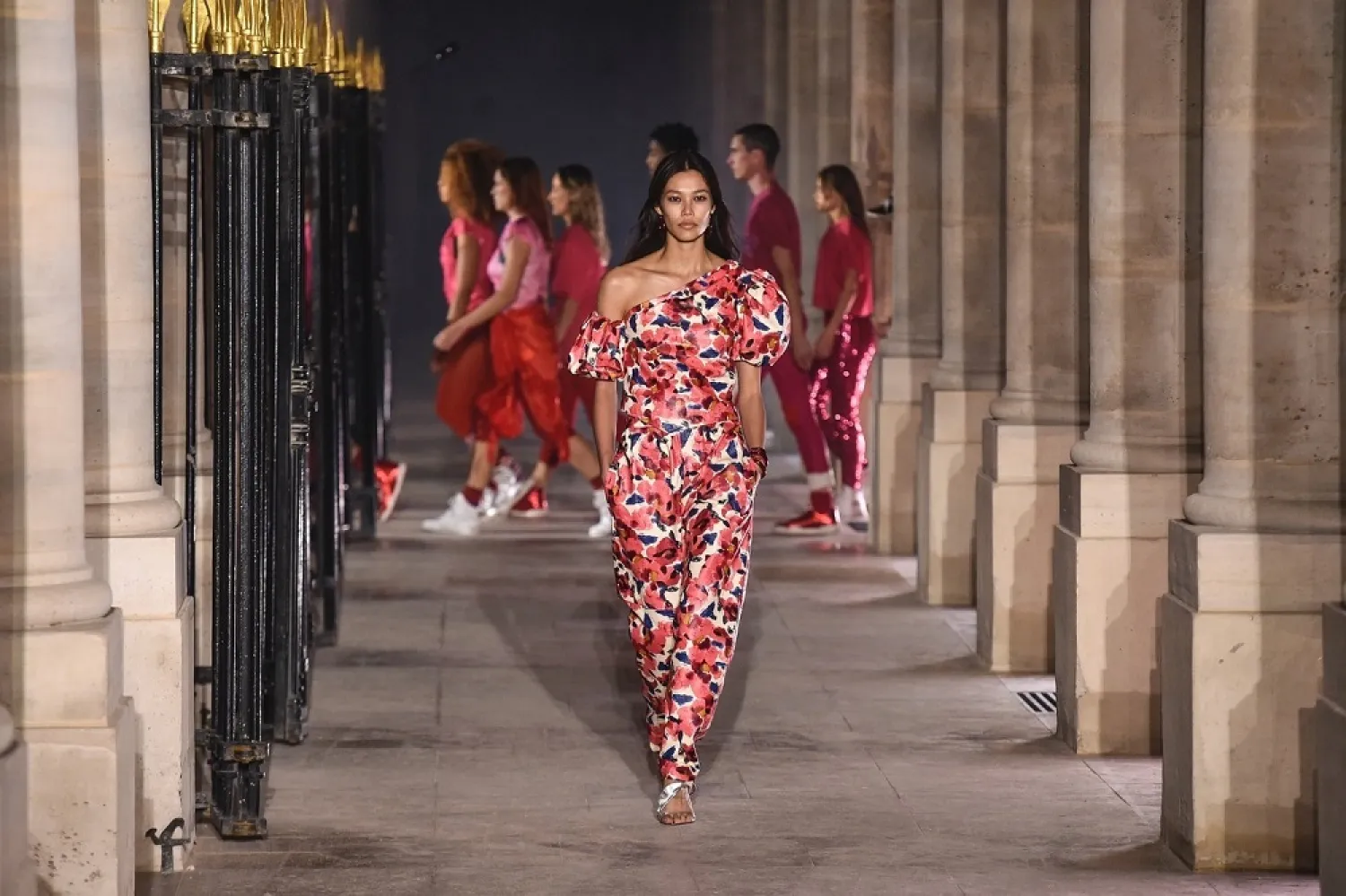
A model wears a creation by designer Isabel Marant. (AFP)
TT

Sparkle, Dance and Postal Service Infuse Paris Fashion Week

A model wears a creation by designer Isabel Marant. (AFP)

From escapism at the disco, to resistance and aggression, even to pondering the importance of the postal service while working from home, designers in Paris have presented divergent creative responses to the global health crisis as spring-summer shows continued Friday.

Like Milan before it, Paris is undertaking an unusual fashion season for spring-summer 2021 because of the coronavirus pandemic.

For its nine-day duration, the calendar is flitting between 16 in-person, ready-to-wear runway collections, with masked guests, celebrities and editors in seated rows, around 20 in-person presentations, and several dozen completely digital shows streamed online with promotional videos.

Some of the show's highlights:

Issey Miyake’s post
The starting point of the latest collection from the Japanese house famed for its techo-fabrics came as the designer was staring one day at a sea of boxes and contemplating the sheer amount of clothing due to be shipped to Paris from his native country.

There Satoshi Kondo had what the house called an “epiphany” about a design idea — making a whole display so compact that it could fit into one box — by tying, rolling, folding, stacking and layering garments.

“I was inspired by the idea of delivering garments in compact forms to people all around the world and by doing so sharing the wonder and joy of unpacking them,” Kondo told The Associated Press in an email.

Kondo said in particular the situation surrounding the coronavirus pandemic, during which many people are working from home and relying on mail, also inspired him to explore this theme.

“As my team and I found ourselves working from home, I started to explore the idea of how a garment can be packed or unpacked,” Kondo added.

The collection was titled “unpack the compact.”

Lightweight black, white coffee and iceberg vests were made up molding fabrics into a soft shell — so that there were no seams. A loose cadmium orange dress was the strongest piece in a series of garments made of interlocking pieces of fabric that are held together thanks to zippers. On one biker jacket in that series, the wearer can play around with the zippers to create a different form.

“The garments I have created for this collection allow our perspectives to change, creating a multidimensional experience when realizing that the compact abstractions can be worn,” Kondo said.

Paris fashion museum reopens
After delays because of the COVID-19 crisis, Paris fashion museum the Palais Galliera has finally reopened following about two years of construction and renovation work to coincide with Paris Fashion Week.

The opening exhibition appropriately is a retrospective dedicated to the pioneering Parisian designer Gabrielle “Coco” Chanel who died in 1971. The exhibit moves from the start of her career, featuring key garments such as an iconic 1916 striped jersey, all the way to the LBD of the 1920s and the pre-World War II period.

The designer’s life came at a consequential moment in Europe, as war nearly shuttered her fashion house. Perfume and accessories were for a period the only surviving lines sold at 31 rue Cambon in Paris. Chanel thus made her name as much in perfume as couture, and the enduring No. 5 fragrance — created in 1921 and immortalized by Marilyn Monroe — is given an entire room. The exhibit runs until March 14.

Isabel Marant
Fashion “rebels” Debbie Harry of Blondie and singer Kim Wilde were cited as inspirations for French designer Isabel Marant’s spring-summer collection on Thursday night, which sparkled with ’80s shimmer and bright statement color.

The fun, girly looks — such mini-shorts revealing inches of legs, a one-shouldered skintight purple glitter dress and a pair of shimmering high-waisted lamé culottes in brilliant lavender — didn’t seem to reference the resistance and aggression seen by other designers responding to the uncertain times.

At this house, Marant said that her response was “a burning desire to go out, dance and escape.” The large leather cowboy style boots channeled the decade of excess — but this collection imitated that era’s styles, more than innovating its own.

Olivier Theyskens
All eyes are on Olivier Theyskens, the former Rochas designer, after he was tapped as artistic director of couture house Azzaro earlier this year.

In his eponymous lines, the French-Belgian designer has been associated with the romantic and couture-infused aesthetic of the early to mid-twentieth century. In Friday’s presentation, the finesse and couture were turned fully up.

A silken champagne-colored gown had 1940’s cross-over lapels and delicate ruching at the midriff. A pair of taupe gray wide-leg pants was made of shimmering material and fell sumptuously owing to a series of vertical knife pleats.

But there were also subtle subversions and contradictions. A kinky black leather “Batgirl”-style micro dress had Renaissance-like sloping shoulders, and historic corset ribbing. And all models donned flaming red wigs, styled like French-Canadian pop star Mylene Farmer.



Fashion Commission, Saudi Retail Academy to Develop National Talent 

Fashion Commission, Saudi Retail Academy to Develop National Talent 
TT

Fashion Commission, Saudi Retail Academy to Develop National Talent 

Fashion Commission, Saudi Retail Academy to Develop National Talent 

The Saudi Fashion Commission signed a memorandum of understanding (MoU) with the Saudi Retail Academy to develop national capabilities and boosting specialized skills in the fashion and retail sectors, reported the Saudi Press Agency on Monday.

The MoU aims to support local talent and the creation of sustainable employment opportunities in this vital industry. It stems from the two sides’ keenness to cooperate in the fields of training and professional development.

The agreement was signed on the sidelines of the graduation ceremony of the academy’s first cohort.

The Fashion Commission focuses on developing local talent, transferring global expertise, and advancing the fashion sector in the Kingdom, while the Saudi Retail Academy is a non-profit institute and a specialized entity in training and development in the retail field and in building professional competencies and skills related to retail and sales.

The MoU aims to establish a framework for cooperation to design and implement specialized training programs that boost the readiness of national cadres and qualify them according to the highest professional standards, with a focus on developing skills in sales, customer experience, and store management to meet labor market requirement and the needs of the growing fashion sector.

Fashion Commission chief executive Burak Cakmak said that developing human capital is a fundamental pillar for the long-term growth of the Kingdom’s fashion sector.

The partnership reflects the commitment to strengthening the capabilities that form the foundation of a competitive and sustainable industry through investment in specialized skills within retail and customer experience, enabling brands to grow and supporting the sector’s confident evolution, he added.

Saudi Retail Academy chief executive Hend Al-Dhaban stressed that the partnership embodies a shared vision to empower national talent and elevate professionalism in the retail sector.

The agreement will help channel training expertise to meet the specialized needs of the fashion sector and equip young men and women with the practical skills required to succeed in the labor market, thereby boosting service quality and supporting localization targets and economic growth, she explained.

This cooperation is part of the Fashion Commission’s ongoing efforts to develop the fashion value chain through building strategic partnerships with specialized training and education entities, expanding professional opportunities for national talent, and linking education and training outputs with labor-market needs.

Through their partnership, the commission and the academy will help in building an integrated ecosystem that connects education, vocational qualification, and employment, bolstering the competitiveness of the fashion and retail sectors and supporting the objectives of Saudi Vision 2030 in empowering national cadres, localizing jobs, and improving quality of life.


Saudi 100 Brands Debuts Landmark Fashion Presentation at Saudi Cup 2026

The experience introduced global audiences to Saudi Arabia’s dynamic and growing fashion ecosystem - SPA
TT

Saudi 100 Brands Debuts Landmark Fashion Presentation at Saudi Cup 2026

The experience introduced global audiences to Saudi Arabia’s dynamic and growing fashion ecosystem - SPA

The Fashion Commission launched its Saudi 100 Brands showcase at the Saudi Cup 2026, marking a historic milestone for the world-renowned equestrian event at King Abdulaziz Racecourse in Riyadh.
The collections celebrate Saudi heritage by blending traditional and contemporary design. Jewelry and accessory brands also exhibited throughout, providing Saudi designers with a platform to reach a broader global audience. These showcases emphasize the fusion of heritage and modern design, offering a new perspective on the Kingdom's creative identity.
The Saudi 100 Brands program, a flagship initiative of the Fashion Commission, supports emerging designers by providing tools, expertise, and platforms to grow their global presence. This collaboration with the Saudi Cup underscores the importance of celebrating cultural heritage while advancing design innovation.

Each piece in the exhibition incorporates heritage motifs, textiles, and storytelling, reimagined through innovative design to appeal to modern and international audiences.

The exhibition aims to celebrate national identity, highlight local creative talent, and present the evolving direction of Saudi fashion, SPA reported.

Visitors explored the intersection of craftsmanship and cultural expression, discovering how designers honor tradition while advancing fashion design.

The experience also introduced global audiences to Saudi Arabia’s dynamic and growing fashion ecosystem.

This participation reflects the Fashion Commission’s vision to develop a thriving fashion sector rooted in cultural heritage and global ambition. By combining cultural narratives with innovative design, the commission enables Saudi fashion to contribute to global creative industries, nurture talent, and position Saudi brands for sustained success.


L’Oreal Shares Sink as Sales Miss Forecasts 

This photo taken on February 16, 2018 shows a board with the L'Oreal logo outside of the L'Oreal plant, in Lassigny. (AFP)
TT

L’Oreal Shares Sink as Sales Miss Forecasts 

This photo taken on February 16, 2018 shows a board with the L'Oreal logo outside of the L'Oreal plant, in Lassigny. (AFP)

L'Oreal shares fell heavily on the Paris stock market on Friday after the cosmetics giant posted sales that fell short of analyst expectations, stoking fears of weakness for its luxury brands and in the key Chinese market.

While revenues rose seven percent in the fourth quarter in Europe -- still the company's biggest market -- they edged up just 0.7 percent in North America and fell five percent in North Asia, which includes China.

Overall, sales were up 1.5 percent to 11.2 billion euros ($13.3 billion) in the final quarter of 2025 -- usually when the company benefits from strong holiday-fueled buying.

This was a marked slowdown from the 4.5-percent growth seen the previous year.

On a like-for-like comparison that excludes the impact of currency fluctuations, sales rose six percent, whereas the consensus forecast was around eight percent, analysts said.

The luxury division (Luxe) in particular, which includes high-end perfumes and make-up and is L'Oreal's biggest by revenue, saw a 0.5-percent sales slide in the fourth quarter, to 4.2 billion euros.

"We think the miss, led by North Asia and Luxe, will be a concern amid a vague outlook," said David Hayes, an analyst at investment bank Jefferies.

L'Oreal's stock was down 3.2 percent in morning trading, partly recovering from a drop of more than six percent at the open.

Net profit for the full year was down 4.4 percent to 6.1 billion euros.

Chief executive Nicolas Hieronimus said when he presented the results on Thursday that L'Oreal had achieved a "solid" performance "despite a context that was at the very least volatile and unfavorable".

For 2026, he said the company had to be "cautious and humble", although he expected "the beauty market to continue its acceleration" unless there was "a new surprise".

"We're going to have to intensify our efforts in terms of innovation to energize the market and win over customers," he added.