


Gronnemark: 'I Work on the Long, Fast and Clever'

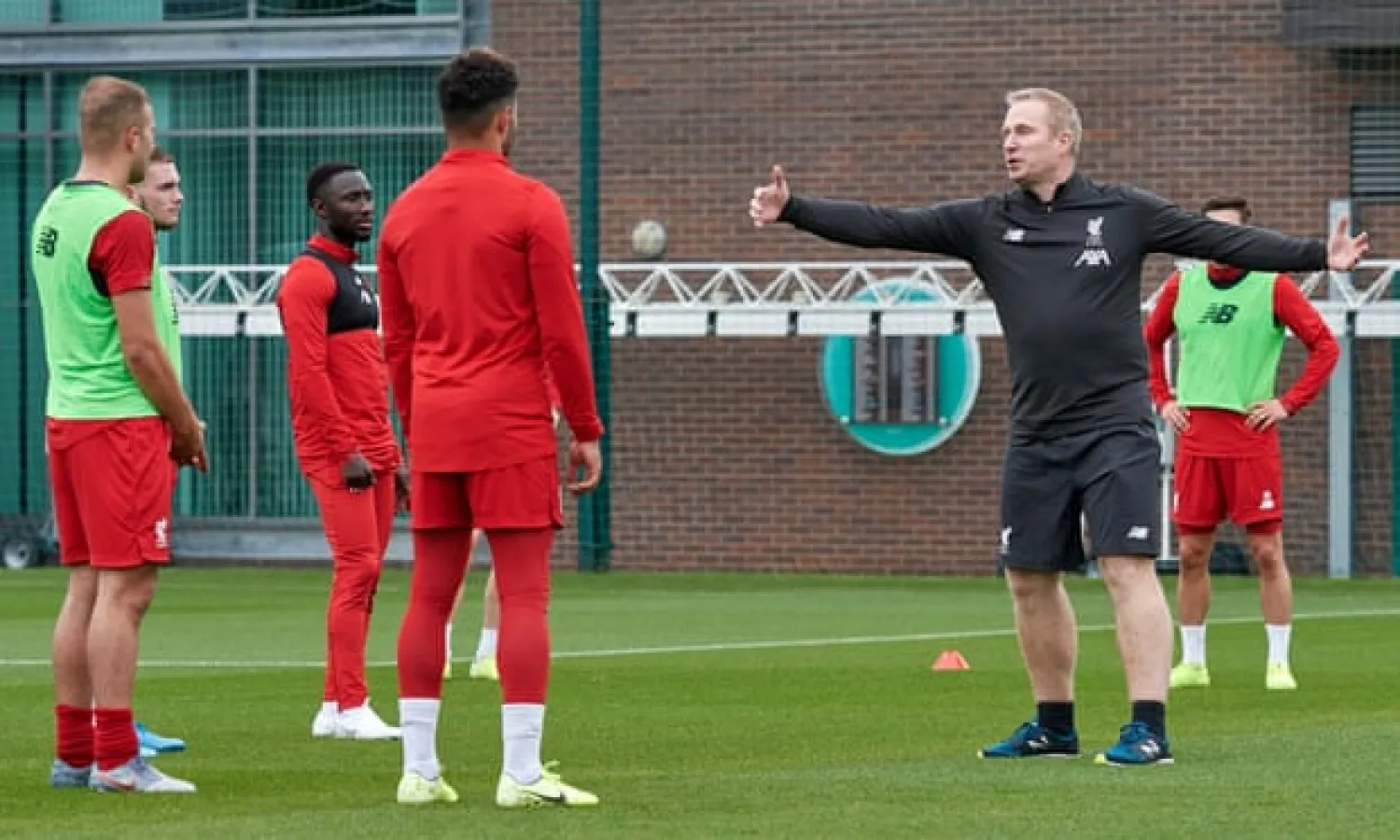
 Thomas Grønnemark works with Liverpool’s players last season. Photograph: Nick Taylor/Liverpool FC/Getty Images
Thomas Grønnemark works with Liverpool’s players last season. Photograph: Nick Taylor/Liverpool FC/Getty Images
TT

Gronnemark: 'I Work on the Long, Fast and Clever'

 Thomas Grønnemark works with Liverpool’s players last season. Photograph: Nick Taylor/Liverpool FC/Getty Images
Thomas Grønnemark works with Liverpool’s players last season. Photograph: Nick Taylor/Liverpool FC/Getty Images

During the scorching summer of 2018, Thomas Grønnemark received a call while touring the Danish countryside with his wife and their two children. He noticed the caller ID on the screen was a +44 number but he was preoccupied with driving and, as the sole proprietor of a registered business, he was quite used to receiving calls from people selling everything from accounting programs to pension schemes. So Grønnemark let the call die out. When the family stopped at the organic chocolate shop in Knebel, he listened to his voicemail.

The person behind the British phone number was none other than Jürgen Klopp, and Liverpool’s manager asked him to call back. Grønnemark wasted no time in doing so but couldn’t get through, so he continued his journey home to Skive. His phone rang not long after. “My wife looked at the display, because I was driving the car, and she said: ‘It’s Jürgen!’ I pulled the car over in the nearest grass field to speak to Jürgen Klopp. He told me that Liverpool had had a fantastic 17-18 season, coming in fourth in the Premier League and reaching the Champions League final. But they had lost the ball almost every time they had had a throw-in.

He invited me to Melwood, Liverpool’s training ground, the following week, and naturally I agreed. It was actually just meant to be a meeting, but he was so convinced I could help them they had me coaching the Premier League players the following day. I’ve coached Liverpool FC ever since.” Grønnemark is a throw-in coach, possibly the only one of his kind, and Klopp had read about his expertise in the German magazine Sport Bild.

The Dane had given an interview in which he spoke of how the Borussia Mönchengladbach left-back Andreas Poulsen had improved his long throw by 14 metres under his supervision. Grønnemark has a varied background in sport: he was a sprinter for Denmark and a brakeman on the bobsleigh team that met the international requirements for the 2006 Winter Olympics but wasn’t selected to compete. He is probably best known, though, for setting a world-record long throw. The record was achieved in 2010 when he used a front flip to propel the ball 51.33 metres across some pitches in Horsens. The long throw is what people want to talk about when they ask about his work, but coaching throw-ins is about so much more, he points out.

“I work with the long, the fast and the clever throw-in. And that goes for the entire field. I’ve coached some teams that only wanted to practice long throws close to the opponents’ goal, but my philosophy is to practice across the entire field. And Liverpool is the first team to really enjoy the benefits of this philosophy.

“You could say that I coach intelligence when it comes to throw-ins. And I’m not afraid to say that most professional players possess very little intelligence in this respect – and among amateurs and young players it tends to be even worse; 99% of the professional players and coaches I’m in contact with have never practiced throw-ins, and those that have, have not practiced at a particularly high level.”

Players need to learn the technique required to throw long and with precision, but also to create space to receive the ball. The aim is to create chances and ultimately goals, which is why the throw-in coach involves every player in his training. “If you watch a Liverpool match, there are usually six or seven different players who do the throw-ins,” Grønnemark said.

“If [Mohamed] Salah is closest to the ball, he should go ahead and do the throw-in, but only if it makes sense. However, it can be a disadvantage to take the throw-in too fast.

The worst thing you can do is to take the throw-in fast in a pressure zone. When I analyse throw-ins, I look at whether we’re able to play our way out of the pressure from our opponent. We might do something amazing based on a throw-in, but that isn’t good enough for me if we lose the ball.”

Klopp contacted Grønnemark after a season in which Liverpool’s statistics on throw-ins under pressure were the third-worst in the Premier League with a success rate of 45.4%, according to Tifo Football. After Grønnemark had worked with the team for a season, Liverpool ranked as the second-best team in Europe within the same parameters, on 68.4%. They were second only to FC Midtjylland, who also work with Grønnemark.

Apart from Liverpool and several Danish teams, Grønnemark has been employed by clubs including RB Leipzig, Ajax and Gent. Last season he coached throw-ins at eight clubs. He usually visits each team six or seven times a year, with two to four days of training per visit. In addition, he conducts a video analysis of all their matches. He singles out Liverpool’s Andy Robertson and Trent Alexander-Arnold as the best throwers in modern football.

“I’ve coached a lot of players who have improved the length of their throws with the help of technical training. When I started working with Kian Hansen [now of Nordsjælland], he could throw 30 metres, which is pretty far, but the throw was very high and easy to defend against. He ultimately reached 36.7 metres but throwing at incredible speed. I believe he assisted every one of the 35 goals that FC Midtjylland scored after throw-ins in the next four seasons.“

A completely different case is Andy Robertson from Liverpool, who couldn’t throw past 19 metres when I met him. That is very, very short, and when you throw that short, it’s very, very easy to put that throw under pressure. He managed to extend his throw by nearly eight metres.

And although he’ll never have the longest throw, with training we’ve managed to improve the radius of his throw-in by more than 500 square meters. “This means he can throw to more players. He improved incredibly fast – tactically, too, in terms of when to take the throw fast and when to hold on to the ball. When is the space created? He’s very good at precision. Trent has reached just about the same level, but it took him a little longer. In my eyes, they are the best all-round throwers in the world.”

Grønnemark is reluctant to highlight specifics from matches where his teams have excelled at a throw-in they have practiced.

“I’m the only one in the world with such in-depth knowledge of throw-ins. Which is actually a pretty big deal, when you think about it, because football is a 140-year-old sport … Until I release the book I’m working on, I’ll keep my secrets to myself.” Grønnemark has extended his contract for another season with Liverpool and selects his clients carefully.

“I don’t want to coach teams that compete with Liverpool at the top, and I don’t want to coach teams that have a historical rivalry. For instance, coaching Liverpool and Manchester United in the same season wouldn’t work. I’ve had several offers from top teams in the Premier League that I’ve turned down – including in this season. Liverpool isn’t holding me back. My own ethics are.” He dreams of adding a national team to his portfolio.

“Especially one attending the World Cup, which is very special. It has been amazing to coach a big team like Liverpool and help win the Champions League and Premier League, but my biggest dream is to help change football, so throw-ins are taken more seriously.”

Grønnemark started as a throw-in coach in 2004 but his international breakthrough came only after he tweeted about his work with Poulsen. That was picked up by one of the Gladbach fansites, which resulted in an interview with Sport Bild. That article was read by Klopp and Ralf Rangnick at Leipzig. “If you’re proactive and get things moving,” he said, “a little tweet could change your life.”

The Guardian Sport


Shakhtar Boss Pays Ukrainian Racer $200,000 After Games Disqualification

Ukrainian President Volodymyr Zelenskiy holds helmet as he meets with a Ukrainian skeleton racer Vladyslav Heraskevych , who was disqualified from the Olympic skeleton competition over his "helmet of remembrance" depicting athletes killed since Russia's invasion and his father and coach, Mykhailo Heraskevych, amid Russia's attack on Ukraine, in Munich, Germany February 13, 2026. (Ukrainian Presidential Press Service/Handout via Reuters)
TT

Shakhtar Boss Pays Ukrainian Racer $200,000 After Games Disqualification

Ukrainian President Volodymyr Zelenskiy holds helmet as he meets with a Ukrainian skeleton racer Vladyslav Heraskevych , who was disqualified from the Olympic skeleton competition over his "helmet of remembrance" depicting athletes killed since Russia's invasion and his father and coach, Mykhailo Heraskevych, amid Russia's attack on Ukraine, in Munich, Germany February 13, 2026. (Ukrainian Presidential Press Service/Handout via Reuters)

The owner of ‌Ukrainian football club Shakhtar Donetsk has donated more than $200,000 to skeleton racer Vladyslav Heraskevych after the athlete was disqualified from the Milano Cortina Winter Games before competing over the use of a helmet depicting Ukrainian athletes killed in the war with Russia, the club said on Tuesday.

The 27-year-old Heraskevych was disqualified last week when the International Bobsleigh and Skeleton Federation jury ruled that imagery on the helmet — depicting athletes killed since Russia invaded Ukraine in 2022 — breached rules on athletes' expression at ‌the Games.

He ‌then lost an appeal at the Court ‌of ⁠Arbitration for Sport hours ⁠before the final two runs of his competition, having missed the first two runs due to his disqualification.

Heraskevych had been allowed to train with the helmet that displayed the faces of 24 dead Ukrainian athletes for several days in Cortina d'Ampezzo where the sliding center is, but the International Olympic Committee then ⁠warned him a day before his competition ‌started that he could not wear ‌it there.

“Vlad Heraskevych was denied the opportunity to compete for victory ‌at the Olympic Games, yet he returns to Ukraine a ‌true winner," Shakhtar President Rinat Akhmetov said in a club statement.

"The respect and pride he has earned among Ukrainians through his actions are the highest reward. At the same time, I want him to ‌have enough energy and resources to continue his sporting career, as well as to fight ⁠for truth, freedom ⁠and the remembrance of those who gave their lives for Ukraine," he said.

The amount is equal to the prize money Ukraine pays athletes who win a gold medal at the Games.

The case dominated headlines early on at the Olympics, with IOC President Kirsty Coventry meeting Heraskevych on Thursday morning at the sliding venue in a failed last-minute attempt to broker a compromise.

The IOC suggested he wear a black armband and display the helmet before and after the race, but said using it in competition breached rules on keeping politics off fields of play. Heraskevych also earned praise from Ukraine President Volodymyr Zelenskiy.


Speed Skating-Italy Clinch Shock Men’s Team Pursuit Gold, Canada Successfully Defend Women’s Title

 Team Italy with Davide Ghiotto, Andrea Giovannini, Michele Malfatti, celebrate winning the gold medal on the podium of the men's team pursuit speed skating race at the 2026 Winter Olympics, in Milan, Italy, Tuesday, Feb. 17, 2026. (AP)
Team Italy with Davide Ghiotto, Andrea Giovannini, Michele Malfatti, celebrate winning the gold medal on the podium of the men's team pursuit speed skating race at the 2026 Winter Olympics, in Milan, Italy, Tuesday, Feb. 17, 2026. (AP)
TT

Speed Skating-Italy Clinch Shock Men’s Team Pursuit Gold, Canada Successfully Defend Women’s Title

 Team Italy with Davide Ghiotto, Andrea Giovannini, Michele Malfatti, celebrate winning the gold medal on the podium of the men's team pursuit speed skating race at the 2026 Winter Olympics, in Milan, Italy, Tuesday, Feb. 17, 2026. (AP)
Team Italy with Davide Ghiotto, Andrea Giovannini, Michele Malfatti, celebrate winning the gold medal on the podium of the men's team pursuit speed skating race at the 2026 Winter Olympics, in Milan, Italy, Tuesday, Feb. 17, 2026. (AP)

An inspired Italy delighted the home crowd with a stunning victory in the Olympic men's team pursuit final as

Canada's Ivanie Blondin, Valerie Maltais and Isabelle Weidemann delivered another seamless performance to beat the Netherlands in the women's event and retain their title ‌on Tuesday.

Italy's ‌men upset the US who ‌arrived ⁠at the Games ⁠as world champions and gold medal favorites.

Spurred on by double Olympic champion Francesca Lollobrigida, the Italian team of Davide Ghiotto, Andrea Giovannini and Michele Malfatti electrified a frenzied arena as they stormed ⁠to a time of three ‌minutes 39.20 seconds - ‌a commanding 4.51 seconds clear of the ‌Americans with China taking bronze.

The roar inside ‌the venue as Italy powered home was thunderous as the crowd rose to their feet, cheering the host nation to one ‌of their most special golds of a highly successful Games.

Canada's women ⁠crossed ⁠the line 0.96 seconds ahead of the Netherlands, stopping the clock at two minutes 55.81 seconds, and

Japan rounded out the women's podium by beating the US in the Final B.

It was only Canada's third gold medal of the Games, following Mikael Kingsbury's win in men's dual moguls and Megan Oldham's victory in women's freeski big air.


Lindsey Vonn Back in US Following Crash in Olympic Downhill 

Milano Cortina 2026 Olympics - Alpine Skiing - Women's Downhill 3rd Official Training - Tofane Alpine Skiing Centre, Belluno, Italy - February 07, 2026. Lindsey Vonn of United States in action during training. (Reuters)
TT

Lindsey Vonn Back in US Following Crash in Olympic Downhill 

Milano Cortina 2026 Olympics - Alpine Skiing - Women's Downhill 3rd Official Training - Tofane Alpine Skiing Centre, Belluno, Italy - February 07, 2026. Lindsey Vonn of United States in action during training. (Reuters)

Lindsey Vonn is back home in the US following a week of treatment at a hospital in Italy after breaking her left leg in the Olympic downhill at the Milan Cortina Games.

“Haven’t stood on my feet in over a week... been in a hospital bed immobile since my race. And although I’m not yet able to stand, being back on home soil feels amazing,” Vonn posted on X with an American flag emoji. “Huge thank you to everyone in Italy for taking good care of me.”

The 41-year-old Vonn suffered a complex tibia fracture that has already been operated on multiple times following her Feb. 8 crash. She has said she'll need more surgery in the US.

Nine days before her fall in Cortina d'Ampezzo, Italy, Vonn ruptured the ACL in her left knee in another crash in Switzerland.

Even before then, all eyes had been on her as the feel-good story heading into the Olympics for her comeback after nearly six years of retirement.
