


PSG v Manchester United Seems a Portent of a Dystopian Super League Future

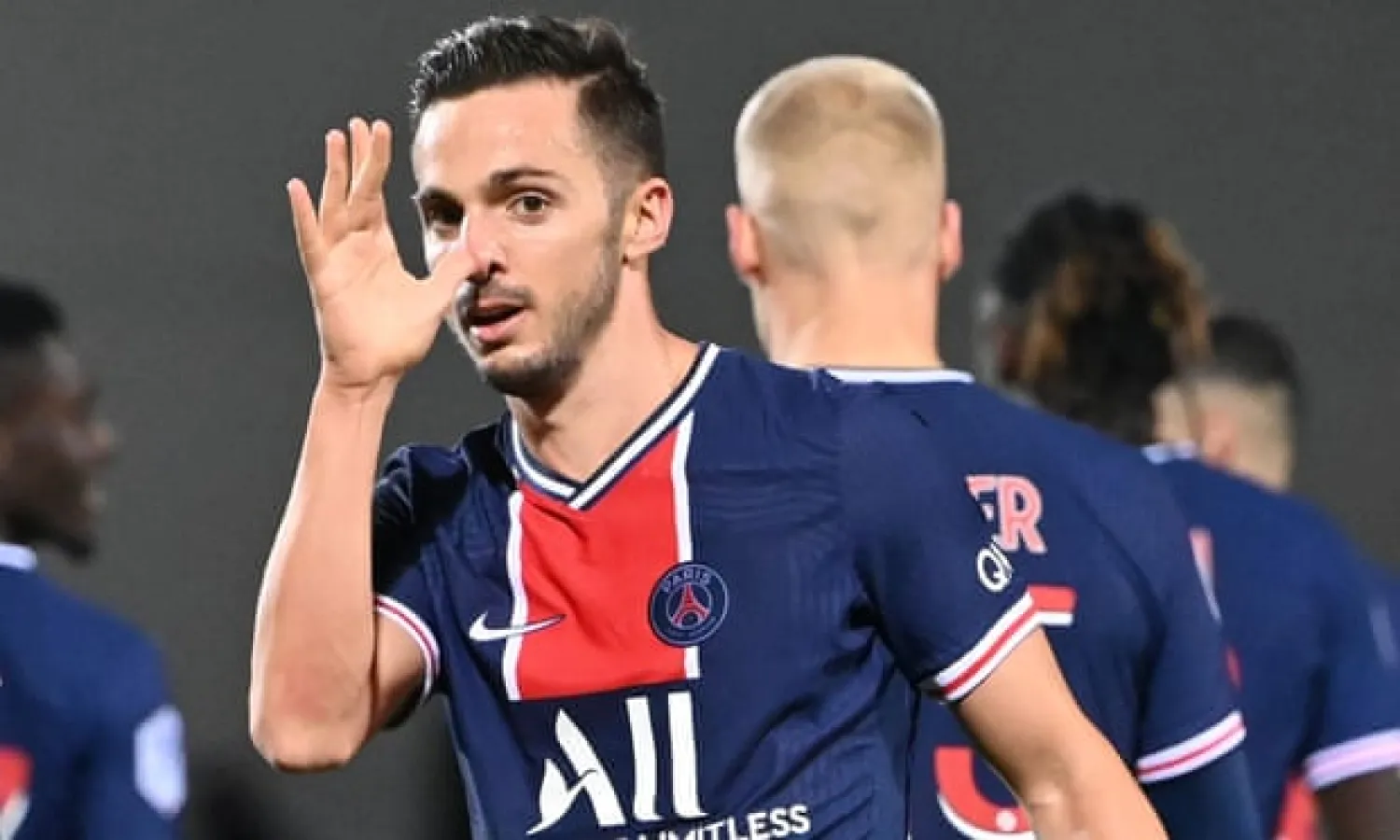
 Paris Saint-Germain’s midfielder Pablo Sarabia celebrates his first Ligue 1 goal of the season. Photograph: Pascal Guyot/AFP/Getty Images
Paris Saint-Germain’s midfielder Pablo Sarabia celebrates his first Ligue 1 goal of the season. Photograph: Pascal Guyot/AFP/Getty Images
TT

PSG v Manchester United Seems a Portent of a Dystopian Super League Future

 Paris Saint-Germain’s midfielder Pablo Sarabia celebrates his first Ligue 1 goal of the season. Photograph: Pascal Guyot/AFP/Getty Images
Paris Saint-Germain’s midfielder Pablo Sarabia celebrates his first Ligue 1 goal of the season. Photograph: Pascal Guyot/AFP/Getty Images

The clock was already showing 90. Diogo Dalot advanced on to the ball in space around 40 yards from the Paris Saint-Germain goal. His first touch was heavy and as three opponents closed in, he had little option but to shoot. Marco Verratti threw himself towards the full-back. Juan Bernat ducked away. And the middle of the three, Presnel Kimpembe, flinching, turned his back, his arm flicking away from his body. VAR showed Dalot’s wild effort had deflected off it. From nowhere, Manchester United had a penalty and an away-goals passage into the Champions League quarter-final.

Football, increasingly, is a game built on the analysis of complex data. Everything is counted, the data studied. We talk of philosophy and psychology, of tactical evolution and leadership strategies, and yet games and seasons and careers can rise and fall on moments of absurd chance. If Dalot’s first touch had been better, would he have shot? If Ligue 1 made Bernat and Kimpembe defend more frequently, might they have shown more conviction? Had Dalot’s shot been struck more cleanly, might it have hit Kimpembe’s ribs or back rather than his arm? A season earlier, there would not have been VAR to overturn the referee’s initial decision to point for a corner. And thus history is made.

Eighteen months on, as the sides prepare to meet again in the Champions League on Tuesday, the ramifications continue to be felt. From that night grew the image of Ole Gunnar Solskjær as a magus able to conjure at will the spirit of ’99. As susceptible to public pressure as ever, Ed Woodward confirmed him in the job the following week. the former United striker had seemingly read the mood of the game, dropping deep as PSG got the upper hand early in the second half, preparing for a late assault on opponents with a habit of freezing at key moments. But emotional intelligence is not enough to be a manager of a super-club.

Last season Solskjær had some success sitting his side deep and breaking. United were relatively defensively sound and they had pace and quality in forward areas but what they did not have was the sort of coordinated attacking that is necessary now at the highest level. This season the defending has also disintegrated, which may, in fairness to the manager, at least in part be the result of Harry Maguire’s struggles.

Solskjær still has his supporters and they are right that there are much bigger problems at the club. The hastiness of his appointment, the apparent lack of broader planning, is symptomatic of the failure of leadership since Sir Alex Ferguson and the chief executive, David Gill, departed in 2013.

Understandably, fans are frustrated by how much the Glazers have taken out of the club, but of just as much practical significance, at least in the short term, is how badly the available money has been spent. Discerning a consistent strategy is impossible: from Alexis Sánchez to a focus on young British talent to Edinson Cavani in two years. A net spend of £500m on transfers over five years should guarantee a certain level, yet United’s squad are short of a left-back, a center-back and a right-sided forward.

With waste like that it is little wonder Joel Glazer had to come up with a wheeze like Project Big Picture to cement United’s place at the top of English game. Far easier to rig the financial structures even further in your favor than actually to run a club properly.

The Champions League is a glimpse of that future. Its group stage should begin with a great sense of expectation and possibility. Look back to its richness and drama in the 90s, before the great stratification, when at least half the fixtures felt like monumental clashes, and compare that with a present that increasingly feels an accounting exercise: tot up the revenues and, in the majority of groups, watch the richest pair progress. And if, as seems likely, the format is rejigged in 2024, it will only be to make the rich richer.

Because United are fallible and because the group also contains RB Leipzig – who may have breached the spirit of German regulations on club ownership but are undeniably well-run, football’s degenerate economics somehow rendering a global brand a plucky outsider – Tuesday’s game against PSG feels significant. But a slightly different draw and this would be an effective exhibition between sides who know they will progress. Or project into a super league future and this could easily be a weary wrangle of sides too flawed to win but too rich to fail.

PSG should stand as a warning to the Premier League’s elite. In Ligue 1 they are untouchable, winning seven of the past eight French titles and the domestic treble in four of the past six years, a joyless hegemony that was at least in part responsible for the abolition of the Coupe de la Ligue at the end of last season, just as Big Picture proposed the axing of the League Cup.

But like so many of the other serial domestic champions, PSG are not happy. European success continues to elude them. Last season, they came closer than ever before thanks to a gentle draw and a late flurry against Atalanta but the tensions between celebrity players and the attempts of Thomas Tuchel to impose a structure remain damagingly close to the surface. And all the while the paradoxical truth grows more urgent: PSG’s domination of Ligue 1 – the latest Deloitte report shows revenues almost three times greater than that of the next French side, Lyon – means it is no preparation for elite football.

Or perhaps that is what Glazer wants. Perhaps this is the dream, two-thirds of the Premier League reduced to vassal status, minnows to be cuffed aside by the elite as a matter of course, no matter how badly they are managed.

PSG against United may be the pick of the week’s Champions League group games but it feels also like a harbinger of some dystopian future, of hollow games between franchises insulated from the costs of mismanagement, denuded of jeopardy and the emotional connection that makes football matter.

The Guardian Sport


Perfect Start for Pereira as Forest Enjoy Record Win at Fenerbahce

Nottingham Forest's Portuguese head coach Vitor Pereira (CR) gestures from the techincal area during the UEFA Europa League - knockout round play-off first leg - football match between Fenerbahce SK and Nottingham Forest FC at the Sukru Saracoglu Stadium in Istanbul on February 19, 2026. (Photo by Yasin AKGUL / AFP)
TT

Perfect Start for Pereira as Forest Enjoy Record Win at Fenerbahce

Nottingham Forest's Portuguese head coach Vitor Pereira (CR) gestures from the techincal area during the UEFA Europa League - knockout round play-off first leg - football match between Fenerbahce SK and Nottingham Forest FC at the Sukru Saracoglu Stadium in Istanbul on February 19, 2026. (Photo by Yasin AKGUL / AFP)

Nottingham Forest's new head ‌coach Vitor Pereira said he had encouraged his players to express themselves at Fenerbahce on Thursday and they responded in style with a 3-0 victory that marked their biggest away win in European competition.

The comfortable win in the first leg of their Europa League knockout round playoff tie in Turkey was the perfect start for Pereira, who took the ‌helm last ‌weekend following the departure of ‌Sean ⁠Dyche.

Goals from Murillo, ⁠Igor Jesus and Morgan Gibbs-White secured the win but the scoreline could have been even more emphatic.

"We had chance to score two more goals. It was a very good result," Portuguese Pereira told TNT Sports, according to Reuters. "It is only ⁠halftime, we need to be consistent, ‌the schedule is ‌tight and difficult."

Pereira is Forest's fourth managerial appointment this ‌season after Nuno Espirito Santo, Ange Postecoglou ‌and Dyche, and the 57-year-old arrives with the side just three points above the Premier League relegation zone.

"Everyone must be ready to help the ‌team. This is what I ask them," said Pereira. "I realized before I ⁠came that ⁠the players have a lot of quality. They need results but they need to enjoy the game.

"If they enjoy the way they are playing they can have a high level. They need organization and confidence. I asked them to express themselves on the pitch. They did it."

Forest host Liverpool in the league on Sunday before Fenerbahce arrive for the second leg of their Europa League tie on February 26.


FIFA President: All 104 World Cup Matches Will be 'Sold Out'

FIFA President Gianni Infantino speaks during a Board of Peace meeting at the US Institute of Peace, Thursday, Feb. 19, 2026, in Washington. (AP Photo/Mark Schiefelbein)
TT

FIFA President: All 104 World Cup Matches Will be 'Sold Out'

FIFA President Gianni Infantino speaks during a Board of Peace meeting at the US Institute of Peace, Thursday, Feb. 19, 2026, in Washington. (AP Photo/Mark Schiefelbein)

FIFA president Gianni Infantino said all 104 matches of ‌the 2026 World Cup will be "sold out" despite tickets available for the tournament running from June 11 to July 19.

"The demand is there. Every match is sold out," Infantino told CNBC in an interview Wednesday from US President Donald Trump's Mar-a-Lago resort in Palm Beach, Fla.

Infantino said there had been 508 million ticket requests in four weeks from more than 200 countries for about seven million available tickets.

"(We've) never see anything like that -- incredible," he said.

The 48-team World Cup is taking place across 16 host cities in the United States, Mexico and Canada, with MetLife Stadium in East Rutherford, N.J., as the site ‌of the ‌World Cup final.

The head of the sport's governing ‌body ⁠said that tournament ⁠locations contribute to what soccer supporters' associations have complained are exorbitant ticket prices.

"I think it is because it's in America, Canada and Mexico," he said. "Everybody wants to be part of something special."

Also affecting prices are resale websites, which take the official ticket that has a fixed price and use "dynamic pricing" leading to the cost to fluctuate.

"You are able as well to resell your tickets ⁠on official platforms, secondary markets, so the prices as ‌well will go up," Reuters quoted Infantino as saying. "That's part ‌of the market we are in."

A report in the Straits Times said that a ‌Category 3 seat -- the highest section in the stadium -- for Mexico's match ‌against South Africa in the tournament opener on June 11 in Mexico City was listed at $5,324 in the secondary market. The original price was $895.

The same seat category for the World Cup final on July 19, originally priced at $3,450, was advertised for $143,750 on ‌Feb. 11, per the report.

In December, FIFA designated "supporter entry tier" tickets with a $60 price to be allocated to ⁠the national federations ⁠whose teams are playing. Those federations are expected to make those tickets available "to loyal fans who are closely connected to their national teams," FIFA said in a press release.

The last time the US served as a World Cup host in 1994, tickets ranged from $25 to $475. At the 2022 World Cup in Qatar, prices ranged from $70 to $1,600 after the matches were announced.

Infantino in his comments this week estimated that the 2026 World Cup will raise $11 billion in revenue for FIFA, with "every dollar" to be reinvested in the sport in the 211 member countries.

He said the economic impact for the United States would be around $30 billion "in terms of tourism, catering, security investments and so on." Infantino also estimated the tournament will attract 20 million to 30 million tourists and


Sports Investment Forum Allocates Third Day to Women's Empowerment to Promote Sustainable Investment in Women’s Sports

Sports Investment Forum Allocates Third Day to Women's Empowerment to Promote Sustainable Investment in Women’s Sports
TT

Sports Investment Forum Allocates Third Day to Women's Empowerment to Promote Sustainable Investment in Women’s Sports

Sports Investment Forum Allocates Third Day to Women's Empowerment to Promote Sustainable Investment in Women’s Sports

The Sports Investment Forum announced that the third day of its 2026 edition will be dedicated to empowering women in the sports sector, in partnership with Princess Nourah bint Abdulrahman University. The move reflects the forum’s commitment to supporting the objectives of Saudi Vision 2030 and enhancing the role of women in the sports industry and sports investment.

This allocation comes as part of the forum’s program, scheduled to take place from April 20 to 22, at The Ritz-Carlton, Riyadh. The third day will feature a series of strategic sessions and specialized workshops focused on sustainable investment in women’s sports, the empowerment of female leadership, the development of inclusive sports cities, and support for research and studies in women’s sports, SPA reported.

Forum organizers emphasized that the partnership with Princess Nourah bint Abdulrahman University, recognized as the largest women’s university in the world, represents a model of integration between the academic and investment sectors. The partnership contributes to building a sustainable knowledge base that supports the growth of women’s sports and enhances investment opportunities at both local and international levels.

The dedicated day will address several strategic themes, including sustainable investment in women’s leagues and events, boosting scalable business models, empowering female leaders within federations, clubs, and sports institutions, and developing inclusive sports cities that ensure women’s participation in line with the highest international standards. It will also include the launch of research initiatives and academic partnerships to support future policies and strategies for the sector.

This approach aims to transform women’s empowerment in sports from a social framework into a sustainable investment and development pathway that enhances women’s contributions to the sports economy and reinforces Saudi Arabia’s position as a leading regional hub for advancing women’s sports.

The day is expected to attract prominent female leaders, decision-makers, investors, and local and international experts, in addition to the signing of several memoranda of understanding and joint initiatives supporting women’s empowerment in the sports sector.

The Sports Investment Forum reiterated that empowering women is a strategic pillar in developing the national sports ecosystem, contributing to economic growth objectives, enhancing quality of life, and building a more inclusive and sustainable sports community.
