

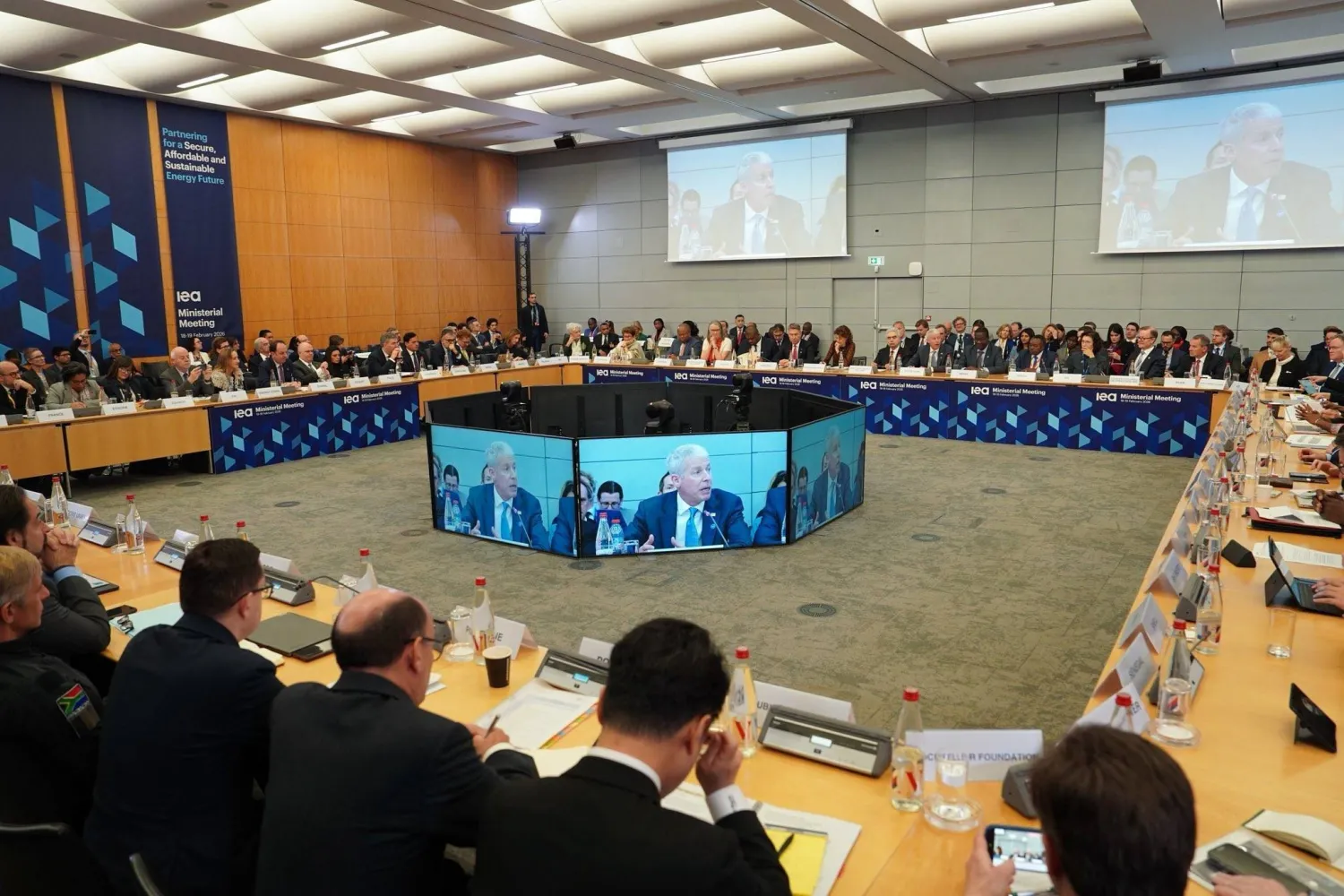

US Renews Threat to Leave IEA

US Energy Secretary Chris Wright speaks at an IEA ministerial meeting in Paris (X)
TT

US Renews Threat to Leave IEA

US Energy Secretary Chris Wright speaks at an IEA ministerial meeting in Paris (X)

US Energy Secretary Chris Wright renewed his threat Thursday to pull out of the International Energy Agency, saying Washington would press the organization to abandon a net-zero agenda “in the next year or so.”

Speaking on the last day of an IEA ministerial meeting in Paris, Wright said the 52-year-old agency should return to its founding mission of ensuring energy security.

“The US will use all the pressure we have to get the IEA to eventually, in the next year or so, move away from this agenda,” Wright said in a news conference.

“But if the IEA is not able to bring itself back to focusing on the mission of energy honesty, energy access and energy security, then sadly we would become an ex-member of the IEA,” he added.

Meaning of Wright’s Warning

A US exit means a deep cut to IEA’s budget undermining the agency’s global influence.

Washington is not just a member of the agency but its largest funder. It alone contributes to 25% of the IEA core budget (equivalent to between $25 and $30 million annually) and therefore its exit would “dry up” a quarter of the agency’s financial resources.

Also, Washington is the world's largest oil and gas producer, meaning the US exit will affect the agency's reports and their credibility in markets.

The IEA was created to coordinate responses to major disruptions of supplies after the 1973 oil crisis. But in recent years, it became the main advocate of green transition policies, which the US considers as “politicized.”

The IEA produces monthly reports on oil demand and supply as well as annual world energy outlooks that include data on the growth of solar and wind energy, among other analyses.

Wright praised IEA Executive Director Fatih Birol for reinserting in November 2025’s annual outlook a Current Policies Scenario in which oil and gas demand would grow in the next decades. That scenario had been dropped for the past five years.

But the report still included a scenario where the world reaches net zero emissions by mid-century.

Birol’s current four-year term ends in 2027, but Wright demurred when asked who he would like to head the IEA, which has over 30 member nations.

“We remain today undecided or neutral on who the leadership is. We care about the mission much more than the individual leaders,” the US energy chief said.

If Birol can make the agency “get out the politics and get out the anti-energy part of it, that's great by us,” said Wright, who first warned last year that the US could leave the IEA if it did not reform.

For his part, Birol insisted that the Paris-based agency was “data-driven.” He said, “We are a non-political organization.”

The IEA was created “to focus on energy security,” Wright said on Wednesday at a ministerial meeting of the agency in Paris.

“That mission is beyond critical and I'm here to plead to all the members (of the IEA) that we need to keep the focus of the IEA on this absolutely life-changing, world-changing mission of energy security,” he said.

The Energy Secretary said he wanted to get support from “all the nations in this noble organization to work with us, to push the IEA to drop the climate. That's political stuff.”

His comments come just a day after he publicly threatened to quit the organization unless it abandoned its focus on the energy transition— a call that several countries rejected, including the UK, Austria and France.


Israel Army Says on ‘Defensive Alert’ Regarding Iran but No Change to Public Guidelines

Israeli air defense system fires to intercept missiles during an Iranian attack over Tel Aviv, Israel, Thursday, June 19, 2025. (AP)
TT

Israel Army Says on ‘Defensive Alert’ Regarding Iran but No Change to Public Guidelines

Israeli air defense system fires to intercept missiles during an Iranian attack over Tel Aviv, Israel, Thursday, June 19, 2025. (AP)

The Israeli army said it was on "defensive alert" as the United States threatens potential military action against Iran, but insisted there were no changes in its guidelines for the public.

"We are closely monitoring regional developments and are aware of the public discourse concerning Iran. The (Israeli military) is on defensive alert," army spokesman Brigadier General Effie Defrin said in a video statement published Friday.

"Our eyes are wide open in all directions, and our finger is more than ever on the trigger in response to any change in the operational reality," he added, but emphasized "there is no change in the instructions".


Trump Says Weighing Strike on Iran as Tehran Says Draft Deal Coming Soon

US President Donald Trump speaks during a Governors Working Breakfast in the State Dining Room of the White House in Washington, DC, USA, 20 February 2026. (EPA)
TT

Trump Says Weighing Strike on Iran as Tehran Says Draft Deal Coming Soon

US President Donald Trump speaks during a Governors Working Breakfast in the State Dining Room of the White House in Washington, DC, USA, 20 February 2026. (EPA)

US President Donald Trump said he was considering a limited strike on Iran after ordering a major naval buildup in the Middle East aimed at heaping pressure on Tehran to cut a deal to curb its nuclear program.

The latest threat came after Iran's foreign minister said a draft proposal for an agreement with Washington would be ready in a matter of days following negotiations between the two sides in Geneva earlier this week.

Trump had suggesting on Thursday that "bad things" would happen if Tehran did not strike a deal within 10 days, which he subsequently extended to 15.

Asked by a reporter on Friday whether he was contemplating a limited military strike, Trump answered: "The most I can say -- I am considering it."

After the talks in Geneva, Tehran said the two sides had agreed to submit drafts of a potential agreement, which Iranian Foreign Minister Abbas Araghchi told US media would be the "next step".

"I believe that in the next two, three days, that would be ready, and after final confirmation by my superiors, that would be handed over to Steve Witkoff," he said, referring to Trump's main Middle East negotiator.

Araghchi also said US negotiators had not requested that Tehran end its nuclear enrichment program, contradicting statements from American officials.

"We have not offered any suspension, and the US side has not asked for zero enrichment," he said in an interview released Friday by US TV network MS NOW.

"What we are now talking about is how to make sure that Iran's nuclear program, including enrichment, is peaceful and would remain peaceful forever," he added.

His comments stand in contrast to information relayed by high-ranking US officials, including Trump, who has repeatedly said Iran must not be allowed to enrich uranium at any level.

Western countries accuse Tehran of seeking to acquire nuclear weapons, which it denies, though it insists on its right to enrichment for civilian purposes.

Iran, for its part, is seeking to negotiate an end to sanctions that have proven to be a massive drag on its economy.

Economic hardships sparked protests in December that evolved into a nationwide anti-government movement last month, prompting a crackdown from authorities that left thousands dead, rights groups say.

- 'No ultimatum' -

The two foes held an initial round of discussions on February 6 in Oman, the first since previous talks collapsed during the 12-day Iran-Israel war last June, which the US joined by striking Iranian nuclear facilities.

Washington has pursued a major military build-up in the region in tandem with the talks, and both sides have traded threats of military action for weeks.

On Thursday, Trump again suggested the US would attack Iran if it did not make a deal within the timeframe he laid out.

"We have to make a meaningful deal otherwise bad things happen," Trump told the inaugural meeting of the "Board of Peace", his initiative for the post-war Gaza Strip.

Iran's ambassador to the UN, Amir Saeid Iravani, warned that US bases, facilities and assets would be "legitimate targets" if the United States followed through on its threats.

Araghchi, however, insisted that "there is no ultimatum".

"We only talk with each other how we can have a fast deal. And a fast deal is something that both sides are interested about," he said.

"We are under sanctions, (so) obviously any day that sanctions are terminated sooner it would be better for us," he said, adding Iran had "no reason to delay".

Washington has repeatedly called for zero enrichment, but has also sought to address Iran's ballistic missile program and its support for militant groups in the region -- issues which Israel has pushed to include in the talks.

The Israeli army said Friday that it was on "defensive alert" regarding the situation with Iran, but that its guidelines for the public remained unchanged.

Ratcheting up the pressure, Trump has deployed a significant naval force to the region.

After sending the aircraft carrier USS Abraham Lincoln and escort battleships to the Gulf in January, he ordered a second carrier, the Gerald Ford, to depart for the Middle East.

Iranian naval forces also conducted military drills this week in the Gulf and around the strategic Strait of Hormuz in their own show of force.


UK Foreign Minister to Meet Rubio amid Tensions over Joint Air Base

British Foreign Secretary Yvette Cooper, president of the United Nations Security Council for February speaks during a press conference before the Security Council meeting, at UN headquarters in New York City, US, February 19, 2026. REUTERS/Jeenah Moon
TT

UK Foreign Minister to Meet Rubio amid Tensions over Joint Air Base

British Foreign Secretary Yvette Cooper, president of the United Nations Security Council for February speaks during a press conference before the Security Council meeting, at UN headquarters in New York City, US, February 19, 2026. REUTERS/Jeenah Moon

Britain's foreign minister Yvette Cooper ‌will meet with US Secretary of State Marco Rubio on Friday, after President Donald Trump renewed his criticism of London for ceding sovereignty of ​the Chagos Islands, which is home to a US-UK air base.
Last year, British Prime Minister Keir Starmer agreed a deal to transfer sovereignty of the Indian Ocean islands to Mauritius, while keeping control of one - Diego Garcia - through a 99-year lease that preserved US operations at the base, Reuters said.
Washington last year gave its blessing to the agreement, but Trump has since ‌changed his mind ‌several times. In January, Trump described it ​as ‌an ⁠act ​of "great stupidity", ⁠but earlier this month said he understood the deal was the best Starmer could make, before then renewing his criticism this week.
Cooper is meeting Rubio to discuss defense and security issues in Washington as Trump also toughens his rhetoric on Iran, saying Tehran must make a deal over its nuclear program in the ⁠next 10 to 15 days, or "really bad ‌things" will happen.
The Diego Garcia ‌base has recently been used for ​operations in the Middle East against ‌Yemen's Houthis and in humanitarian aid to Gaza.
Although on Tuesday ‌Rubio's State Department said it backed the Chagos accord, the next day Trump said Britain was making a big mistake.
"DO NOT GIVE AWAY DIEGO GARCIA!" Trump wrote in a post on Truth Social, saying the ‌base could be called upon in any future military operation to "eradicate a potential attack" from ⁠Iran.
Under the ⁠conditions for using the joint base, Britain would need to agree in advance to any operations out of Diego Garcia.
On Thursday, Britain's The Times newspaper reported that Trump's latest criticism of the Chagos deal came because Britain was yet to give permission to use the bases for future strikes against Iran, owing to concerns they may breach international law.
Asked about The Times report, Britain's Ministry of Defence said on Thursday it does not comment on operational matters and that Britain supported ​the ongoing political process between ​the US and Iran.
