

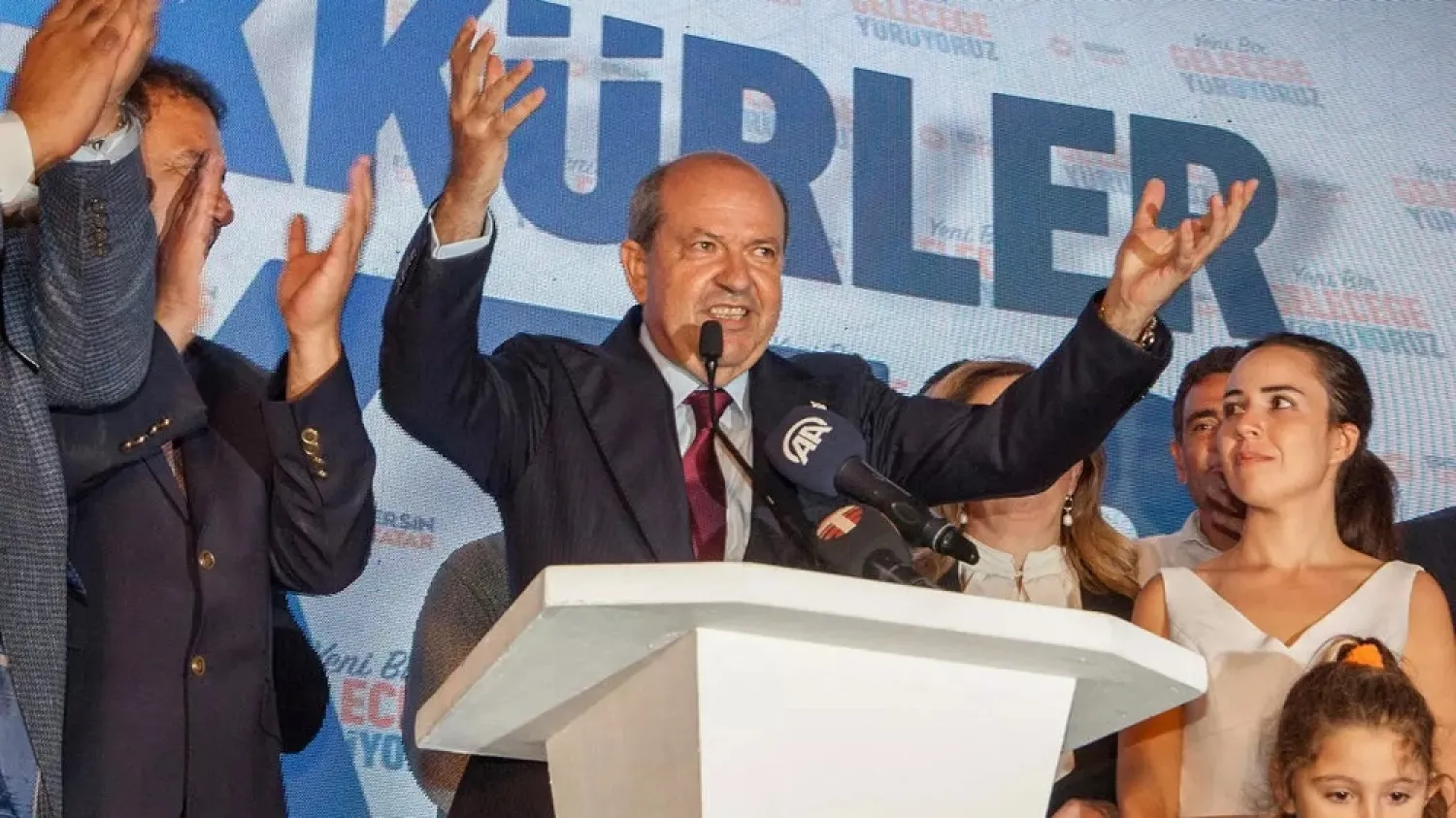

Divided Cyprus Eyes Impact of Turkey's Man Winning Northern Vote

Newly-elected Turkish Cypriot president Ersin Tatar celebrates after winning to vote Sunday. (AFP)
TT

Divided Cyprus Eyes Impact of Turkey's Man Winning Northern Vote

Newly-elected Turkish Cypriot president Ersin Tatar celebrates after winning to vote Sunday. (AFP)

Breakaway northern Cyprus has elected the Ankara-backed right-wing nationalist Ersin Tatar as its leader in a surprise win at a time of heightened tensions in the eastern Mediterranean.

Tatar, 60, clinched victory late Sunday in a second round of the "presidential" election in the self-proclaimed Turkish Republic of Northern Cyprus (TRNC).

The Cambridge-educated chartered accountant won 51.7 percent of the vote.

With Turkey an increasingly assertive regional actor, Tatar's win could help shift the balance of power in the region and impact reunification efforts for divided Cyprus.

Why did Tatar win?

Tatar won the first-round vote on October 11 with 32 percent, ahead of outgoing leader Mustafa Akinci who won 30 percent.

Akinci's relationship with Ankara had come under strain, especially after he described the prospect of the north's annexation by Turkey as "horrible" in February.

But while Akinci had secured the backing of Tufan Erhurman -- a fellow social democrat who came third in the first round -- that support was not enough.

Political scientist Mete Hatay, from the PRIO Cyprus Centre, said it was Turkish settlers and immigrants with TRNC citizenship --- making up nearly a third of voters -- that tipped the balance.

"Settlers' votes went to Ersin Tatar, especially in rural areas," Hatay said.

Support for Tatar from Turkish President Recep Tayyip Erdogan was also key.

Days before the first round, Tatar had announced -- from Ankara, along with Erdogan -- the partial reopening of the fenced-off seaside ghost town of Varosha for the first time since Turkish forces invaded the north in 1974.

Turkey has also supplied northern Cyprus with a 100-bed hospital for coronavirus cases and fixed an undersea freshwater pipeline.

When Akinci admitted defeat, he referred to Turkish interventions in the election.

Last week, he claimed that pro-Turkish media were carrying out a "disinformation campaign" and that he had received threats urging him to withdraw.

What does it mean for Cyprus' future?

Cyprus has been divided since Turkey invaded and occupied its northern third in 1974 in reaction to a Greek-engineered coup aiming to annex the island.

The TRNC, now with a population of about 300,000, is recognized only by Turkey.

The Republic of Cyprus, which is in control of the mainly Greek-speaking south, has been a European Union member since 2004.

The two sides are separated by a UN-patrolled buffer zone.

The last attempt at UN-mediated negotiations collapsed in Switzerland in July 2017.

While Akinci had revived hopes for reunification by advocating the creation of a federal state, Tatar defends a two-state solution.

In his victory speech, Tatar said he would return to the negotiating table "when necessary", but said that Turkish Cypriots would "not compromise" on certain points essential to their "sovereignty".

"Our neighbors in the south and world community should respect our fight for freedom," Tatar said.

The UN is expected to convene a meeting between the two sides, Turkey, Greece -- the key ally of Greek Cypriots -- as well as former colonial ruler Britain.

On Monday, Cyprus President Nicos Anastasiades called on Tatar to back the UN-led peace initiative, after Turkey's Erdogan had said earlier he would work with Tatar "to resolve the Cyprus issue".

A spokesman for Anastasiades' government later said that the Greek-Cypriot president and Tatar had agreed to meet in the UN buffer zone, at an undecided date.

The TRNC is already economically and politically dependent on Turkey -- not least because some 30,000 Turkish troops are on Cypriot soil.

Tatar's win is expected to deepen those ties further -- with some fearing the specter of annexation.

"Anything is possible nowadays in this crazy world," Hatay said, but added he did not see annexation imminently.

"They have to get Turkish Cypriots on board for that, and even those who support Tatar are not ready at this stage," he said.

What impact for the Eastern Med?

Northern Cyprus is a centerpiece of Turkey's strategy in the eastern Mediterranean, including a bitter dispute with Greece and Cyprus over oil and gas reserves.

The EU has deplored Turkey's drilling for hydrocarbons in disputed waters and warned Ankara against further "provocations".

In a call with Tatar after his victory, Erdogan said their cooperation would continue -- "starting with activities related to hydrocarbons".

But new leadership could also bring a chance of fresh talks. UN-led discussions on Cyprus will bring Greece and Turkey to the same table -- and that could help talks on wider issues, analysts say.

"This process will not only be about solving Cyprus problem," Hatay said. "It will also be about easing the tensions in the region."



Andrew Mountbatten-Windsor Arrested on Suspicion of Misconduct in Public Office

FILE - Britain’s Andrew Mountbatten-Windsor, formerly known as Prince Andrew, looks round as he leaves after attending the Easter Matins Service at St. George's Chapel, Windsor Castle, England, April 20, 2025. (AP Photo/Kirsty Wigglesworth, File)
TT

Andrew Mountbatten-Windsor Arrested on Suspicion of Misconduct in Public Office

FILE - Britain’s Andrew Mountbatten-Windsor, formerly known as Prince Andrew, looks round as he leaves after attending the Easter Matins Service at St. George's Chapel, Windsor Castle, England, April 20, 2025. (AP Photo/Kirsty Wigglesworth, File)

UK police arrested Andrew Mountbatten-Windsor on Thursday on suspicion of misconduct in public office.

The Thames Valley Police, an agency that covers areas west of London, including Mountbatten-Windsor’s former home, said it was “assessing” reports that the former Prince Andrew sent trade reports to convicted sex offender Jeffrey Epstein in 2010. The assessment followed the release of millions of pages of documents connected to a US investigation of Epstein.

The police force did not name Mountbatten-Windsor, as is normal under UK law. But when asked if he had been arrested, the force pointed to a statement saying that they had arrested a man in his 60s. Mountbatten-Windsor is 66.

“Following a thorough assessment, we have now opened an investigation into this allegation of misconduct in public office,’’ the statement said. “It is important that we protect the integrity and objectivity of our investigation as we work with our partners to investigate this alleged offence."

“We understand the significant public interest in this case, and we will provide updates at the appropriate time,” the statement added.

Pictures circulated online appearing to show unmarked police cars at Wood Farm on the Sandringham Estate in Norfolk, with plainclothes officers appearing to gather outside the home of Mountbatten-Windsor.


Georgia Arrests Two Foreigners Trying to Purchase Uranium

FILE PHOTO: A block with the symbol, atomic number and mass number of Uranium (U) element, in this illustration taken January 21, 2026. REUTERS/Dado Ruvic/Illustration/File Photo
TT

Georgia Arrests Two Foreigners Trying to Purchase Uranium

FILE PHOTO: A block with the symbol, atomic number and mass number of Uranium (U) element, in this illustration taken January 21, 2026. REUTERS/Dado Ruvic/Illustration/File Photo

Georgia has ‌detained two people who attempted to purchase $3 million worth of uranium and a cache of a radioactive isotope found in nuclear weapons testing programs, the national security service said on Thursday.

Two foreign nationals from unspecified countries were arrested in the city of Kutaisi, the State Security Service said in a statement.

"They were planning to ‌illegally purchase ‌nuclear material uranium and radioactive ‌substance ⁠Cesium 137 for $3 ⁠million and illegally transport it to the territory of another country," Reuters quoted it as saying.

It said other foreigners had been arriving in Georgia in recent weeks with the aim of purchasing and transporting the nuclear and ⁠radioactive materials, without elaborating further.

The ‌statement did ‌not specify the quantity of materials the individuals were ‌attempting to procure. There were ‌no details on the substances' origin or potential destination.

Cesium 137 is a radioactive isotope present primarily in the aftermath of nuclear weapons testing ‌and nuclear power plant accidents such as the Chernobyl disaster in ⁠then-Soviet ⁠Ukraine in 1986.

The security of nuclear materials was one of the biggest concerns after the 1991 fall of the Soviet Union, of which Georgia was part. There have been several serious incidents involving the illicit trade in nuclear materials in Georgia over recent decades.

Most recently, three Chinese citizens were arrested in the capital Tbilisi for attempting to purchase two kilograms of "nuclear material" uranium.


Former South Korean President Yoon Receives Life Sentence for Imposing Martial Law

FILE PHOTO: South Korea’s impeached President Yoon Suk Yeol attends the fourth hearing of his impeachment trial over his short-lived imposition of martial law at the Constitutional Court in Seoul, South Korea, 23 January 2025. JEON HEON-KYUN/Pool via REUTERS/File Photo
TT

Former South Korean President Yoon Receives Life Sentence for Imposing Martial Law

FILE PHOTO: South Korea’s impeached President Yoon Suk Yeol attends the fourth hearing of his impeachment trial over his short-lived imposition of martial law at the Constitutional Court in Seoul, South Korea, 23 January 2025. JEON HEON-KYUN/Pool via REUTERS/File Photo

Former South Korean President Yoon Suk Yeol was sentenced to life in prison for his brief imposition of martial law in a dramatic culmination to the country’s biggest political crisis in decades.

Yoon was ousted from office after a baffling attempt to overcome an opposition-controlled legislature by declaring martial law and sending troops to surround the National Assembly on Dec. 3, 2024, The Associated Press said.

Judge Jee Kui-youn of the Seoul Central District Court said he found Yoon guilty of rebellion for mobilizing military and police forces in an illegal attempt to seize the liberal-led Assembly, arrest politicians and establish unchecked power for a “considerable” time.

Martial law crisis recalled dictatorial past Yoon’s martial law imposition, the first of its kind in more than four decades, harkened back to South Korea’s past military-backed governments when authorities occasionally proclaimed emergency decrees that allowed them to station soldiers, tanks and armored vehicles on streets or at public places such as schools to prevent anti-government demonstrations.

As lawmakers rushed to the National Assembly, Yoon’s martial law command issued a proclamation declaring sweeping powers, including suspending political activities, controlling the media and publications, and allowing arrests without warrants.

The decree lasted about six hours before being lifted after a quorum of lawmakers managed to break through a military blockade and unanimously voted to lift the measure.

Yoon was suspended from office on Dec. 14, 2024, after being impeached by lawmakers and was formally removed by the Constitutional Court in April 2025. He has been under arrest since last July while facing multiple criminal trials, with the rebellion charge carrying the most severe punishment.

Yoon's lawyers reject conviction Yoon Kap-keun, one of the former president’s lawyers, accused Jee of issuing a “predetermined verdict” based solely on prosecutors’ arguments and said the “rule of law” had collapsed. He said he would discuss whether to appeal with his client and the rest of the legal team.

Yoon Suk Yeol told the court the martial law decree was only meant to raise public awareness of how the liberals were paralyzing state affairs, and that he was prepared to respect lawmakers if they voted against the measure.

Prosecutors said it was clear Yoon was attempting to disable the legislature and prevent lawmakers from lifting the measure through voting, actions that exceeded his constitutional authority even under martial law.

In announcing Yoon and Kim’s verdicts, Jee said the decision to send troops to the National Assembly was key to his determination that the imposition of martial law amounted to rebellion.

“This court finds that the purpose of (Yoon’s) actions was to send troops to the National Assembly, block the Assembly building and arrest key figures, including the National Assembly speaker and the leaders of both the ruling and opposition parties, in order to prevent lawmakers from gathering to deliberate or vote,” Jee said. “It’s sufficiently established that he intended to obstruct or paralyze the Assembly’s activities so that it would be unable to properly perform its functions for a considerable period of time.”

Protesters rally outside court

As Yoon arrived in court, hundreds of police officers watched closely as Yoon supporters rallied outside a judicial complex, their cries rising as the prison bus transporting him drove past. Yoon’s critics gathered nearby, demanding the death penalty.

There were no immediate reports of major clashes following the verdict.

A special prosecutor had demanded the death penalty for Yoon Suk Yeol, saying his actions posed a threat to the country’s democracy and deserved the most serious punishment available, but most analysts expected a life sentence since the poorly-planned power grab did not result in casualties.

South Korea has not executed a death row inmate since 1997, in what is widely seen as a de facto moratorium on capital punishment amid calls for its abolition.

Other officials sentenced for enforcing martial law

The court also convicted and sentenced several former military and police officials involved in enforcing Yoon’s martial law decree, including ex-Defense Minister Kim Yong Hyun, who received a 30-year jail term for his central role in planning the measure and mobilizing the military.

Last month, Yoon was sentenced to five years in prison for resisting arrest, fabricating the martial law proclamation and sidestepping a legally mandated full Cabinet meeting before declaring the measure.

The Seoul Central Court has also convicted two members of Yoon’s Cabinet in other cases. That includes Prime Minister Han Duck-soo, who received a 23-year prison sentence for attempting to legitimize the decree by forcing it through a Cabinet Council meeting, falsifying records and lying under oath. Han has appealed the verdict.

Yoon is the first former South Korean president to receive a life sentence since former military dictator Chun Doo-hwan, who was sentenced to death in 1996 for his 1979 coup, a bloody 1980 crackdown on pro-democracy protesters in Gwangju that left more than 200 people dead or missing, and corruption.

The Supreme Court later reduced his sentence to life imprisonment, and he was released in late 1997 under a special presidential pardon. He died in 2021.