


Iraq's 'Stadium of Horrors' in Ruins, but the Game Goes On

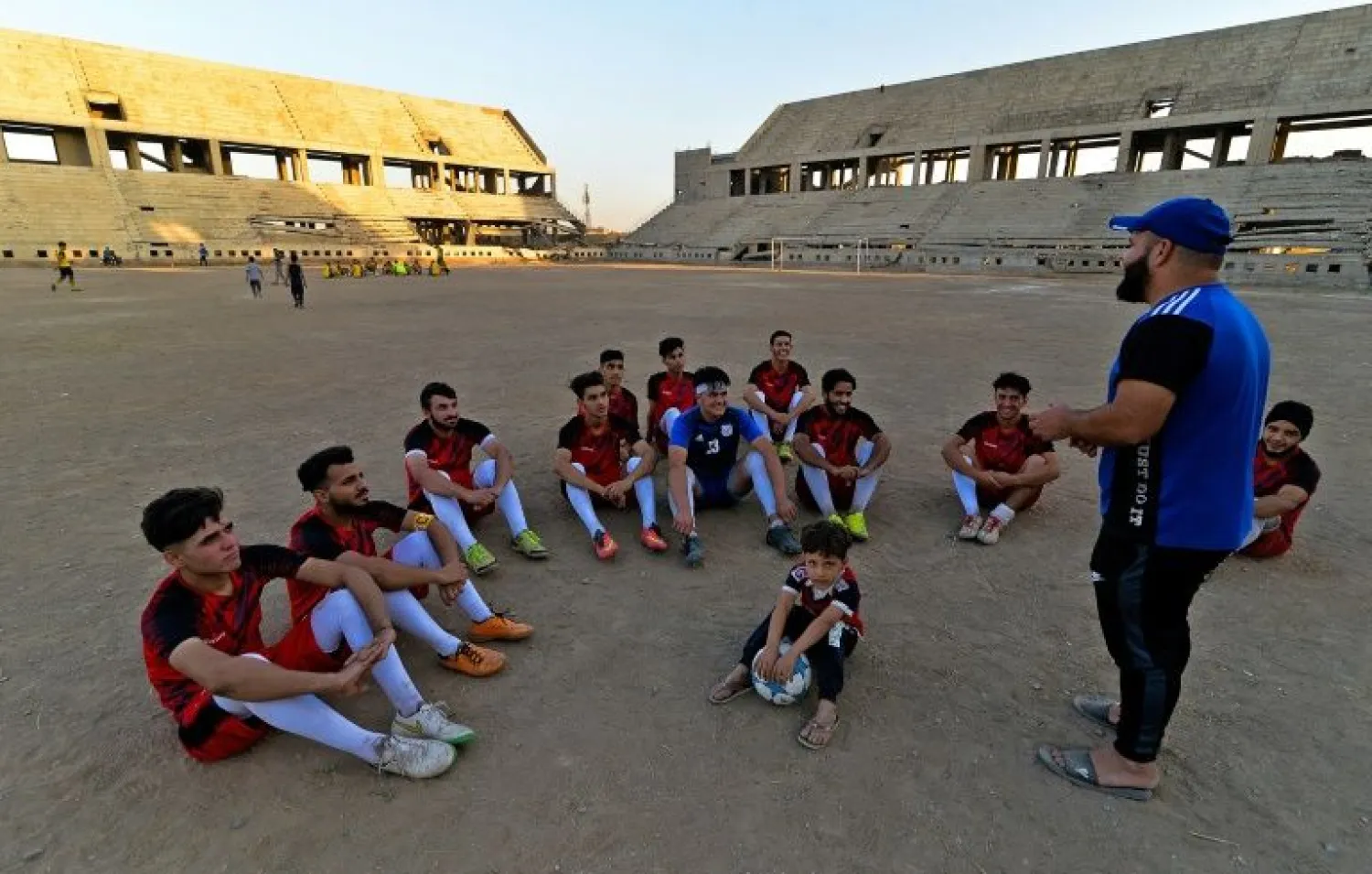
Football players train on the dusty pitch of the Al-Idara al-Mahalia stadium in Mosul which was once used by ISIS group fighters as a weapons depot and a launchpad for rocket and mortar attacks | AFP
TT

Iraq's 'Stadium of Horrors' in Ruins, but the Game Goes On

Football players train on the dusty pitch of the Al-Idara al-Mahalia stadium in Mosul which was once used by ISIS group fighters as a weapons depot and a launchpad for rocket and mortar attacks | AFP

Mohamed Fathi, coach of Mosul's football club in northern Iraq, hardly recognizes the ruined soccer stadium once used by the ISIS group fighters to fire rockets and lob mortars from.

Piles of rubble lie alongside a pitch of bumpy sand. The high concrete stadium tiers surrounding it -- with all seats torn out -- look dangerously close to collapse.

"After this was destroyed, there's no other stadiums in the city to play football," Fathi said, waving his hand at the crumbling building.

"The impact of the destruction is enough to tell you everything that happened here."

Jihadi fighters from the ISIS group seized Mosul in 2014, later expanding its so-called "caliphate" to over a third of Iraq and into neighboring Syria.

In 2017, Iraqi and coalition forces forced the hardened insurgents out in a grinding urban battle that left ancient Mosul in ruins.

The bullet-riddled 20,000-seater stadium, home to Mosul Sports Cub, was not spared, caught up in the deadly battles for control.

Two other smaller stadiums in town were also damaged.

- Football 'brings life' -

"Sadly the central government doesn't realize that football is what brings life back to a town, its people, and its youth," Fathi said. "So things have stayed the same."

Mosul Sports Club was once a solid performing club that produced some of the country's best players.

They include Hawar Mulla Mohammed, who led Iraq to its historic 2007 Asian Cup championship, and who played professionally in Europe.

Decades earlier, Iraq's national squad made its only World Cup appearance in Mexico in 1986.

Mosul's own son, skilled midfielder Haris Mohammed, ably led his country to the rare international honor.

Founded in 1947, Mosul SC played 18 seasons in Iraq's premier league, before its relegation to the first division a decade ago.

With thousands of roaring fans passionately backing their team, locals dubbed it the "stadium of horrors" for visiting teams.

But that ominous label would take on a more sinister meaning with the arrival of ISIS militants.

"I used to follow soccer matches here, and suddenly out of nowhere convoys of ISIS militants decked out with guns would show up," recounted Omar al-Mosuli, a resident in his thirties.

"It was a frightening scene, and I used to walk away quietly."

ISIS' austere and terror-ridden reign was marked by beheadings and shootings.

Like so many other facets of daily life, football changed.

Soccer disappeared as a professional pursuit -- and violence became established a past-time instead.

"Under the stands, ISIS fighters transformed the space into a massive weapons depot," Mosuli said.

"They set up launchpads inside the stadium to fire rockets during the battle to liberate the city."

He recalled how the extremists forced people to play in long shorts that reached below their knees -- and there was a strict ban on anyone donning jerseys of their favorite international teams or players.

Football matches would be abruptly halted for prayer time, he added.

- 'Plenty of talent' -

Amid Mosul's disfigured landscape, its committed players still train on the stadium's dusty pitch a couple of times a week.

There are no other suitable fields to play on.

"We are forced to train here now," Fathi, the coach, explained.

"The club's president and some of the staff even pay for the equipment out of their own pocket," he added.

But the lack of a proper place play for the team is also a reflection of the rampant corruption Iraq struggles with.

The country is consistently ranked as one of the worst performers on Transparency International's Corruption Perceptions Index.

"A foreign aid agency started reconstructing Mosul SC stadium, but the province's sports authority reassigned the site two years ago to a businessman," Mosul-based sports journalist Talal al-Ameri told AFP.

The businessman sat on the project -- a common occurrence in Iraq.

When a respected former captain of the Iraqi national squad became sports minister, Adnan Darjal, he reviewed the file.

"Due to corruption allegations, the new minister has suspended everything," Ameri added.

But the lack of stadium has not deterred Maytham Younis, the 34-year-old coach of the aptly-named amateur team Al-Mustaqbal, or "The Future".

He urges his young players to train hard, as they practice in a dusty field in Mosul's al-Bakr neighborhood in front of a small but loyal following of fans.

It is a far cry from the cheering thousands who once watched in Mosul's centerpiece stadium, but it is the best they can do for now as they wait for football to flourish again.

For now, hopes of a return to the glory days the club has seen remain a dream.

"We have plenty of talent," Younis said. "But without a stadium, it's hard for them to get noticed."



Mexico City Suspends Classes, Shifts to Remote Work for World Cup Kickoff

 Souvenirs shaped like the FIFA World Cup trophy are displayed for sale on a street in Mexico City on June 8, 2026. (AFP)
Souvenirs shaped like the FIFA World Cup trophy are displayed for sale on a street in Mexico City on June 8, 2026. (AFP)
TT

Mexico City Suspends Classes, Shifts to Remote Work for World Cup Kickoff

 Souvenirs shaped like the FIFA World Cup trophy are displayed for sale on a street in Mexico City on June 8, 2026. (AFP)
Souvenirs shaped like the FIFA World Cup trophy are displayed for sale on a street in Mexico City on June 8, 2026. (AFP)

Mexico's President Claudia Sheinbaum on Tuesday issued a decree ordering federal workers in the capital to work from home on June 11 and suspending school classes to ease traffic ‌during FIFA World ‌Cup opening ‌events.

The decree aims ⁠to improve urban mobility and road safety as Mexico City hosts the World Cup opening match and accompanying ⁠events on June 11.

The ‌opening events are expected ‌to draw significant numbers of ‌visitors.

Federal agencies must implement remote work schemes for Mexico City-based staff, with ‌exceptions for essential services including healthcare, security, critical ⁠infrastructure ⁠and World Cup operations.

Schools from preschool through university, both public and private, will close for the day under the decree.

The government also urged private companies to adopt similar remote work arrangements.


Iran Football Body Claims Fans’ Tickets for World Cup Games in the US Have Been Revoked

 Reza Mansoori (R) and Mostafa Pourmanda, Iranian supporters living in San Diego and staying at the same hotel as Iran's national football team, cheer for their team in Tijuana, Mexico, on June 8, 2026, ahead of the FIFA 2026 World Cup football tournament. (AFP)
Reza Mansoori (R) and Mostafa Pourmanda, Iranian supporters living in San Diego and staying at the same hotel as Iran's national football team, cheer for their team in Tijuana, Mexico, on June 8, 2026, ahead of the FIFA 2026 World Cup football tournament. (AFP)
TT

Iran Football Body Claims Fans’ Tickets for World Cup Games in the US Have Been Revoked

 Reza Mansoori (R) and Mostafa Pourmanda, Iranian supporters living in San Diego and staying at the same hotel as Iran's national football team, cheer for their team in Tijuana, Mexico, on June 8, 2026, ahead of the FIFA 2026 World Cup football tournament. (AFP)
Reza Mansoori (R) and Mostafa Pourmanda, Iranian supporters living in San Diego and staying at the same hotel as Iran's national football team, cheer for their team in Tijuana, Mexico, on June 8, 2026, ahead of the FIFA 2026 World Cup football tournament. (AFP)

FIFA has revoked the ticket allocation for Iran fans at the team’s three World Cup games in the United States, the national soccer federation claimed Tuesday.

Each federation for the 48 teams taking part is entitled to receive and distribute 8% of stadium capacity at the World Cup, adding up to several thousands of tickets for each game.

Just days before Iran opens its World Cup — on June 15 at the Los Angeles Rams’ stadium in Inglewood against New Zealand — the federation claimed in a statement reported by semi-official state media that it was now unable to provide any tickets to its supporters.

FIFA was approached for comment.

The claim adds to the turmoil between Iranian soccer, FIFA and tournament co-host the US, which began military attacks on Iran on Feb. 28.

Iran’s team is now based in the Mexican border city of Tijuana instead of its pre-war plan to train in Tucson, Arizona.

Some federation officials also have been denied visas to enter the US, where Iran also plays Belgium in Inglewood on June 21 and then Egypt in Seattle on June 26.

Federations of World Cup teams typically sell their ticket allocation to the most loyal fans who attend games at home and away.

Iran residents were subject to a travel ban by the US government since last year and were unlikely to get entry visas for the World Cup. It was unclear how many tickets in Iran’s allocation were sold since the tournament draw was made in December to the country's diaspora including in the US.

Still, FIFA president Gianni Infantino stated in 2017 — when US football officials were preparing a co-hosting bid with Canada and Mexico they won the following year — that fans must have access to the tournament.

“It’s obvious when it comes to FIFA competitions as well (that) any team, including the supporters and the officials of that team, who would qualify for a World Cup need to have access to the country, otherwise there is no World Cup,” Infantino said nine years ago. “That is obvious.”

A FIFA-appointed match referee from Somalia was denied entry to the US in Miami at the weekend and on Monday he was ruled out of taking part in the 104-game tournament that starts on Thursday.


World Cup Nears Kickoff after Pre-tournament Turbulence

The World Cup will kick off in the Estadio Azteca in Mexico City. Carl DE SOUZA / AFP
TT

World Cup Nears Kickoff after Pre-tournament Turbulence

The World Cup will kick off in the Estadio Azteca in Mexico City. Carl DE SOUZA / AFP

The World Cup kicks off on Thursday with FIFA betting that the enduring appeal of the greatest footballing show on earth can rise above anger at soaring ticket prices, an uneasy political climate in Donald Trump's America and the shadow of conflict in the Middle East.

A record 48 teams and millions of fans are set to descend on the United States, Canada and Mexico for the first ever World Cup co-hosted by three nations, the largest and most logistically complex edition of the tournament ever staged.

The action gets under way at Mexico City's iconic Estadio Azteca on Thursday, with co-hosts Mexico taking on South Africa at 3:00 pm local time (1900 GMT), launching a sprawling, nearly six-week-long spectacle that will culminate in the final at New Jersey's 82,500-seat MetLife Stadium on July 19.

Can Lionel Messi, at the age of 38, settle any lingering debate about his status as the greatest player of all time by leading Argentina to a second consecutive World Cup title?

Or can Messi's great rival, the 41-year-old Cristiano Ronaldo, defy father time by inspiring a talented Portugal team to its maiden World Cup win?

Or will England, led by Harry Kane, finally end the country's 60-year wait for a second major international championship following their lone 1966 World Cup victory?

Those questions and more will be answered over the course of a tournament that Gianni Infantino, the president of world football's governing FIFA, has bullishly hyped as "the greatest show that the planet has ever seen."

- Ticket fury -

Yet Infantino's breezy optimism has run into hurricane-force headwinds of skepticism during a build-up dogged by concerns over affordability, politics and conflict.

The skyrocketing cost of tickets to the tournament has triggered a global backlash which has left FIFA and Infantino struggling to mount a convincing public relations defense.

The most expensive ticket for the 2022 World Cup final cost around $1,600 at face value; in 2026 the most expensive face value ticket being sold by FIFA is an eye-watering $32,970.

That kind of inflation has been prevalent across the tournament's 104 matches, where seats for many games remain available on secondary re-sale markets despite huge demand.

Even Infantino's staunch ally, Donald Trump, has balked at the cost, reacting with surprise when told of the $1,000 price tag for tickets to the USA's opening game with Paraguay in Los Angeles on Friday -- the first game on US soil.

"I wouldn't pay it either, to be honest with you," the US president told the New York Post.

While fans absorb the expense of travel to the tournament, other critics have questioned whether the World Cup party will be soured by the political climate in the United States.

Human Rights Watch says Trump's crackdowns on immigration, demonstrations and press freedom could lead to a World Cup defined by "exclusion and fear."

Those fears were fueled Monday when FIFA dropped a Somali referee from the World Cup after he was denied entry to the United States.

Omar Artan was set to be the first match official from Somalia to referee at a global finals, but he was turned back when he arrived at Miami International Airport on Saturday.

FIFA said it was powerless to influence the decision and announced it had omitted Artan from its 52-strong referees roster.

The US-Israel military strikes launched against Iran in February have also loomed large over the tournament, where Iran are due to play three group games in the United States, starting with their opener against New Zealand on June 15.

Trump initially suggested Iran should withdraw from the tournament for their own "life and safety" before walking back his rhetoric.

Iran meanwhile have switched their base camp from Tucson, Arizona to the Mexican city of Tijuana, where they touched down early Sunday.

While Iran's players are free to travel in and out of the United States, some 15 administrative and management staff have been denied visas by US authorities in a move Iranian authorities have condemned as "deliberate and discriminatory treatment."

- Expanded field -

On the field, the decision to expand the tournament to 48 teams -- up from 32 in 2022 -- is likely to strip the group stage of any sense of jeopardy.

A total of 72 first-round matches will be needed to eliminate just 12 teams, with 32 advancing to the knockout rounds -- the top two finishers in each of the 12 first ground groups along with the eight best third-place finishers.

The tournament will see a range of other innovations.

For the first time in World Cup history, every game will feature cooling breaks in the middle of each half, a measure designed to mitigate the effects of searing heat and humidity expected at many of the tournament's 16 venues.

Players and referees will need to adjust to several new rules being rolled out at the World Cup, including teams being required to make substitutions inside 10 seconds to prevent time-wasting.

A crackdown on racist abuse will see players risk a red card for covering their mouth with a hand, arm or shirt during a confrontation with an opponent.

Next month's final, meanwhile, could well be the longest on record due to the decision to stage a Super Bowl-style halftime show, headlined by Madonna, Shakira and BTS.

The show means the half-time interval will be stretched from the traditional 15 minutes to around 25 minutes.