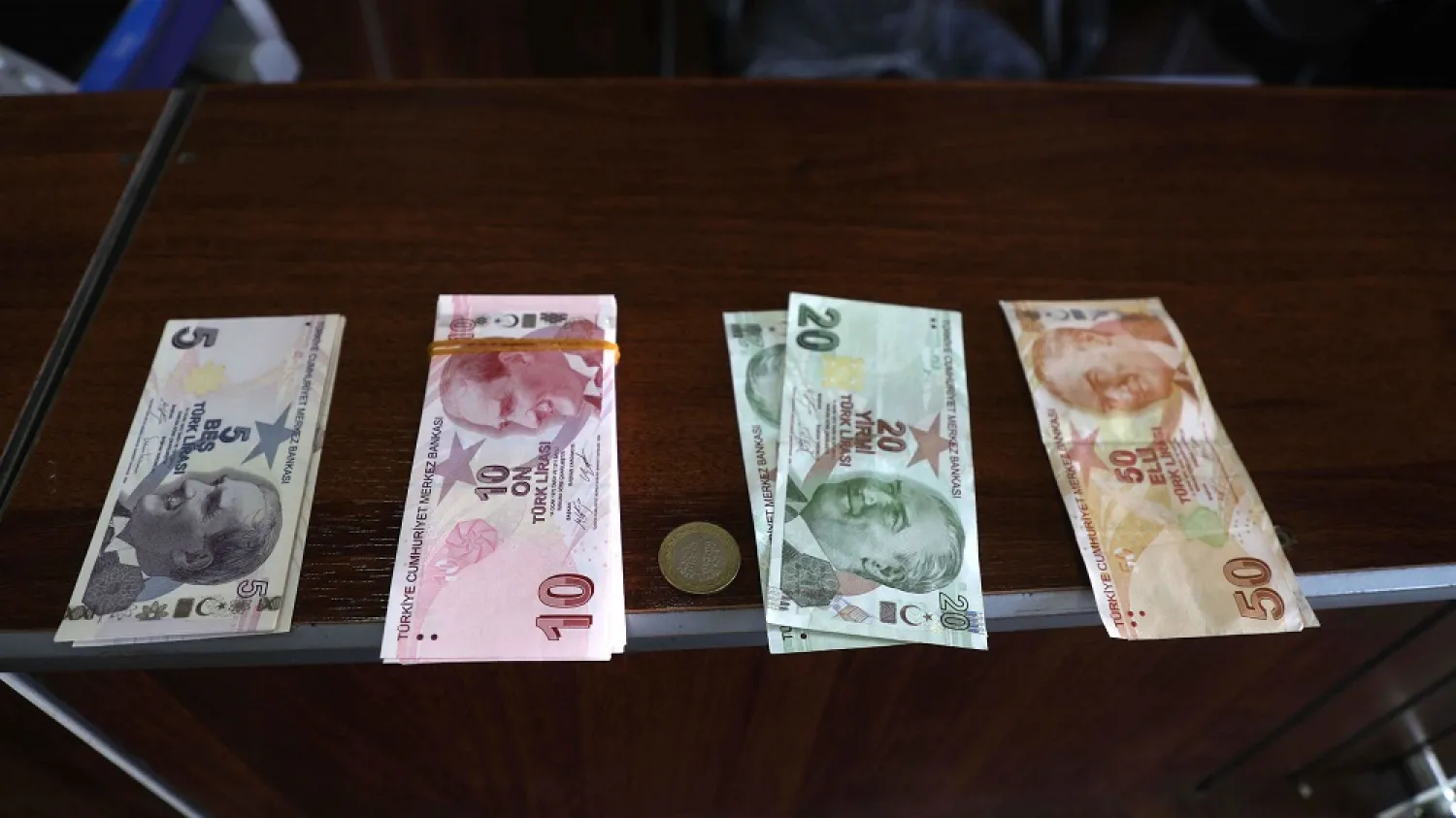
Turkish Lira Hits New Lows on Policy, Geopolitical Concerns

The Turkish lira weakened to a fresh record low against the US dollar. (Getty Images)
TT

Turkish Lira Hits New Lows on Policy, Geopolitical Concerns

The Turkish lira weakened to a fresh record low against the US dollar. (Getty Images)

The Turkish lira weakened to a fresh record low beyond 8.05 against the US dollar on Monday on investor unease about the central bank's decision last week to keep its policy rate on hold and various sources of geopolitical concern.

Strains in ties with the United States, a row with France, a dispute between Turkey and Greece over maritime rights and the conflict in Nagorno-Karabakh have all unsettled investors.

The lira weakened more than 1% to as far as 8.0515 from a close of 7.9650 on Friday. It has lost 26% of its value this year against the US currency. It also hit a record low beyond 9.5 against the euro.

"So very predictable after the CBRT fell short with its rate action last week," said Timothy Ash at BlueBay Asset Management.

The central bank (CBRT) had been expected to raise its policy rate by 175 basis points to 12% in the face of weakness in the lira triggered by concerns about high inflation and the central bank's badly depleted FX reserves.

However, it left the rate at 10.25% on Thursday and raised its late liquidity window to 14.75%, saying significant tightening in financial conditions had already been achieved after steps to contain inflation risks.

President Recep Tayyip Erdogan confirmed on Friday that Turkey had been testing the S-400 air defense systems that it bought from Russia and said US objections on the issue did not matter.

Washington says Ankara's purchase of the Russian systems compromises NATO defenses, and has threatened sanctions. The S-400 firing test last week prompted a furious response from the US State Department and the Pentagon.

But Erdogan struck a defiant tone on the issue of sanctions on Sunday, saying in a speech: "You don't know who you are dancing with. Whatever the sanctions are don't be late. Do it."

He also unleashed fierce personal criticism of France's Emmanuel Macron at the weekend, saying had a problem with Muslims and needed mental checks - a rebuke that caused France to recall its ambassador from Ankara.

Separately, Turkey has extended the seismic survey work of an exploration ship in a disputed area of the eastern Mediterranean until Nov. 4 - a move that Greece condemned on Sunday as "illegal", reviving tensions between the NATO members.


Treasury Chief Says US May 'Unsanction' Iran Oil Already Being Shipped

Ships line up in the Strait of Hormuz as seen from Khor Fakkan, United Arab Emirates, Wednesday, March 11, 2026. (AP Photo/Altaf Qadri)
TT

Treasury Chief Says US May 'Unsanction' Iran Oil Already Being Shipped

Ships line up in the Strait of Hormuz as seen from Khor Fakkan, United Arab Emirates, Wednesday, March 11, 2026. (AP Photo/Altaf Qadri)

US Treasury Secretary Scott Bessent said Thursday that Washington might "unsanction" Iranian oil that is already being shipped, as energy prices soar due to the war in the Middle East.

Bessent's comments to Fox Business came as oil and gas prices made a renewed surge after Iran hit the world's biggest liquefied natural gas (LNG) facility in Qatar and threatened to destroy the region's energy infrastructure, AFP reported.

Bessent added in the interview that the US government could also release more oil from its strategic reserves.

US President Donald Trump's administration has been scrambling to rein in rocketing energy costs after US-Israeli strikes on Iran on February 28.

Tehran's retaliation brought commercial shipping through the Strait of Hormuz to a virtual halt, snarling energy supply chains.

Around a fifth of global crude oil and liquefied natural gas passes through the critical waterway during peacetime.

Already, international benchmark Brent surged 10 percent earlier before easing to a 5.0 percent increase at $112.76 per barrel.

Recently, the United States also temporarily allowed the sale of sanctioned Russian oil that is at sea. On Wednesday, Trump temporarily waived a century-old maritime shipping law in an attempt to help ease energy prices.


UK Wage Growth Slows to Weakest in 5 Years

FILED - 17 February 2016, United Kingdom, London: A Job Centre Plus is pictured in this file photo from February 17, 2016. Photo: Philip Toscano/PA Wire/dpa
TT

UK Wage Growth Slows to Weakest in 5 Years

FILED - 17 February 2016, United Kingdom, London: A Job Centre Plus is pictured in this file photo from February 17, 2016. Photo: Philip Toscano/PA Wire/dpa

British wages rose at their slowest pace since late 2020 in the three months to January, according to official data which also suggested a weakening in employment might have bottomed out before the start of the war in the Middle East.

The figures would normally boost bets on the Bank of England cutting interest rates. But the central bank is widely expected to signal at 1200 GMT that it is waiting to see the impact of the war on Britain's economy before deciding its next move.

Yael Selfin, chief economist at KPMG UK, said Thursday's data would not change the BoE Monetary Policy Committee's immediate views.

"Priorities have shifted, with MPC members set to turn their attention to the new upside risks to the inflation outlook," she said. "This could see interest rates staying higher for longer, raising the prospect of a more pronounced loosening in the labor market over the coming months."

Last ⁠week ONS data ⁠showed zero growth in Britain's economy in January, but a surge in oil prices means an expected fall in inflation back towards its 2% target in April may prove more fleeting than the BoE had hoped.

The Office for National Statistics said regular earnings, which exclude bonuses, rose by 3.8% in the November-to-January period, the smallest increase since the three months to November 2020 and down from 4.1% in the final quarter of 2025.

Economists polled by Reuters had mostly expected regular pay growth of 4.0%. Total pay growth, which includes bonuses, showed a similar trend, slowing to 3.9%.

The ONS data also ⁠showed Britain's unemployment rate - which is calculated from a survey that the ONS is still overhauling - held at 5.2%, its highest since the COVID-19 pandemic period but below a median forecast in the Reuters poll for a rise to 5.3%.

Unemployment for 16-24 year olds - a key focus of government concern - edged down to 16.0% from an 11-year high of 16.1% in the final quarter of 2025.

Separate, more timely tax office data, also released on Thursday, showed the number of people in payrolled employment rose by a provisional estimate of 20,000 people between January and February.

In January, payrolls rose by a revised estimate of 6,000 compared with a provisional estimate of a fall of 11,000.

The latest data and revisions make it the first time that there have been three consecutive monthly rises in payrolled employment since May 2024.

"Today's labor market data will make for some positive reading. After nearly a year of disappointment, signs of stabilization are emerging," Sanjay Raja, ⁠chief UK economist at Deutsche ⁠Bank, said.

Until this month, the BoE had been trying to gauge whether lingering inflation heat in the labor market or a weakening of hiring in recent months posed the bigger risk to the economy.

But new inflation pressures have emerged, caused by the jump in energy prices after the start of the war in the Middle East.

The BoE is expected to keep borrowing costs on hold on Thursday at the end of the MPC's March meeting which, until recently, had been expected to result in a quarter-point rate cut.

The ONS data showed private sector annual regular wage growth - a measure of inflation heat closely watched by the BoE - slowed to 3.3% in the three months to January from 3.4% in the three months to December, also its weakest since late 2020.

Last month, the BoE said pay growth needed to be around 3.25% to keep inflation at its 2% target.

Deutsche Bank's Raja said the figures showed wage growth was slowing by slightly more than the BoE had forecast, offering some relief from the worries about a new energy price shock coming from the US-Israeli war on Iran.

"This, we think, can allow the MPC to remain cool-headed as we brace for another inflation wave - at least for now," he said.


Morgan Stanley Joins Peers in Pushing Back Fed Cut Forecasts on Inflation Fears

FILE PHOTO: Morgan Stanley logo appears in this illustration taken December 1, 2025. REUTERS/Dado Ruvic/Illustration/File Photo
TT

Morgan Stanley Joins Peers in Pushing Back Fed Cut Forecasts on Inflation Fears

FILE PHOTO: Morgan Stanley logo appears in this illustration taken December 1, 2025. REUTERS/Dado Ruvic/Illustration/File Photo

Morgan Stanley on Thursday joined Goldman Sachs and Barclays in pushing back its forecast for the US ​Federal Reserve's next interest rate cut to September from June after the central bank flagged inflationary risks amid the Middle East conflict.

The Wall Street brokerage now expects quarter-point reductions in September and December, revising its earlier forecast of reductions in June and September.

"In the near term, ‌higher energy prices ‌will push up overall inflation, ​but ‌it ⁠is ​too soon ⁠to know the scope and duration of the potential effects on the economy," Fed Chair Jerome Powell said in a press conference after the central bank kept interest rates unchanged on Wednesday.

New projections show that Fed policymakers as a ⁠group anticipate the Federal Open Market Committee ‌will cut the policy rate ‌by a quarter percentage point ​before the end ‌of the year, while major Wall Street firms ‌still expect two rate cuts.

"A cautious Fed means delay. The primary risk to our view remains that rate cuts come later or not at all," Morgan ‌Stanley strategists said in a note.
"In the other direction, a second-round surge ⁠in oil ⁠prices could mean activity and labor markets weaken, prompting cuts."

Oil prices have climbed above $100 a barrel due to the ongoing Middle East conflict that has led to the closure of the Strait of Hormuz, a key trade route that handles almost a fifth of the global oil trade.

Traders are currently pricing in over a 70% chance that the US central bank will ​hold rates steady ​in September, according to the CME FedWatch tool.