


Moon Richer in Water than Once Thought

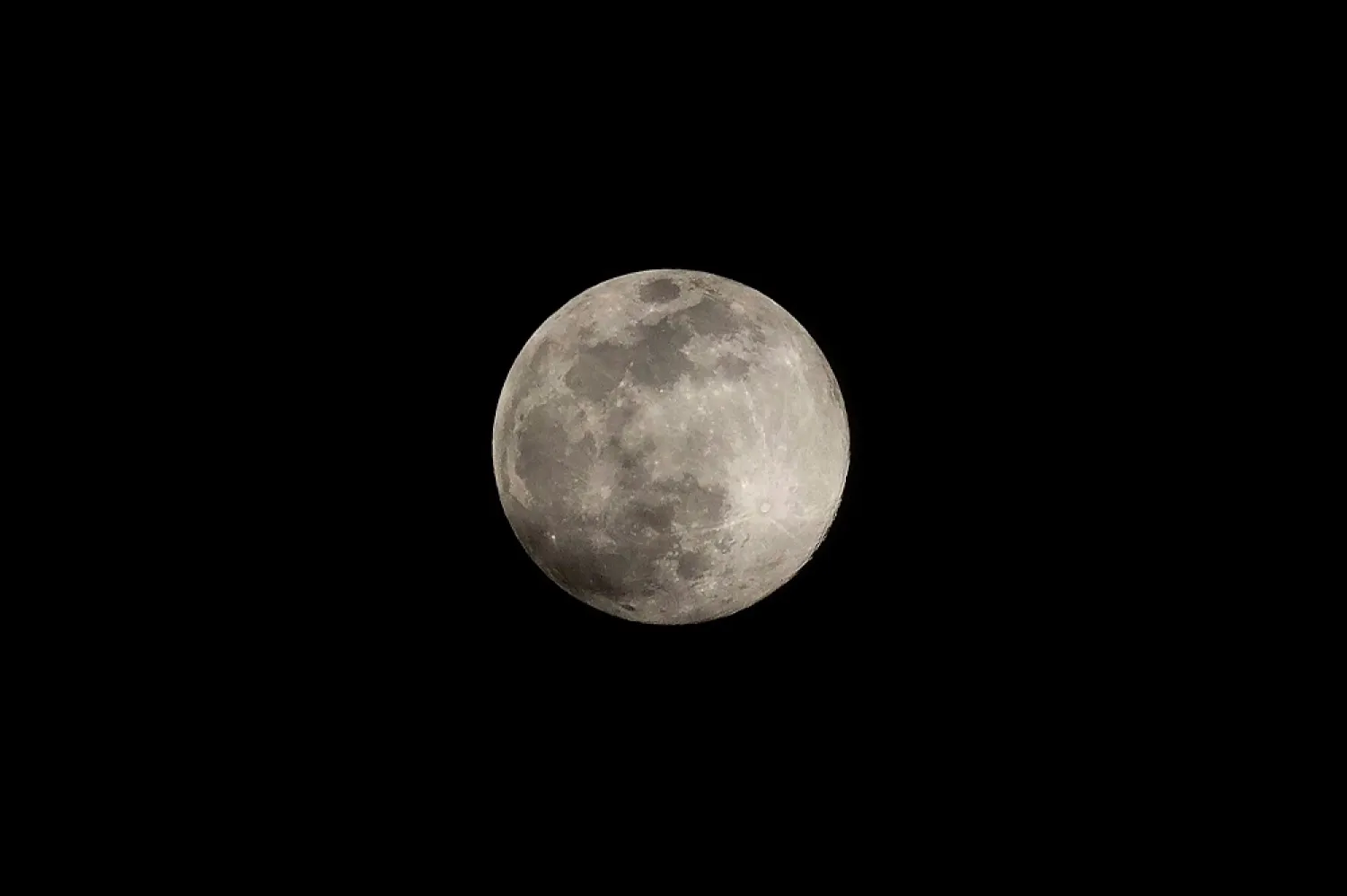
In this file photo taken on April 7, 2020, the "supermoon," one of the biggest full moons of the year, shines in the sky in Ronda, Spain. (AFP)
TT

Moon Richer in Water than Once Thought

In this file photo taken on April 7, 2020, the "supermoon," one of the biggest full moons of the year, shines in the sky in Ronda, Spain. (AFP)

There may be far more water on the Moon than previously thought, according to two studies published Monday raising the tantalizing prospect that astronauts on future space missions could find refreshment -- and maybe even fuel -- on the lunar surface.

The Moon was believed to be bone dry until around a decade ago when a series of findings suggested that our nearest celestial neighbor has traces of water trapped in the surface.

Two new studies published in Nature Astronomy on Monday suggest there could be much more water than previously thought, including ice stored in permanently shadowed "cold traps" at lunar polar regions.

Previous research has found indications of water by scanning the surface -- but these were unable to distinguish between water (H2O) and hydroxyl, a molecule made up of one hydrogen atom and one oxygen atom.

But a new study provides further chemical proof that the Moon holds molecular water, even in sunlit areas.

Using data from the Stratospheric Observatory for Infrared Astronomy (SOFIA) Airborne Telescope, researchers scanned the lunar surface at a more precise wavelength than had been used before -- six microns instead of three.

This allowed them to "unambiguously" distinguish the spectral fingerprint of molecular water, said co-author Casey Honniball, of the Hawaii Institute of Geophysics and Planetology.

Researchers believe the water might be trapped in glass beads, or another substance that protects it from the harsh lunar environment, Honniball told AFP, adding that further observations would help better understand where the water may have come from and how it is stored.

"If we find the water is abundant enough in certain locations we may be able to use it as a resource for human exploration," Honniball said.

"It could be used as drinking water, breathable oxygen, and rocket fuel."

'Tiny shadows'

A second study looks at areas of the Moon's polar regions, where water ice is believed to be trapped in lunar craters that never see sunlight.

Large hollows had previously been discovered -- NASA in 2009 found water crystals in a deep crater near the Moon's southern pole.

But the new study found evidence of billions of micro-craters that could each cradle a miniscule amount of water ice.

"If you were standing on the Moon near one of the poles, you would see a whole 'galaxy' of little shadows speckled across the surface," said lead author Paul Hayne of the Department of Astrophysics at the University of Colorado.

"Each of these tiny shadows -- most of them smaller than a coin -- would be extremely cold, and most of them cold enough to harbor ice."

This "suggests that water could be much more widespread on the Moon than previously thought", Hayne told AFP.

The authors say this could mean that approximately 40,000 km2 of the lunar surface has the capacity to trap water.

They were able to reconstruct the size and distribution of these little craters using high-resolution images and lunar temperature measurements taken from NASA's Lunar Reconnaissance Orbiter.

These micro-craters are distributed across both poles and should be as cold -- around -160 degrees Celsius -- as the larger, kilometer-scale lunar hollows, Hayne told AFP.

And there are "tens of billions" of them, Hayne said, compared to a few hundred larger cold traps.

Scientists hope that samples from these cold traps could tell us more about how the Moon -- and even Earth -- got its water, he said, perhaps providing evidence of water delivered by asteroids, comets and the solar wind.

But they also present a potential practical resource for astronauts, both on the Moon and for a human mission to Mars.

NASA, which plans to establish a space station in the lunar orbit called Gateway, envisages that ice excavated from the Moon's south pole may one day supply drinking water.

They could also split the molecules apart to make rocket fuel for an onward journey.


Spain and Portugal Continue to Battle Storm Leonardo as New Storm Approaches

 A mountain landslide blocks railway tracks during heavy rains, as storm Leonardo hits parts of Spain, in Benaojan, Spain, February 6, 2026. (Reuters)
A mountain landslide blocks railway tracks during heavy rains, as storm Leonardo hits parts of Spain, in Benaojan, Spain, February 6, 2026. (Reuters)
TT

Spain and Portugal Continue to Battle Storm Leonardo as New Storm Approaches

 A mountain landslide blocks railway tracks during heavy rains, as storm Leonardo hits parts of Spain, in Benaojan, Spain, February 6, 2026. (Reuters)
A mountain landslide blocks railway tracks during heavy rains, as storm Leonardo hits parts of Spain, in Benaojan, Spain, February 6, 2026. (Reuters)

Storm Leonardo continued to batter the Iberian Peninsula on Friday, bringing floods and putting rivers at risk of bursting their banks while thousands of people were evacuated from their homes in Spain and Portugal.

In southern Spain's Andalusia region, some 7,000 people have had to leave their homes due to successive storms.

Among them were around 1,500 people ordered to evacuate the mountain village of Grazalema, where Andalusia's regional leader Juan Manuel Moreno warned that aquifers were "full to the brim with water,” and at risk of collapsing.

“It's raining on already saturated ground. The land is unable to drain," Moreno said. “We urge extreme caution. This is not over.”

Spanish police said Friday they had found a body located 1,000 meters (about 0.6 miles) away from where a woman had disappeared Wednesday after she fell into a river in Malaga province while trying to rescue her dog. Police said they had not yet identified the body, but believed it belonged to the 45-year-old woman.

Another storm front, Marta, was expected to arrive Saturday, with Spain's weather agency AEMET saying it would bring even more rain and heavy winds, including to areas already drenched by Storm Leonardo.

Marta is expected to affect Portugal, too.

Of particular concern was southern Spain's Guadalquivir River, which flows through Córdoba and Seville and eventually into the Atlantic Ocean, and whose water levels have dramatically risen in recent days.

Additional rain Saturday could leave many more homes at risk in Córdoba, local authorities warned.

In Portugal, parts of Alcacer do Sal were submerged after the Sado River overflowed, forcing residents to leave the city located 90 kilometers (about 56 miles) south of Lisbon.

Alerts were issued also for regions near the Tagus River due to rising water levels.

A separate storm in late January left a trail of destruction in Portugal, killing several people, according to Portuguese authorities.


AROYA Cruises Debuts Arabian Gulf Voyages for 2026

AROYA offers a curated experience featuring culturally inspired entertainment and diverse dining options - SPA
TT

AROYA Cruises Debuts Arabian Gulf Voyages for 2026

AROYA offers a curated experience featuring culturally inspired entertainment and diverse dining options - SPA

AROYA Cruises, a subsidiary of the PIF-owned Cruise Saudi, has officially launched its inaugural season in the Arabian Gulf.

Running from February 21 to May 8, the season marks a milestone in regional tourism by blending authentic Saudi hospitality with international maritime standards, SPA reported.

AROYA offers a curated experience featuring culturally inspired entertainment and diverse dining options.

The season is designed to provide guests with a dynamic way to explore the Gulf, setting a new benchmark for luxury travel that reflects the Kingdom's heritage on a global stage.


Snowstorm Brings Much of Denmark to a Halt

A car drives in heavy snow at Store Heddinge in South Zealand, Denmark, 05 February 2026.  EPA/Mads Claus Rasmussen
A car drives in heavy snow at Store Heddinge in South Zealand, Denmark, 05 February 2026. EPA/Mads Claus Rasmussen
TT

Snowstorm Brings Much of Denmark to a Halt

A car drives in heavy snow at Store Heddinge in South Zealand, Denmark, 05 February 2026.  EPA/Mads Claus Rasmussen
A car drives in heavy snow at Store Heddinge in South Zealand, Denmark, 05 February 2026. EPA/Mads Claus Rasmussen

Denmark authorities halted public transport, closed schools and cancelled flights on Friday as heavy snowfall blanketed much of the country.

The Nordic country's meteorological institute DMI warned that heavy snow would likely continue until Friday evening in the east, where the capital Copenhagen is located.

Police said people should avoid going outdoors unless necessary and stay indoors in the capital and the surrounding region.

Copenhagen's airport cancelled flights to Paris and Berlin and warned of "delay and cancellation risks because of snowy conditions." Many schools were closed.

In the second-largest city of Aarhus, bus services were cancelled.
