

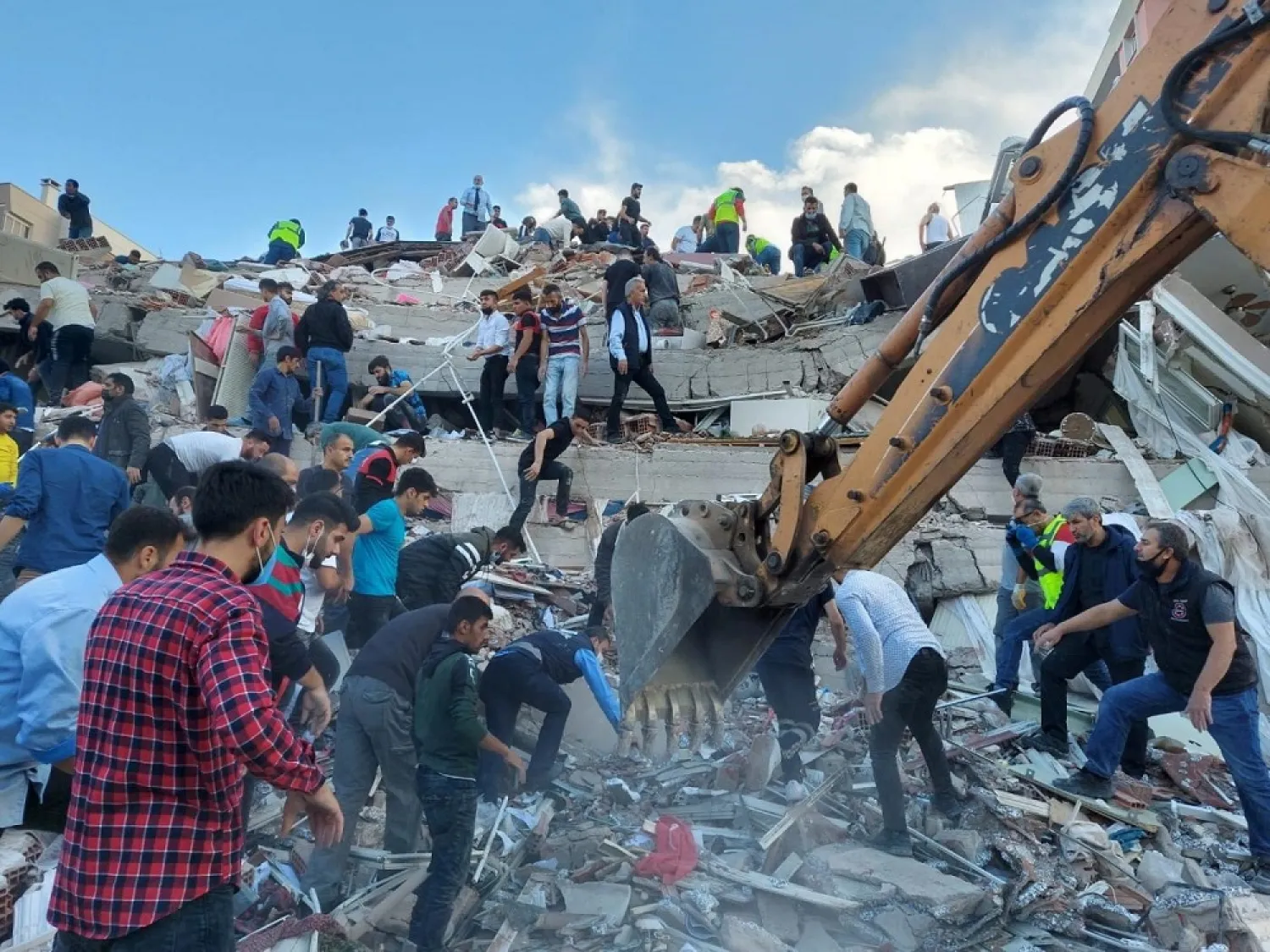

14 Killed as Quake Strikes Turkish Coast, Greek Island

Locals and officials search for survivors at a collapsed building in Izmir, Turkey, after a strong earthquake struck the Aegean Sea on October 30, 2020. (Reuters)
TT

14 Killed as Quake Strikes Turkish Coast, Greek Island

Locals and officials search for survivors at a collapsed building in Izmir, Turkey, after a strong earthquake struck the Aegean Sea on October 30, 2020. (Reuters)

A strong earthquake struck Friday in the Aegean Sea between the Turkish coast and the Greek island of Samos, killing at least 14 people and injuring hundreds amid collapsed buildings and flooding, officials said.

A small tsunami struck the Seferihisar district south of Izmir, the city in western Turkey that was the worst affected, said Haluk Ozener, director of the Istanbul-based Kandilli Observatory and Earthquake Research Institute.

At least 12 people were killed in Izmir, Turkey’s third-largest city, including one who drowned, according to Turkey’s Disaster and Emergency Management Presidency, or AFAD.

Turkey’s President Recep Tayyip Erdogan, speaking in Istanbul, said 438 were injured with five undergoing surgery and eight in intensive care.

On Samos, two teenagers died after being struck by a wall that collapsed. Greek Prime Minister Kyriakos Mitsotakis tweeted condolences, saying “Words are too poor to describe what one feels before the loss of children.”

At least 19 people were injured in Samos, with two, including a 14-year-old, being airlifted to Athens and seven hospitalized on the island, health authorities said.

The small tsunami that hit the Turkish coast also affected Samos, with seawater flooding streets in the main harbor town of Vathi. Authorities warned people to stay away from the coast and from potentially damaged buildings.

Izmir Gov. Yavuz Selim Kosger said at least 70 people were rescued from wrecked buildings, with four destroyed and more than 10 collapsed. Others suffered less severe damage, he said, but did not give an exact number.

Search-and-rescue efforts were underway in at least 17 buildings, AFAD said. Turkish media showed rescuers pulling people from the rubble. Clouds of dust or smoke rose from several spots.

The earthquake, which the Kandilli institute said had a magnitude of 6.9, struck at 2:51 pm local time (1151 GMT) in Turkey and was centered was centered in the Aegean northeast of Samos at a depth of 16.5 kilometers (10.3 miles).

It was felt across the eastern Greek islands and as far as the Greek capital, Athens, and in Bulgaria. In Turkey, it was also felt across the regions of Aegean and Marmara, including Istanbul. Istanbul’s governor said there were no reports of damage in the city, Turkey’s largest.

Video on Twitter showed flooding in the Seferihisar district, and Turkish officials and broadcasters called on people to stay off the streets after reports of traffic congestion. Izmir Mayor Tunc Soyer urged residents to not enter damaged buildings and to be mindful of social distancing and mask mandates amid the COVID-19 pandemic.

Greek seismologist Akis Tselentis told Greek state broadcaster ERT that due to the shallow depth of its epicenter — roughly 10 kilometers — potentially powerful aftershocks could be expected for several weeks and warned that buildings could collapse in a strong aftershock.

Rescue teams and relief supplies were sent to Izmir from Istanbul and other cities, as well as from the Turkish Red Crescent.

France offered assistance to both countries. The secretary of state for European affairs tweeted France’s “full solidarity with Greece and Turkey” and said “we are ready to offer the necessary aid.”

The Greek minister responsible for civil protection and crisis management, Nikos Hardalias, headed to Samos along with a search and rescue team, paramedics and engineers.

In a show of solidarity rare in recent months of tense bilateral relations, Greek and Turkish government officials issued mutual messages of solidarity.

“We pray that there is no further loss of live in Turkey or Greece and we send our best wishes to all those affected on both sides of the earthquake," Turkey’s Communications Director Fahrettin Altun tweeted. "This tragedy reminds us once again how close we are despite our differences over policy. We’re ready to help if Greece needs it.”

Mitsotakis, the Greek prime minister, tweeted that he had phoned Erdogan “to offer my condolences for the tragic loss of life from the earthquake that struck both our countries. Whatever our differences, these are times when our people need to stand together.”

Speaking Friday evening, Erdogan thanked Mitsotakis for his call and offer for help. He said Turkey was not currently in need but reciprocated by saying, “We stand by Greece.” He also thanked other countries for their offers of aid.

Relations between Turkey and Greece have been particularly tense, with warships from both facing off in the eastern Mediterranean in a dispute over maritime boundaries and energy exploration rights. The ongoing tension has led to fears of open conflict between the two neighbors and NATO allies.



Türkiye: Ocalan Announces ‘Integration Phase’

Members of the Kurdish community take part in a protest calling for the release of convicted Kurdistan Worker's Party (PKK) leader Abdullah Ocalan in Diyarbakir on February 15, 2026. (Photo by Ilyas AKENGIN / AFP)
TT

Türkiye: Ocalan Announces ‘Integration Phase’

Members of the Kurdish community take part in a protest calling for the release of convicted Kurdistan Worker's Party (PKK) leader Abdullah Ocalan in Diyarbakir on February 15, 2026. (Photo by Ilyas AKENGIN / AFP)

The jailed leader of the Kurdistan Workers Party, Abdullah Ocalan, has said that the Ankara-PKK peace process has entered its “second phase,” as the Turkish parliament sets the stage to vote on a draft report proposing legal reforms tied to peace efforts.

A delegation from the pro-Kurdish Peoples' Equality and Democracy Party (DEM Party), including lawmakers Pervin Buldan, Mithat Sancar, and Ocalan’s lawyer Ozgur Faik, met with the jailed PKK leader on Monday on the secluded Imrali island.

Sancar said that the second phase will be focused on democratic integration into
Türkiye’s political system.

According to the lawmaker, the PKK leader considered the first phase the “negative dimension” concerned with ending the decades-old conflict between the armed group and Ankara.

“Now we are facing the positive phase,” Ocalan said, “the integration phase is the positive phase; it is the phase of construction.”

For the second phase to be implemented, Ocalan called on Turkish authorities to provide conditions that would allow him to put his “theoretical and practical capacity” to work.

The 60-page draft report on peace with the PKK was completed by a five-member writing team, which is chaired by Parliament Speaker Numan Kurtulmuş, and is scheduled for a vote on Wednesday.

The report is organized into seven sections.

In July last year, Ocalan said the group's armed struggle against Türkiye has ended and called for a full shift to democratic politics.


Iranians Chant Slogans Against Supreme Leader at Memorials for Slain Protesters

An Iranian man holds the Iranian national flag during a memorial ceremony for those killed in anti-government protests earlier last month, at the Mosalla mosque in Tehran, Iran, 17 February 2026. (EPA)
TT

Iranians Chant Slogans Against Supreme Leader at Memorials for Slain Protesters

An Iranian man holds the Iranian national flag during a memorial ceremony for those killed in anti-government protests earlier last month, at the Mosalla mosque in Tehran, Iran, 17 February 2026. (EPA)

Iranians shouted slogans against Supreme Leader Ali Khamenei on Tuesday as they gathered to commemorate protesters killed in a crackdown on nationwide demonstrations that rights groups said left thousands dead, according to videos verified by AFP.

The country's clerical authorities also staged a commemoration in the capital Tehran to mark the 40th day since the deaths at the peak of the protests on January 8 and 9.

Officials acknowledge more than 3,000 people died during the unrest, but attribute the violence to "terrorist acts", while rights groups say many more thousands of people were killed, shot dead by security forces in a violent crackdown.

The protests, sparked by anger over the rising cost of living before exploding in size and anti-government fervor, subsided after the crackdown, but in recent days Iranians have chanted slogans from the relative safety of homes and rooftops at night.

On Tuesday, videos verified by AFP showed crowds gathering at memorials for some of those killed again shouting slogans against the theocratic government in place since the 1979 revolution.

In videos geolocated by AFP shared on social media, a crowd in Abadan in western Iran holds up flowers and commemorative photos of a young man as they shout "death to Khamenei" and "long live the shah", in support of the ousted monarchy.

Another video from the same city shows people running in panic from the sounds of shots, though it wasn't immediately clear if they were from live fire.

In the northeastern city of Mashhad a crowd in the street chanted, "One person killed, thousands have his back", another verified video showed.

Gatherings also took place in other parts of the country, according to videos shared by rights groups.

- Official commemorations -

At the government-organized memorial in Tehran crowds carried Iranian flags and portraits of those killed as nationalist songs played and chants of "Death to America" and "Death to Israel" echoed through the Khomeini Grand Mosalla mosque.

Iranian President Masoud Pezeshkian attended a similar event at the Imam Reza shrine in Mashhad.

Authorities have accused sworn enemies the United States and Israel of fueling "foreign-instigated riots", saying they hijacked peaceful protests with killings and vandalism.

Senior officials, including First Vice President Mohammad Reza Aref and Revolutionary Guards commander Esmail Qaani, attended the ceremony.

"Those who supported rioters and terrorists are criminals and will face the consequences," Qaani said, according to Tasnim news agency.

International organizations have said evidence shows Iranian security forces targeted protesters with live fire under the cover of an internet blackout.

The US-based Human Rights Activists News Agency (HRANA) has recorded more than 7,000 killings in the crackdown, the vast majority protesters, though rights groups warn the toll is likely far higher.

More than 53,500 people have been arrested in the ongoing crackdown, HRANA added, with rights groups warning protesters could face execution.

Tuesday's gatherings coincided with a second round of nuclear negotiations between Iran and the United States in Geneva, amid heightened tensions after Washington deployed an aircraft carrier group to the Middle East following Iran's crackdown on the protests.


Independent UN Body Condemns ‘Vicious Attacks’ on UN Expert on Palestinian Rights

United Nations (UN) Special Rapporteur on the occupied Palestinian territories Francesca Albanese looks on at the end of a press conference on the human rights situation in Gaza in Geneva on September 15, 2025. (AFP)
TT

Independent UN Body Condemns ‘Vicious Attacks’ on UN Expert on Palestinian Rights

United Nations (UN) Special Rapporteur on the occupied Palestinian territories Francesca Albanese looks on at the end of a press conference on the human rights situation in Gaza in Geneva on September 15, 2025. (AFP)

An ‌independent United Nations body on Tuesday condemned what it described as vicious attacks based on disinformation by several European ministers against the organization's special rapporteur for Palestine, Francesca Albanese.

In the past week several European countries, including Germany, France and Italy, called for Albanese’s resignation over her alleged criticism of Israel. Albanese, an Italian lawyer, denies making the remarks.

On Friday, the Czech Republic's Foreign Minister Petr Macinka quoted Albanese on X as having called Israel a "common enemy of humanity", and he ‌also called for ‌her resignation.

A transcript of Albanese's remarks ‌made ⁠in Doha on ⁠February 7 seen by Reuters did not characterize Israel in this way, although she has consistently criticized the country in the past over the Gaza conflict.

The UN Coordination Committee - a body of six independent experts which coordinates and facilitates the work of Special Rapporteurs - accused European ministers of relying on "manufactured ⁠facts".

"Instead of demanding Ms. Albanese's resignation ‌for performing her mandate...these government representatives ‌should join forces to hold accountable, including before the International Criminal Court, ‌leaders and officials accused of committing war crimes and ‌crimes against humanity in Gaza," the Committee said.

It said the pressure exerted on Albanese was part of an increasing trend of politically motivated and malicious attacks against independent human rights experts, UN officials ‌and judges of international courts.

US President Donald Trump's administration imposed sanctions on Albanese after she wrote ⁠letters ⁠to US companies accusing them of contributing to gross human rights violations by Israel in Gaza and the West Bank.

UN experts are commissioned by the Geneva-based Human Rights Council to monitor and document specific human rights crises but are independent of the organization itself.

There is no precedent for removing a special rapporteur during their term, although diplomats said that states on the 47-member council could in theory propose a motion to do so.

However, they said strong support for Palestinian rights within the body means that such a motion was unlikely to pass.