


Stocks Sweat on US Election Race, Safe-Haven Bonds Gain

The London Stock Exchange Group offices are seen in the City of London, Britain, December 29, 2017. REUTERS/Toby Melville/File Photo
TT

Stocks Sweat on US Election Race, Safe-Haven Bonds Gain

The London Stock Exchange Group offices are seen in the City of London, Britain, December 29, 2017. REUTERS/Toby Melville/File Photo

Share markets were whipsawed, while bonds and the dollar gained on Wednesday as results from the US presidential election proved far closer than polls had predicted, potentially leaving the outcome in doubt for days or weeks.

Democratic contender Joe Biden took to the air to declare he was optimistic about winning and called for all votes to be counted, no matter how long it took.

President Donald Trump responded by saying he had won, that "they" were trying to steal the election, and that he would go to the US Supreme Court to fight for victory if necessary.

Investors initially wagered that a possible Democratic sweep by Biden could ease political risk and provide a huge boost to fiscal stimulus.

But the mood quickly changed as Trump snatched Florida and ran much closer in other battleground states than polls predicted.

US equity futures went on a wild ride, rising then falling, climbing again as the voting seemed to favor Trump only to sag once more as the president vowed to make a Supreme Court challenge.

The prospect of a drawn out and bitter fight ahead meant Europe's main bourses in London, Paris, and Frankfurt fell a modest 0.1%-0.8% as they opened as investors factored in the uncertainty ahead.

"It means possibly quite a lot of volatility," said AXA Group's Chief Economist Gilles Moec in London.

"As it is not clear, markets are going to overreact to every tiny piece of news," such as any further talk from Trump or Biden about legal fights.

Dealers said investors could be thinking a status quo result would lessen political uncertainty and remove the risk a Biden administration would roll back corporate tax cuts.

The technology sector saw reason for gains, with NASDAQ futures rising 2.4%. E-Mini futures for the S&P 500 dropped 1% after Trump signaled his intention to go to the Supreme Court but clawed higher again in early European dealing.

Andrew Brenner, head of international fixed income at NatAlliance Securities, said the move in techs appeared to be a play on the Senate potentially staying Republican.

Brenner said that under a Biden win tech stocks were seen faring worse, partly due to Democrats going after the sector in hearings and because a potential rise in capital gains tax would hit tech stocks harder.

Stéphane Monier, CIO at Lombard Odier said a divided Congress would have "far-reaching implications for markets, mostly because it means that any kind of pandemic recovery package is still tough to approve."

Japan's Nikkei was ahead by 1.7%, while MSCI's broadest index of Asia-Pacific shares outside Japan edged up 0.2%.

Chinese blue chips rose 0.7%, with markets uncertain how Sino-US relations would develop from here.

Some investors hedged against the risk of a contested election or at least a drawn-out process as mail-in ballots were counted.

"It's a wait-and-see," said Matt Sherwood, head of investment strategy at Perpetual in Sydney.

"I think the odds of a clean (Democrat) sweep are diminishing, almost by the minute. That reduces the possibility, or the likelihood at least of a large stimulus programme being agreed to in the first days of a Biden administration."

That saw 10-year Treasury yields fall all the way back to 0.81%, having been at a five-month top of 0.93%.

The US dollar had a roller-coaster session, reversing early losses to be last up 1% on a basket of currencies at 93.902. The euro fell back hard to $1.1650 and away from a top of $1.1768.

The chance of a Trump victory saw the dollar jump 2% against the Mexican peso on the assumption US trade policies would continue to favor tariffs. Norway's crown, Australia's risk-sensitive dollar, and Britain's pound all tumbled too.

Going the other way, the dollar eased nearly 1% at one point to the Russian rouble, which had been one of the hardest fallers in the run up to the election, though the move seemed to lose traction in European trading.

STILL TO COME

Investors are awaiting the outcome of US Federal Reserve and Bank of England meetings this week, which are expected to at least give a nod to further stimulus.

The Reserve Bank of Australia on Tuesday cut interest rates to near zero and boosted its bond-buying program, adding to the tidal wave of cheap money flooding the global financial system.

Gold had been buoyed by the extensive liquidity but ran into profit-taking on Wednesday, losing 0.6% to $1,896 an ounce.

Oil prices held gains made after industry data showed crude inventories in the United States dropped sharply.

Dealers said a returned Republican administration would likely be more positive for the oil industry than the Democrats that favor renewable technology.

US crude futures were up 25 cents at $37.86 a barrel, with Brent crude futures gaining 22 cents to $39.94.



US Stocks Dip on Mixed Earnings as Markets Monitor Iran

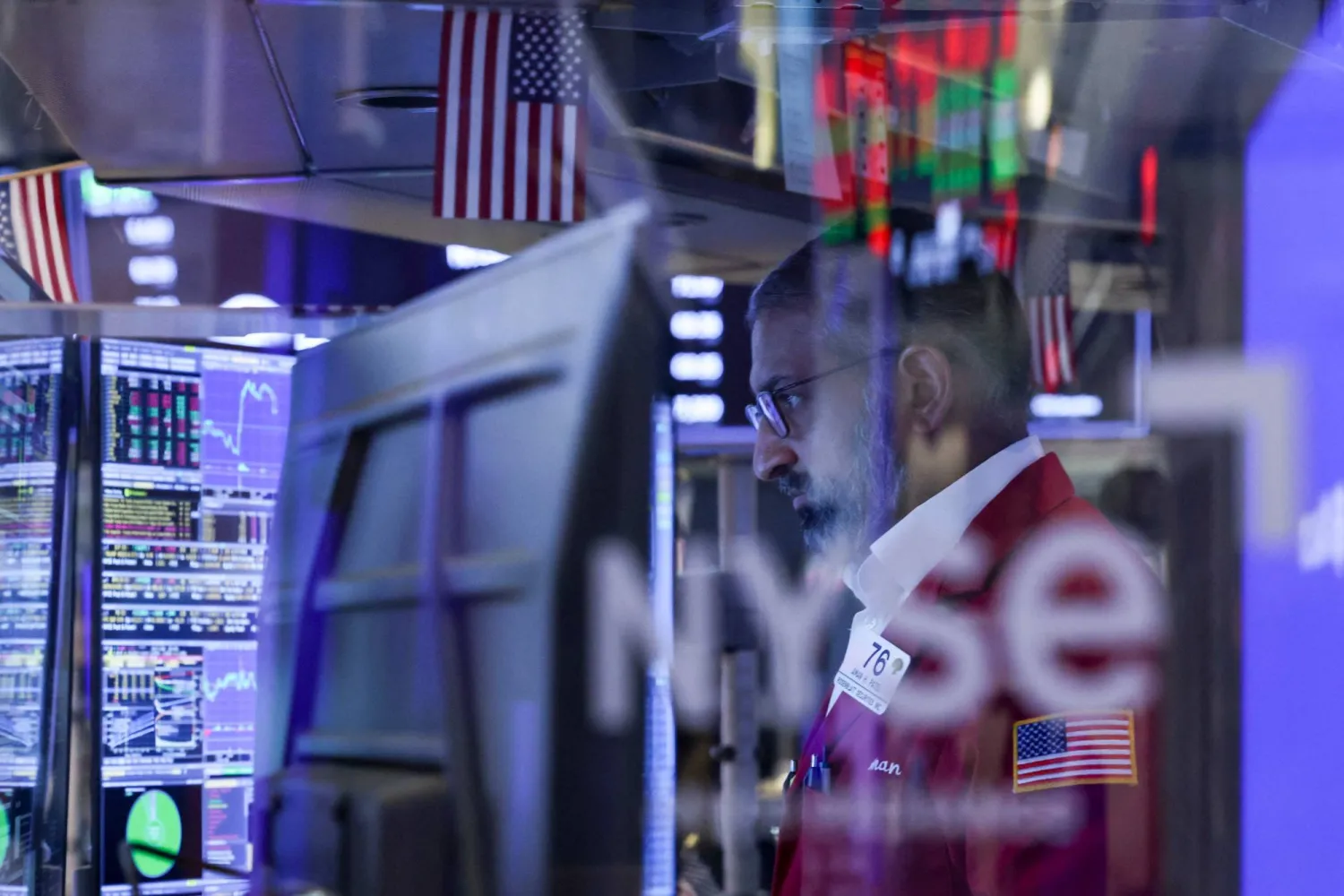
A trader works on the floor of the New York Stock Exchange (NYSE) at the opening bell in New York on March 24, 2026.  (Photo by ANGELA WEISS / AFP)
A trader works on the floor of the New York Stock Exchange (NYSE) at the opening bell in New York on March 24, 2026. (Photo by ANGELA WEISS / AFP)
TT

US Stocks Dip on Mixed Earnings as Markets Monitor Iran

A trader works on the floor of the New York Stock Exchange (NYSE) at the opening bell in New York on March 24, 2026.  (Photo by ANGELA WEISS / AFP)
A trader works on the floor of the New York Stock Exchange (NYSE) at the opening bell in New York on March 24, 2026. (Photo by ANGELA WEISS / AFP)

Wall Street stocks retreated from records early Thursday as markets digested a trove of mixed earnings reports and monitored the latest dynamics between the United States and Iran.

Analysts cited profit-taking after both the S&P 500 and Nasdaq shrugged off a jump in oil prices to finish at records on Wednesday.

About 10 minutes into trading, the Dow Jones Industrial Average was down 0.4 percent at 49,311.39, AFP reported.

The broad-based S&P 500 dipped 0.2 percent to 7,126.19, while the tech-rich Nasdaq Composite Index declined 0.3 percent to 24,588.07.

David Morrison, senior market analyst at FCA, called Thursday's early trading action "a mild bout of profit-taking triggered by some worrying reports of hostile action between the US and Iran," according to a note.

The US Defense Department said its forces boarded a vessel in the Indian Ocean that was transporting oil from Iran, while President Donald Trump announced on social media that he ordered the Navy to "shoot and kill" boats placing mines in the Strait of Hormuz.

Iran vowed it would keep the strait closed to all but a trickle of approved vessels for as long as the United States blockaded its ports.

Among companies reporting results, Tesla fell 1.7 percent and Lockheed Martin dropped 3.7 percent, while American Airlines jumped 4.9 percent.


What Does the Inclusion of Saudi Bonds in the J.P. Morgan Index Mean?

Saudi woman walks at the Saudi stock market in Riyadh - Reuters
TT

What Does the Inclusion of Saudi Bonds in the J.P. Morgan Index Mean?

Saudi woman walks at the Saudi stock market in Riyadh - Reuters

Saudi Arabia’s debt market is set for a strategic shift in early 2027, following J.P. Morgan’s announcement that local-currency bonds will be included in its global emerging markets bond index. The move represents a vote of confidence in the Kingdom’s structural reforms and is expected to open the door to substantial capital inflows that will help finance major economic transformation projects.

In a note, J.P. Morgan said the move follows a series of reforms to improve foreign investor access and enhance local market capabilities.

The bank added that Saudi sukuk, Shariah-compliant debt instruments that function similarly to bonds, with a remaining maturity of up to 15 years, will be eligible for inclusion in the Government Bond Index-Emerging Markets (GBI-EM), the most widely tracked benchmark of its kind, with $233 billion in assets tracking it.

J.P. Morgan said eight sukuk issues would be eligible for inclusion, with a total value of $69 billion.

The Kingdom’s inclusion in the index is expected to boost liquidity and demand for sovereign debt, contributing to lower borrowing costs.

In September, J.P. Morgan had placed Saudi Arabia on “Positive Index Watch,” paving the way for its eventual inclusion in the GBI-EM.

Commenting on the decision, Saudi Finance Minister Mohammed Al-Jadaan told Bloomberg that the move reflects continued confidence in the Kingdom’s economic transformation trajectory. He said the inclusion marks a new milestone in Saudi Arabia’s integration into global financial markets, adding that its immediate impact will be seen in broadening and diversifying the investor base and supporting long-term capital inflows into the domestic debt market, thereby strengthening the resilience and stability of the national economy.

The Significance of the Index

The importance of J.P. Morgan’s index lies in its role as a benchmark guiding major global fund allocations, particularly passive funds that track indices automatically. With an expected weighting of around 2.52 percent, Saudi bonds will become a core component of international investor portfolios, increasing government bond liquidity and reducing borrowing costs over the long term, a critical factor for the Kingdom’s economy.

Passive funds play a key role in ensuring steady inflows. Trillions of dollars globally are managed through such funds. Once Saudi Arabia is included in the index, these funds will purchase Saudi bonds to remain aligned with it. Unlike active investors, they do not rapidly buy or sell based on daily news or market sentiment, but continue to hold bonds as long as they remain in the index, providing significant stability to the Saudi debt market. Their participation also ensures a constant base of large-scale buyers, facilitating bond trading at any time.

Reforms That Paved the Way

This inclusion is the result of a series of regulatory reforms highlighted by the bank in its note. Saudi Arabia has improved international investor access by linking to the global Euroclear system, expanding its network of primary dealers to include international banks, and facilitating cross-border settlement and trading. These measures have enhanced legal certainty and transparency, making the Saudi debt market an attractive and secure destination for foreign capital.

Financial Stability Amid Regional Challenges

Beyond its economic dimensions, the move carries strategic significance amid ongoing geopolitical tensions in the region. Increased inflows into local bonds are expected to strengthen the government’s ability to manage any economic fallout from regional instability. It underscores the resilience and attractiveness of the Saudi economy, demonstrating its capacity to attract quality investment and secure the financing needed for its development plans regardless of external challenges.


S&P Warns African Sovereign Credit Rating Risks Likely to Worsen

Central Bank of Egypt building (A.P.)
TT

S&P Warns African Sovereign Credit Rating Risks Likely to Worsen

Central Bank of Egypt building (A.P.)

S&P Global Ratings warned on Thursday that the risks to African sovereign credit scores were likely to worsen the longer the Middle East war drags on.

The ratings agency said that higher fuel and fertilizer import costs would increase inflation and fiscal strains for countries, "potentially leading to rating pressure".

Egypt, Mozambique and Rwanda are among the "most exposed" the agency said, although Egypt's deep domestic capital markets and Rwanda's high levels of concessional debt provide some offset, according to Reuters.

Less exposed are net-oil exporters Nigeria, Angola and Congo-Brazzaville as well as Morocco, due to stronger foreign-currency reserves.

S&P's "base case" assumed that the conflict will peak and that the Strait of Hormuz will gradually reopen but related disruptions will likely persist for months. A resumption of hostilities and a more prolonged conflict would present a greater threat to many African sovereigns.

The ratings agency said it expected Africa's borrowing costs to increase due to war's impacts and as a result of global risk aversion.

S&P in recent weeks kept Egypt's credit rating on a "stable" outlook and affirmed ratings for Morocco, Ghana and Mozambique.