The Evolution of Football Nutrition: From Chocolate to 'Kevin Carbonara'

Arsene Wenger in 1999. Photograph: Jamie McDonald/Getty Images
TT

The Evolution of Football Nutrition: From Chocolate to 'Kevin Carbonara'

Arsene Wenger in 1999. Photograph: Jamie McDonald/Getty Images

When Arsène Wenger arrived in England in 1996 he was alarmed at the diet – or more accurately, lack of diet – among his Arsenal players. Wenger banned chocolate immediately, causing senior members of the squad to bristle with resentment. He recalls the resistance en route to his first game: “We were travelling to Blackburn and the players were at the back of the bus chanting: ‘We want our Mars bars!’” Almost 25 years later, the landscape has changed dramatically in English football. Clubs now provide detailed nutritional advice to their players, with the richest clubs even employing full-time nutritionists.

Shortly after Jürgen Klopp moved to Liverpool in 2016, Mona Nemmer joined the club as head of nutrition from Bayern Munich, where she had worked with Pep Guardiola for three years. She quickly established individual dietary plans for every player in the first-team squad. Her sphere of influence does not stop at the club’s training ground, but extends to what players consume on the team bus, in the hotels they use for away games, and even their homes. “Some players like to cook for themselves, some like to take away a packed bag with food in, but here we like to react individually,” she says. “If the player wants a cooking lesson, or their wives or girlfriends do, we are free in the sense to help them with whatever they need.” A Liverpool FC recipe book was even mooted but it has yet to see the light of day.

Some players go to the extent of hiring their own personal chefs. Harry Kane started working with his own chef a few years ago. “It kind of clicked in my head that a football career is so short. It goes so quickly, you have to make every day count,” he said in 2017. “I have a chef at home to eat the right food, helping recovery. You can’t train as hard as you’d like when you have so many games, so you have to make the little gains elsewhere, like with food. He’s there every day, Monday to Saturday, and leaves it in the fridge for Sunday. I hardly ever see him because I’m at training, but he’ll cook the food and leave it in the fridge. We’ve got a good plan going.”

Kevin de Bruyne, Ilkay Gündogan, Luke Shaw, Paul Pogba and Phil Jones are among the Manchester-based players who use the services of Jonny Marsh, a private chef who was trained by Raymond Blanc before working for billionaires and on private yachts. Marsh started working in football when Manchester City contacted him to ask whether he would make Christmas dinner for De Bruyne.

De Bruyne is particularly fond of carbonara, so Marsh spent a few months developing a recipe for the dish that tastes right but has none of the usual ingredients. “The players love simple food. Kevin De Bruyne’s favourite dish is the ‘Kevin Carbonara’ - which is not bad for you at all,” writes Marsh in his food column for the Mirror. “The attention to detail that goes into something that looks so simple is huge. Making sure I’m using natural anti-inflammatory and recovery agents from food on specific days enables players to recover quicker, making sure that players with certain deficiencies are able to eat normal food without having to ram certain foods down them. I make sure that snacks, desserts and breakfasts, fuel, recover, and aid them in their days.

“The way it works is, I ask what they want that week and then me and my chefs will start prep on a Monday and get everything ready for everyone. Then we deliver all over the country to players. It’s mad though – word gets out if someone’s playing well and suddenly everyone wants to eat what they had.”

Marsh liaises closely with club nutritionists, such as Tom Parry at Manchester City, to ensure menus are specifically tailored towards the players’ requirements. Nutritional advice will differ depending on the players’ age, metabolism, position, and even taste, says Dr. Mayur Ranchordas, a nutrition consultant who currently works with Wolverhampton Wanderers. “We are dealing with a variety of different cultures and different tastes. So we create diverse menus suitable for a Mediterranean diet, as well as English or South American ones. You have to make allowances for that.” Wolves employ several chefs to cater for the individual tastes in their squad.

Ranchordas has worked in football for decades and has noticed how attitudes have changed over time. “Nutritional support was brought in as and when it was needed, rather than being a service that is required on a day-to-day basis,” Ranchordas says. “Nuno [Espirito Santo] is very open to anything we can do to help players from both a performance and recovery perspective. It has become more holistic. Ten years ago players would pay attention to what you were saying, but they weren’t that fussed about applying the info. Whereas now players are so much more receptive and open-minded as they realize what impact good nutrition can have on their performance, recovery, and injury prevention and will act upon it accordingly.”

The technology available to nutritionists has also improved, with everything from heart rate and body fat percentages checked and monitored at all times. “I have continuous feedback and data,” Ranchordas says. “For example, when we do the bloods, we know if players are deficient in certain nutrients. So, some players might need vitamin D or Omega 3, or they might be lacking iron, so you can target the nutrition intervention through adapting their diet and providing supplements.”

What players eat also depends on their position on the pitch. The players who cover a lot of distance – such as full-backs or box-to-box midfielders – expend more energy than center-backs or goalkeepers so will need a lot more calories. Chris Rosimus, who has worked with Leicester City as well as the England cricket teams, says: “For a footballer there’s a huge emphasis on ensuring that the body is loaded with fuel before a match, mainly through carbohydrates so that they can perform and delay fatigue over those 90 minutes,” Rosimus says. “Whereas cricketers can be in the field for a long period of time for many days in hot conditions so it’s not highly anaerobic work. Although they might need comparable amounts of calories, the distribution of the carbohydrates, fats, and proteins would be entirely different.”

“Most players will eat five times a day,” Ranchordas says. “They’ll have breakfast then train, followed by lunch, then after more training they will have a mid-afternoon snack followed by dinner and lastly a protein meal or shake with a bit of fruit before they go to bed. With nutrition what you eat before, during and after can have huge implications on how you perform and on how you feel.

“If you think about how many meals a football player eats in a typical season, how many games they play, small changes in what and when they eat plus the quality of that food has massive implications on how they feel and how quickly they can recover so that is why nutrition is no longer overlooked or viewed just as a treatment but very much as a performance enhancer.”

The days of the whole team eating the same meals together are long gone. “When I first came into the industry there was pretty much a blanket approach,” says Rosimus. “But nowadays, although the food provision is roughly the same, how that is applied to individuals is very specific. So chicken and pasta will always be staples of a high-performance diet but how and when they are consumed is what makes it different.”

Aside from providing guidance and healthy menus, nutritionists occasionally have to warn players off particular foods, as Ranchordas recalls. “A few years ago a player came to me as he had been told by some of his fellow professionals that eating bulls’ testicles would increase his testosterone and he wanted to explore that. That’s probably the weirdest thing I have had to deal with during my time in the game.” One imagines there were not too many protests when this particular foodstuff was taken off the menu.

(The Guardian)


Ukraine's Officials to Boycott Paralympics over Russian Flag Decision

Milano Cortina 2026 Winter Olympics - Skeleton - Interview with Ukraine Youth and Sports minister Matvii Bidnyi - N H Hotel, Milan, Italy - February 12, 2026 Ukraine Youth and Sports Minister Matvii Bidnyi speaks after the disqualification of Ukrainian skeleton racer Vladyslav Heraskevych from the Winter Games. REUTERS/Kevin Coombs
TT

Ukraine's Officials to Boycott Paralympics over Russian Flag Decision

Milano Cortina 2026 Winter Olympics - Skeleton - Interview with Ukraine Youth and Sports minister Matvii Bidnyi - N H Hotel, Milan, Italy - February 12, 2026 Ukraine Youth and Sports Minister Matvii Bidnyi speaks after the disqualification of Ukrainian skeleton racer Vladyslav Heraskevych from the Winter Games. REUTERS/Kevin Coombs

Ukrainian officials will boycott the Paralympic Winter Games, Kyiv said Wednesday, after the International Paralympic Committee allowed Russian athletes to compete under their national flag.

Ukraine also urged other countries to shun next month's Opening Ceremony in Verona on March 6, in part of a growing standoff between Kyiv and international sporting federations four years after Russia invaded.

Six Russians and four Belarusians will be allowed to take part under their own flags at the Milan-Cortina Paralympics rather than as neutral athletes, the Games' governing body confirmed to AFP on Tuesday.

Russia has been mostly banned from international sport since Moscow invaded Ukraine. The IPC's decision triggered fury in Ukraine.

Ukraine's sports minister Matviy Bidny called the decision "outrageous", and accused Russia and Belarus of turning "sport into a tool of war, lies, and contempt."

"Ukrainian public officials will not attend the Paralympic Games. We will not be present at the opening ceremony," he said on social media.

"We will not take part in any other official Paralympic events," he added.

Ukrainian Foreign Minister Andriy Sybiga said he had instructed Kyiv's ambassadors to urge other countries to also shun the opening ceremony.

"Allowing the flags of aggressor states to be raised at the Paralympic Games while Russia's war against Ukraine rages on is wrong -- morally and politically," Sybiga said on social media.

The EU's sports commissioner Glenn Micallef said he would also skip the opening ceremony.

- Kyiv demands apology -

The IPC's decision comes amid already heightened tensions between Ukraine and the International Olympic Committee, overseeing the Winter Olympics currently underway.

The IOC banned Ukrainian skeleton racer Vladyslav Heraskevych for refusing to ditch a helmet depicting victims of the war with Russia.

Ukraine was further angered that the woman chosen to carry the "Ukraine" name card and lead its team out during the Opening Ceremony of the Games was revealed to be Russian.

Media reports called the woman an anti-Kremlin Russian woman living in Milan for years.

"Picking a Russian person to carry the nameplate is despicable," Kyiv's foreign ministry spokesman Georgiy Tykhy said at a briefing in response to a question by AFP.

He called it a "severe violation of the Olympic Charter" and demanded an apology.

And Kyiv also riled earlier this month at FIFA boss Gianni Infantino saying he believed it was time to reinstate Russia in international football.

- 'War, lies and contempt' -

Valeriy Sushkevych, president of the Ukrainian Paralympic Committee told AFP on Tuesday that Kyiv's athletes would not boycott the Paralympics.

Ukraine traditionally performs strongly at the Winter Paralympics, coming second in the medals table four years ago in Beijing.

"If we do not go, it would mean allowing Putin to claim a victory over Ukrainian Paralympians and over Ukraine by excluding us from the Games," said the 71-year-old in an interview.

"That will not happen!"

Russia was awarded two slots in alpine skiing, two in cross-country skiing and two in snowboarding. The four Belarusian slots are all in cross-country skiing.

The International Paralympic Committee (IPC) said earlier those athletes would be "treated like (those from) any other country".

The IPC unexpectedly lifted its suspension on Russian and Belarusian athletes at the organisation's general assembly in September.


'Not Here for Medals', Nakai Says after Leading Japanese Charge at Olympics

Ami Nakai of Japan competes during the women's short program figure skating at the 2026 Winter Olympics, in Milan, Italy, Tuesday, Feb. 17, 2026. (AP Photo/Ashley Landis)
TT

'Not Here for Medals', Nakai Says after Leading Japanese Charge at Olympics

Ami Nakai of Japan competes during the women's short program figure skating at the 2026 Winter Olympics, in Milan, Italy, Tuesday, Feb. 17, 2026. (AP Photo/Ashley Landis)

Ami Nakai entered her first Olympics insisting she was not here for medals — but after the short program at the Milano Cortina Games, the 17-year-old figure skater found herself at the top, ahead of national icon Kaori Sakamoto and rising star Mone Chiba.

Japan finished first, second, and fourth on Tuesday, cementing a formidable presence heading into the free skate on Thursday. American Alysa Liu finished third.

Nakai's clean, confident skate was anchored by a soaring triple Axel. She approached the moment with an ease unusual for an Olympic debut.

"I'm not here at this Olympics with the goal of achieving a high result, I'm really looking forward to enjoying this Olympics as much as I can, till the very last moment," she said.

"Since this is my first Olympics, I had nothing to lose, and that mindset definitely translated into my results," she said.

Her carefree confidence has unexpectedly put her in medal contention, though she cannot imagine herself surpassing Sakamoto, the three-time world champion who is skating the final chapter of her competitive career. Nakai scored 78.71 points in the short program, ahead of Sakamoto's 77.23.

"There's no way I stand a chance against Kaori right now," Nakai said. "I'm just enjoying these Olympics and trying my best."

Sakamoto, 25, who has said she will retire after these Games, is chasing the one accolade missing from her resume: Olympic gold.

Having already secured a bronze in Beijing in 2022 and team silvers in both Beijing and Milan, she now aims to cap her career with an individual title.

She delivered a polished short program to "Time to Say Goodbye," earning a standing ovation.

Sakamoto later said she managed her nerves well and felt satisfied, adding that having three Japanese skaters in the top four spots "really proves that Japan is getting stronger". She did not feel unnerved about finishing behind Nakai, who also bested her at the Grand Prix de France in October.

"I expected to be surpassed after she landed a triple Axel ... but the most important thing is how much I can concentrate on my own performance, do my best, stay focused for the free skate," she said.

Chiba placed fourth and said she felt energised heading into the free skate, especially after choosing to perform to music from the soundtrack of "Romeo and Juliet" in Italy.

"The rankings are really decided in the free program, so I'll just try to stay calm and focused in the free program and perform my own style without any mistakes," said the 20-year-old, widely regarded as the rising all-rounder whose steady ascent has made her one of Japan's most promising skaters.

All three skaters mentioned how seeing Japanese pair Riku Miura and Ryuichi Kihara deliver a stunning comeback, storming from fifth place after a shaky short program to capture Japan's first Olympic figure skating pairs gold medal, inspired them.

"I was really moved by Riku and Ryuichi last night," Chiba said. "The three of us girls talked about trying to live up to that standard."


PSG’s Mental Strength Hailed as they Come from Behind to Win at Monaco

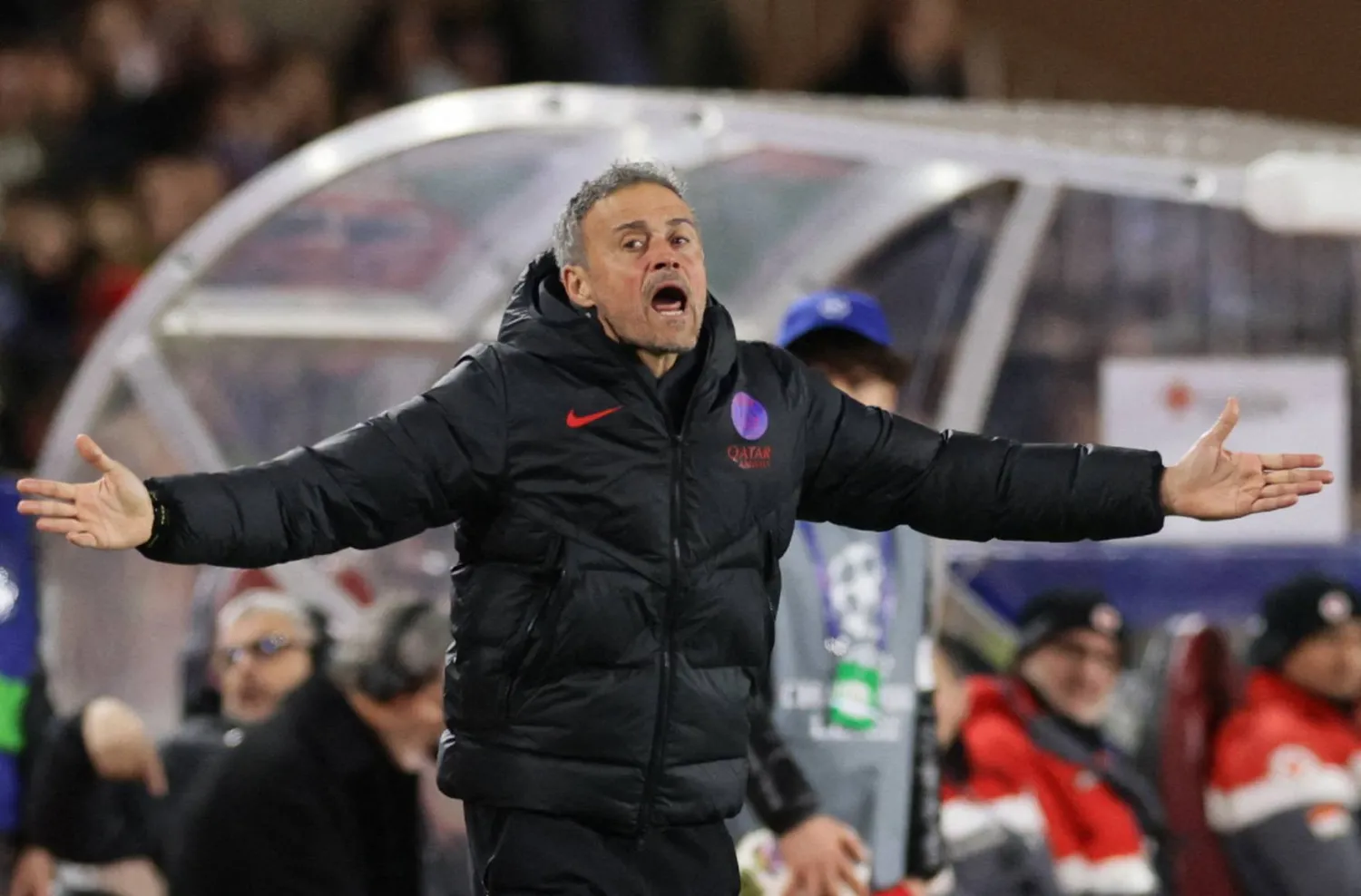
Soccer Football - UEFA Champions League - Play Off - First Leg - AS Monaco v Paris St Germain - Stade Louis II, Monaco - February 17, 2026 Paris St Germain coach Luis Enrique reacts REUTERS/Manon Cruz
TT

PSG’s Mental Strength Hailed as they Come from Behind to Win at Monaco

Soccer Football - UEFA Champions League - Play Off - First Leg - AS Monaco v Paris St Germain - Stade Louis II, Monaco - February 17, 2026 Paris St Germain coach Luis Enrique reacts REUTERS/Manon Cruz

Paris Saint-Germain coach Luis ‌Enrique hailed the mental strength of his side in coming from two goals down to win 3-2 away at Monaco in the Champions League on Tuesday, but warned the knockout round tie was far from finished.

The first leg clash between the two Ligue 1 clubs saw Folarin Balogun score twice for the hosts in the opening 18 minutes before Vitinha had his penalty saved to compound matters.

But after Desire Doue came on for injured Ousmane Dembele, the ‌match turned ‌and defending champions PSG went on to ‌secure ⁠a one-goal advantage ⁠for the return leg.

"Normally, when a team starts a match like that, the most likely outcome is a loss,” Reuters quoted Luis Enrique as saying.

“It was catastrophic. It's impossible to start a match like that. The first two times they overcame our pressure and entered our half, they scored. They ⁠made some very good plays.

“After that, it's difficult ‌to have confidence, but we ‌showed our mental strength. Plus, we missed a penalty, so ‌it was a chance to regain confidence. In the ‌last six times we've played here, this is only the second time we've won, which shows how difficult it is.”

The 20-year-old Doue scored twice and provided a third for Achraf Hakimi, just ‌days after he had turned in a poor performance against Stade Rennais last Friday ⁠and was ⁠dropped for the Monaco clash.

“I'm happy for him because this past week, everyone criticized and tore Doue apart, but he was sensational, he showed his character. He helped the team at the best possible time.”

Dembele’s injury would be assessed, the coach added. “He took a knock in the first 15 minutes, then he couldn't run.”

The return leg at the Parc des Princes will be next Wednesday. “Considering how the match started, I'm happy with the result. But the match in Paris will be difficult, it will be a different story,” Luis Enrique warned.