


Eco-Fashion Offers a Renaissance for New Tunisian Brands

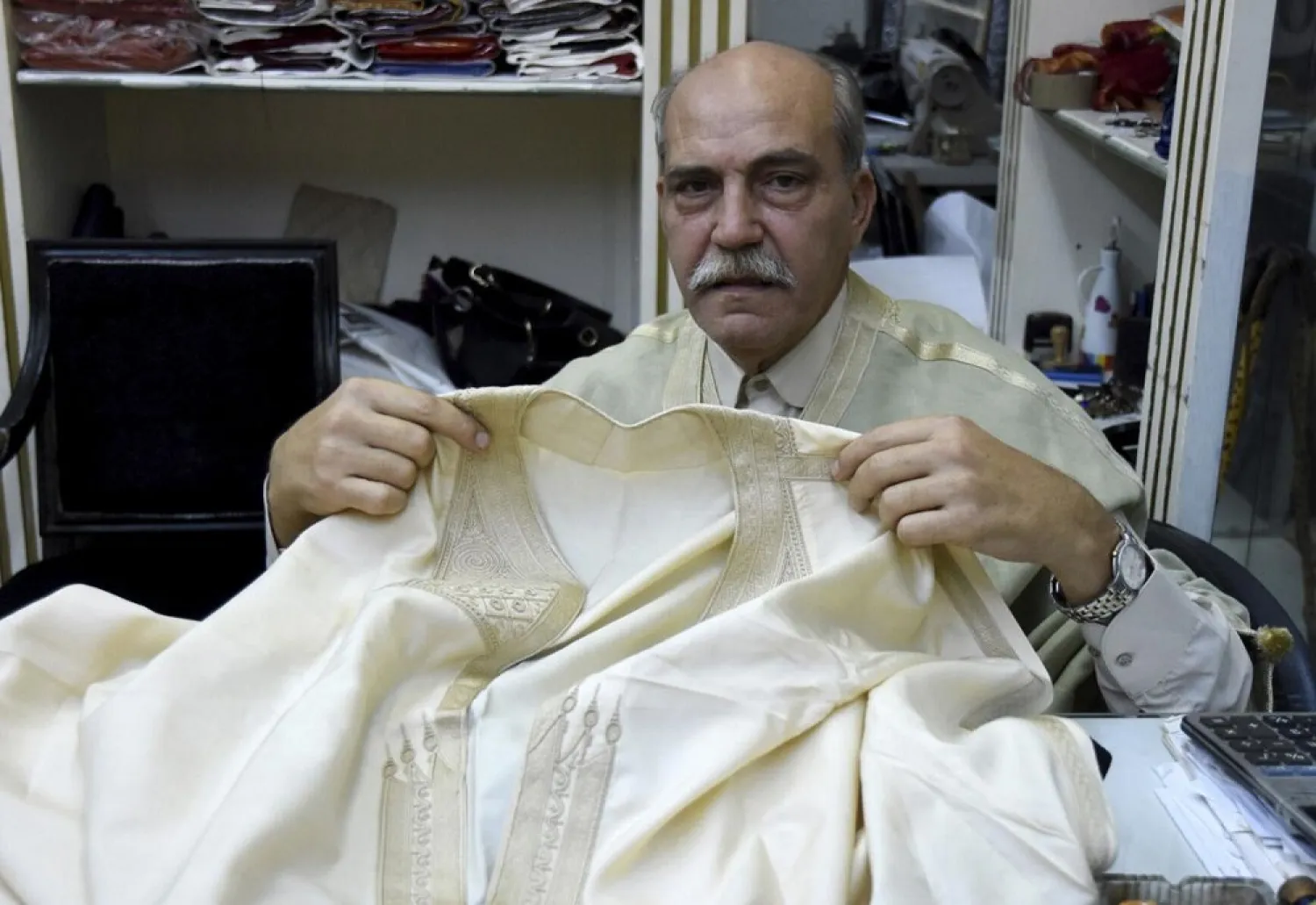
Lasaad El Beji Amine El Hrairia, a silk weaver In Tunis' Medina and that Hassan Ben Ayech, the designer for the Bardo Collection, holds a fabric in Tunis, Monday Oct.5, 2020. (AP)
TT

Eco-Fashion Offers a Renaissance for New Tunisian Brands

Lasaad El Beji Amine El Hrairia, a silk weaver In Tunis' Medina and that Hassan Ben Ayech, the designer for the Bardo Collection, holds a fabric in Tunis, Monday Oct.5, 2020. (AP)

The sun is setting by the time Tunisian fashion designer Chems Eddine Mechri reaches the breezy, seaside town of Mahdia. He has spent half the day driving in the scorching heat in pursuit of the precious, handmade fabrics he needs for his upcoming winter collection.

With a 200-kilometer (125-mile) road trip from Tunis coming to an end, the designer knows just the place: the basement of a blue-lit workshop, hidden away in the labyrinth of Mahdia’s old medina, where silk weaver Mohamed Ismail’s spinning wheel still is going at full speed.

In a globalized world dominated by fast fashion brands such as Zara, H&M and Topshop, Tunisian designers like Mechri are increasingly going back to their roots, embracing local artisans and environmentally conscious materials. Thanks to North African nation's age-old textile-making traditions, Tunisia is a good fit for the eco-fashion they want to champion.

Ismail has been spinning locally sourced wool and cotton, as well as silk thread imported from China, for the last 47 years. “This work is in our blood…it’s in our DNA,” Ismail says as he unwinds a crimson silk yarn in his workshop. “It’s intergenerational, and for my family, this work is very precious to us.”

Back in the capital of Tunis, Mechri and his dressmaker sew together a dress from scratch for his fashion brand Née. They combine a shimmering pink and gold traditional fabric used in Tunisian embroidery with a mesh material from the 1960s. Both were deemed unsellable by the merchant Mechri bought them from.

“They (didn’t) fit with the tastes of the day,” Mechri said. “And that’s why they (the fabric merchants) need us, the designers...to give a second life to these materials.”

The $2.6 billion textile industry is a pillar of the Tunisian economy, employing 160,000 people and producing roughly 25% of the country’s total exports, according to estimates by the Oxford Business Group. However, fashion is among the most polluting industries in the world, responsible for producing 10% of carbon dioxide globally, according to the World Bank, and tens of millions of tons of clothing is discarded every year.

Mechri and other designers have turned to the eco-friendly practice of “upcycling” — taking old or unwanted materials and turning them into something new and modern by incorporating high-quality fabrics. Mechri mixes old fabrics with the craftwork of artisans across Tunisia - from embroiderers in Tataouine, on the edge of the desert, to seamstresses in Bizerte in the country's north.

Fashion brands in the West are getting serious about upcycling, too, including American brand Bode and Hotel, a Danish-French brand founded by Alexandra Hartmann.

“People are starting to realize the negative impact of that desire to constantly consume all the time without taking a step back, taking a pause to reflect and ask questions about the environment and the future of humanity,” Mechri said in his Tunis boutique as clothing on the racks behind him shimmered and rustled at the touch. “Fashion is an intelligent way to pay homage to local materials.”

The desire to honor one’s ancestry was equally important to Hassen Ben Ayech, a 26-year-old former computer scientist. He founded the fledgling high-end brand Bardo with the express intent of reviving Tunisia’s heritage and traditional crafts in “an era of uncertainty and fear of environmental doom, coupled with the slow death of small pockets of culture in the face of globalization.”

The brand’s first collection evokes imagery from the famous Bardo palace in Tunis and the era of the beys, the rulers in the Tunisian monarchy that was abolished in 1957.

“We wanted to go back to a period that is often overlooked and avoid the clichés,” Ayech said. “We wanted to show that there is more to us than kaftans, (and to) dive deeper into our history and identity.”

In 2018, Riad Trabelsi relaunched his French-Tunisian brand BASSCOUTUR to prove to the industry that sustainable fashion is possible on a wider scale. The brand has a growing client base in Japan and South Korea and will soon launch in Italy.

“We’re seeing this concept become normative. If it’s not sustainable, it’s not cool,” Trabelsi said.

He feels his designs reflect the complexity of the modern Tunisian diaspora: “My identity is complex - I have a Tunisian father, an Algerian mother, meanwhile I was born in France. I draw all my DNA from this incredible mix… I am constantly evolving, reconditioning myself and my understanding of my Tunisian heritage each day.”

Sofia Guellaty, a Tunisian fashion journalist and the founder of MILLE World, an online platform spotlighting Arab youth culture, arts and fashion, said these brands “are using the storytelling of where they come from to make their garments stand out.”

“Tunisia is exactly on the mood board: the natural shapes, the beautiful, raw, organic materials. They are what the international and local markets want," she said.

Guellaty notes that most Tunisians, still excited by the novelty of fast fashion brands that only started becoming available locally over the last decade — are not so eco-conscious. Still, she has noticed more young Tunisians embracing their cultural identity and turning to local brands.

Ayech says Tunisia’s still-flourishing textile industry represents hope for those swept up in the country's ongoing economic crisis, which has been exacerbated by the coronavirus pandemic.

“The industry sustains a lot of families with a steady income even in remote areas and without access to higher education,” he said. Businesses that strike a balance between ethical industrial practices and community-driven craftmanship offer Tunisia “a hope of a better tomorrow.”



Nike Shares Rise as Apple’s Cook Doubles His Bet on CEO Hill’s Overhaul Effort

A jogger wearing Nike shoes runs along the Charles River in Cambridge, Massachusetts, US, March 18, 2019. (Reuters)
TT

Nike Shares Rise as Apple’s Cook Doubles His Bet on CEO Hill’s Overhaul Effort

A jogger wearing Nike shoes runs along the Charles River in Cambridge, Massachusetts, US, March 18, 2019. (Reuters)

Nike shares rose 5% in early trading on Wednesday after Apple CEO Tim Cook doubled his personal stake in the sportswear maker, raising his bets on the margin-pinching turnaround efforts led by CEO Elliott Hill.

Cook, who has been on Nike's board since 2005, bought 50,000 shares at $58.97 ‌each, according to ‌a regulatory filing. As of December ‌22, ⁠he holds about ‌105,000 shares, which is now worth nearly $6 million.

It was the largest open market stock purchase for a Nike director or executive and possibly the largest in more than a decade, said Jonathan Komp, analyst at Baird Equity Research.

"(We see) Cook's move as a positive signal for the progress under CEO Elliott Hill and Nike's 'Win ⁠Now' actions," Komp said.

The purchase comes days after Nike reported weaker quarterly margins and weak ‌sales in China even as CEO ‍Hill tries to revive demand ‍through fresh marketing plans and innovation focused on running and sports, ‍while phasing out lagging lifestyle brands.

He has also attempted to mend Nike's ties with wholesalers such as Dicks Sporting Goods to increase visibility among shoppers amid stiff competition from newer brands.

However, the strategy has strained Nike's margins, which have been declining for over a year, while its efforts to win back its ⁠premier position in discount-friendly China appears to be faltering.

Nike's shares have slumped nearly 13% since it reported results on December 18 and are on track for the fourth straight year of declines. They were trading at $60.19 on Wednesday.

Cook has been a lead independent director of Nike since 2016 when co-founder Phil Knight stepped down as its chairman.

The Apple CEO "remains extremely close" with Knight, Komp said, adding that he has advised Nike through key strategic decisions including Hill's appointment last year.

Board director and former Intel CEO ‌Robert Swan also bought about 8,700 shares for about $500,000 this week.


Etro Founding Family Exits Group as New Investors Including Türkiye's RAMS Global Join

L Catterton, a private equity firm backed by French luxury giant LVMH, will remain Etro's majority owner. Reuters
TT

Etro Founding Family Exits Group as New Investors Including Türkiye's RAMS Global Join

L Catterton, a private equity firm backed by French luxury giant LVMH, will remain Etro's majority owner. Reuters

The founding family of Italian fashion house Etro has sold the minority stake it still owned in the brand to a group of investors including Turkish group RAMS Global, the company said on Friday.

L Catterton, a private equity firm backed by French luxury giant LVMH, will remain Etro's majority owner and "will continue to actively support the brand's long-term growth strategy," Etro added, according to Reuters.

The new investors comprise also Italian fashion group Swinger International and small private equity firm ⁠RSI.

In addition to buying the stake, they all subscribed to a capital increase that will lower L Catterton's holding in Etro to between 51% and 55% from around 65%.

When including both the acquisition and the capital increase, the deal is worth around 70 ⁠million euros ($82 million), two sources close to the matter said. Etro did not disclose financial details.

Chief Executive Fabrizio Cardinali will remain at the helm, while Faruk Bülbül, representing RAMS Global, will become chairman of the board.

L Catterton bought a 60% stake in the brand known for its paisley motif four years ago, and it slightly increased the holding over the years.

The company, founded by Gimmo Etro in 1968, has ⁠been struggling with its turnaround. Last year it posted a net loss of 23 million euros with net revenues declining to 245 million euros from 261 million euros, according to filings with the local chambers of commerce reviewed by Reuters.

Rothschild advised L Catterton and the Etro family on the deal.

Rothschild had been hired in 2024 to look for a new investor who could buy all or part of the Etro fashion group, sources had previously told Reuters.


Paris Court Rejects Bid to Suspend Shein Platform in France

A customer holds shopping bags with a Shein logo in the first physical space of Chinese online fast-fashion retailer Shein on the day of its opening inside the Le BHV Marais department store, the Bazar de l'Hotel de Ville, in Paris, France, November 5, 2025. REUTERS/Sarah Meyssonnier/File Photo
TT

Paris Court Rejects Bid to Suspend Shein Platform in France

A customer holds shopping bags with a Shein logo in the first physical space of Chinese online fast-fashion retailer Shein on the day of its opening inside the Le BHV Marais department store, the Bazar de l'Hotel de Ville, in Paris, France, November 5, 2025. REUTERS/Sarah Meyssonnier/File Photo

A Paris court on Friday rejected a government request to suspend Chinese fast-fashion platform Shein in France after authorities found illegal weapons and child-like sex dolls for sale on the fast-fashion giant’s website.

Shein welcomed the decision, saying it remains committed to strengthening its control processes in cooperation with French authorities.

“Our priority remains protecting French consumers and ensuring compliance with local laws and regulations," the company said in an emailed statement to The Associated Press.

The controversy dates to early November, when France’s consumer watchdog and Finance Ministry moved toward suspending Shein’s online marketplace after authorities said they had found childlike sex dolls and prohibited “Class A” weapons listed for sale, even as the company opened its first permanent store in Paris.

French authorities gave Shein hours to remove the items. The company responded by banning the products and largely shutting down third-party marketplace listings in France.

French officials have also asked the European Commission to examine how illegal products were able to appear on the platform under EU rules governing large online intermediaries.