


Airports near Ethiopia's Tigray State Attacked with Rockets, Government Says

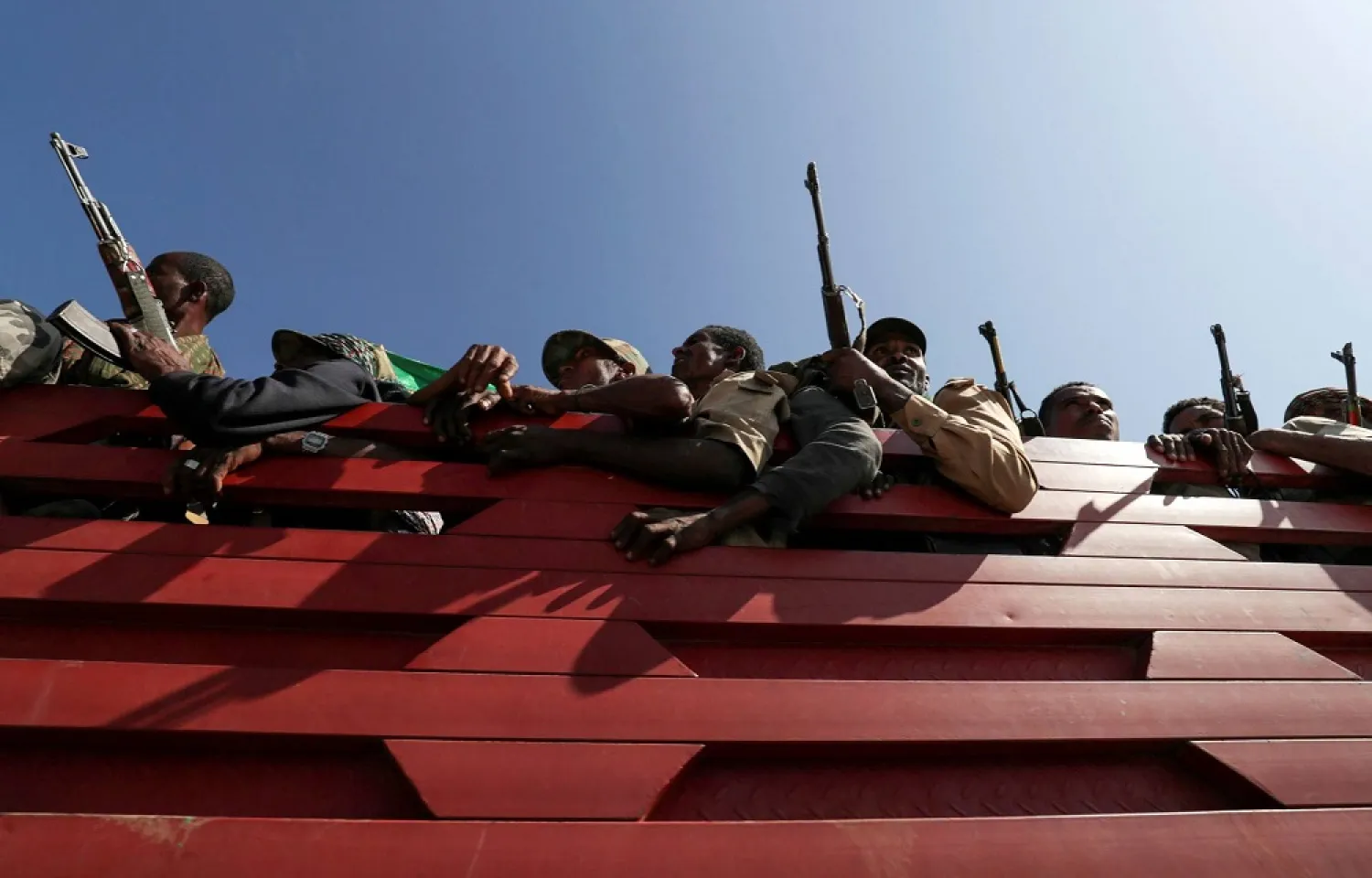
Members of Amhara region militias head to the mission to face the Tigray People's Liberation Front (TPLF), in Sanja, Amhara region near a border with Tigray, Ethiopia November 9, 2020. (Reuters)
TT

Airports near Ethiopia's Tigray State Attacked with Rockets, Government Says

Members of Amhara region militias head to the mission to face the Tigray People's Liberation Front (TPLF), in Sanja, Amhara region near a border with Tigray, Ethiopia November 9, 2020. (Reuters)

Two airports in Ethiopia’s Amhara state which neighbors Tigray where federal troops are fighting local forces were targeted by rocket fire late on Friday, the government said.

One of the rockets hit the airport in Gondar and partially damaged it late on Friday, said Awoke Worku, spokesperson for Gondar central zone, while a second one fired simultaneously landed just outside of the airport at Bahir Dar.

The government blamed the ruling party in Tigray, the Tigray People’s Liberation Front (TPLF).

“The TPLF junta is utilizing the last of the weaponry within its arsenals,” the government’s emergency task force wrote on Twitter.

Debretsion Gebremichael, chairman of the TPLF and the state’s president, said the airports were legitimate targets.

“Any airport used to attack Tigray will be a legitimate target, not cities of Amhara,” he told Reuters in a text message.

Hundreds of people have been killed in the 11-day-old war. Prime Minister Abiy Ahmed sent the national defense force on an offensive against local troops in Tigray last week, after accusing them of attacking federal troops.

An Ethiopian Airlines worker who did not wish to be identified said flights to both Gondar and Bahir Dar airports had been cancelled after the attacks.

Yohannes Ayele, a resident of Gondar, said he heard a loud explosion in the Azezo neighborhood of the city at 10:30 pm..

Another resident of the area said the rocket had damaged the airport terminal building. The area was sealed off and firefighting vehicles were parked outside, the resident added.

The Amhara regional state’s forces have been fighting alongside their federal counterparts against Tigray’s fighters.

The United Nations, the African Union and others are concerned that the fighting could spread to other parts of Ethiopia, Africa’s second most populous country, and destabilize the wider Horn of Africa region.

More than 14,500 people have fled into neighboring Sudan, with the speed of new arrivals “overwhelming the current capacity to provide aid”, the UN refugee agency said on Friday.

Ethiopia’s Human Rights Commission, appointed by the government but independent, said it was sending a team of investigators to the town of Mai Kadra in Tigray, where Amnesty International this week reported what it said was evidence of mass killings.

The commission will investigate any human rights violations in the conflict, it said in a statement.



Türkiye Says It Deployed Six F-16 Fighter Jets, Air Defense Systems to Northern Cyprus

An acrobatic plane pilot performs with General Dynamics F-16 Solo Turk aerial aerobatic aircraft during the 5th Sivrihisar Airshow in Sivrihisar district of Eskisehir, in Türkiye, on September 13, 2020. (AFP)
TT

Türkiye Says It Deployed Six F-16 Fighter Jets, Air Defense Systems to Northern Cyprus

An acrobatic plane pilot performs with General Dynamics F-16 Solo Turk aerial aerobatic aircraft during the 5th Sivrihisar Airshow in Sivrihisar district of Eskisehir, in Türkiye, on September 13, 2020. (AFP)

Türkiye on Monday deployed six F-16 fighter jets and air defense systems to northern Cyprus to boost the security of the Turkish community there amid the war in Iran, the defense ministry said, adding that Ankara would take additional measures if needed.

European powers have moved to ramp up military deployments to the ethnically-split island in recent days, after an Iranian drone, which ‌security officials ‌believe was fired by Hezbollah, an ‌ally ⁠of Iran in ⁠Lebanon, hit the British Akrotiri air base in Cyprus last week.

"In the context of the latest developments in our region, six F-16 fighter jets and air defense systems have been deployed to the Turkish Republic of Northern Cyprus as ⁠of today," the ministry said in ‌a statement, adding that ‌this was part of the phased planning to strengthen ‌the breakaway state's security.

"As a result of ‌the evaluations to be made depending on the developments, additional measures will continue to be taken if necessary," it added.

Türkiye does not recognize the internationally-recognized and European ‌Union-member Greek Cypriot administration in the south of the island, and is ⁠the only ⁠country to recognize the Turkish Cypriot state to the north.

Last week, NATO defenses shot down a ballistic missile fired from Iran into Turkish airspace, in a significant escalation of a US-Israeli war against Iran that has spread to the wider region. NATO member Ankara warned Iran on Saturday against firing more missiles towards it.

Türkiye has criticized the European deployments to Cyprus as moves that risk dragging the island into the conflict.


Iran Could Retrieve Uranium Entombed at Isfahan Site

A satellite imagery taken on February 1, 2026, shows a new roof over a previously destroyed building at Isfahan nuclear site, Iran. 2026 PLANET LABS PBC/Handout via REUTERS. 
TT

Iran Could Retrieve Uranium Entombed at Isfahan Site

A satellite imagery taken on February 1, 2026, shows a new roof over a previously destroyed building at Isfahan nuclear site, Iran. 2026 PLANET LABS PBC/Handout via REUTERS. 

American intelligence agencies said Iran could retrieve its primary store of highly enriched uranium even though it was entombed under the country’s nuclear site at Isfahan by US strikes last year.

Multiple officials familiar with the classified reports told The New York Times on Sunday Iran can now get to the uranium through a very narrow access point.

It is unclear how quickly Iran could move the uranium, which is in gas form and stored in canisters.

US officials have said that US spy agencies have constant surveillance of the Isfahan site and have a high degree of confidence they could detect — and react — to any attempt by the Iranian government or other groups to move it.

Last week, US Special Envoy to the Middle East Steve Witkoff told Fox News that Iran has 10,000, roughly, kilograms of fissionable material that's broken up into roughly 460 kilograms of 60% enriched uranium, another 1,000 kilograms 20% enriched uranium.

“The 60% material can be brought to 90% - that's weapon grade - in roughly one week, maybe 10 days at the outside. The 20% can be brought to weapons grade inside of three to four weeks,” he said.

On March 3, Rafael Mariano Grossi, director general of the International Atomic Energy Agency, said while there has been no evidence of Iran building a nuclear bomb, its large stockpile of near-weapons-grade enriched uranium and refusal to grant my inspectors full access are cause for serious concern.

That stockpile of uranium would be a key building block if Iran decided to move toward making a nuclear weapon, The New York Times said.

With Iran in chaos from the ongoing strikes by the United States and Israel, the fate of the uranium and the options for securing it have become critical issues for the Trump administration.

On Saturday, President Donald Trump was asked by reporters on Air Force One if he would consider sending in ground forces to secure the highly enriched uranium.

“Right now we’re just decimating them, but we haven’t gone after it,” he said. “But something we could do later on. We wouldn’t do it now.”

The United States chose not to try to retrieve the uranium last year after the 12-day war in which Iran’s nuclear sites came under intense bombardment.

Trump determined that doing so at that time would be too dangerous.

Soon after the US strike on Iran, high-resolution spy satellites detected that Iran had moved excavation equipment to Isfahan, and had begun to access the underground tunnels, according to US officials and others briefed on the intelligence.

The spy satellite images showed Iranians moving both the dirt they placed in the tunnel entrances and debris generated by the Tomahawk strikes, the people said.

An analysis of commercial satellite imagery by The New York Times’s visual investigations team reached similar conclusions, finding evidence of digging in multiple areas of Isfahan.

At one location just north of the main facility, satellite photos show several pieces of excavating equipment moving earth. The images indicate that workers had excavated a pit, placed an unidentified object inside of it under a tarp, then buried it.

At another location northeast of the main facility, there was not much activity until last month, when satellite images showed what appeared to be a crane moving dirt into a truck.

A large amount of earth moving was seen at several of the tunnel entrances in satellite imagery taken in February, including a tunnel on the western side, as seen in a time lapse of commercial satellite imagery.

It is unclear whether the dirt was taken to a dumping site or moved to the tunnel entrances to protect them from future strikes.

Earlier this year, researchers at the Institute for Science and International Security also noticed increased activity on the road leading to the tunnel entrances.

They suggested in a report that some tunnel entrances were being buried by soil as a possible preparation for strikes, similar to Iran’s activities ahead of the strikes last June.


Iranians Chant Against New Supreme Leader in Tehran

A vehicle moves along a street in a residential area in Tehran on March 8, 2026. (AFP)
TT

Iranians Chant Against New Supreme Leader in Tehran

A vehicle moves along a street in a residential area in Tehran on March 8, 2026. (AFP)

Chants hostile to Iran's new supreme leader Mojtaba Khamenei were heard in Iranian capital Tehran shortly after his appointment, according to a video posted on social media Sunday.

In the 17-second clip, filmed at night from a building window, women's voices can be heard shouting "Death to Mojtaba" in Persian, while religious chants can be heard in the distance.

AFP was unable to determine exactly where the footage was filmed or whether similar chants were heard elsewhere in the city.

The Assembly of Experts, the religious body tasked with electing the supreme leader, announced Sunday evening that Mojtaba Khamenei had been designated the successor to his father, Ali Khamenei, who was killed on February 28 in Israeli and American strikes on Tehran.