


‘No Good Choice’: The Afghans Forced to Return from Iran

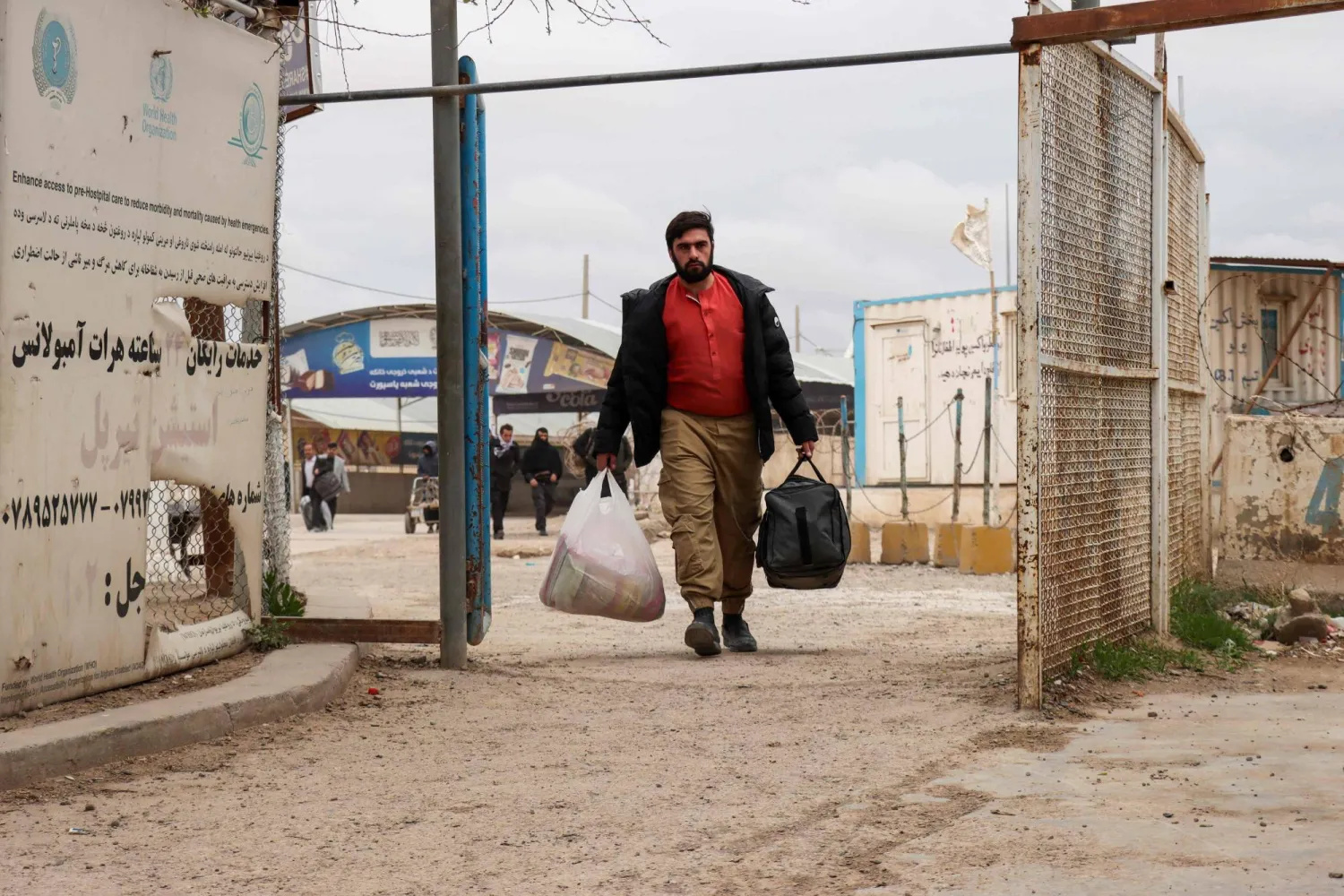
 An Afghan national arrives with his belongings at the Islam Qala border crossing between Afghanistan and Iran in Herat province on March 10, 2026, upon his arrival from Iran amid the Middle East war. (AFP)
An Afghan national arrives with his belongings at the Islam Qala border crossing between Afghanistan and Iran in Herat province on March 10, 2026, upon his arrival from Iran amid the Middle East war. (AFP)
TT

‘No Good Choice’: The Afghans Forced to Return from Iran

 An Afghan national arrives with his belongings at the Islam Qala border crossing between Afghanistan and Iran in Herat province on March 10, 2026, upon his arrival from Iran amid the Middle East war. (AFP)
An Afghan national arrives with his belongings at the Islam Qala border crossing between Afghanistan and Iran in Herat province on March 10, 2026, upon his arrival from Iran amid the Middle East war. (AFP)

Exhausted Afghans cross the border from Iran in a sandstorm, leaving behind a country in the grip of war to return to a homeland that is battered by conflict and humanitarian crisis.

At the Islam Qala crossing point in Herat province, western Afghanistan, Talibshah, who did not to give his family name, said he had been working in agriculture northwest of Tehran.

He was cheated by money changers at the border and was trying to figure out how to get back to Sar-e-Pol province in the north, hundreds of kilometers away on difficult, mountainous roads.

Talibshah's work in Qazvin in northern Iran helped support seven people -- his mother, father, brothers and sisters -- at a time when drought had made farming difficult, if not impossible, back home.

"I don't know whether I will be able to find a job or not. We are left without prospects," he told AFP.

"If I don't find a job here, I'll have to emigrate again. We have no choice. We can't starve," he added.

- Funding shortfall -

The United Nations has warned that nearly half of Afghanistan -- 21.9 million people -- will need humanitarian aid this year.

Since February 26, the country has been hit by fresh clashes with neighboring Pakistan to the east, which have killed at least 56 civilians and forced about 115,000 from their homes.

The UN refugee agency's representative in Afghanistan, Arafat Jamal, said there was "no good choice" for those coming back.

"They're fleeing war in Iran and coming to a country that is also itself at war," he said. "In other words, these people are coming into a country that is wracked by drought, that has unemployment, and that now has conflict inside it."

Since the war began in the Middle East on February 28, about 1,700 people have returned every day. But the UNHCR is expecting bigger numbers in the future if there is no let-up in the conflict.

The agency is ready in terms of staff and infrastructure to receive those leaving Iran but funding was lacking for the relief effort, said Jamal.

- '50 times greater' -

At the Islam Qala border post, more people arrived on Tuesday than the previous week, said an AFP correspondent on the ground.

Families crossed quickly, their faces expressionless, with one or two suitcases holding their meager belongings.

Mohammad Kabir Nazari, 48, had been working for the last 11 months as a security guard in Tehran, and was in the country during the 12-day war last June.

He described the latest strikes as "50 times greater".

"Missiles were coming from all sides, every day," he said. "For Afghans, there was no shelter. The situation was very bad."

Nazari, originally from Ghazni province in eastern Afghanistan, said he had been travelling to Iran for the last 32 years.

Then, the markets were busy around the Persian new year, Nowruz, and for the end of Ramadan but were currently empty, he added.

The slowdown in Iran's economy has consequences for the many Afghan migrant workers: one friend of Nazari told him he had been sacked with other Afghans and forced to return.

- 'Waves and waves' -

Naeemullah Rahimi, 24, was also working as a security guard at a factory in the Tehran suburbs. He said he was forced to shelter from air strikes in the basement.

"When we saw that the situation was very bad, we had to come back to Afghanistan," he said.

Jobs are scarce in his home province of Wardak in central Afghanistan.

"I don't know what to do," said Rahimi. "But if I find a job, I'll work."

The UNHCR's Jamal said "waves and waves" of people have been deported to Afghanistan from Iran and Pakistan since September 2023. Last year alone, 2.8 million Afghans returned.

"That was the largest such movement in the world," he added.

"If we start to experience similar numbers this year, will Afghanistan really be able to cope? Perhaps, but it needs international support.

"We cannot afford to let Afghanistan fail," he said, warning that forgetting the region will had an even more destabilizing effect in the world.



Strikes Near Iran, Israel Nuclear Sites Risk ‘Unmitigated Catastrophe’, Says UN

 A drone view shows a damage in a residential neighborhood, following a night of Iranian missile strikes which injured dozens of Israelis, amid the US-Israel conflict with Iran, in Dimona, southern Israel March 22, 2026. (Reuters)
A drone view shows a damage in a residential neighborhood, following a night of Iranian missile strikes which injured dozens of Israelis, amid the US-Israel conflict with Iran, in Dimona, southern Israel March 22, 2026. (Reuters)
TT

Strikes Near Iran, Israel Nuclear Sites Risk ‘Unmitigated Catastrophe’, Says UN

 A drone view shows a damage in a residential neighborhood, following a night of Iranian missile strikes which injured dozens of Israelis, amid the US-Israel conflict with Iran, in Dimona, southern Israel March 22, 2026. (Reuters)
A drone view shows a damage in a residential neighborhood, following a night of Iranian missile strikes which injured dozens of Israelis, amid the US-Israel conflict with Iran, in Dimona, southern Israel March 22, 2026. (Reuters)

Strikes around Iran and Israel's nuclear sites risk unleashing an "unmitigated catastrophe", the United Nations rights chief said Wednesday, warning that the Middle East war had created an "extremely dangerous" situation.

Speaking before the UN Human Rights Council, where countries were holding an urgent debate on Tehran's attacks across the Gulf, Volker Turk warned that many of the strikes in the weeks-long war "raise serious concerns under international law".

In particular, Turk cautioned that "recent missile strikes near nuclear sites in both Israel and Iran underscore the immense danger of further escalation".

"States are flirting with unmitigated catastrophe."

His comments came after the UN nuclear watchdog said Iran had informed it that "another projectile hit the premises" of the Bushehr nuclear power plant on Tuesday, without damaging it.

Over the weekend, an Iranian strike hit the southern Israeli town of Dimona, home to a nuclear facility, in what Tehran said was in response to an earlier attack on its nuclear site at Natanz.

"The situation is extremely dangerous and unpredictable, and has created chaos across the region," Turk said, insisting that "we cannot go back to war as a tool of international relations".

The UN rights chief also warned that "this conflict has an unprecedented power to ensnare countries across borders and around the world".

"The complex dynamics could ignite further national, regional or global crises at any moment, with an appalling impact on civilians and people everywhere."


Hungary Says Will Phase Out Gas Deliveries to Ukraine

Hungarian Prime Minister Viktor Orban speaks during an assembly of European far-right parties with Orban’s Patriots for Europe group, in Budapest, Hungary, Monday, March 23, 2026. (AP)
TT

Hungary Says Will Phase Out Gas Deliveries to Ukraine

Hungarian Prime Minister Viktor Orban speaks during an assembly of European far-right parties with Orban’s Patriots for Europe group, in Budapest, Hungary, Monday, March 23, 2026. (AP)

Hungary's prime minister said on Wednesday that Budapest would phase out gas deliveries to Ukraine, the latest salvo in a bitter feud between the two countries over a damaged pipeline transporting Russian oil. 

Hungarian Prime Minister Viktor Orban, whose country is a major gas supplier to Ukraine, has accused Kyiv of delaying repairs on the pipeline, effectively stopping the flow of Russian oil to Hungary and its neighbor Slovakia. 

"To break the oil blockade and guarantee the security of Hungary's energy supply, new measures are now necessary," Orban said in a video posted on Facebook. 

"We are gradually halting gas shipments from Hungary to Ukraine and storing the gas that remains here domestically. Until Ukraine supplies oil, it will receive no gas from Hungary," he added. 

Ukrainian authorities have said that the Druzhba (Friendship) pipeline, which crosses its territory, was damaged by Russian airstrikes on January 27. 

Hungary and Slovakia, which have obtained exemptions from the European Union to continue purchasing Russian oil, accuse Kyiv of dragging their feet to repair it. 

In retaliation, Orban -- who is facing crucial parliamentary elections next month -- is blocking a European loan of 90 billion euros ($104 billion) to Ukraine. 

Last week, European Commission President Ursula von der Leyen announced that the EU would help reopen the Druzhba pipeline. 

Budapest and Bratislava are also blocking the official adoption of new economic sanctions against Russia, endorsed by other EU countries. 

According to analysts at the pro-government Hungarian Economic Research Foundation (Oeconomus), Hungary has become one of Ukraine's main gas suppliers. 

Ukraine imported 2.94 billion cubic meters of gas from Hungary in 2025, the top source for Ukrainian imports, accounting for 45.5 percent of all Ukrainian imports, Ukrainian consultancy ExPro said in a report. 

ExPro said separately that Ukraine's imports from Hungary were already slightly dropping as a share in 2026, down to 34 percent of Ukraine's import mix in March 2026. 

Ukraine's total gas consumption in 2025 was 21 billion cubic meters, the Dixi group consultancy said in a report in March, meaning Hungary accounted for 14 percent of Ukraine's total gas use in 2025. 


Iran Speaker Warns US Not to Test 'Resolve to Defend Our Land'

FILED - 12 October 2024, Lebanon, Beirut: Iranian Parliament speaker Mohammad Bagher Ghalibaf speaks during a press conference in Beirut. Photo: Hassan Ibrahim/Lebanese Parliament/dpa
TT

Iran Speaker Warns US Not to Test 'Resolve to Defend Our Land'

FILED - 12 October 2024, Lebanon, Beirut: Iranian Parliament speaker Mohammad Bagher Ghalibaf speaks during a press conference in Beirut. Photo: Hassan Ibrahim/Lebanese Parliament/dpa

Iran's parliament speaker on Wednesday warned Washington not to test Tehran’s determination to defend its territory after the United States was reported to be sending more troops to the Middle East.

"We are closely monitoring all US movements in the region, especially troop deployments.

What the generals have broke, the soldiers can't fix; instead, they will fall victim to (Israeli Prime Minister Benjamin) Netanyahu's delusions," said Mohammad Bagher Ghalibaf in an X post in English.

"Do not test our resolve to defend our land."

At least 1,000 troops from the 82nd Airborne Division will be sent to the Mideast in the coming days, three people with knowledge of the plans told The Associated Press. They spoke on condition of anonymity to discuss sensitive military plans.

The Pentagon is also in the process of deploying two Marine units that will add about 5,000 Marines and thousands of sailors to the region.