


Washington, Pittsburg G20 Summits and the Model of Economic Balance

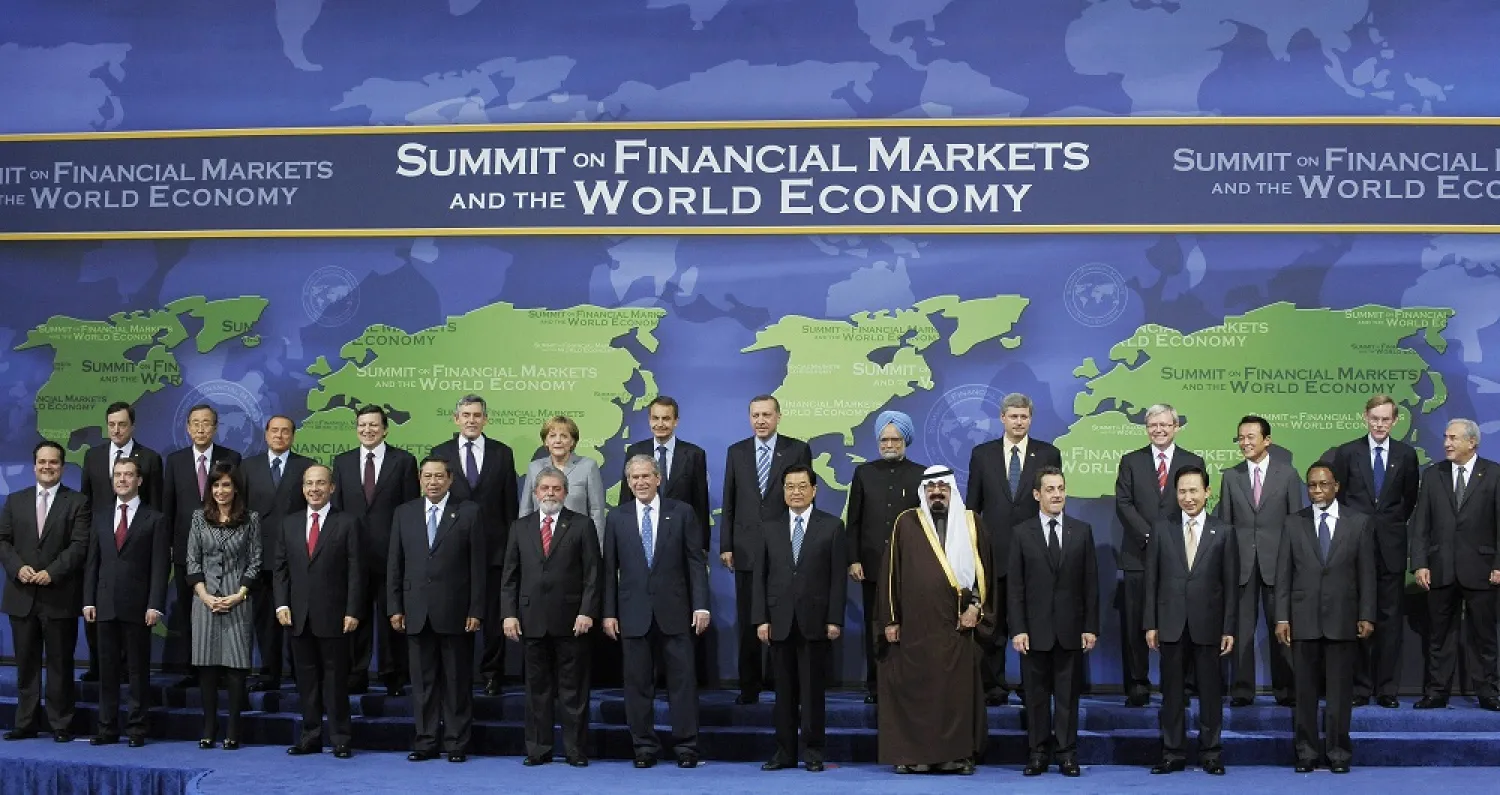
World leaders pose for a group photo at the opening of the G20 Summit hosted by US President George W. Bush (7th L) on November 15, 2008 in Washington, DC. (AFP)
TT

Washington, Pittsburg G20 Summits and the Model of Economic Balance

World leaders pose for a group photo at the opening of the G20 Summit hosted by US President George W. Bush (7th L) on November 15, 2008 in Washington, DC. (AFP)

“Just like yesterday.” The phrase has been uttered a lot these days when referring to past and the upcoming G20 summit. Even though the coronavirus pandemic has upended people’s lives and the global economy, it still appears as though history is repeating itself as it encounters crisis after crisis.

In 2008, the world witnessed another crisis – one less severe than the pandemic, but no less significant – with the global economic collapse. It took almost two years for the world to recover from it.

The crisis prompted world leaders at the time to form the Group of Twenty in order to address pressing international economic issues and problems. And so the first G20 summit was held in Washington on November 14–15, 2008. The third was held in Pittsburg in the United States.

Both summits were faced with similar daunting economic challenges, amid the global economic collapse, falling stock markets and real estate challenges. World leaders therefore called for setting up a new global economic framework and a council for global stability that would tackle the fallout from the crisis and avert its recurrence.

Extraordinary summit
World leaders gathered at the “extraordinary” inaugural G20 summit in the American capital. The summit on “Financial Markets and the World Economy” vowed to set up a model for more balanced global growth to avert another economic collapse. The leaders agreed to launch a series of policies and mechanisms that maintain this balance.

They reached a common understanding of the root causes of the global crisis, reviewed actions countries had taken and would take in the future to address the immediate crisis and strengthen growth, agreed on common principles for reforming their financial markets and reaffirmed their commitment to free market principles.

Observers believe that leaders at the upcoming G20 summit in Saudi Arabia will reiterate these commitments and boost cooperation to avert the impact of the pandemic. Riyadh will host the summit on November 21 and 22.

King Salman bin Abdulaziz had represented the Kingdom at the Washington meeting.

Collective work
A year later, world leaders met in Pittsburg for the third G20 summit. They discussed further actions to assure a sound and sustainable recovery from the global financial and economic crisis. They also designated the G20 to be the premier forum for international economic cooperation. They established the Financial Stability Board (FSB) to include major emerging economies and welcome its efforts to coordinate and monitor progress in strengthening financial regulation.

They agreed to work together to assess each others’ economic plans, reach consensus on best practices for needed reforms, and adopt policies to support the necessary rebalancing of global demand to ensure strong growth for all. The leaders committed to update the architecture for global economic cooperation. They reached a historic agreement to put the G20 at the center of their efforts to work together to build a durable recovery and reform the international financial system. They also made specific commitments to increase access to food, fuel and finance among the world’s poorest.

‘Corporate greed’
Outside the convention center, protests were staged against the G20 and “corporate greed”. Some 10,000 protesters staged a peaceful march. Protesters -- from environmentalists, socialists, Palestinians and Tibetans to union workers -- marched toward the convention center holding up signs such as “We Say No To Corporate Greed,” and “G20 = Death by Capitalism”. Protests -- usually against some aspect of capitalism -- have often marked summits since trade talks in Seattle in 1999.



Moody’s Establishes Regional HQ in Riyadh, Deepening Presence in Region

(FILES) Signage for Moody's Corporation is displayed at their headquarters at 7 World Trade Center on March 18, 2025 in New York City. (Photo by ANGELA WEISS / AFP)
TT

Moody’s Establishes Regional HQ in Riyadh, Deepening Presence in Region

(FILES) Signage for Moody's Corporation is displayed at their headquarters at 7 World Trade Center on March 18, 2025 in New York City. (Photo by ANGELA WEISS / AFP)

Moody’s Corporation announced that it has established its regional headquarters in Riyadh, reflecting ongoing commitment to support the development of the Kingdom’s capital markets and economy.

“This investment aligns to the Kingdom's Vision 2030 initiative and underscores its dynamism and growth,” Moody’s said in a statement this week.

The new regional headquarters marks an expansion of Moody’s presence in Saudi Arabia, where the company first opened an office in 2018, and reflects its longstanding commitment to the Middle East.

“The headquarters will strengthen Moody’s engagement with Saudi institutions and enable broader access to Moody’s decision grade data, analytics and insights,” said the statement.

“Our decision to establish a regional headquarters in Riyadh reflects our confidence in Saudi Arabia’s strong economic momentum, as well as our commitment to helping domestic and international investors unlock opportunities with our expertise and insights,” said President and Chief Executive Officer of Moody’s Rob Fauber.

“We are well positioned to provide the analytical capabilities and market intelligence that investors and institutions need to navigate evolving markets across the Middle East,” the statement quoted him as saying.

Mahmoud Totonji will lead the regional headquarters as General Manager.


Saudi Arabia Launches First Endowment Fund for Environmental, Water and Agricultural Sustainability

The launch of the Namaa Endowment Fund (Asharq Al-Awsat)
TT

Saudi Arabia Launches First Endowment Fund for Environmental, Water and Agricultural Sustainability

The launch of the Namaa Endowment Fund (Asharq Al-Awsat)

Saudi Arabia has launched its first endowment fund dedicated to advancing environmental, water and agricultural sustainability, reinforcing efforts to strengthen the Kingdom’s non-profit sector and long-term development.

Minister of Environment, Water and Agriculture Eng. Abdulrahman Al-Fadhli on Tuesday inaugurated the Namaa Endowment Fund at the ministry’s headquarters, in the presence of senior officials and stakeholders.

The fund is designed to support economic and social development goals, address community needs, increase the non-profit sector’s contribution to GDP, and promote sustainable management of environmental, water and agricultural resources.

Al-Fadhli said the fund represents a new model of institutional endowment work and a practical mechanism to expand developmental impact while ensuring the sustainability of non-profit initiatives.

Developed in partnership with the General Authority for Awqaf, the fund aims to build assets commensurate with its ambitions, enabling higher returns and a wider impact over the long term.

It will pursue carefully structured investments that balance financial performance with developmental outcomes, with the potential to own or benefit from real estate assets that can be used by non-profit organizations.

Encouraging Private-Sector Participation

Al-Fadhli added that the ministry, in cooperation with the General Authority for Awqaf, the Capital Market Authority and AlAhli Capital, will support the fund and encourage contributions from the private sector, business leaders and the wider public.

Contributions will be made through a licensed digital platform under strict financial governance. He called on all segments of society to contribute in support of sustainable development across the environment, water and agriculture sectors.

Namaa will finance endowment initiatives within the ministry’s ecosystem, including the non-profit institutions Reef, Morooj and Saqaya. Its focus areas include water provision and conservation, afforestation, biodiversity protection, vegetation cover, the circular economy, sustainable agriculture and irrigation, and reducing food loss and waste.

Emad Alkharashi, Governor of the General Authority for Awqaf, announced an initial contribution of SAR100 million, describing it as a foundation for a sustainable endowment model.

He said the fund combines the legacy of endowments with modern investment practices to protect natural resources, strengthen food security and ensure lasting developmental impact.

Alkharashi added that the partnership with the ministry maximizes results and positions the fund as a model for directing endowments toward high-impact, long-term priorities through a transparent, well-governed institutional framework.


Makkah Gears Up for Ramadan with Tourism Drive, Record Hospitality Growth  

Tourism Minister Ahmed Al-Khateeb and other officials during his inspection tour on Tuesday. (Asharq Al-Awsat)
TT

Makkah Gears Up for Ramadan with Tourism Drive, Record Hospitality Growth  

Tourism Minister Ahmed Al-Khateeb and other officials during his inspection tour on Tuesday. (Asharq Al-Awsat)

Saudi Arabia’s Ministry of Tourism has raised the readiness of Makkah’s hospitality sector to its highest level ahead of the holy month of Ramadan, stressing that serving pilgrims and visitors remains a top national priority.

Makkah is preparing to receive worshippers and visitors amid a marked expansion in hospitality capacity. The city now has more than 2,200 licensed accommodation facilities, reflecting growth of 35 percent over the past year. The number of licensed hotel rooms has exceeded 380,000, up 25 percent, while total domestic and inbound tourism spending is projected to surpass SAR 143 billion ($38.1 billion) in 2025.

The wider Makkah region recorded unprecedented performance indicators last year, both in visitor numbers and tourism spending, underscoring sustained growth and operational readiness.

Total domestic and international visitors exceeded 50 million, marking a 14 percent increase compared with 2024.

Tourism Minister Ahmed Al-Khateeb announced the figures during an annual inspection tour on Tuesday, stressing that the indicators reflect a major expansion in accommodation capacity and record growth in visitor numbers.

The tour included inspections of temporary lodging facilities designated for pilgrims, part of a proactive plan to increase capacity during peak seasons, alongside early preparations for the upcoming Hajj.

Vision 2030 targets surpassed

Official data has shown that Saudi Arabia has exceeded its Vision 2030 targets for the Umrah. The number of pilgrims arriving from abroad rose from 8.5 million in 2019 to more than 18 million in 2025, surpassing the original goal of 15 million by 2030.

A number of hotels surrounding the Grand Mosque in Makkah. (General Authority for Awqaf)

Service quality indicators improved as well, with pilgrim satisfaction reaching 94 percent, exceeding Vision 2030 benchmarks.

Workforce development kept pace with demand, as the number of licensed tour guides rose to more than 980, a 23 percent increase.

Masar Mall project

Al-Khateeb announced a joint financing agreement between the Tourism Development Fund and the Arab National Bank with Hamat Holding to support the Masar Mall project. The development carries a total cost of SAR 936 million (about $250 million).

The project is expected to become the largest shopping center in Makkah with the capacity to accommodate around 20 million visitors annually.

Its location near the Haramain High-Speed Railway station and a direct pedestrian link to the Grand Mosque are expected to strengthen the city’s commercial and tourism infrastructure.

Jeddah: Gateway to pilgrims

Meanwhile, Jeddah continues to consolidate its position as a complementary destination to Makkah and a primary gateway for pilgrims, while also expanding its role as a coastal tourism hub.

The city welcomed more than 13 million domestic and international visitors in 2025, a 10 percent increase from 2024. Tourism spending reached SAR 28 billion ($7.47 billion), up 6 percent year on year.

Jeddah’s hospitality sector also expanded, with more than 500 licensed facilities and over 33,000 licensed rooms.

The city is currently developing 46 tourism projects valued at SAR 21 billion ($5.6 billion) and expected to add more than 11,000 hotel rooms and further strengthen its tourism infrastructure and economic value.