

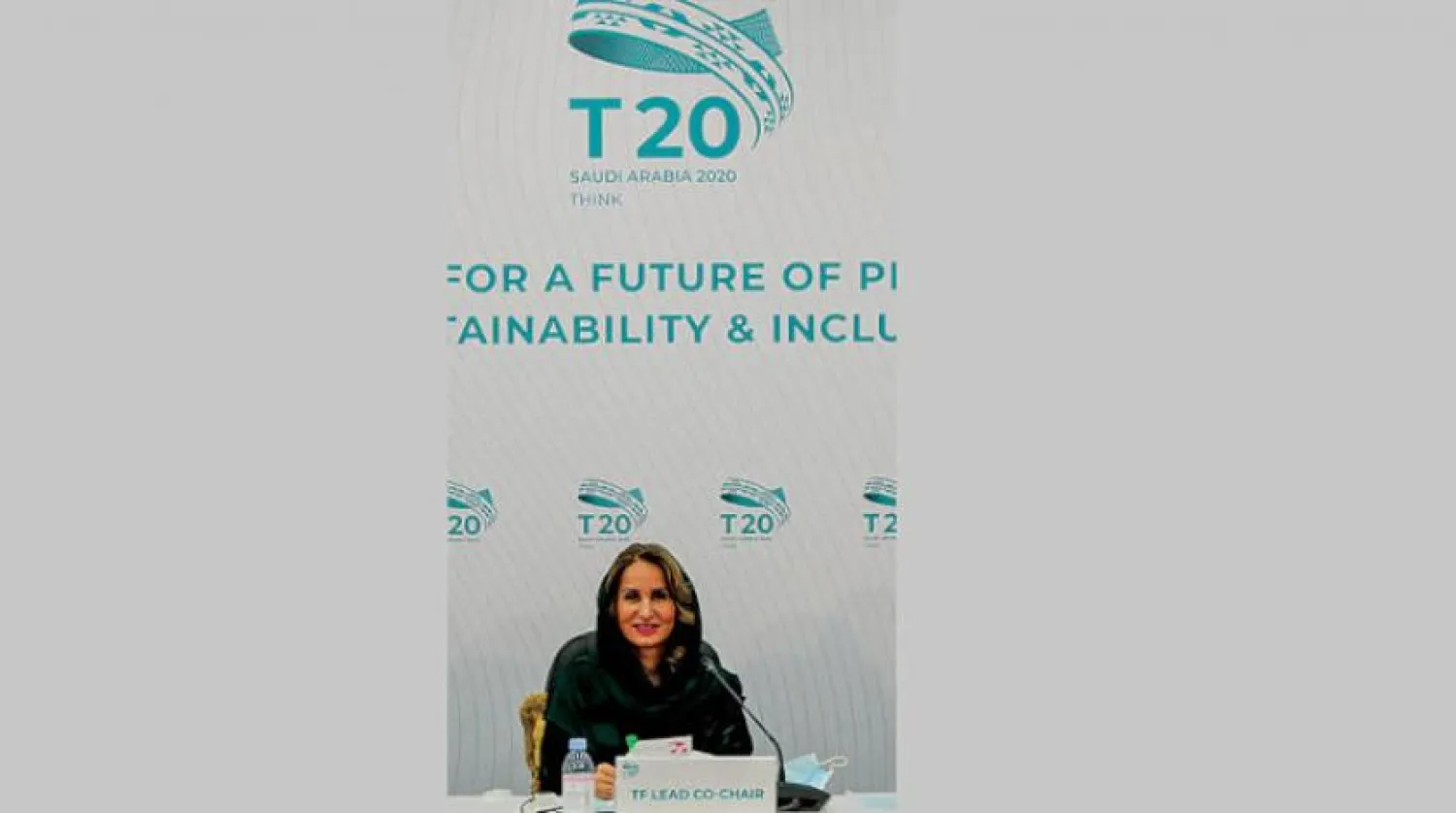

Princess Maha Bint Mishari: Women, Youth Participation in Labor Productivity Crucial for Human Capital Investment

Princess Maha Bint Mishari, Asharq Al-Awsat
TT

Princess Maha Bint Mishari: Women, Youth Participation in Labor Productivity Crucial for Human Capital Investment

Princess Maha Bint Mishari, Asharq Al-Awsat

Saudi Princess Maha Bint Mishari, who is co-leading the migration and young societies task force at the Think 20 (T20) engagement group of the G20, revealed that recommendations presented by her team to the G20 presidency promote increased productivity by investing in human capital.

Proposals by the task force focus on boosting productivity through increasing youth and women involvement.

“Young societies are a necessary and important component at the present time, especially in the Arab region, and specifically in Saudi Arabia, which has a high percentage of youth,” Princess Maha noted.

She also pointed out the importance of raising technical awareness, especially with regard to distance education, and called for building a special infrastructure for distance learning.

Princess Maha, in an interview with Asharq Al-Awsat, said that the T20 taskforce she is overseeing dealt with the file of migration and young societies through the scope of macro and microeconomic policies, unemployment, education, the labor market, intergenerational participation, regional conflicts, and voluntary and forced migration.

Recommendations endorsed by the taskforce, according to Princess Maha, will aid in achieving the social and economic integration of refugees and migrants and help provide basic services and education for migrant and refugee children.

They will also diagnose the social, political and economic impacts of migrants, and migration mechanisms.

As for challenges emanating from demographic change, Princess Maha said that the taskforce had proposed a score of measures that could help.

These measures include extending the retirement age, investing in education, vocational and technical training, expanding the financial framework, as well as considering public spending tax reforms, comprehensive reforms of public pensions, social security and healthcare schemes.

On how to divide global burdens resulting from forced migration, Princess Maha said: “The G20 Protocol on Forced Migration solves the problem of dividing the burdens of forced migration, and guarantees life in safety and dignity.”

She also suggested integrating immigrants through training and education.

This will help bridge the employment gap in host countries where the elderly are predominant in the population.

Princess Maha stressed that investing in the education and training of local immigrants will improve the prospects for their integration.

She called for the establishment of a virtual communication network dedicated to offering advisory services to refugees to facilitate integration in host countries.

This can be achieved through launching refugee portals in which all government educational, medical and legal services are provided.



EU Reportedly Set to Freeze US Trade Deal Approval Over Trump Tariff Risk

FILE PHOTO: Containers are loaded on freight trains at the railroad shunting yard in Maschen near Hamburg, Germany November 14, 2019. REUTERS/Fabian Bimmer/File Photo
TT

EU Reportedly Set to Freeze US Trade Deal Approval Over Trump Tariff Risk

FILE PHOTO: Containers are loaded on freight trains at the railroad shunting yard in Maschen near Hamburg, Germany November 14, 2019. REUTERS/Fabian Bimmer/File Photo

The European Union is poised to freeze the ratification process of its trade deal ‌with the ‌US and is ‌seeking ⁠more details from ⁠President Donald Trump’s administration on its new tariff program, Bloomberg News reported on Monday.

Zeljana ⁠Zovko, the lead ‌trade ‌negotiator in the ‌European People’s Party group ‌on the US deal, told Bloomberg in an interview that the ‌EU has "no other option" but to ⁠delay ⁠the approval process to seek to clarity on the situation.

The center-right EPP group is the largest political bloc in the European parliament.

Trump said Saturday that he wants a global tariff of 15%, up from the 10% he announced a day earlier.

American and EU officials sealed a trade deal last year that imposes a 15% import tax on 70% of European goods exported to the United States. The European Commission handles trade for the 27 EU member countries.

The value of EU-US trade in goods and services amounted to 1.7 trillion euros ($2 trillion) in 2024, or an average of 4.6 billion euros a day, according to EU statistics agency Eurostat.


Mexico Eyes Trade Expansion, Targets Saudi Market with Premium Rice Exports

Rice products at a commercial market in Saudi Arabia (SPA)
TT

Mexico Eyes Trade Expansion, Targets Saudi Market with Premium Rice Exports

Rice products at a commercial market in Saudi Arabia (SPA)

Mexico is preparing to expand its trade ties with Saudi Arabia by exporting high-quality rice to the Kingdom, sources told Asharq Al-Awsat.

They said Mexico has an export offer for three premium rice varieties that meet the highest international standards.

Saudi Arabia imports limited quantities of Mexican rice, mainly for use in Mexican cuisine and restaurants.

The latest initiative reflects the Kingdom’s position as one of the world’s largest rice consumers, with per capita consumption averaging 45.77 kilograms annually, the highest among plant-based food products.

Around 70 percent of consumption consists of basmati rice, while total annual imports exceed 1.3 million tons.

According to the information obtained by Asharq Al-Awsat, the Saudi Ministry of Foreign Affairs received a request from the Mexican Embassy in Riyadh conveying the interest of the Mexican state of Nayarit in exporting premium rice to the Saudi market.

The embassy said three varieties are available for export: Super Extra Whole Grain Rice (long grain) with a monthly supply of 120 tons; Milagro Super Extra Rice (polished broad grain) with a capacity of 30 tons per month; and Morelos rice, an additional premium-grade variety.

Saudi Arabia has previously taken steps to encourage private-sector imports of Cambodian rice in a move aimed at diversifying supply sources alongside imports from India, Pakistan, the United States and Egypt.

Strong demand for favored rice varieties in Saudi Arabia and across the Gulf, combined with challenges such as rising shipping costs and climate-related disruptions, has occasionally led to price fluctuations. These factors have prompted the Kingdom to broaden its supplier base to ensure the availability of this commodity and maintain price stability.

The government recently decided to increase Pakistani rice imports to account for 20 percent of total needs, reinforcing supply stability and food security.

Forecasts suggest that per capita rice consumption in Saudi Arabia could rise to around 50 kilograms annually in the coming years, up from the current 45.77 kilograms, underscoring rice’s central role in the Kingdom’s food industry and traditional cuisine.


Capricorn Energy Sees Production Boost, Driven by Growth in Egypt

People run to catch a tram in the coastal city of Alexandria, on February 18, 2026. (Photo by Khaled DESOUKI / AFP)
TT

Capricorn Energy Sees Production Boost, Driven by Growth in Egypt

People run to catch a tram in the coastal city of Alexandria, on February 18, 2026. (Photo by Khaled DESOUKI / AFP)

Oil producer Capricorn Energy said on Monday it expects higher production in 2026 compared with last year, supported by the expansion of its Egypt operations.

In May, the Scottish company and Egyptian General Petroleum Corporation (EGPC) agreed to merge eight concessions ⁠in Egypt into a ⁠single deal under a joint venture with Cheiron Oil and Gas.

Capricorn expects 2026 production in the range of 18,000-22,000 barrels ⁠of oil equivalent per day (boepd), boosted by the agreement with EGPC and growth in the region.

Capricorn CEO Randy Neely said, "We have entered 2026 with strong momentum as our 2025 exit rate of 21,003 boepd and robust balance sheet ⁠position ⁠us to capitalize on development opportunities on the merged concession."

According to Reuters, Capricorn Energy also said it continues to evaluate M&A opportunities in the UK North Sea, Egypt and general MENA region.

The company forecast 2025 production between 17,000 and 21,000 boepd.