Shaping Saudi Arabia’s Global Identity Through Diriyahhttps://english.aawsat.com/home/article/2634491/shaping-saudi-arabia%E2%80%99s-global-identity-through-diriyah
Shaping Saudi Arabia’s Global Identity Through Diriyah
Jerry Inzerillo, CEO of the Diriyah Gate Development Authority. Photo: Bashir Salih
Diriyah Gate Development Authority CEO Jerry Inzerillo has stressed that Saudi Arabia has an abundance of historical sites, but described Diriyah as “special.”
“It is the cradle of the establishment of the Saudi entity and the birthplace of the Arabian Peninsula,” he said, indicating that he is awaiting the announcement of the protocol on containing the spread of the coronavirus to resume activities and allow tourists to visit the historic site.
He made the comments on Wednesday during a media briefing on the sidelines of the Group of Twenty meetings.
He said the World Travel & Tourism Council and the World Tourism Organization had listed Saudi Arabia’s tourism sector as among the fastest growing in the world after it began to issue tourist visas late last year.
On the stages of development of Saudi Arabia’s different sectors, Inzerillo said: “It all started in Diriyah.”
He emphasized the importance of building the future on the basis of the region’s history and heritage.
He also hoped Diriyah, often referred to as the "jewel of the Kingdom," will become Saudi Arabia’s icon.
“We want the palaces of Turaif to be the primary image that identifies Saudi Arabia, and for it to become the location tourists flock to in order to have their picture taken next to it, just as many other sites visited by tourists have come to identify countries.”
He said: “In addition to the Crown Prince’s vision for supporting the Diriyah community, it seeks to make it an attractive place to live, work, study, enjoy oneself and play sports.”
He added that the Authority is working on establishing “many museums, 30 hotels, and hundreds of restaurants.”
Princess Diana's Famous 'Revenge Dress' Goes on Show Ahead of Sotheby's Auctionhttps://english.aawsat.com/varieties/5319893-princess-dianas-famous-revenge-dress-goes-show-ahead-sothebys-auction
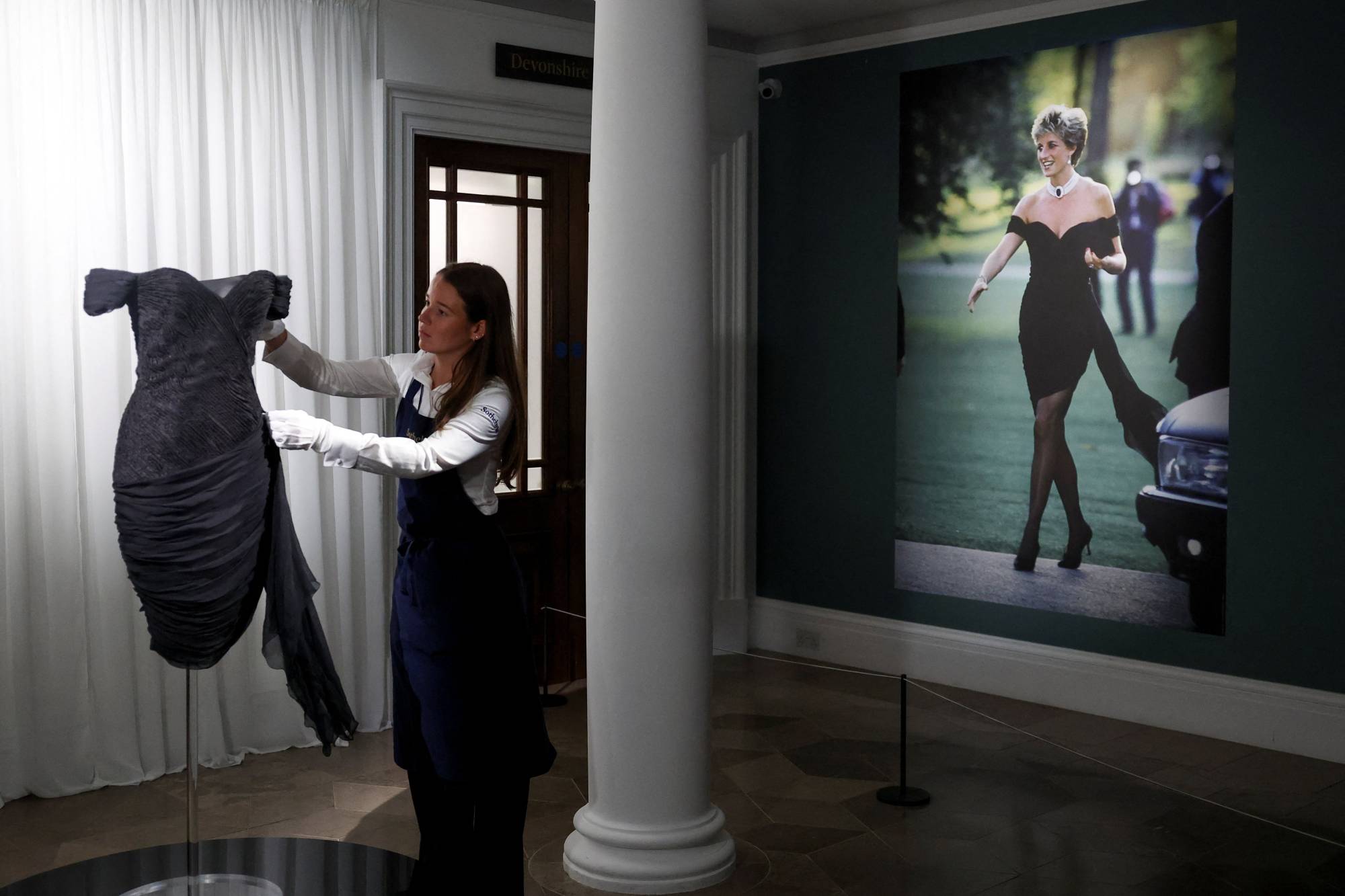
A Sotheby’s employee adjusts Princess Diana's "Revenge Dress" by Greek designer Christina Stambolian in London, Britain, September 18, 2026. REUTERS/Toby Melville
Princess Diana's Famous 'Revenge Dress' Goes on Show Ahead of Sotheby's Auction
A Sotheby’s employee adjusts Princess Diana's "Revenge Dress" by Greek designer Christina Stambolian in London, Britain, September 18, 2026. REUTERS/Toby Melville
Revenge has rarely been so stylish.
A striking black dress worn by the late Princess Diana on the day her estranged husband publicly admitted adultery is going up for auction at Sotheby’s, with a presale estimate of up to $300,000.
First, the “revenge dress,” as it has become known, is going on an international tour, testament to the enduring global fascination with Diana almost 30 years after her death.
The garment, which went on public display Friday at Sotheby’s in London, was worn by Diana on June 29, 1994, the broadcast date of an interview in which the then-Prince Charles acknowledged infidelity.
Diana, who knew the revelation was coming, chose to wear the figure-hugging, off-the-shoulder silk dress by Greek designer Christina Stambolian for a gala at London’s Serpentine Gallery.
A Sotheby’s employee adjusts Princess Diana's "Revenge Dress" by Greek designer Christina Stambolian during a media preview, as it is displayed publicly for the first time in nearly 30 years ahead of its sale during Sotheby's Luxury Week, in London, Britain, September 18, 2026. REUTERS/Toby Melville
Morgane Halimi, Sotheby’s global head of handbags and fashion, said Diana chose the “beautiful and powerful outfit” as a way to seize control of her own story.
“She always used fashion as a way of expression, but this time (it) was a way to communicate her personal expression of herself,” Halimi said. “The way she felt on that day is that, ‘I’m taking back the story and I’m here and I stand for myself.’”
Images of Diana in the dress, accessorized with a sapphire necklace, black pumps and bright red nail polish, shot around the world. The Sun tabloid proclaimed on its front page the next day: “Revenge is chic.”
The following year Diana gave an interview in which she acknowledged her own extramarital affair, and famously said “there were three of us in this marriage,” in reference to Charles’ paramour Camilla Parker-Bowles, now Queen Camilla. Charles and Diana divorced in 1996, a year before Diana was killed in a car crash in Paris at the age of 36.
The dress remained so famous that a life-size waxwork replica of Diana wearing it was unveiled at a Paris museum last year.
The dress is being auctioned for the first time since 1997, when Diana sold it and other garments to raise money for AIDS charities. It has a presale estimate of $150,000 to $300,000, but Sotheby’s experts would not be surprised if it far exceeds that price.
A red sweater adorned with sheep that Diana wore to a polo match in 1981 sold in 2023 for $1.1 million, many times its presale estimate and a record for an item owned by the late royal.
“I personally believe that this dress is the most powerful item linked to Diana,” Halimi said.
“The Diana provenance always attracts collectors,” she added. “But the story of this dress and the universal message that it brings will definitely attract also institutions as well as private collectors who are looking for unique pieces and one-of-a kind items.”
In her lifetime, Diana was a style icon and one of the world’s most photographed women. Her star power has not dimmed, and neither has the fascination with the dramatic disintegration of her marriage to the now King Charles III. A new book by Diana’s brother Charles Spencer has seized headlines again and reignited a public feud between the Spencers and the royal family over the treatment of the princess.
The revenge dress is on show in London until Sept. 24 and travels to Hong Kong and Geneva ahead of its sale in New York on Dec. 9.
Japan's Busiest Rail Station Tests Robot Binshttps://english.aawsat.com/varieties/5319867-japans-busiest-rail-station-tests-robot-bins
Mobile robotic trash bins are pictured during testing at the Shinjuku Station transport complex in Tokyo on September 18, 2026. (Photo by Toshifumi KITAMURA / AFP)
Mobile robotic trash bins are pictured during testing at the Shinjuku Station transport complex in Tokyo on September 18, 2026. (Photo by Toshifumi KITAMURA / AFP)
The world's busiest railway station, located at the heart of Tokyo in Japan, is testing whether mobile robotic rubbish bins can ease the workload of sanitation workers, a rail operator representative said on Friday.
Shinjuku Station is a sprawling transport complex with multiple rail firms that serve more than 2.7 million passengers every day, and holds the Guinness World Record for the world's busiest rail station.
In a part of the station operated by East Japan Railway, the bins are emptied manually more than 10 times a day -- though the number of wastebaskets has been reduced in recent years for cleanliness and security reasons.
JR East is testing three automated bins, each standing just over one meter (three feet) tall and moving at a cautious 20 centimeters (eight inches) per second.
"We wanted to test how well something like this can operate automatically and safely in an environment like Shinjuku Station," Shinya Kawamichi, a JR East research official, told AFP.
"We want to see how much of a difference mobile trash bins that collect garbage make, and whether people are actually willing to throw their trash into them," he said.
The trial project, which runs until late November, will put the robots up against the station's always-hectic underground concourse, where they are meant to bring trash to human workers.
Kawamichi said the robots are designed to be "slow so that people can put trash in them and so (they) can stop at any moment".
The company also wanted to test if the robots can navigate busy crowds and be accepted by commuters -- with an eye to expanding the future uses of this technology.
The bulky, googly-eyed devices have become a hit among tourists, many of whom stopped to snap photos.
"The eyes are very cute," said German train driver Chris Genseliein, 30, adding that he had a tough time finding bins in Japanese train stations.
Despite being an enormous complex with two above-ground floors and a massive underground section, JR East's section of Shinjuku Station only has seven sets of bins and recycling boxes.
Some Japanese passengers said stations are kept clean because people take their trash home.
But others welcomed the added convenience.
"It's just easier if you could throw things away while walking," said university student Ryunosuke Noguchi, 22.
Swimmer Killed in Shark Attack at Popular Australia Beachhttps://english.aawsat.com/varieties/5319736-swimmer-killed-shark-attack-popular-australia-beach
Greg Metzger, lead field biologist for SOFO's shark research and education program, catches a sand tiger shark off the coast of Hampton Bays, N.Y., Thursday, Aug. 20, 2026. (AP Photo/Seth Wenig)
Swimmer Killed in Shark Attack at Popular Australia Beach
Greg Metzger, lead field biologist for SOFO's shark research and education program, catches a sand tiger shark off the coast of Hampton Bays, N.Y., Thursday, Aug. 20, 2026. (AP Photo/Seth Wenig)
A man died on Friday after being mauled by a shark while swimming at a popular beach in the state of Western Australia, police said.
It is the latest in a spate of shark attacks in the country and comes just days after a surfer was bitten in an attack in the same state.
The Western Australia Police Force said emergency services were called to a reported shark-related incident in the water off Sorrento Beach at around 10.30 a.m. local time (0230 GMT).
"It was reported a male swimmer had been bitten by a shark while swimming along the coast," WA Police said in a statement.
Authorities launched an extensive air and sea search, but the swimmer died as a result of the attack, the statement said, according to Reuters.
Sorrento Beach is a popular swimming spot around 20 km (12.5 miles) from Perth's central business district. The local council said it closed down all beaches in its jurisdiction after the attack.
A 5-meter-long (16.4-foot) white shark was reported to monitoring website SharkSmart at the nearby Boyinaboat reef just after noon on Friday. There was no confirmation that it was the shark involved in the attack.
On Monday, a surfer was attacked at a beach in the town of Geraldton, around 400 km north of Perth. The surfer lost his foot in the attack and suffered serious leg injuries, local media said.
It follows the death of a 35-year-old man killed while spearfishing off the state's south coast in June, while a 38-year-old man was mauled to death off an island near Perth in May.
لم تشترك بعد
انشئ حساباً خاصاً بك لتحصل على أخبار مخصصة لك ولتتمتع بخاصية حفظ المقالات وتتلقى نشراتنا البريدية المتنوعة