



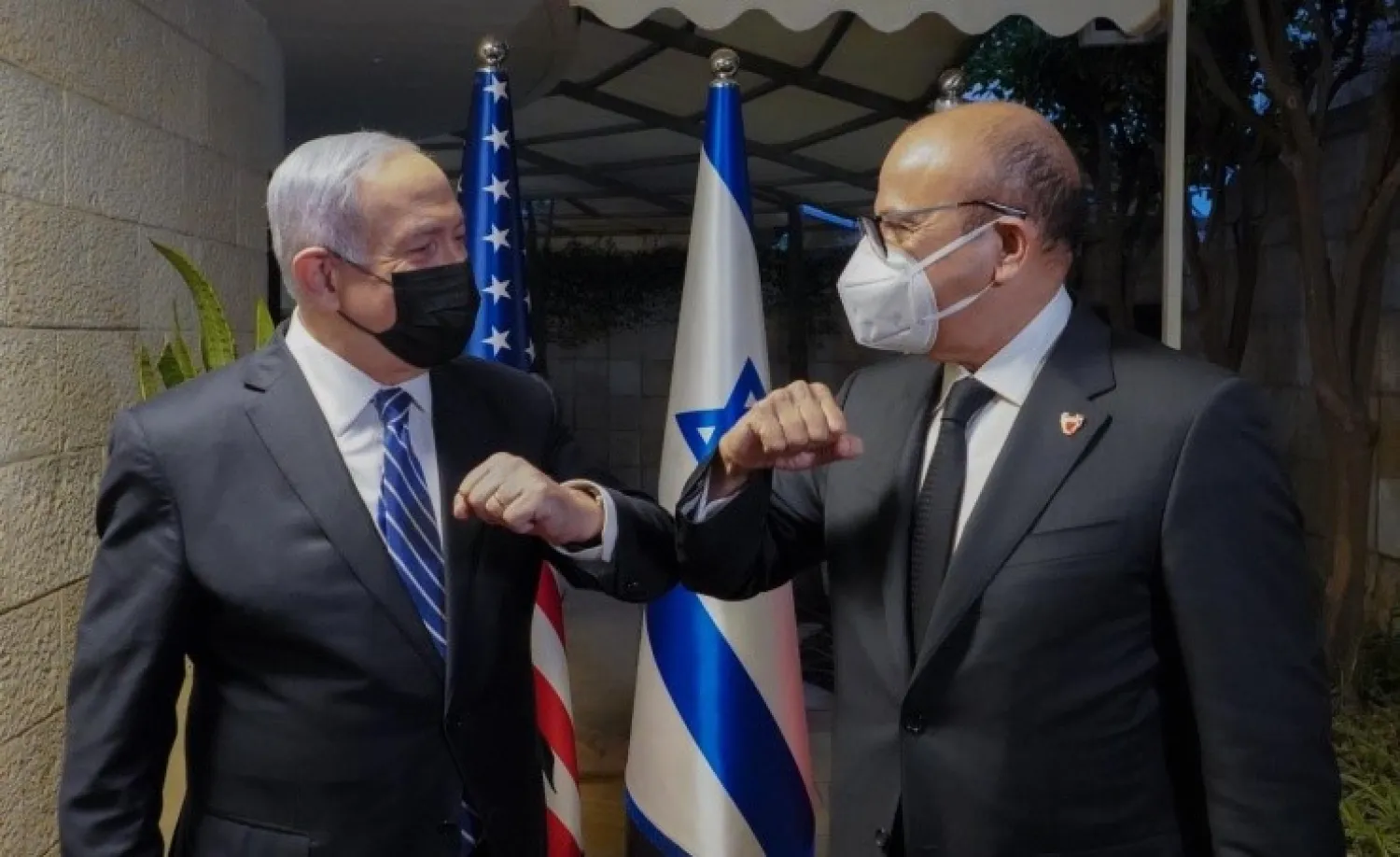

Tel Aviv and Manama have agreed to exchange embassies soon, Israeli Foreign Minister Gabi Ashkenazi and his Bahraini counterpart Abdlatif al-Zayani announced during a joint press conference in the West Bank.
Zayani arrived in Tel Aviv on Wednesday for a short visit, heading a delegation of 25 Bahraini political figures aboard the first commercial nonstop flight to Israel.
The Bahraini FM conveyed to his Israeli counterpart Manama’s approval of a request by Tel Aviv to open an embassy, and submitted an official request to open a mission in Israel.
The bilateral talks addressed issues of shared interest to achieve stability in the region, especially in light of the escalating challenges of terrorism and extremism and the growing need to enhance the culture of dialogue and mutual understanding, according to Bahrain News Agency (BNA).
Zayani affirmed that cooperation would pave the way for peace in the Middle East, indicating that the Israeli-Palestinian conflict needs to be resolved through negotiations.
The Bahraini foreign minister also announced that he has invited his Israeli counterpart to visit Manama next month, and a close associate of Ashkenazi said he will be visiting Bahrain on December 4.
Ashkenazi described the visit as "historic," saying Zayani is a friend and partner in peacemaking. He stressed that the deals signed with the UAE and Bahrain pave the way for achieving peace with the Palestinians.
He also welcomed the Palestinian Authority’s decision to resume cooperation, saying: “our door is open to renew negotiations and I urge the Palestinians to step through this door with no preconditions.”
Bahrain’s Foreign Ministry issued a statement announcing that Wednesday’s discussions focus on ways to boost bilateral relations and mechanisms for activating the memoranda of understanding they signed last month following the declaration to support peace and the Abraham Accords.
Meanwhile, an Israeli official who attended the first meeting between the two ministers, indicated that it is clear that Bahrain wants to push the cooperation forward, in almost all fields. He noted that this will certainly be reflected in a number of bilateral agreements, including aviation and technological cooperation.
The Israeli diplomat indicated that there is an enormous economic potential in the relations with the UAE and Bahrain, and many officials who have helped establish these relationships for more than 15 years, are now happy to be able to talk about it openly.
The Bahraini minister also met with Israeli President Reuven Rivlin, who lauded the historic beginning for joint cooperation between the two countries.
Rivlin presented the foreign minister with a copy of the Quran translated into Hebrew by his father, Professor Yosef Yoel Rivlin.
“This is a gift I will treasure all my life,” Zayani said thanking Rivlin.
He stressed that Bahrain’s approach is based on commitment to peace as a strategic alternative to launch initiatives to promote international cooperation, stability and peace as well as prosperity in the Middle East, reported BNA.
Zayani then headed to a one-on-one meeting with Prime Minister Benjamin Netanyahu followed by a tripartite meeting in the presence of US Secretary of State Mike Pompeo.
They were later joined by Ashkenazi and a high-level US delegation, headed by the outgoing administration’s chief peace negotiator Avi Berkowitz.
During a joint press conference, Netanyahu announced that the peace between "Israel and Bahrain is built on solid foundations of mutual appreciation and shared interest," that extend to years even before the signing of the Abraham Accords.
Pompeo hoped there will be peace agreements between Israel and other countries in order to provide excellent opportunities for development.
"These agreements open up wonderful opportunities for commerce and economic development."
For his part, Zayani called on the Israelis and Palestinians to return to peace talks aimed at resolving the conflict between the two sides and reaching a viable two-state solution.
“It was a tremendously important step on our common path to reconciliation and peace. Today, King Hamad and I are building a bridge of peace that many others will cross in the future.”


