


Ethiopia: Military Operation in Tigray Region Over, Hunt for Tigray Leaders Begins

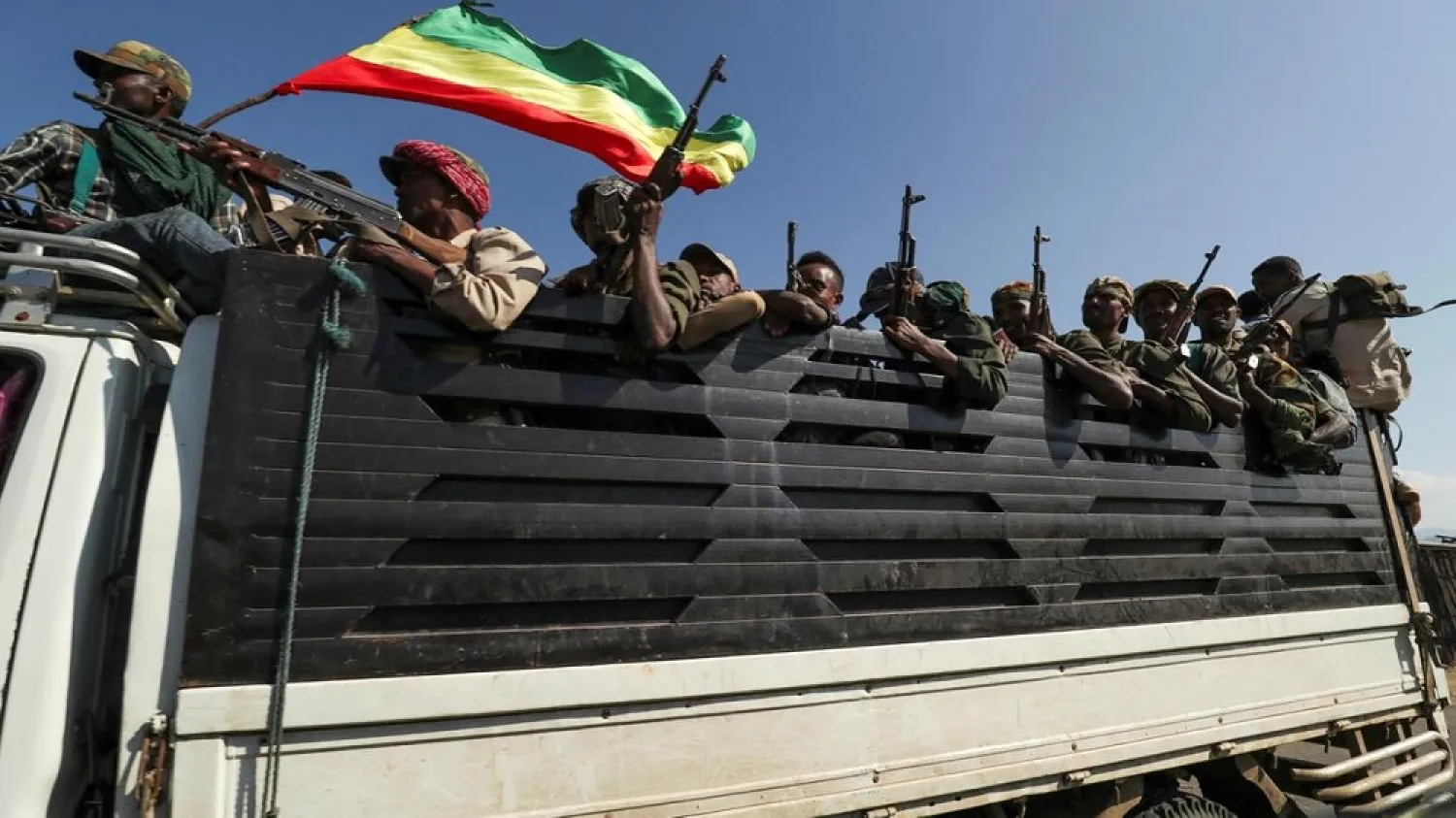
Members of Amhara region militias ride on a truck as they head to face the Tigray People's Liberation Front (TPLF), in Sanja, Amhara, Ethiopia. (Reuters)
TT

Ethiopia: Military Operation in Tigray Region Over, Hunt for Tigray Leaders Begins

Members of Amhara region militias ride on a truck as they head to face the Tigray People's Liberation Front (TPLF), in Sanja, Amhara, Ethiopia. (Reuters)

The Ethiopian government launched a manhunt on Sunday for leaders of a rebellious faction in the northern region of Tigray after announcing federal troops had taken over the regional capital and military operations were complete.

Prime Minister Abiy Ahmed government has been trying to quell a rebellion by the Tigray People's Liberation Front (TPLF), a powerful ethnically-based party that dominated the central government from 1991 until Abiy came to power in 2018.

He said on Saturday evening federal troops had taken control of the Tigrayan capital Mekelle within hours of launching an offensive there, laying to rest fears of protracted fighting in the city of 500,000 people.

The prime minister, who refers to the three-week-old conflict as an internal law and order matter and has rebuffed international offers of mediation, said federal police will try to arrest TPLF "criminals" and bring them to court.

However, TPLF leader Debretsion Gebremichael told Reuters in a text message on Saturday evening that TPLF forces would fight on, raising the prospect that the conflict could drag on.

Thousands of people are believed to have been killed and nearly 44,000 have fled to Sudan since the fighting began on Nov. 4. The conflict has been another test for Abiy, who took office two years ago and is trying to hold together a patchwork of ethnic groups that make up Ethiopia's 115 million people.

The flow of refugees and attacks by the TPLF on neighboring Eritrea have also threatened to destabilize the wider Horn of Africa region.

Claims from all sides are difficult to verify since phone and internet links to Tigray have been down and access tightly controlled since the fighting began.

The police late on Saturday issued arrest warrants for 17 more military officers charged with crimes in connection with the conflict that include treason and embezzlement of public properties, state-affiliated Fana TV reported. They add to the 117 warrants issued for senior military officers it says are connected to TPLF since the conflict broke out.

It was not clear if any TPLF leaders had surrendered, their whereabouts or their next plans.

"Their brutality can only add (to) our resolve to fight these invaders to the last," the TPLF's Debretsion told Reuters in a text message on Saturday.

Asked by Reuters if that meant his forces would continue fighting, he replied: "Certainly. This is about defending our right to self-determination."

Debretsion said in another text message that Tigrayan forces were withdrawing from around Mekelle.

History of resistance
Regional diplomats and experts have warned that a rapid military victory might not signal the end of the conflict.

The TPLF has a history of guerrilla resistance. Tigray's mountainous terrain and borders with Sudan and Eritrea helped the TPLF during its long struggle against Marxist ruler Mengistu Haile Mariam, whom it eventually toppled in 1991.

The TPLF and Eritrean forces fought together against Mengistu, but relations later soured after Eritrea became independent in 1993. The two nations fought over a border dispute in 1998-2000 and the TPLF sees Eritrea as a mortal enemy.

Eritrea signed a peace deal with Abiy in 2018, and the prime minister won the Nobel Peace Prize last year.

Explosions in Eritrea’s capital
Six explosions were reported in the Eritrean capital, Asmara, on Saturday night, the US State Department said, although it was not immediately clear if they were related to the Tigray conflict. The State Department post did not mention the cause or location of the explosions.

Tigrayan forces fired rockets at Eritrea on Nov. 14.

Reuters was unable to reach the Eritrean government or Tigrayan forces for comment.

The TPLF, which denounces Abiy's warm relations with Eritrea, has accused Eritrea of sending troops to Tigray to join the Ethiopian government's fight.

It has not been possible to contact the Eritrean government for comment on this.

The TPLF also accuses Abiy of wanting to centralize control at the expense of Ethiopia's 10 regions. The constitution grants the regions wide-ranging powers over matters like taxation and security.

Abiy has denied he wants to centralize power.

This year, Abiy postponed elections scheduled for August to next year because of the COVID-19 pandemic. Calling this a power grab, the TPLF held its own regional elections in September and announced it no longer recognized federal authority. Abiy's government declared the Tigray election illegal.



Russia's Lavrov Warns against Any New US Strike on Iran

FILE PHOTO: Russia's Foreign Minister Sergei Lavrov speaks during an annual press conference in Moscow, Russia, January 14, 2025. REUTERS/Evgenia Novozhenina/File Photo
TT

Russia's Lavrov Warns against Any New US Strike on Iran

FILE PHOTO: Russia's Foreign Minister Sergei Lavrov speaks during an annual press conference in Moscow, Russia, January 14, 2025. REUTERS/Evgenia Novozhenina/File Photo

Russian Foreign Minister Sergei Lavrov, in ‌an interview made public on Wednesday, said that any new US strike on Iran would have serious consequences and called for restraint to find a solution to enable Iran to pursue a peaceful nuclear program.

Lavrov's interview with Saudi Arabia's Al-Arabiya television was aired a day after US and Iranian negotiators held indirect talks in Geneva to head off a new mounting crisis between Washington and Tehran, Reuters said.

"The consequences are not good. There have already been strikes on Iran on ‌nuclear sites ‌under the control of the International Atomic ‌Energy ⁠Agency. From what ⁠we can judge there were real risks of a nuclear incident," Lavrov said in the interview, which was posted on his ministry's website.

"I am carefully watching reactions in the region from Arab countries, Gulf monarchies. No one wants an increase in tension. Everyone understands this is playing with fire."

Boosting ⁠tensions, he said, could undo the ‌positive steps of recent years, including ‌improved relations between Iran and nearby countries, notably Saudi Arabia.

A senior ‌US official told Reuters on Wednesday that Iran was ‌expected to submit a written proposal on how to resolve its standoff with the United States after the talks in Geneva.

US national security advisers met in the White House on Wednesday and ‌were told all US military forces deployed to the region should be in place ⁠by mid-March, ⁠the official said.

The United States wants Iran to give up its nuclear program, and Iran has adamantly refused and denied it is trying to develop an atomic weapon.

Lavrov said Arab countries were sending signals to Washington "clearly calling for restraint and a search for an agreement that will not infringe on Iran's lawful rights and ... guarantee that Iran has a purely peaceful nuclear enrichment program".

Russia, he said, remained in close, regular contact with Iran's leaders "and we have no reason to doubt that Iran sincerely wants to resolve this problem on the basis of observing the Nuclear Non-Proliferation Treaty".


AI Cannot Be Left to 'Whims of a Few Billionaires', UN Chief Says

India's Prime Minister Narendra Modi speaks with United Nations Secretary-General Antonio Guterres during a welcoming ceremony at AI Impact Summit, in New Delhi, India, February 18, 2026. India's Press Information Bureau/Handout via REUTERS
TT

AI Cannot Be Left to 'Whims of a Few Billionaires', UN Chief Says

India's Prime Minister Narendra Modi speaks with United Nations Secretary-General Antonio Guterres during a welcoming ceremony at AI Impact Summit, in New Delhi, India, February 18, 2026. India's Press Information Bureau/Handout via REUTERS

UN chief Antonio Guterres warned technology leaders Thursday of the risks of artificial intelligence, saying its future cannot be left to "the whims of a few billionaires".

Speaking at a global AI summit in India, the UN chief called on tech tycoons to support a $3 billion global fund to ensure open access to the fast-advancing technology for all.

"AI must belong to everyone," he said.

"The future of AI cannot be decided by a handful of countries -- or left to the whims of a few billionaires," he added, warning the world risked deepening inequality unless urgent steps were taken.

"Done right, AI can... accelerate breakthroughs in medicine, expand learning opportunities, strengthen food security, bolster climate action and disaster preparedness and improve access to vital public services," he said.

"But it can also deepen inequality, amplify bias and fuel harm."

The UN has set up an AI scientific advisory body to help countries make decisions about the revolutionary technology.

Guterres warned that people must be protected from exploitation, and that "no child should be a test subject for unregulated AI".

He pressed for global guardrails to ensure oversight and accountability, and the creation of "Global Fund on AI" to build basic capacity.

"Our target is $3 billion," he told the conference, which includes national leaders as well as tech CEOs, including Sam Altman of OpenAI and Google's Sundar Pichai.

"That's less than one percent of the annual revenue of a single tech company. A small price for AI diffusion that benefits all, including the businesses building AI."

Without investment, "many countries will be logged out of the AI age", exacerbating global divides, he said.

He also cautioned that as AI's energy and water demands soar, data centers must switch to clean power, rather than "shift costs to vulnerable communities".


US Military Tells Trump It's ‘Ready’ to Strike Iran as Soon as Saturday

A shot showing personnel preparations aboard the US aircraft carrier "Gerald Ford" (US Navy)
TT

US Military Tells Trump It's ‘Ready’ to Strike Iran as Soon as Saturday

A shot showing personnel preparations aboard the US aircraft carrier "Gerald Ford" (US Navy)

Top national security officials have told US President Donald Trump the military is ready for potential strikes on Iran as soon as Saturday, but the timeline for any action is likely to extend beyond this weekend, sources familiar with the discussions told CBS News.

Trump has not yet made a final decision about whether to strike, said the officials, who spoke under condition of anonymity to discuss sensitive national matters.

The conversations have been described as fluid and ongoing, as the White House weighs the risks of escalation and the political and military consequences of restraint, added CBS.

Over the next three days, the Pentagon is moving some personnel temporarily out of the Middle East region — primarily to Europe or back to the United States — ahead of potential action or counterattacks by Iran if the US were to move ahead with its operation, according to multiple officials.

It's standard practice for the Pentagon to shift assets and personnel ahead of a potential US military activity and doesn't necessarily signal an attack on Iran is imminent, one of the sources told CBS.

Contacted by CBS News on Wednesday afternoon, a Pentagon spokesperson said they had no information to provide.

Iran was discussed in the White House Situation Room on Wednesday, a US official and a senior military official told CBS News. All military forces deployed to the region are expected to be in place by mid-March.

Axios had also said that a war between the United States and Iran is looming — and there are several factors suggesting President Trump might push the button soon.

On Wednesday, Iran's top diplomat Abbas Araghchi said that Tehran was "drafting" a framework for future talks with the United States, as the US energy secretary said Washington would stop Iran's nuclear ambitions "one way or another".