2 Small Iraqi Oil Wells Set Ablaze in 'Terrorist Attack', Ministry Sayshttps://english.aawsat.com/home/article/2672611/2-small-iraqi-oil-wells-set-ablaze-terrorist-attack-ministry-says
2 Small Iraqi Oil Wells Set Ablaze in 'Terrorist Attack', Ministry Says
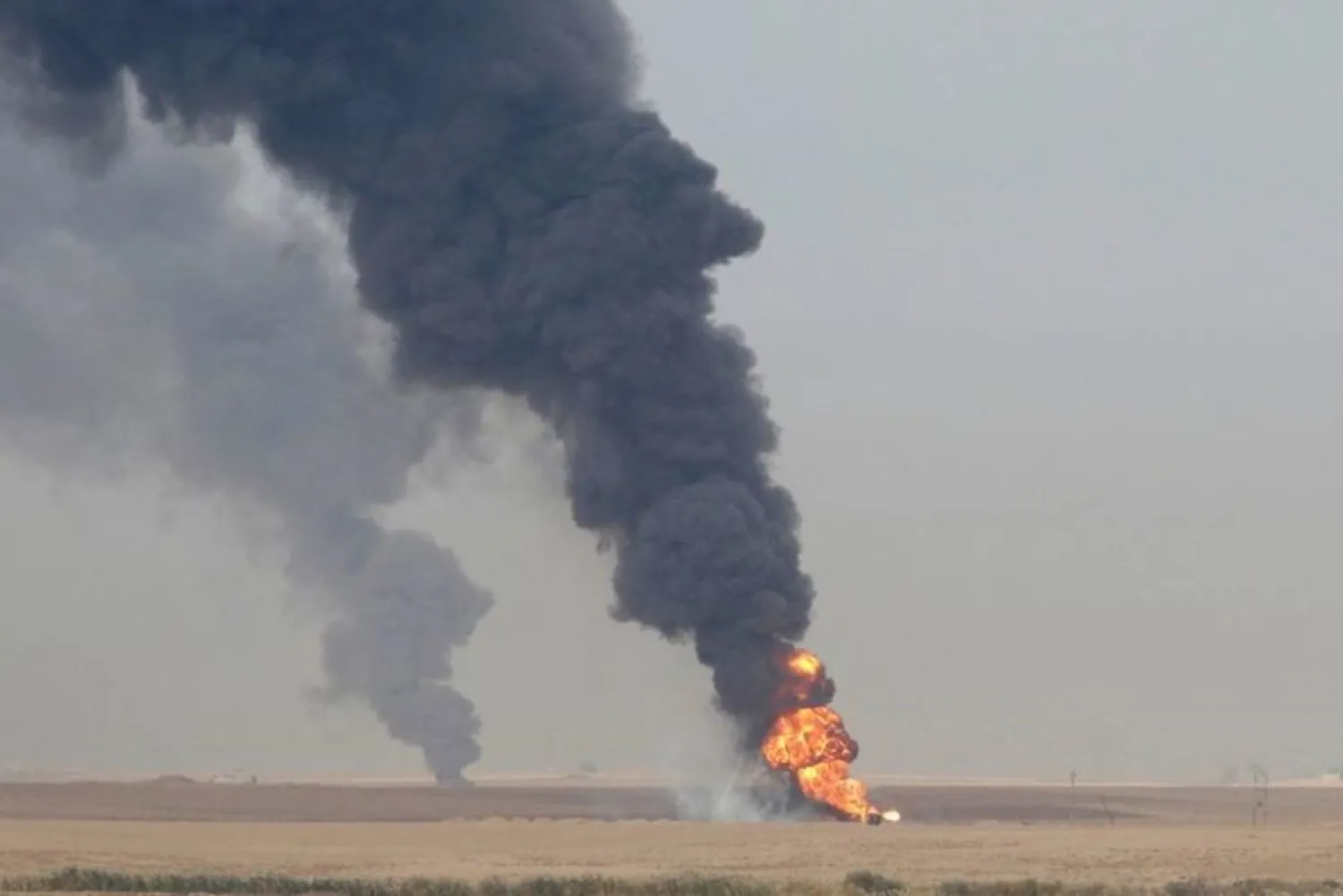
Smoke rises from oil wells inside the Khabbaz oilfield after they were bombed on the outskirts of Kirkuk, Iraq December 9, 2020. (Reuters)
Two wells in a small oilfield in northern Iraq were set ablaze by explosives on Wednesday in a "terrorist attack" but overall production from the field was not affected, the Oil Ministry and officials said Wednesday.
The Oil Ministry gave no details about the assailants behind the explosive devices that targeted the wells in Khabbaz oilfield, 20 km (12 miles) southwest of Kirkuk.
In a statement issued through its official channel on Telegram, ISIS claimed responsibility for the attack, though it did not provide any evidence to back up its claim.
Technical teams isolated the two burning oil wells and there was no impact on output, two sources from the state-run North Oil Company (NOC), who spoke on condition of anonymity, said.
The field produces about 25,000 barrels per day, oil officials said. The ministry said production from the two wells that were targeted did not exceed 2,000 bpd.
The ministry statement said a fire erupted at the two oil wells after explosive devices were set off half an hour apart, with one going off at 1:30 am (1030 GMT) and the second at 2:00 am (1100 GMT).
Asharq Al-Awsat's Mohammed al-Shafei Passes Away Leaving Behind Long Career in Pursuing the Toughest Fileshttps://english.aawsat.com/arab-world/5225220-asharq-al-awsats-mohammed-al-shafei-passes-away-leaving-behind-long-career
Asharq Al-Awsat's Mohammed al-Shafei Passes Away Leaving Behind Long Career in Pursuing the Toughest Files
Mohammed al-Shafei on board a military jet on his way to Afghanistan. (Asharq Al-Awsat)
Mohammed al-Shafei, one of Asharq Al-Awsat's most prominent journalists, passed away at 74 on Wednesday, leaving behind a career that spanned over 40 years during which he tackled the thorniest and most complex files.
Al-Shafei specialized in extremist groups and was among the first journalists to have written about these issues in Arab press. He pursued his stories with strict professionalism, seeking out sources. He joined Asharq Al-Awsat in 1982, kicking off a long, dedicated career, marked by accuracy, commitment and high professionalism.
Al-Shafei was born in Egypt in 1951. He earned a Bachelor of Islamic Archeology from the University of Cairo in 1974. He traveled to London in 1977 and earned a Postgraduate Diploma in translation from the University of Westminster. He pursued further studies in journalistic translation at the School of Oriental and African Studies (SOAS) in the mid-1980s, forging his unique skills in handling foreign sources, complex documents and sensitive security and political texts.
Mohammed al-Shafei at his Asharq Al-Awsat office in, as photographed by his colleague Adil al-Salmi.
He kicked off his journalism career in London in the 1980s. He worked at several Arabic newspapers published abroad, including “Al-Muslimoon” newspaper that was published by the Saudi Research & Publishing Company (SRMG) and the London-based “Al-Arab” newspaper. He returned to SRMG by working for the “Al-Zahira” newspaper that was established after the Iraqi invasion of Kuwait. The years he will spend at the newspaper will shape his deep knowledge of regional conflicts and their complexities.
He joined Asharq Al-Awsat newspaper in 1991, starting off in the sports section, where he worked for 15 years, during which he showed high professionalism and a remarkable ability to follow up and analyze news before moving on to the next step in his career by handling the terrorism file. He became a pioneer in Arab journalism, relying on accurate documentation and deep analyses while steering clear of sensationalism in tackling the most sensitive issues.
Mohammed al-Shafei with former British Ambassador to Afghanistan Mark Sedwill. (Asharq Al-Awsat)
His accomplishments include holding direct interviews with senior al-Qaeda leaders, including Mullah Omar. He traveled to Afghanistan where he interviewed Taliban leaders during times of heightened tensions. The rare insights offered by his interviews became a main reference for researchers and journalists interested in jihadists groups.
During the war on al-Qaeda, al-Shafei made several field visits to American bases in Afghanistan, joined international forces in conflict zones and carried out investigative reports from the battlefield, offering a glimpse of developments on the ground, the nature of the operations and the complexities of the scene, which was rare in Arab journalism at the time.
Mohammed al-Shafei interviews former Afghan Vice President Abdul Karim Khalili. (Asharq Al-Awsat)
Al-Shafei also carried out several interviews of Osama bin Laden’s son, presenting a humanitarian angle of the news and underscoring his professional ability to reach what were perceived as inaccessible sources, all without losing his professionalism and objectivity.
He was among the few Arab journalists who carried out interviews from Guantanamo prison where al-Qaeda members were being detained. The interviews offered yet another rare insight into terrorism issues and how these groups operate.
Al-Shafei helped in writing the book, “Al-Qaeda’s Men in Iran... A Safe Haven and Suspicious Alliance”, which was a result of years of research. It is seen as one of the first Arab publications about Iran’s ties to al-Qaeda, revealing that they had existed for years and were based on mutual interests.
Mohammed al-Shafei with an American soldier in Afghanistan. (Asharq Al-Awsat)
Al-Shafei married a Turkish woman in London in the late 1970s. They have a son and daughter. His son, Mahmoud, followed in his father’s footsteps, pursuing a career in journalism. He worked for Asharq Al-Awsat for three years.
Hours before his passing, al-Shafei remained dedicated to his profession. He wrote several articles that he sent to Asharq Al-Awsat and was in touch with his colleague by telephone to follow up on his work as was his habit throughout his career. With his passing, Arab journalism loses a calm and hardworking journalist, who was known by his colleagues for his discipline and humility.
Freed Prisoner Close to Sinwar Leading ‘Revolution’ Within Hamas in Gazahttps://english.aawsat.com/arab-world/5225219-freed-prisoner-close-sinwar-leading-%E2%80%98revolution%E2%80%99-within-hamas-gaza
The sun sets over a tent camp sheltering Palestinians displaced by the Israeli offensive, on New Year’ Eve in Khan Younis, southern Gaza Strip, December 31, 2025. REUTERS/Ramadan Abed
Freed Prisoner Close to Sinwar Leading ‘Revolution’ Within Hamas in Gaza
The sun sets over a tent camp sheltering Palestinians displaced by the Israeli offensive, on New Year’ Eve in Khan Younis, southern Gaza Strip, December 31, 2025. REUTERS/Ramadan Abed
Hamas has undergone a series of leadership changes in the Gaza Strip following the assassination of several senior figures during the two-year Israeli war, increasing the influence of individuals close to the movement’s former leader, Yahya Sinwar, who was killed in clashes with the Israeli army in Rafah in October 2024.
According to Hamas sources, freed prisoner Ali al-Amoudi, a member of the political bureau and former head of the movement’s media department, has assumed the role of acting head of Hamas’ political bureau in Gaza.
Al-Amoudi was tasked, along with several figures close to Sinwar, with managing the movement’s affairs in the Palestinian enclave, most of whom are based in Khan Younis in southern Gaza.
Al-Amoudi, who was released as part of the Israeli soldier Gilad Shalit prisoner exchange deal in 2011, has become the central figure in managing the impoverished territory. He was among those very close to Sinwar during their imprisonment in Israeli jails and after their release, accompanying him frequently to meetings and events.
Several sources told Asharq Al-Awsat that no elections took place for the political bureau. Rather, the process was carried out through appointment and consultation.
While some sources said the process took place “by circumventing by-laws,” others explained that the aim was “to fill internal gaps,” saying “all those chosen - such as Tawfiq Abu Naim, Salah Abu Sharkh - are close to Sinwar.”
The sources say that al-Amoudi is currently leading what can be described as a “revolution” within Hamas in Gaza. He has moved to replace some local leaders, especially officials of regional administrative bodies who were wounded in Israeli attacks.
Yet, he is still seeking to appoint replacements for former leaders who were assassinated, removed from their posts, or transferred to other positions.
According to some sources, his policies have angered local Hamas leaders in the Gaza Strip, as well as leaders abroad.
Members of the political bureau outside the territory reportedly informed local leaders that what happened “violates internal regulations, and that it is necessary to wait for the election of the movement’s head in the coming days, so that agreement can be reached on temporarily filling vacancies within the leadership of some regions until general elections are held after a year.”
The sources said that the “state of chaos” prevailing at the political level within Hamas in the Gaza Strip contrasts with a state of stability within the military wing, which continues to reorganize systematically.
They explained that Izz al-Din al-Haddad, the new leader of al-Qassam Brigades, is holding a series of meetings to appoint leaders who would replace figures assassinated or killed during the war.
According to the sources, al-Haddad is working to fill vacancies in various leadership positions, including commanders of brigades in some areas, while retaining others who had been chosen to run those brigades after their commanders were killed.
During the war, Israel assassinated most of the brigade commanders in the Gaza Strip (Northern, Central, Khan Younis, and Rafah), with the exception of the Gaza City Brigade, which was led by al-Haddad, who was replaced by Muhannad Rajab.
Israel Begins Demolishing 25 Residential Buildings in West Bank Camphttps://english.aawsat.com/arab-world/5225091-israel-begins-demolishing-25-residential-buildings-west-bank-camp
An Israeli army excavator demolishes buildings during a military operation in Nur Shams refugee camp, near the West Bank city of Tulkarem, 31 December 2025. (EPA)
TT
TT
Israel Begins Demolishing 25 Residential Buildings in West Bank Camp
An Israeli army excavator demolishes buildings during a military operation in Nur Shams refugee camp, near the West Bank city of Tulkarem, 31 December 2025. (EPA)
Israeli bulldozers began demolishing 25 buildings housing Palestinians in a refugee camp on Wednesday, in what the military said was an effort to root out armed groups in northern areas of the occupied West Bank.
The buildings, home to some 100 families, are in the Nur Shams camp, a frequent site of clashes between Palestinian gunmen and Israeli forces.
Israeli military bulldozers and cranes tore through the structures early Wednesday, sending thick plumes of dust into the air, an AFP journalist reported. Many residents watched from a distance.
The military said the demolitions were part of an operation against gunmen.
"Following ongoing counterterrorism activity by Israeli security forces in the area of Nur Shams in northern Samaria, the commander of the Central Command, Major General Avi Bluth, ordered the demolition of several structures due to a clear and necessary operational need," the military told AFP in a statement.
"Areas in northern Samaria have become a significant center of terrorist activity, operating from within densely populated civilian areas."
Earlier this year, the military launched an operation it said was aimed at dismantling Palestinian armed groups from camps in northern West Bank -- including Nur Shams, Tulkarem and Jenin.
"Even a year after the beginning of military operations in the area, forces continue to locate ammunition, weapons, and explosive devices used by terrorist organizations, which endanger soldiers and impair operational freedom of action," the military said on Wednesday.
Earlier in December, AFP reported residents of the targeted buildings retrieving their belongings, with many saying they had nowhere to go.
The demolitions form part of a broader Israeli strategy aimed at easing access for military vehicles within the densely built refugee camps of the West Bank.
Israel has occupied the Palestinian territory since 1967.
Nur Shams, along with other refugee camps in the West Bank, was established after the creation of Israel in 1948, when hundreds of thousands of Palestinians were displaced from their homes in what is now Israel.
With time, the camps they established inside the West Bank became dense neighborhoods not under their adjacent cities' authority. Residents pass on their refugee status from one generation to the next.
Many residents believe Israel is seeking to destroy the idea of the camps themselves, turning them into regular neighborhoods of the cities they flank, in order to eliminate the refugee issue.
لم تشترك بعد
انشئ حساباً خاصاً بك لتحصل على أخبار مخصصة لك ولتتمتع بخاصية حفظ المقالات وتتلقى نشراتنا البريدية المتنوعة