


Football Needs to Catch Up and Get Its House in Order Over Concussion

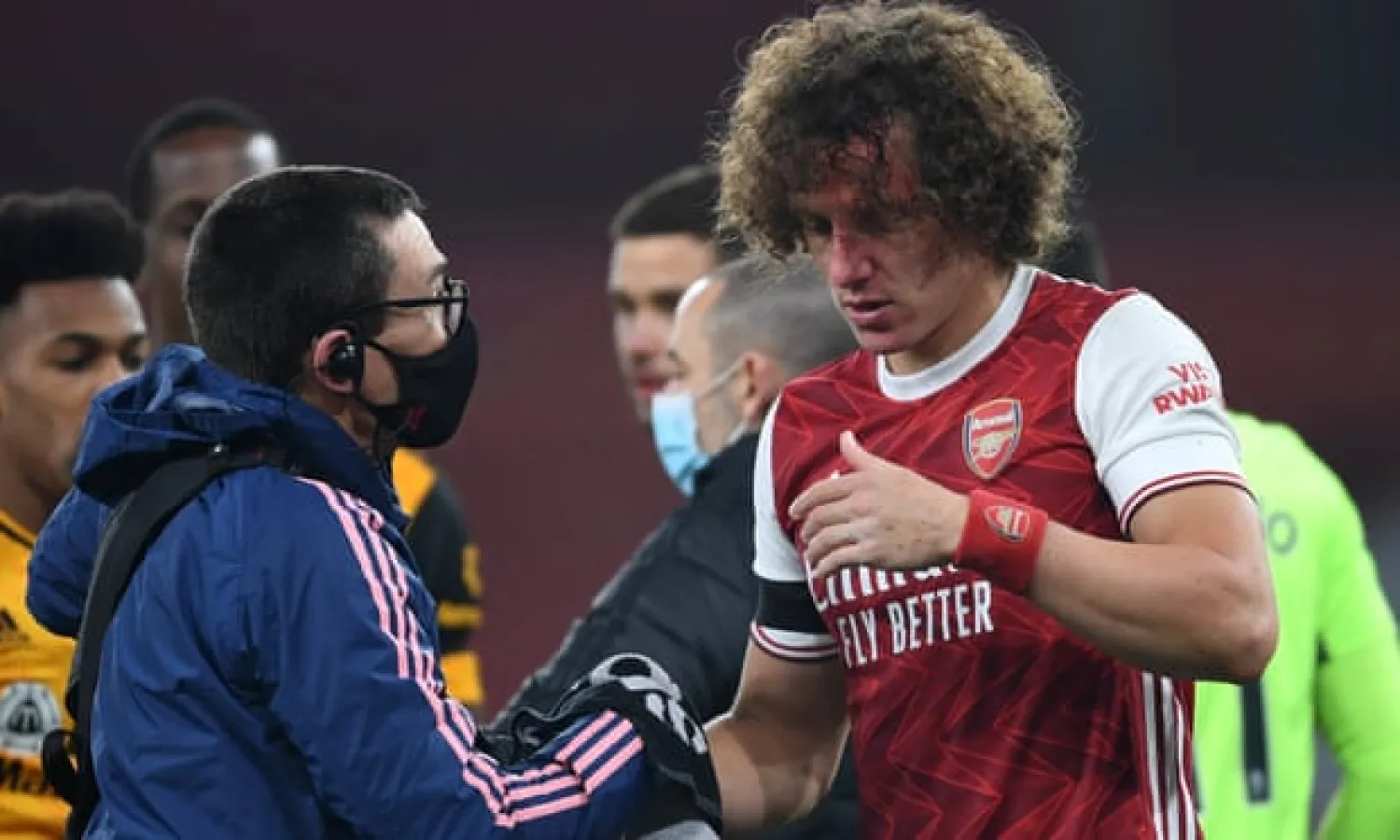
Arsenal’s David Luiz is treated after Sunday’s sickening clash of heads with Wolves’ Raúl Jiménez, who has now been diagnosed with a fractured skull. Photograph: David Price/Arsenal FC/Getty Images
TT

Football Needs to Catch Up and Get Its House in Order Over Concussion

Arsenal’s David Luiz is treated after Sunday’s sickening clash of heads with Wolves’ Raúl Jiménez, who has now been diagnosed with a fractured skull. Photograph: David Price/Arsenal FC/Getty Images

For too long football has played tiki-taka with the issue of concussion, rather than tackling it head on. It has been passed around from committee to committee, governing body to governing body, without the authorities facing up to its pernicious threat. Perhaps the recent deaths of Jack Charlton and Nobby Stiles will sharpen the focus.

What happened at the Emirates on Sunday certainly should. It was jolting enough to witness Wolves’ Raúl Jiménez receiving oxygen and leaving on a stretcher with a fractured skull following a clash of heads with David Luiz. It was almost as worrying when the Arsenal man got up and carried on for another 40 minutes, despite blood oozing through his head bandages.

True, David Luiz passed all the required medical assessments. And the Premier League emphasizes that doctors have a long list of clues they use to detect concussion, ranging from a “dazed, blank or vacant look” on a player’s face to asking questions such as: “What team did you play last week?” Gone are the days when a dose of smelling salts was applied to the nostrils before the player was shunted back into action.

Even so, was it an unnecessary risk? Scientists have long since established that concussion symptoms do not always show up immediately after a head impact and that playing on can damage recovery. One study in the journal Pediatrics followed 69 high‑school athletes who sustained head injuries in American football, ice hockey, soccer, and volleyball and found that those who stayed on the field took twice as long to recover (44 days compared with 22 days).

There also remains a wearing sense that football is lagging behind both rugby codes as well cricket, the NFL, and horse racing when it comes to head impacts. As Alan Shearer put it on Match of the Day 2: “We are talking about life and death.”

He added: “Football needs to get real, it needs to wake up, it needs to get serious. Not next year, next month, now. It is not acceptable, it has been going too far too long.”

In rugby union, it used to be regarded as a badge of honor to battle on, no matter how groggy the brain or bloodied the shirt. Attitudes have changed. Incidents such as Wales’s George North appearing to be concussed twice in a Six Nations match focused minds – as did the year‑on‑year rise in the reported incidents of concussion in the Premiership from 2009-10 onwards.

Nowadays if there is any suspicion of a concussion then a player is removed from the pitch for a head injury assessment, which takes 10 minutes. If a player fails any of the cognitive tests, which are measured against a pre-season baseline, they are removed from play. The rules have also been changed in an attempt to make the game safer, particularly when it comes to tackling.

Rugby remains dangerous. Last year, a study in the British Journal of Sports Medicine found that on average, a professional rugby union player is more likely than not to sustain a concussion after 25 matches. But at least there is a sense of the authorities recognizing the seriousness of the problem and trying to do something about it.

Cricket’s attitude to concussion also changed in 2014 after the Australia batsman Phil Hughes died after being struck on the back of the head. Concussion substitutes are now allowed – which enabled Australia’s Steve Smith to be replaced mid-match in last year’s Ashes Test at Lord’s after he was struck on the neck by a Jofra Archer bouncer.

Horse racing has more concussions than any other sport, with an average of 25 per 1,000 hours in jumping and 17 in Flat races, but the British Horseracing Authority insists they have been “well ahead of the game” in recognizing the dangers thanks to its former doctor, Michael Turner, a world authority on concussion.

Since 2018 any jockey who is involved in a fall is immediately assessed by a Scat5 test and often again 25-30 minutes later, even if they are asymptomatic. “If they fail the test they are stood down for a minimum of six days,” says Robin Mounsey of the BHA. “Any rider with concussion shouldn’t be driving so they will also be helped to get home. If it is a severe case of concussion, they will be sent to hospital.”

The riders also do a two-yearly CogSport test to set a baseline and then to pick up any concerning shifts.

Football finally looks to be getting its act together with Lukas Brud, the chief executive of the International Football Association Board, telling the Guardian that new protocols, allowing additional substitutions if a player suffers a head injury, are likely to be passed on 16 December and trialed “as soon as possible” next year.

It is a start. But there is still a sense the game is skirting around the issue. That is despite a major Glasgow University finding last year that former professional footballers are three and a half times more likely to suffer from dementia than the general population. Another study, by scientists at Purdue in Indiana, showed when teenage girls head a football regularly there is a risk of low‑level brain injuries, which in some cases last for four or five months before the brain looks normal on MRI scans.

Perhaps the lack of X-rated collisions compared with other sports led football’s authorities to relax for too long. Thankfully attitudes are now changing. But with Watford’s Troy Deeney claiming on Monday that players know best when it comes to head injuries there is still some way to go.

(The Guardian)


Chelsea Injuries up 44% After Club World Cup but Report Says Event Has Had ‘Minimal’ Impact

Chelsea's Reece James, center, lifts the trophy following the Club World Cup final soccer match between Chelsea and PSG at MetLife Stadium in East Rutherford, N.J., Sunday, July 13, 2025. (AP)
TT

Chelsea Injuries up 44% After Club World Cup but Report Says Event Has Had ‘Minimal’ Impact

Chelsea's Reece James, center, lifts the trophy following the Club World Cup final soccer match between Chelsea and PSG at MetLife Stadium in East Rutherford, N.J., Sunday, July 13, 2025. (AP)

Chelsea suffered a 44% spike in injuries after competing in the supersized Club World Cup this year, according to findings published on Tuesday.

But the newly expanded tournament has so far had a “minimal impact” on injuries overall, the latest edition of the Men’s European Football Injury Index found.

There was fierce opposition to FIFA's new flagship club event when it was confirmed in 2023 that it would increase from seven to 32 teams, with players' unions warning of physical and mental burnout of players due to an ever expanding match schedule. But FIFA pressed ahead and staged the tournament in the United States in June-July.

Chelsea went on to win the inaugural competition, receiving the trophy from US President Donald Trump at MetLife Stadium and taking home prize money of around $125 million. But, according to the Index, from June-October, Chelsea picked up more injuries — 23 — than any of the nine clubs from Europe's top leagues that participated in the Club World Cup.

They included star player Cole Palmer, and was a 44% increase on the same period last year.

While Chelsea, which played 64 games over the entire 2024-25 season, saw an increase in injuries, the Index, produced by global insurance firm Howden, found that overall there was a decrease.

“In principle you would expect this increased workload to lead to an increase in the number of injuries sustained, as a possible rise in overall injury severity,” the Index report said, but added: “The data would suggest a minimal impact on overall injury figures.”

Despite the figures, the authors of the report accept it was too early to assess the full impact of the Club World Cup, with the findings only going up to October.

“We would expect to see the impact to spike in that sort of November to February period,” said James Burrows, Head of Sport at Howden. “What we’ve seen previously is that’s where the impact is seen from summer tournaments."

Manchester City has sustained 22 since the tournament, which is the highest among the nine teams from Europe's top leagues — England, Spain, Italy, Germany and France.

Those teams have recorded 146 injuries from June-October, which is down on the previous year's figure of 174.

From August-October that number is 121, the lowest for that three-month period in the previous six years of the Index.


Sunderland Worst Hit by Losing Players to African Cup of Nations 

14 December 2025, United Kingdom, London: Sunderland's Habib Diarra (L) and Leeds United's Gabriel Gudmundsson battle for the ball during the English Premier League soccer match between Brentford and Leeds United at the Gtech Community Stadium. (dpa)
TT

Sunderland Worst Hit by Losing Players to African Cup of Nations 

14 December 2025, United Kingdom, London: Sunderland's Habib Diarra (L) and Leeds United's Gabriel Gudmundsson battle for the ball during the English Premier League soccer match between Brentford and Leeds United at the Gtech Community Stadium. (dpa)

Premier League Sunderland will have to do without six players over the next few weeks and are the club worst hit as the Africa Cup of Nations takes its toll on European clubs competing over the holiday season.

Sunderland, eighth in the standings, had four of their African internationals in action when they beat Newcastle United on Sunday, but like 14 other English top-flight clubs will now lose those players to international duty.

The timing of the African championship, kicking off in Morocco on Sunday and running through to January 18, has long been an irritant for coaches, with leagues in Belgium, France, Germany, Italy, Netherlands, Portugal, and Spain also affected.

Hosting the tournament in the middle of the season impacts around 58% of the players at the Cup of Nations, though the Confederation of African Football did try to mitigate the impact by moving the start to before Christmas, so it is completed before the next round of Champions League matches.

The impact on European clubs was also lessened by allowing them to release players seven days, rather than the mandatory 14 days, before the tournament, meaning they could play for their clubs last weekend.

Sunderland's Congolese Arthur Masuaku and Noah Sadiki, plus full back Reinildo (Mozambique), midfielder Habib Diarra (Mali), and attackers Chemsdine Talbi (Morocco) and Bertrand Traore (Burkina Faso) have now departed for Morocco.

Ironically, Mohamed Salah’s absence from Liverpool to play for Egypt should lower the temperature at the club after his recent outburst against manager Arne Slot, but Manchester United will lose three players in Noussair Mazraoui, Bryan Mbeumo and Amad Diallo, who scored in Monday’s 4-4 draw with Bournemouth.

France is again the country with the most players heading to the Cup of Nations, and with 51 from Ligue 1 clubs. But their absence is much less impactful than previously as Ligue 1 broke after the weekend’s fixtures and does not resume until January 2, by which time the Cup of Nations will be into its knockout stage.

There are 21 players from Serie A clubs, 18 from the Bundesliga, and 15 from LaLiga teams among the 24 squads at the tournament in Morocco.


Rodgers Takes Charge of Saudi Team Al-Qadsiah After Departure from Celtic 

Then-Celtic head coach Brendan Rodgers greets supporters after a Europa League soccer match between Red Star and Celtic at Rajko Mitic Stadium in Belgrade, Serbia, Sept. 24, 2025. (AP)
TT

Rodgers Takes Charge of Saudi Team Al-Qadsiah After Departure from Celtic 

Then-Celtic head coach Brendan Rodgers greets supporters after a Europa League soccer match between Red Star and Celtic at Rajko Mitic Stadium in Belgrade, Serbia, Sept. 24, 2025. (AP)

Brendan Rodgers has returned to football as the coach of Saudi Arabian club Al-Qadsiah, six weeks after resigning from Scottish champion Celtic.

Al-Qadsiah, whose squad includes Italian striker Mateo Retegui and former Real Madrid defender Fernandez Nacho, is in fifth place in the Saudi Pro League in its first season after promotion.

Rodgers departed Celtic on Oct. 27 and has opted to continue his managerial career outside Britain for the first time, having previously coached Liverpool, Leicester and Swansea.

In its statement announcing the hiring of Rodgers on Tuesday, Al-Qadsiah described him as a “world-renowned coach” and said his arrival “reflects the club’s ambitious vision and its rapidly growing sporting project.”

Aramco, the state-owned Saudi oil giant, bought Al-Qadsiah in 2023 in a move that has helped to transform the club’s status.

“This is a landmark moment for the club,” Al-Qadsiah chief executive James Bisgrove said. “The caliber of his experience and track record of winning reflects our ambition and long-term vision to establish Al-Qadsiah as one of Asia’s leading clubs.”

Rodgers is coming off winning back-to-back Scottish league titles with Celtic, where he won 11 major trophies across his two spells. He also won the FA Cup with Leicester.

Al-Qadsiah's last two coaches were former Liverpool striker Robbie Fowler and former Spain midfielder Michel.
