


Jean-Michel Aulas: 'I Realized I Could Do Something About the Inequalities in Football'


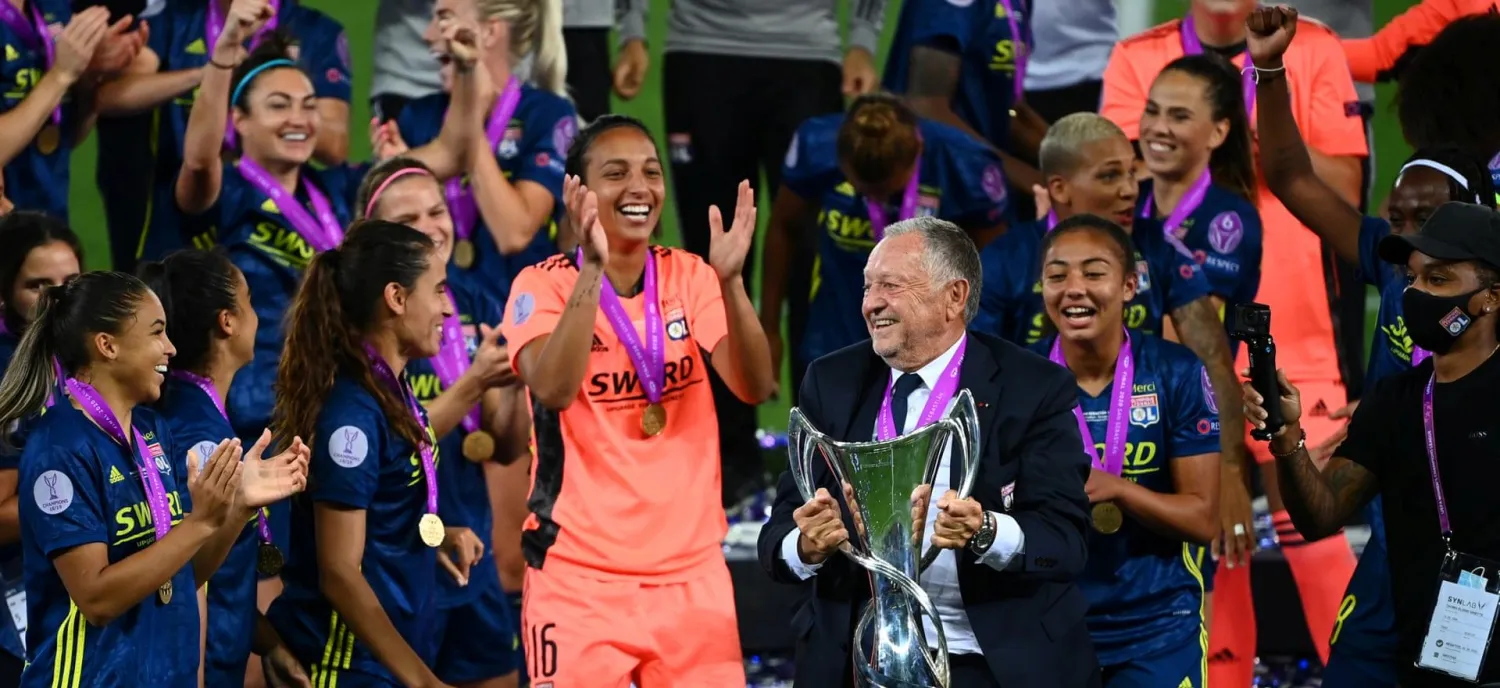
Lyon president Jean-Michel Aulas celebrates with the team after they beat Wolfsburg in the Champions League final in August.
Photograph: Getty Images
Lyon president Jean-Michel Aulas celebrates with the team after they beat Wolfsburg in the Champions League final in August. Photograph: Getty Images
TT

Jean-Michel Aulas: 'I Realized I Could Do Something About the Inequalities in Football'


Lyon president Jean-Michel Aulas celebrates with the team after they beat Wolfsburg in the Champions League final in August.
Photograph: Getty Images
Lyon president Jean-Michel Aulas celebrates with the team after they beat Wolfsburg in the Champions League final in August. Photograph: Getty Images

In August the Lyon owner-president, Jean-Michel Aulas, felt he was close to realising an incredibly ambitious dream. For the second time during his 33 years in charge he had the men’s and women’s teams competing in the latter stages of the Champions Leagues. Could a historic double be achieved?

In 2010 the men failed to reach the final, while the women were runners-up after losing to Turbine Potsdam on penalties. A decade later, in a “quite exceptional” year, both Lyon teams were readying to play Bayern Munich, the men in a semi-final and the women in a quarter-final three days later.

But where the women triumphed the men were emphatically defeated. The men had a period of ruthless domestic success in the 2000s after Aulas had bought the debt-ridden club in 1987 and began the process of lifting them out of the second division, but the Champions League has eluded them. For the women though, this was business as usual, a fifth consecutive European title and seventh win overall.

At the heart of a decade of dominance sits Aulas, who, in 2004, oversaw the acquisition of struggling women’s side FC Lyon and embarked on another “great adventure” that would lead the team to become the envy of clubs around the world.

“He’s basically the gamechanger,” says the Lyon forward and Champions League record scorer Ada Hegerberg. “’I’m not talking about him being the gamechanger just for Lyon but for women’s football in general.”

Aulas has invested in women’s football to an extent that few, if any, have before and it was not easy. “Within men’s football there was a huge resistance, inside clubs, inside the federation and in society in a general sense,” Aulas says. “I thought I had to take responsibility and proceed with those changes.”

Change was motivated by seeing first hand the level of inequality that existed. He cites two examples. First, around 2006, a player made him aware of the fact the men’s teams had complete freedom in choosing their kits, while the women’s had theirs imposed on them.

He collared the president of the France Football Federation and said that this “had to change immediately and that it didn’t correspond at all to the vision that should exist about the treatment of women, both in sports clubs but in companies in general”.

Then, in 2011, he stood in the changing rooms at half-time of Lyon’s Champions League semi-final second leg against Arsenal wringing out rainsoaked kits which would “again bring to light the unacceptable differences in the treatment that existed”.

He set about changing things. “I thought that the best way to address these issues was to fight to get comparable and equal treatment between all players regardless of their gender by providing full and equal investment in equipment, infrastructure and logistics and [at Lyon] we had the means to make this happen,” he says.

These values feel somewhat unique to find in a man of his generation and influence, but they are deep rooted. There are essentially two factors that built the 71-year-old entrepreneur’s ideological commitment to equality and the holistic values that have driven him in business and football.

“My father was a French teacher and my mother a maths teacher, and the culture they raised me in was one of respect for rules and values,” he says of the first. The second was a strong desire to remain independent and he actually filed for emancipation from his parents so that he could run his own business as a minor.

The purchase of FC Lyon in 2004 and then the ongoing financial commitment was prompted by conversations with Uefa, Fifa and with the former chairman of Montpellier, Louis Nicollin, who died in 2017 and had pioneered the women’s team at the club, all of which gave Aulas an “understanding of the inequalities that existed in football” and “my personal ability to do something about it”.

Aulas, who founded Cegid, a company that specialises in the development of management and accounting software, has not just handed over cash and guidance though, he has built relationships with the players past and present in the same way he does on the men’s side of the game.

Ask Lucy Bronze, who played for Lyon between 2017 and 2020, or Megan Rapinoe, who embraced the Lyon president on the pitch after the US women’s national team had won the World Cup in 2019, about his influence and they will gush in the same way Hegerberg does. That care is not just affection for the team, though that is there, but it is also strategic. “It is a personal investment I have in both the players from the academy but also with all the international players,” he says. “It is very important for me not because it’s absolutely necessary, but because it is something that can be very personally enriching, for both sides. It is something I do in all my companies because it is win-win.

“It’s very important, especially for high-level players, that if you are going to expect a lot from them then you should also give a lot. And in that sense it can help grow the game because the investment that you give pays off on the field and women’s football is promoted through their accomplishments.

“We should separate the return on investment from an economic point of view and then the return on investment from the point of view of the image and the values,” he adds. “It is true from a strictly financial point of view, the balance is not there yet in terms of the women’s game but the evolution is generally going in the right direction.”

The long view is key. Where other European clubs, such as Chelsea, Manchester City and Barcelona, are all increasing their investments as they try to catch Lyon, it is having played the long game and having built a culture at the club that sees the women’s team firmly embedded that is keeping the French giants ahead. “We don’t just want to fight for titles but also to make women’s football an absolutely essential and super positive part of the success of the whole club,” explains Aulas.

Hegerberg says: “We shouldn’t forget that maybe eight years ago, the team didn’t even have a changing room. We have come to a point where we’re at the same training ground as the men which is in my eyes very essential. That should be modern football today. And there’s still things to improve at Lyon as well. And that’s why it’s so important that we still keep on pushing.”

Another area where Lyon has set the benchmark is through player salaries. The club reportedly pays the best wages in the world with top salaries believed to be between €300,000 and €400,000 a year. However, those figures are still far below the salaries of male footballers, so how do they set the level?

“It’s an excellent question,” says Aulas thoughtfully. “Women’s football exists in the economic society that we live in. We operate as a private company, of which I’m the main shareholder, and which is also on stock exchange. So we need a balance sheet and to justify everything we do.

“In addition to money on the minds of many players is also the broader question about the position that they occupy in the football club. The promotion of gender equality and the values we have has to be translated into the economic aspect but unfortunately we can’t do as much [for the women’s players] as we can do with the men’s players [at the time being]. Certainly we pay better than others, because for us the economic respect is an important part of our values.”

Aulas is a playmaker. He is on the board of the European Club Association and chairs the women’s football committee. Now he is expanding the Lyon brand into the US with the takeover of Reign FC, now called OL Reign. “It is a strategy that aims to make the most from the influence of US women’s football and hopefully it will help the group be able to act even more effectively as a lever to influence things, such as pushing for the introduction of a women’s Club World Cup,” he says.

Never stand still is the motto and it is the constantly evolving drive and the depth of the equality culture that exists at Lyon that means the task of dislodging Lyon from the top of the women’s game is probably a far greater one than many clubs will have reckoned with.

(The Guardian)


Arbeloa Vows to ‘Fight for Everything’ as Real Madrid Manager

 Real Madrid new coach Alvaro Arbeloa attends a press conference at the club's Valdebebas training ground in Madrid, Tuesday, Jan. 13, 2026. (AP)
Real Madrid new coach Alvaro Arbeloa attends a press conference at the club's Valdebebas training ground in Madrid, Tuesday, Jan. 13, 2026. (AP)
TT

Arbeloa Vows to ‘Fight for Everything’ as Real Madrid Manager

 Real Madrid new coach Alvaro Arbeloa attends a press conference at the club's Valdebebas training ground in Madrid, Tuesday, Jan. 13, 2026. (AP)
Real Madrid new coach Alvaro Arbeloa attends a press conference at the club's Valdebebas training ground in Madrid, Tuesday, Jan. 13, 2026. (AP)

Real Madrid's new manager Alvaro Arbeloa pledged to fight for everything as he stepped into the role vacated by Xabi Alonso and said he would stay in post as long as he was needed.

Real announced Alonso had left the club by mutual agreement on Monday, following a poor run of form and reports of unrest with some of his senior players.

The 42-year-old Arbeloa stepped up in his place from reserve ‌team Real Madrid ‌Castilla and inherits a side ‌trailing ⁠Barcelona by ‌four points in LaLiga and reeling from a 3-2 defeat in Sunday's Spanish Super Cup final.

"Of course, I am aware of the responsibility and the task ahead of me, and I am very excited," Arbeloa told a press conference on Tuesday. "I've found a group of ⁠players who are really eager... They share my enthusiasm to fight ‌for everything and to win."

Arbeloa, ‍who has been part ‍of Real Madrid's coaching structure since 2020, faces ‍a swift baptism of fire with only one training session before Wednesday's Copa del Rey round of 16 clash against second-division Albacete.

The former right back, who played 238 matches for Real from 2009 to 2016 and won eight trophies, including two Champions League titles, ⁠was relaxed about how long he would serve as coach.

"I've been in this house for 20 years, and I'll stay as long as they want me to," he said.

Arbeloa's immediate goal is to bridge the gap with Barcelona in LaLiga while ensuring progress in the Champions League and Copa del Rey.

"The important thing is that the players are happy, enjoy themselves on the pitch, and honor the badge. Wearing this ‌badge is the best thing that can happen to you in life," he added.


Roma Takes the Dakar Lead in Saudi Arabia as Ford Goes One-Two

 Ford Racing's Spanish driver Nani Roma and Spanish co-pilot Alex Haro compete in Stage 8 of the 48th edition of the Dakar Rally 2026, in Saudi Arabia on January 12, 2026. (AFP)
Ford Racing's Spanish driver Nani Roma and Spanish co-pilot Alex Haro compete in Stage 8 of the 48th edition of the Dakar Rally 2026, in Saudi Arabia on January 12, 2026. (AFP)
TT

Roma Takes the Dakar Lead in Saudi Arabia as Ford Goes One-Two

 Ford Racing's Spanish driver Nani Roma and Spanish co-pilot Alex Haro compete in Stage 8 of the 48th edition of the Dakar Rally 2026, in Saudi Arabia on January 12, 2026. (AFP)
Ford Racing's Spanish driver Nani Roma and Spanish co-pilot Alex Haro compete in Stage 8 of the 48th edition of the Dakar Rally 2026, in Saudi Arabia on January 12, 2026. (AFP)

Spaniard Nani Roma led compatriot Carlos Sainz in a Ford one-two at the top of the Dakar Rally car standings on Tuesday after a tough ninth stage in the Saudi Arabian desert for some frontrunners.

Dacia's previous leader and five times winner Nasser Al-Attiyah slipped to third but still only one minute 10 seconds behind Roma, with Toyota's South African Henk Lategan fourth - and with a further five minutes to make up.

"I had three punctures today, but I think everyone had problems," said Roma, who last led the Dakar 12 years ago when he won. "We are positive to be here."

Sainz said it had been hard to find the way at one point, with the cars taking ‌a different route ‌to the bikes and no longer having tracks ‌to ⁠follow.

Lategan described it ‌as a "little bit of a disaster of a day" after getting lost, suffering a puncture, broken windscreen and loss of power steering.

"I was driving with no power steering, extremely difficult in these cars because the wheels are so big so you have to have massive power to even turn the wheels," he said.

"And then we had some more punctures, got lost and we hit that bush in Seb (Loeb)'s dust ⁠that broke the windscreen. So we had to stop and kick the windscreen out because I couldn't ‌see from inside the car, put some goggles ‍on and carry on going."

The 410km ‍stage from Wadi Ad Dawasir to the overnight bivouac, first half of a ‍marathon stage, was won by 21-year-old Polish non-factory Toyota driver Eryk Goczal.

He finished seven minutes ahead of his uncle Michal, also with the Energylandia team, while father Marek was in 31st position.

Australian Toby Price, a double Dakar winner on motorcycles, was third on the stage for Toyota.

Sainz, 63, was handed a one minute 10 second penalty for speeding and finished the stage seventh but ahead ⁠of most of his rivals, including Roma in eighth.

The four times Dakar winner is now 57 seconds behind Roma, who also won on a motorcycle in 2004.

Sweden's Mattias Ekstrom, who had been second overall for Ford, lost a lot of time with a navigation error and dropped to fifth and 11 minutes and 19 seconds off the pace. Dacia's nine times world rally champion Loeb was sixth.

Spaniard Tosha Schareina won the stage in the motorcycle category for Honda, with KTM's Argentine rider Luciano Benavides losing the way and his overall lead to Australia's defending champion Daniel Sanders.

Sanders, also on a KTM, led Honda's American Ricky Brabec by six minutes ‌and 24 seconds.

The race, which ends on Saturday on the Red Sea coast, is the first round of the World Rally-Raid Championship (W2RC) season.


Sinner Seeks Australian Open ‘Three-Peat’ to Maintain Melbourne Supremacy

13 January 2026, Australia, Melbourne: Italian tennis player Jannik Sinner in action during a practice session ahead of the Australian Open tennis tournament at Melbourne Park. (dpa)
TT

Sinner Seeks Australian Open ‘Three-Peat’ to Maintain Melbourne Supremacy

13 January 2026, Australia, Melbourne: Italian tennis player Jannik Sinner in action during a practice session ahead of the Australian Open tennis tournament at Melbourne Park. (dpa)

Jannik Sinner returns to the Australian Open targeting a third straight title as the Italian seeks to impose a level of supremacy reminiscent of Novak Djokovic's stranglehold on the year's ​opening Grand Slam.

The 24-year-old will arrive at Melbourne Park under vastly different circumstances from 12 months ago when his successful title defense was partly overshadowed by a doping controversy which saw him serve a three-month ban.

With that storm firmly behind him, Sinner steps onto the blue courts unencumbered and with his focus sharpened after an outstanding 2025 in which he was only seriously challenged by world number ‌one Carlos ‌Alcaraz.

"I feel to be a better player ‌than ⁠last ​year," Sinner ‌said after beating Alcaraz to win the season-ending ATP Finals with his 58th match victory of a curtailed campaign.

"Honestly, amazing season. Many, many wins, and not many losses. All the losses I had, I tried to see the positive things and tried to evolve as a player.

"I felt like this happened in a very good way."

Sinner now sets his sights ⁠on a third straight Melbourne crown - a feat last achieved in the men's game during ‌the second of Djokovic's "three-peats" from 2019 to ‍2021 - and few would bet ‍against him pushing his overall major tally to five.

That pursuit continues ‍to be built on a game as relentless as it is precise, a metronomic rhythm from the baseline powered by near-robotic consistency and heavy groundstrokes that grind opponents into submission.

Although anchored in consistency and control, Sinner has worked ​to add a dash of magic - the kind of spontaneity best embodied by Alcaraz - and his pursuit will add intrigue ⁠to a rivalry that has become the defining duel of men's tennis.

"It's evolved in a positive way, especially the serving," Sinner said at the ATP Finals of his game.

"From the back of the court, it's a bit more unpredictable. I still have margins where I can play better at times.

"It's also difficult because you have to give a lot of credit to your opponent. Carlos is an incredible player. You have to push yourself over the limits."

The "Sincaraz" rivalry has already lit up most of the biggest tennis tournaments but Melbourne remains the missing piece, ‌and all signs point to that changing this year with the Australian Open set for a blockbuster title showdown.
