

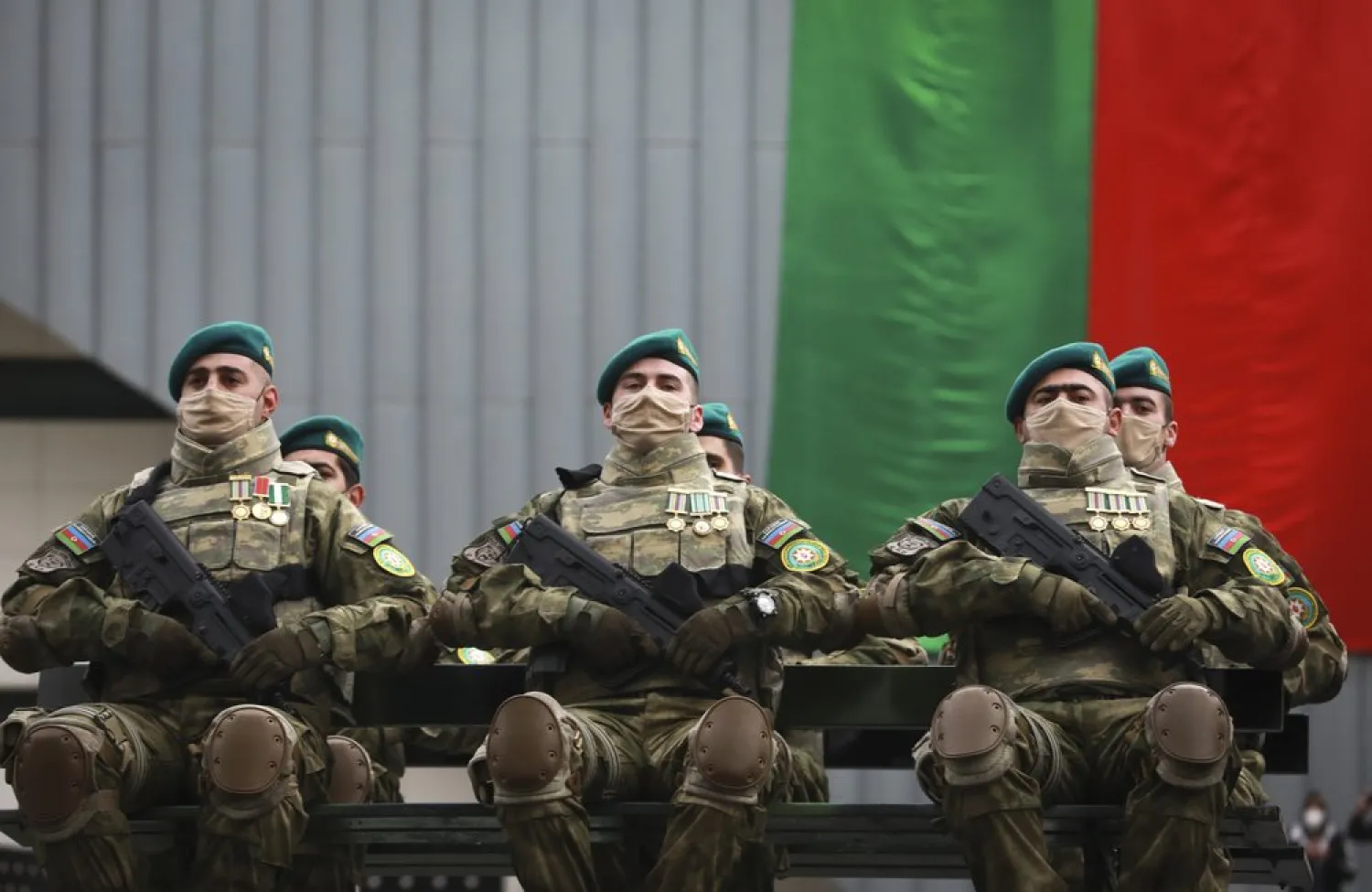

Armenians, Azerbaijan Trade Blame over Breach of Peace Deal

Azerbaijani troops attend the parade in Baku, Azerbaijan, Thursday, Dec. 10, 2020. (AP)
TT

Armenians, Azerbaijan Trade Blame over Breach of Peace Deal

Azerbaijani troops attend the parade in Baku, Azerbaijan, Thursday, Dec. 10, 2020. (AP)

Armenian officials and Azerbaijan on Saturday accused each other of breaching a peace deal that ended six weeks of fierce fighting over Nagorno-Karabakh, and Azerbaijan’s leader threatened to crush Armenian forces with an “iron fist.”

The new clashes mark the first significant breach of the peace deal brokered by Russia on Nov. 10 that saw Azerbaijan reclaim control over broad swathes of Nagorno-Karabakh and surrounding lands which were held by Armenian forces for more than a quarter-century.

Separatist officials in Nagorno-Karabakh said the Azerbaijani military launched an attack late Friday that left three local ethnic Armenian servicemen wounded.

Russian peacekeepers deployed to the region to monitor the peace deal reported a violation of the ceasefire in the Gadrut region on Friday. The report issued Saturday by the Russian Defense Ministry didn’t assign blame.

Later in the day, the Armenian Defense Ministry also charged that the Azerbaijani army mounted an attack in the south of Nagorno-Karabakh on Saturday.

Azerbaijani President Ilham Aliyev reacted on Saturday by blaming Armenia for the new clashes and threatened to “break its head with an iron fist.”

“Armenia shouldn’t try to start it all over again,” Aliyev said during a meeting with top diplomats from the United States and France who have tried to mediate the decades-old conflict. “It must be very cautious and not plan any military action. This time, we will fully destroy them. It mustn’t be a secret to anyone.”

Nagorno-Karabakh lies within Azerbaijan but was under the control of ethnic Armenian forces backed by Armenia since a separatist war there ended in 1994. That war left Nagorno-Karabakh itself and substantial surrounding territory in Armenian hands.

In 44 days of fighting that began in late September and left more than 5,600 people killed on both sides, the Azerbaijani army pushed deep into Nagorno-Karabakh, forcing Armenia to accept last month’s peace deal that saw Azerbaijan reclaim much of the separatist region along with surrounding areas. Russia deployed nearly 2,000 peacekeepers for at least five years to monitor the peace deal and to facilitate the return of refugees.

Azerbaijan marked its victory with a military parade on Thursday that was attended by Turkish President Recep Tayyip Erdogan and involved more than 3,000 troops, dozens of military vehicles, and a flyby of combat aircraft.

The peace deal was a major shock for Armenians, triggering protests calling for the resignation of Prime Minister Nikola Pashinyan, who has refused to step down. He described the peace agreement as a bitter but necessary move that prevented Azerbaijan from taking over all of Nagorno-Karabakh.



Magnitude 5.0 Quake Hits Southeastern Türkiye

Scenes from the devastating earthquake that struck southeastern Turkey in 2023 (Reuters file photo)
TT

Magnitude 5.0 Quake Hits Southeastern Türkiye

Scenes from the devastating earthquake that struck southeastern Turkey in 2023 (Reuters file photo)

A 5.0-magnitude earthquake struck several southeastern provinces in Türkiye on Saturday morning without causing casualties or damage, the country's disaster management agency said.

"No adverse situation has been reported following the magnitude 5 earthquake that occurred at 6:20 am (0320 GMT) in the Battalgazi district, in Malatya province, and was felt in the provinces of Malatya, Elazig, Adiyaman, Tunceli and Sanliurfa. Our teams continue to work in the field," AFP quoted the disaster agency AFAD as saying

Türkiye is crisscrossed by several geological fault lines that have previously caused catastrophes in the country.


Netanyahu Pushes Off Washington Visit After US ‘Anger’ Over PM’s Behavior

US President Donald Trump and Israeli Prime Minister Benjamin Netanyahu (L) arrive for a press conference in the State Dining Room of the White House in Washington, DC on 29 September 2025. (AFP)
TT

Netanyahu Pushes Off Washington Visit After US ‘Anger’ Over PM’s Behavior

US President Donald Trump and Israeli Prime Minister Benjamin Netanyahu (L) arrive for a press conference in the State Dining Room of the White House in Washington, DC on 29 September 2025. (AFP)

Israeli Prime Minister Netanyahu has canceled his planned trip to the United States next week as both the US and Israeli sides do not want US President Donald Trump to meet with the PM in the White House.

On Friday, Netanyahu’s Office said the postponement was due to changes surrounding the funeral of Senator Lindsey Graham. However, sources in Tel Aviv affirmed that the scheduling issue was only part of the reason behind the decision.

The sources said efforts to schedule a meeting between Netanyahu and Trump during the visit have failed.

According to the same sources, the Israeli PM knows the US administration is rigged against him. He also knows why.

“The Americans are closely monitoring Netanyahu and his cabinet members, tracking their public and private statements,” they said.

In return, intelligence assessments detail an escalation of Israeli surveillance targeting US decision-makers.

Several reports in Israel said Netanyahu fears such a trip could end in humiliation in front of the cameras, similar to what Trump did with Ukrainian President Volodymyr Zelensky in early 2025.

Meanwhile, US officials believe that Netanyahu is obstructing Trump's policies and plans to reach a ceasefire in the Middle East.

The US-Israeli tension was highlighted by US Vice President JD Vance who accused some members of the Israeli government of trying to influence Americans' opinions to prolong the Iran war.

In an interview, Vance told podcaster Joe Rogan that while he trusts some people within the Israeli government, there are others “who are manipulating and trying to change American public opinion to keep the war going on indefinitely.”

Vance said that people within the Israeli government have been trying to shift the US away from its efforts to negotiate with Iran.

“I definitely think you have seen this very discreet, extremely well-funded campaign to try to derail the negotiation and try to derail the deal,” he said, adding there is “exact evidence” that some Israeli leaders “hate the deal.”

The Vice President also referenced a Time magazine article suggesting Israel had used funds to pay online influencers, some of whom Vance said had attacked him.

Political sources confirm that Trump has been delaying meeting with Netanyahu since the US-Iranian agreement on June 16. The President has expressed frustration over Israeli criticisms of the deal, which paves the way for a window to curb Iran’s nuclear program.

Israeli officials have strongly criticized the peace agreement, describing it as “terrible” and a disaster for Israel.

Their statements have reflected on Israeli public opinion toward the US.

Polling in Israel shows a remarkable drop in Trump's popularity, falling from 74% support to roughly 32% following his administration's negotiations and ceasefire agreements regarding Iran while 62% of Israelis believe Trump does not care about Israeli interests.

Many in Washington view these numbers as “ingratitude” and a “stab in the back.” US officials suspect Israel is escalating conflicts to evade specific promises previously made to Trump.

In several telephone conversations, Trump advised Netanyahu to “drive people behind him” as a “strong leader,” to pull Israeli troops from south Syria, Lebanon and to implement the peace deal in Gaza.

But sources noted that Netanyahu was said to have pushed back, citing Israel’s security needs. Washington came to the conclusion that Netanyahu was not willing to meet the necessary terms, including pulling troops out of Syria.

Currently, Netanyahu is relying on Strategic Affairs Minister Ron Dermer to soothe rising tensions with the US President, striving to realign Trump's support ahead of the upcoming Israeli elections.

The Israeli PM fears the US administration may pivot to support his rivals, following a five-day trip by Naftali Bennett to the US last week and reports of indirect US contacts with Gadi Eisenkot.


Report: US Sending Dozens of Refueling Planes to Israel

A US A-10 aircraft prepares for in-flight refueling during operations (US Central Command)
TT

Report: US Sending Dozens of Refueling Planes to Israel

A US A-10 aircraft prepares for in-flight refueling during operations (US Central Command)

The Trump administration notified Israel it is sending dozens more refueling planes to the country ahead of a potential expansion of military operations against Iran, three US and Israeli officials told Axios on Friday.

The officials said US President Donald Trump could order an escalation in the coming days.
Trump was presented with several new military plans in a Situation Room meeting on Tuesday.

Among the options being considered are bombing Iranian infrastructure facilities like power plants, conducting more attacks on Iran's nuclear facilities in order to bury Iran's enriched uranium even deeper, and bombing the Pickaxe Mountain underground site that is suspected to be a facility in the making, according to Axios.

On Thursday, the US military conducted strikes against Iranian targets in the Strait of Hormuz and the southern coast of Iran for the fifth day in a row.

A US official said the military bombed at least seven bridges around the city of Bandar Abbas, which is considered a hub for the Iranian Revolutionary Guard Corps (IRGC) operations in the Strait of Hormuz.

Ammunition, supplies and reinforcements go through Bandar Abbas to other parts of the strait, he said.

Iran also escalated attacks targeting US bases in Jordan, Qatar, Bahrain, Iraq and Kuwait. The IRGC also claimed it attacked an American base in Syria, although US troops withdrew from the base several months ago.

The US currently has about 30 military refueling planes at Ben Gurion International Airport near Tel Aviv and around the same number in Ramon Airport in southern Israel.

Israeli officials say the US military prefers operating the refueling planes from Ben Gurion Airport, because other air bases in the region are more exposed to Iranian attacks and less safe for US planes.