

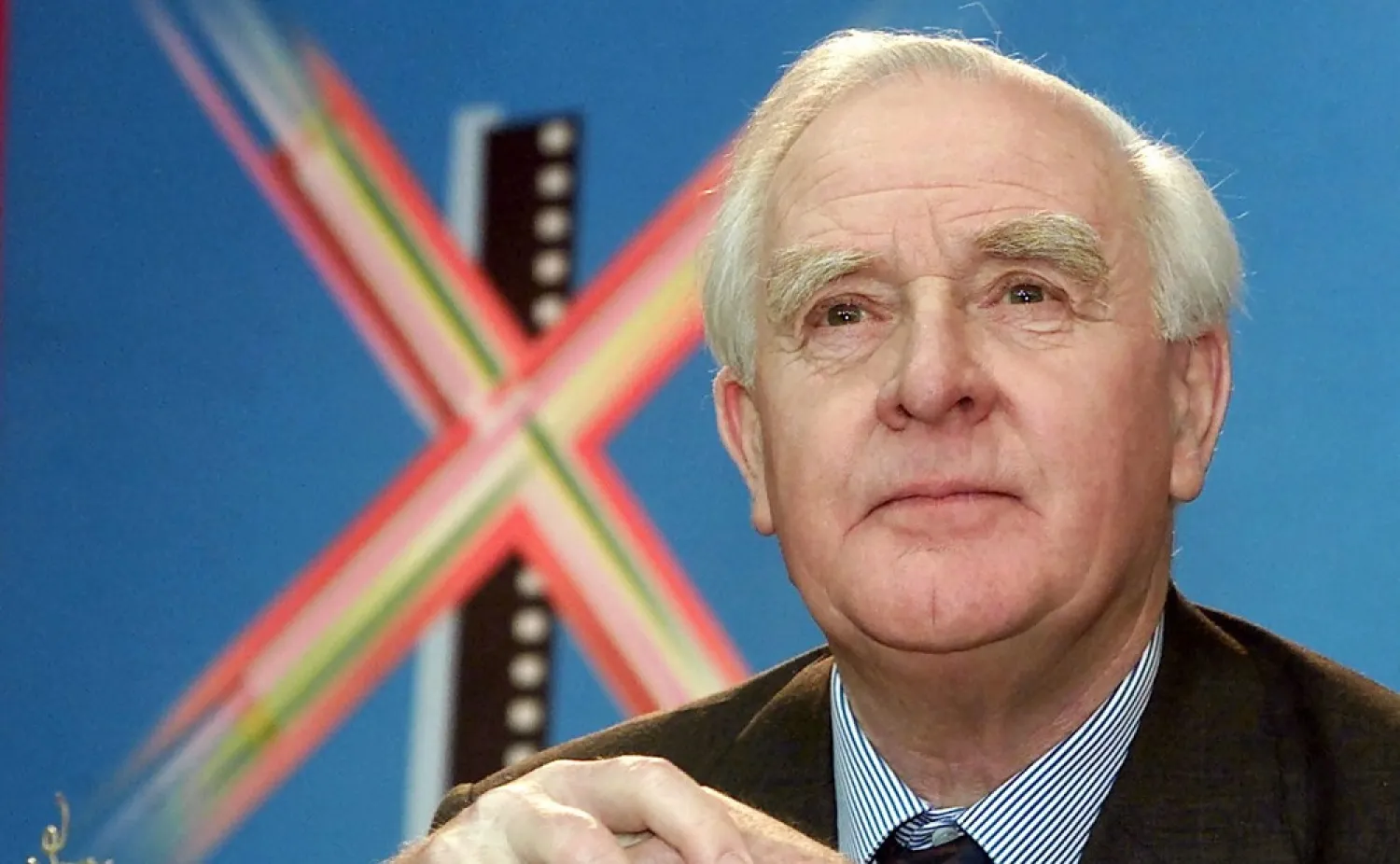

'Tinker Tailor Soldier Spy' Novelist John le Carre Dies Aged 89

John le Carre. (Reuters)
TT

'Tinker Tailor Soldier Spy' Novelist John le Carre Dies Aged 89

John le Carre. (Reuters)

“Tinker Tailor Soldier Spy” author John le Carre, who cast flawed spies on to the bleak chessboard of Cold War rivalry, has died aged 89.

His agent said in a statement that David Cornwell, known to the world as John le Carre, died after a short illness in Cornwall, southwestern England, on Saturday evening.

“His like will never be seen again, and his loss will be felt by every book lover, everyone interested in the human condition,” said Jonny Geller, CEO of The Curtis Brown Group.

Le Carre was survived by his wife, Jane, and four sons. The family said in a brief statement he had died of pneumonia.

By exploring treachery at the heart of British intelligence in spy novels, le Carre challenged Western assumptions about the Cold War by defining for millions the moral ambiguities of the battle between the Soviet Union and the West.

Unlike the glamour of Ian Fleming’s unquestioning James Bond, le Carre’s heroes were trapped in the wilderness of mirrors inside British intelligence which was reeling from the betrayal of Kim Philby who fled to Moscow in 1963.

“It’s not a shooting war anymore, George. That’s the trouble,” Connie Sachs, British intelligence’s resident alcoholic expert on Soviet spies, tells spy catcher George Smiley in the 1979 novel “Smiley’s People”.

“It’s grey. Half angels fighting half devils. No one knows where the lines are,” Sachs says in the final novel of Le Carre’s Karla trilogy.

Such a bleak portrayal of the Cold War shaped popular Western perceptions of the rivalry between the Soviet Union and the United States that dominated the second half of the 20th century until the collapse of the Soviet Union in 1991.

The Cold War, for le Carre, was “A Looking Glass War” (the name of his 1965 novel) with no heroes and where morals were up for sale - or betrayal - by spy masters in Moscow, Berlin, Washington and London.

Betrayal of family, lovers, ideology and country run through le Carre’s novels which use the deceit of spies as a way to tell the story of nations, particularly Britain’s sentimental failure to see its own post-imperial decline.

Such was his influence that le Carre was credited by the Oxford English Dictionary with introducing espionage terms such as “mole”, “honey pot” and “pavement artist” to popular English usage.

British spies were angry that le Carre portrayed the MI6 Secret Intelligence Service as incompetent, ruthless and corrupt. But they still read his novels.

Other fans included Cold War warriors such as former US President George H. W. Bush and former British Prime Minister Margaret Thatcher.

Soldier, spy
David John Moore Cornwell was born on Oct. 19, 1931 in Dorset, England, to Ronnie and Olive, though his mother, despairing at the infidelities and financial impropriety of her husband, abandoned the family when he was five years old.

Mother and son would meet again decades later though the boy who became le Carre said he endured “16 hugless years” in the charge of his father, a flamboyant businessman who served time in jail.

At the age of 17, Cornwell left Sherborne School in 1948 to study German in Bern, Switzerland, where he came to the attention of British spies.

After a spell in the British Army, he studied German at Oxford, where he informed on his left-wing students for Britain’s MI5 domestic intelligence service.

Le Carre was awarded a first-class degree before teaching languages at Eton College, Britain’s most exclusive school. He also worked at MI5 in London before moving in 1960 to the Secret Intelligence Service, known as MI6.

Posted to Bonn, then capital of West Germany, Cornwell fought on one of the toughest fronts of Cold War espionage: 1960s Berlin.

As the Berlin Wall went up, le Carre wrote “The Spy Who Came in from the Cold,” where a British spy is sacrificed for an ex-Nazi turned Communist who is a British mole.

By casting British spies as every bit as ruthless as their Communist foes, le Carre defined the dislocation of the Cold War that left broken humans in the wake of distant superpowers.

‘Moscow rules’
Now rich, but with a failing marriage and far too famous to be a spy, le Carre devoted himself to writing and the greatest betrayal in British intelligence history gave him material for a masterpiece.

The discovery, which began in the 1950s with the defection of Guy Burgess and Donald Maclean, that the Soviets had run spies recruited at Cambridge to penetrate British intelligence hammered confidence in the once legendary services.

Le Carre wove the story of betrayal into the Karla trilogy, beginning with the 1974 novel “Tinker Tailor Soldier Spy” and ending with “Smiley’s People” (1979).

George Smiley seeks to track down a Soviet mole at the top of Britain’s secret service and battles with Soviet spy master Karla, ultimate master of the mole who is sleeping with Smiley’s wife.

Smiley, betrayed in love by his aristocratic wife Ann (also the name of Cornwell’s first wife), traps the traitor. Karla, compromised by an attempt to save his schizophrenic daughter, defects to the West in the last book.

Absolute friends?
After the Soviet Union collapsed, leaving Russia’s once mighty spies impoverished, le Carre turned his focus to what he perceived as the corruption of the US-dominated world order.

From corrupt pharmaceutical companies, Palestinian fighters and Russian oligarchs to lying US agents and, of course, perfidious British spies, le Carre painted a depressing - and at times polemical - view of the chaos of the post-Cold War world.

“The new American realism, which is nothing other than gross corporate power cloaked in demagogy, means one thing only: that America will put America first in everything,” he wrote in the foreword to “The Tailor of Panama”.

He opposed the 2003 US-led invasion of Iraq and his anger at the United States was evident in his later novels, which sold well and were turned into popular films but did not match the mastery of his Cold War bestsellers.

But in a life of espionage how much was true?

“I am a liar,” le Carre was quoted as saying by his biographer Adam Sisman. “Born to lying, bred to it, trained to it by an industry that lies for a living, practiced in it as a novelist.”



Italy Uncovers Basilica Designed by Vitruvius, the 'Father of Architecture'

A handout photo made available by Regione Marche press office shows the excavations in Piazza Andrea Costa from which large columns emerge, remains believed of the Basilica of Vitruvius, in Fano, Italy, 19 January 2026. (EPA/Regione Marche press office)
TT

Italy Uncovers Basilica Designed by Vitruvius, the 'Father of Architecture'

A handout photo made available by Regione Marche press office shows the excavations in Piazza Andrea Costa from which large columns emerge, remains believed of the Basilica of Vitruvius, in Fano, Italy, 19 January 2026. (EPA/Regione Marche press office)

Italian officials on Monday hailed the discovery of a more than 2,000-year-old public building attributed to Vitruvius, the ancient Roman architect and engineer known as the "father of architecture."

"It is a sensational finding ... something that our grandchildren will be talking about," Italian Culture Minister Alessandro Giuli told a press conference.

Vitruvius, who lived in the ‌1st century BC, ‌is celebrated for having written "De architectura," ‌or ⁠The Ten ‌Books on Architecture, the oldest surviving treatise on the subject.

His teachings on the classical proportions of buildings have inspired artists over centuries, including Leonardo da Vinci, whose famous drawing of the human body is known as the "Vitruvian Man."

Archaeologists believe they have found ⁠the remains of an ancient basilica, or public building, in the central ‌Italian city of Fano northeast of ‍Rome, that was created ‍by Vitruvius.

"I feel like this is the discovery ‍of the century, because scientists and researchers have been searching for this basilica for over 500 years," said the Mayor of Fano Luca Serfilippi.

"We have absolute match" between what was discovered and the descriptions given by Vitruvius in his books, regional archaeological superintendent Andrea Pessina told reporters.

The basilica had a rectangular layout, with 10 columns on the long side, and four on the short ones, Pessina said.

During excavation, when traces of four columns emerged, archaeologists used Vitruvius' descriptions to calculate where the top right column should be. When they started digging, they found it immediately, Pessina said.

"The are few certainties in archaeology ... but we were impressed by the precision" of the match, he added.

Further digging will determine whether more of the ‌basilica lies underground and if the site can be shown to the public, the superintendent said.


French TV Broadcasts Louvre Robbery Images

People wait for the Louvre museum to open as employees at the Louvre Museum vote to extend a strike that has disrupted operations at the world's most visited museum, Thursday, Dec. 18, 2025 in Paris. (AP)
TT

French TV Broadcasts Louvre Robbery Images

People wait for the Louvre museum to open as employees at the Louvre Museum vote to extend a strike that has disrupted operations at the world's most visited museum, Thursday, Dec. 18, 2025 in Paris. (AP)

Footage of the spectacular robbery at the Louvre Museum has been broadcast for the first time on French television, showing the brazen jewel thieves breaking into display cases.

The images, filmed by surveillance cameras, were shown by the TF1 and public France Televisions channels on Sunday evening, three months after the hugely embarrassing break-in in October.

They show the two burglars, one wearing a black balaclava and a yellow high-visibility jacket, the other dressed in black with a motorcycle helmet, as they force their way into the Apollo Gallery.

After breaking in through a reinforced window with a high-powered disk cutters, they begin slicing into display cases under the eyes of several staff members who do not intervene.

Managers at the Louvre have stressed that staff are not trained to confront thieves and are asked to prioritize the evacuation of visitors.

During the roughly four minutes that the two men were inside the gallery, one staff member can be seen holding a bollard used to orient visitor through the gallery, according to France Televisions.

The images form a key part of the ongoing criminal investigation into the October 19 heist.

Details of the footage have been reported in French newspapers, including Le Parisien.

Four suspects are in police custody, including the two suspected thieves, but the eight stolen items of French crown jewels worth an estimated $102 million have not been found.

The security failures highlighted by the break-in on a Sunday morning in broad daylight have lead to major pressure on director Laurence des Cars, who has apologized.

Metal bars have since been installed over the windows of the Apollo Gallery.


Cultural Development Fund Highlights Economic Value of Saudi Culture in Davos

The Cultural Development Fund (CDF) logo
TT

Cultural Development Fund Highlights Economic Value of Saudi Culture in Davos

The Cultural Development Fund (CDF) logo

The Cultural Development Fund (CDF) is participating in the Saudi House pavilion initiative, led by the Ministry of Economy and Planning, during the Annual Meeting of the World Economic Forum 2026, held in Davos, Switzerland, from January 19 to 23.

Through this participation, CDF aims to showcase the economic value of Saudi culture, highlight its role in diversifying the national economy and enhancing quality of life, attract international investment in the cultural sector, and spotlight Saudi cultural entrepreneurship.

According to a statement from the fund, the CDF’s participation includes a networking breakfast bringing together global economic leaders and investors from various countries, with the aim of raising awareness of Saudi culture as an economic force and a key pillar of Saudi Vision 2030.

The event will also provide a platform for exchanging perspectives and opportunities with international investors and financial institutions, while offering a closer look at the enablers of the Saudi cultural sector and its investment opportunities.

As part of the event, the CDF will host a panel discussion titled “Investing in Culture as an Economic Engine” that will feature CEO of the Cultural Development Fund Majed bin Abdulmohsen Al-Hugail, alongside Deputy Minister of Cultural Strategies and Policies at the Ministry of Culture Albara Al-Auhali.

The discussion will address the economic value of culture globally and locally, highlighting the CDF’s role in providing financial solutions that support cultural enterprises and enable their contribution to GDP growth and quality of life. The session will also explore cultural policies and their impact on strengthening the sector’s economic and investment potential.

Within the NextOn dialogue series organized by the Saudi House in Davos, the Cultural Development Fund will enable supported cultural projects to share their success stories and highlight their role in enhancing cultural production and increasing its economic value.

Participating entrepreneurs include Co-Founder of AlMashtal Creative Incubator Princess Noura bint Saud bin Naif, and CEO of Arabian Housing and Building company (AHB) Khalid Henaidy, who will speak about the role of entrepreneurship in shaping the future of the Kingdom’s cultural economy.

‏This participation underscores the CDF’s role as a center of excellence and financial enabler for the cultural sector in the Kingdom, and forms part of its efforts to strengthen the presence of Saudi cultural dynamism on the global stage. It aligns with the CDF’s objectives to maximize the cultural sector’s economic and social impact, increase its contribution to GDP, quality of life, and advance the goals of Saudi Vision 2030.