


Fiji Tourism Hit With Climate, Pandemic Double Whammy

Workers on Fiji's Coral Coast say tourism has "all but evaporated" because of coronavirus | AFP
TT

Fiji Tourism Hit With Climate, Pandemic Double Whammy

Workers on Fiji's Coral Coast say tourism has "all but evaporated" because of coronavirus | AFP

Fiji dive operator Ashwin Pal was living his dream until the global pandemic hit, guiding tourists around an underwater wonderland of dazzling Pacific coral reefs.

Now the 35-year-old hunts the neon-hued fish he once proudly showed off to international visitors, forced to kill the creatures he loves to feed his wife and four children.

And the coronavirus-induced shutdown of Fiji's tourism industry is not the only crisis facing Pal's Coral Coast paradise, with climate change posing a longer-term threat to the region's marine environment.

"Lots of coral's been bleached, lots of corals are dying -- soft coral, hard coral -- to be honest," Pal told AFP.

Fiji is also regularly pounded by category five super-storms, with Cyclone Yasa the latest to menace the island nation of 900,000 this week.

Such top-of-the-scale monsters were once rare, but many scientists and Prime Minister Frank Bainimarama blame their increased frequency -- and the accompanying damage to coral and tourism infrastructure -- on climate change.

It has created an uncertain future for Pal and many thousands like him across the Pacific, who rely on tourism and a climate-vulnerable environment for their livelihoods.

- 'Life's pretty tough' -

The Manila-based Institute for Climate and Sustainable Cities said the pandemic had exacerbated climate challenges facing Pacific island nations that were not of their making.

"Tourism has all but evaporated, remittances have shrunk to a trickle, and disruptions to international trade have come as a hammer blow," executive director Red Constantino told AFP.

"And no help seems to be forthcoming from their wealthy neighbors," he added, pointing the finger at Australia and New Zealand which have both been accused of lagging on climate.

Pal opened his dive shop three years ago, fulfilling an ambition created when he first took scuba lessons as a teenager.

But with no overseas visitors in Fiji, the beachside hut he operates from a high-end resort is shuttered and all staff have been laid off as Pal scrapes by on his savings.

"I've been at home for the past eight months, there's been no income coming in," said Pal, a father of four boys.

"Life's been pretty tough. To make a living I switched from diving into farming and, since I love the ocean, fishing.

"Once, twice, three times a week we go out (fishing), do a bit of vegetable farming to keep my family running."

- Reefs 'first to go' -

On a palm-fringed beach a few kilometers from Pal's dive shop, marine biologist Victor Bonito outlines his decades-long struggle to preserve Fiji's coral reefs.

The frustration evident in his voice as he explains the scale of the challenge and the need for urgent action.

"In 2014, 2015 and 2016 we experienced coral bleaching on reefs all around Fiji, mainly shallow, near-shore reefs," he said.

"Here on the Coral Coast we lost 30-60 percent of the reef area in a matter of weeks -- there are the reefs where tourists would be snorkeling, just off the beach."

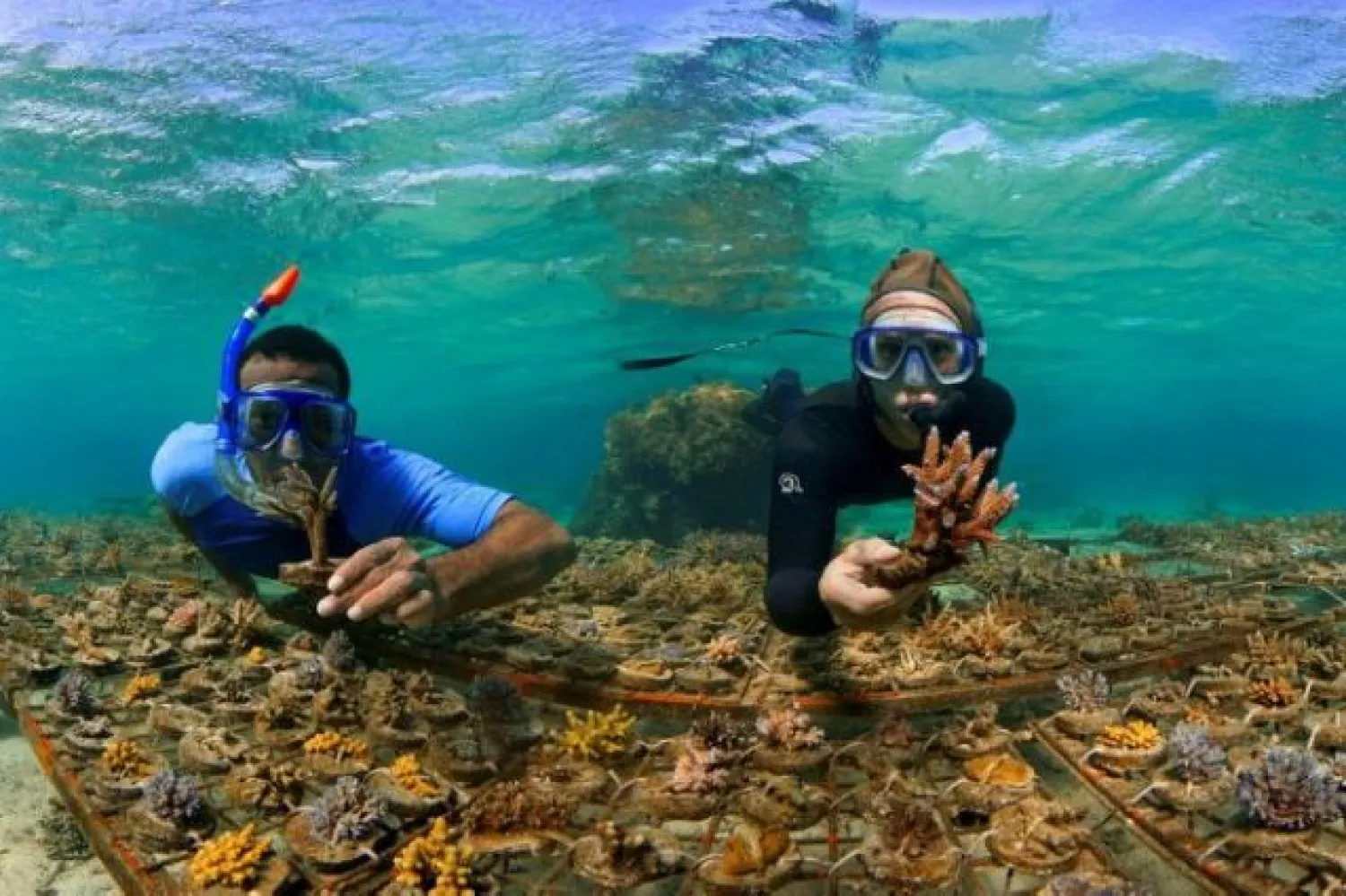
Bonito's Reef Explorer Fiji has been farming strains of heat-tolerant coral to replenish the reefs, but he says it will not be enough without meaningful action to address climate change.

"Stop with the talking and planning," he said.

"If we don't have a global commitment and we don't take serious action on a global scale, our coral reefs -- not just in Fiji but around the world -- are going to be one of the first ecosystems to go."

Bainimarama warned this month that the Pacific's environment was a bellwether for the health of the planet as a whole and a way of life would be lost without concerted action to save it.

"We Pacific nations owe it to our people, and to humanity as a whole, to raise our voices more to demand that major emitters step up their climate actions and commitments," he said.

"Without this, we will lose our homes, our way of life our wellbeing and livelihoods -- it's past time to get serious.




EU, US Reportedly Near Critical Minerals Deal to Combat Chinese Control

FILE PHOTO: A block with the symbol, atomic number and mass number of Dysprosium (Dy), a heavy rare earth, in this illustration taken January 21, 2026. REUTERS/Dado Ruvic/Illustration/File Photo
TT

EU, US Reportedly Near Critical Minerals Deal to Combat Chinese Control

FILE PHOTO: A block with the symbol, atomic number and mass number of Dysprosium (Dy), a heavy rare earth, in this illustration taken January 21, 2026. REUTERS/Dado Ruvic/Illustration/File Photo

The European Union and Washington are closing in on an agreement to coordinate on producing and securing critical minerals, Bloomberg News reported on Friday.

The potential deal would include incentives such as minimum price guarantees that could favor non-Chinese suppliers, the report said, citing an "action plan".

The EU and US would also ⁠cooperate on standards, investments ⁠and joint projects, along with increased coordination on any supply disruptions by countries like China, the report added.

The European Commission declined to comment on the report. The office of the ⁠US Trade Representative did not immediately respond to Reuters' requests for comment.

EU trade commissioner Maros Sefcovic said in March he had a "very positive" meeting with US Trade Representative Jamieson Greer on the sidelines of a World Trade Organization ministerial meeting in Cameroon, where the two sides agreed to further advance work on ⁠critical ⁠minerals and also discussed tariffs.

The EU-US deal would cover “critical minerals along the entire value chain and life-cycle management, including exploration, extraction, processing, refining, recycling and recovery,” Bloomberg reported, citing a non-binding memorandum of understanding.

The US has been scrambling to get access to critical mineral reserves, especially rare earth supply chains currently dominated by Chinese players.


Gold Set for Third Weekly Gain as US Rate Outlook Offsets Dollar Strength

FILE PHOTO: Customers crowd around a jewelry showroom during Akshaya Tritiya, a major gold-buying festival, in Kochi, India April 28, 2017. REUTERS/Sivaram V/File Photo
TT

Gold Set for Third Weekly Gain as US Rate Outlook Offsets Dollar Strength

FILE PHOTO: Customers crowd around a jewelry showroom during Akshaya Tritiya, a major gold-buying festival, in Kochi, India April 28, 2017. REUTERS/Sivaram V/File Photo

Gold steadied on Friday as US-Iran ceasefire uncertainty lingered, but the metal stayed on course for a third consecutive weekly climb as investors priced in earlier and deeper US rate cuts, supporting non-yielding bullion.

Spot gold held its ground at $4,764.54 per ounce by 0532 GMT. The metal, however, has gained 1.8% so far this week.

US gold futures for June delivery fell 0.6% to $4,787.80.

The ‌dollar index strengthened, ‌making greenback-priced bullion more expensive for holders of other currencies, Reuters said.

"There's ‌a ⁠lack of clarity ⁠about the way that the ceasefire is evolving in the Middle East and what that means to energy markets... so we're in sort of a little bit of a holding pattern (with gold) going into the final session of the week," said Kyle Rodda, senior financial market analyst at Capital.com.

Spot gold has fallen about 10% since the US-Israel conflict with Iran ⁠erupted on February 28, with elevated energy prices sparking ‌inflation concerns and the prospect of ‌higher US interest rates.

The fragile two-week ceasefire between the US and Iran showed further ‌strain on Friday, as Washington accused Tehran of breaching promises on ‌the Strait of Hormuz.

Brent crude, however, has slid more than 11% this week on optimism that the ceasefire could reopen the Strait of Hormuz, through which about 20% of the world's oil and liquefied natural gas passes.

"If things break down, (gold) ‌could end up back in mid-$4,000's pretty quickly. But if the ceasefire holds and the peace deal starts ⁠to look more ⁠likely, then we could push through $5,000," Rodda added.

On the data front, the US Personal Consumption Expenditures index, the Federal Reserve's preferred inflation gauge, advanced 2.8% in the 12 months through February, in line with estimates, and likely rose further in March.

Investors are now looking out for March's US Consumer Price Index data, due later in the day, for further clues on Fed's monetary policy direction.

Markets are pricing in a 31% chance for a US rate cut of at least 25 basis points at the Fed's December meeting, according to CME's FedWatch Tool, up from 20% in the prior session.

Among other metals, spot silver rose 1.3% to $76.03 per ounce, platinum lost 2% to $2,061.10, and palladium fell 0.2% to $1,553.92.


Saudi Business Confidence Index Remains Optimistic

A street in the Saudi capital, Riyadh (Reuters)
TT

Saudi Business Confidence Index Remains Optimistic

A street in the Saudi capital, Riyadh (Reuters)

Saudi Arabia’s Business Confidence Index remained in optimistic territory at 52.1 points in March, underscoring private sector resilience despite geopolitical challenges.

The index fell from 60.7 in February but stayed above the neutral 50 threshold, reflecting continued confidence in stable economic activity and sustained growth across key sectors, according to the General Authority for Statistics (GASTAT).

A statement released by GASTAT said that the BCI for the industrial sector recorded 50.8 points, maintaining an optimistic level despite a decline of 15.8 percent compared to February.

The BCI for the services sector recorded 52.0 points, maintaining an optimistic level despite a decline of 14.9 percent compared to February, it said.

Regarding the BCI in the construction sector, the data revealed that in March, it recorded an optimistic level at 53 points, confirming the continued positive confidence among establishments in the sector, the statement added.