The Arab Spring: A Timeline

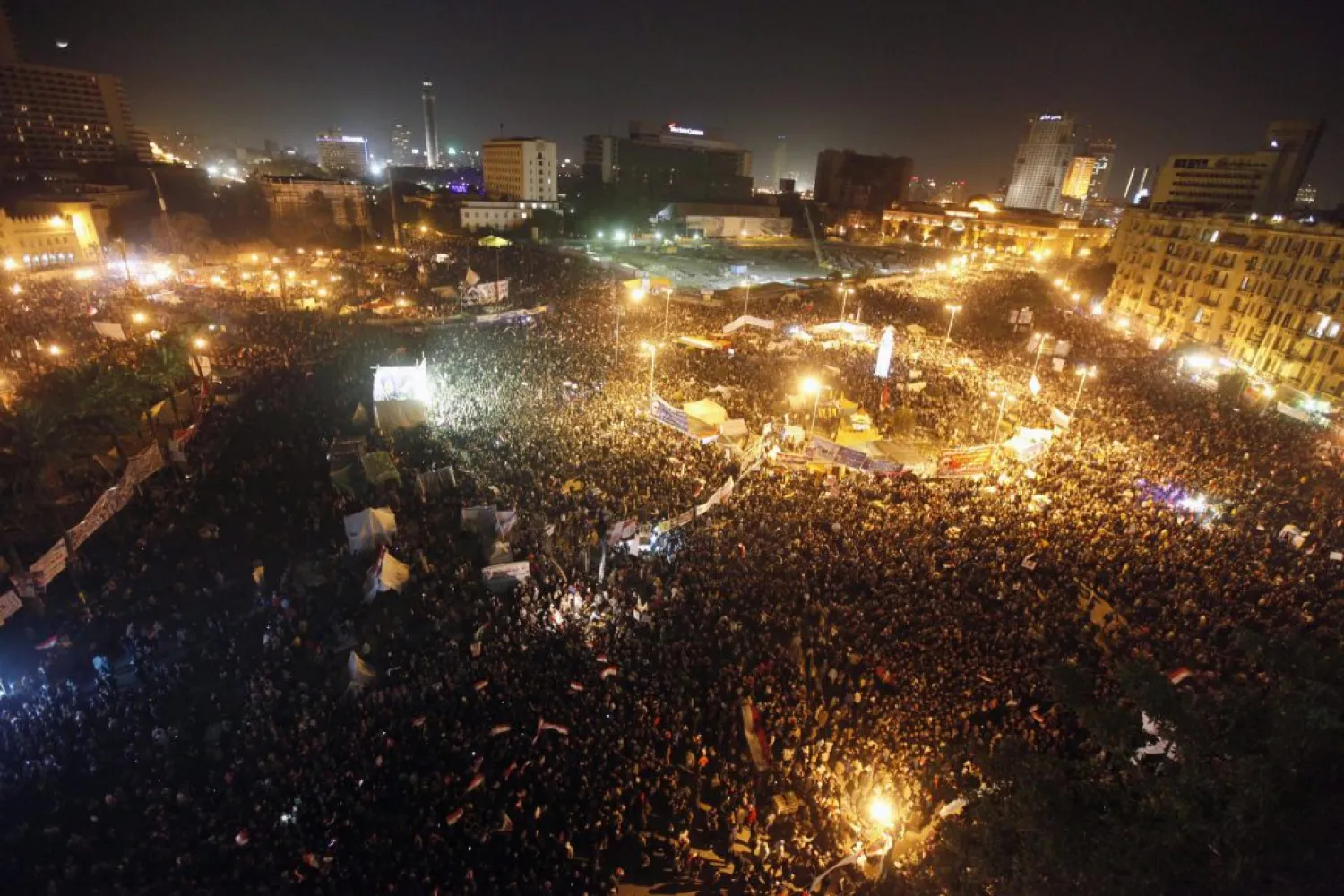
Demonstrators take part in a protest marking the first anniversary of Egypt's uprising at Tahrir Square in Cairo, January 25, 2012 | REUTERS
TT

The Arab Spring: A Timeline

Demonstrators take part in a protest marking the first anniversary of Egypt's uprising at Tahrir Square in Cairo, January 25, 2012 | REUTERS

From the fall of old, authoritarian leaders to the repression of revolts, here are some key dates that make up what is known as the Arab Spring.

- The Tunisian spark -

On December 17, 2010, a young Tunisian who sold vegetables from a barrow sets himself on fire to protest police harassment.

Mohamed Bouazizi dies on January 4, 2011 but not before his gesture goes viral, sparking protests against the cost of living and the country's authoritarian president, Zine El Abidine Ben Ali.

Ben Ali's 23-year rule ends 10 days later when he flees the country, becoming the first leader of an Arab nation to be pushed out by popular protest.

The spirit of the "Jasmine Revolution" soon spreads.

- 'Mubarak out!' -

On January 25, thousands of Egyptians march in Cairo, Alexandria, and other cities, demanding the departure of President Hosni Mubarak -- who has been in power for 30 years -- and "bread, freedom, and dignity".

On February 11, as more than a million take to the streets, Mubarak resigns and hands control to the military.

Thousands amass in Tahrir (Liberation) Square in Cairo, chanting, "The people demand the removal of the regime."

- Libya explodes -

Libyan police use force to break up a sit-in against the government in the second city, Benghazi.

Clashes follow.

The country's leader Moamer Kadhafi vows to hunt down the "rats" opposing him "street by street, alley by alley, house by house".

The uprising turns into civil war with French, British, and US air forces intervening against Kadhafi.

- Syria follows -

On March 6, a dozen teenagers tag the wall of their school in southern Syria with "Your turn, doctor," referring to President Bashar al-Assad, a trained ophthalmologist.

The torture of the youths sparks mainly peaceful protests at first, and calls for democratic reform.

But with violent repression by the government, the revolt turns into civil war.

- Kadhafi captured in drain -

On October 20, Moamer Kadhafi is captured and killed in his home region of Sirte by rebels who find him hiding in a storm drain.

- Tunisia's first election -

On October 23, Tunisians stream to the polls for their first free election, in which members of the Islamist Ennahdha movement triumph.

- Yemen's Saleh goes -

On February 27, 2012, Ali Abdullah Saleh, who had ruled Yemen for 33 years, hands power to his deputy Abdrabuh Mansur Hadi, after a year of protests.

He is the fourth leader to be undone by the Arab Spring.

- 'The Caliphate' -

On June 29, 2014, the ISIS group proclaims a "caliphate" over territory it has seized in Syria and Iraq.

Militants carry out beheadings, mass executions, abductions, rape, and ethnic cleansing of minorities.

- Moscow saves Assad -

Russia, who with Iran is Assad's biggest ally, starts airstrikes against Syrian rebels on September 30, 2015, changing the course of the war.

After a decade of fighting which left 380,000 dead, Assad is able to claim decisive victories.


Syrian Interior Ministry Airs Confessions of ‘Saraya al-Jawad’ Members

The February operation targeted hideouts in the villages of Beit Alouni and Basniya in Latakia province. (SANA)
TT

Syrian Interior Ministry Airs Confessions of ‘Saraya al-Jawad’ Members

The February operation targeted hideouts in the villages of Beit Alouni and Basniya in Latakia province. (SANA)

The Syrian Interior Ministry released a video showing confessions from members of the "Saraya al-Jawad" armed group, nearly two weeks after announcing a raid on one of its main strongholds in the countryside of Jableh in the Latakia province.

According to the ministry, the February 23 operation targeted hideouts in the villages of Beit Alouni and Basniya in Latakia province. The raid killed the group’s coastal leader Bashar Abdullah Abu Ruqayya and two other commanders, and led to the arrest of six members.

The video released Monday includes footage from the twin operation carried out by the Interior Ministry’s Internal Security Directorate.

Authorities said the raid followed several days of surveillance and resulted in the destruction of a weapons depot and explosives storage site belonging to the group.

One member of the Syrian special task forces was killed and another was lightly wounded during the operation.

In the recorded confessions, detainees said they took part in attacks along the Syrian coast in March 2025. One suspect admitted to ambushing a General Security patrol and killing one officer during a clash.

The confessions also described the establishment of an operations room in a residential house that doubled as an arms depot. According to the detainees, the group received financial support from businessmen Ayman Jaber and Mohammad Jaber, while supplies were smuggled in from Lebanon.

Mohammad Jaber, a businessman close to the former government of Bashar al-Assad and a commander in the Desert Hawks militia founded by his brother Ayman, previously appeared in a television interview acknowledging his role in organizing attacks by pro-regime remnants along the Syrian coast on March 6, 2025.

Documents and recordings obtained by Al Jazeera’s investigative program Al-Mutahari suggested that senior figures linked to the former government sought to form armed groups to carry out attacks on Syrian security forces and the army.

The Interior Ministry said it is pursuing members of those networks and attempting to curb their activities.

Saraya al-Jawad has been active in Syria’s coastal region — particularly in Latakia, Jableh and Tartus — since August 2025, when activists circulated a video showing a car bomb targeting a General Security vehicle in rural Jableh.

Earlier this month, security forces in Tartus also arrested three suspects — Ali Zuhair Idris, Ammar Madin Youssef and Mousa Mazhar Mia — accused of planning attacks targeting the province’s security and civilians.

Officials said intelligence showed the group had received explosives training abroad before infiltrating back into Syria.


Hezbollah Pressure on Military Court Undermines Lebanon’s Weapons Ban

Blankets are distributed at a school converted into a shelter in Beirut, where a banner displaying images of leaders and members of Hezbollah can be seen (EPA). 
TT

Hezbollah Pressure on Military Court Undermines Lebanon’s Weapons Ban

Blankets are distributed at a school converted into a shelter in Beirut, where a banner displaying images of leaders and members of Hezbollah can be seen (EPA). 

Lebanon’s government decision to prohibit any military or security activity by Hezbollah has yet to translate into meaningful enforcement.

Hezbollah has continued to escalate its military operations, launching rockets and drones toward Israeli territory, while signs of deteriorating security have appeared inside Lebanon, particularly among displaced residents who have fled southern Lebanon and Beirut’s southern suburbs.

Security agencies have struggled to identify those responsible for launching rockets toward Israel. However, Lebanese forces recently recorded a notable development with the arrest of around 30 individuals affiliated with or supportive of Hezbollah.

The detainees were apprehended while fleeing alongside civilians from southern areas and the southern suburbs of Beirut after being found carrying individual weapons, including assault rifles, pistols and grenades.

The arrests appeared to signal a tentative shift in how Lebanon’s security and judicial institutions handle the issue of illegal weapons. Yet the move quickly ran up against what officials say is Hezbollah’s continuing influence over judicial decisions.

Last week, the military court tried three Hezbollah members detained days earlier. The court imposed a fine of 900,000 Lebanese pounds —about $10 — on each of them for possessing unlicensed military weapons and waived any prison sentence.

The ruling diverges sharply from typical sentences in similar cases, where possession or transport of unlicensed weapons usually carries at least a one-month prison term.

Judicial sources say the unusually lenient sentence reflects pressure exerted by Hezbollah on the military court to secure the release of its detained members.

According to the sources, the group sought their release last Thursday and pushed for their trial to be held the following day. The military prosecutor’s office objected, resulting in the hearing being postponed until Monday.

The verdict also drew criticism from the government commissioner to the military court, Judge Claude Ghanem, who promptly appealed the ruling before the Military Court of Cassation, requesting tougher penalties.

A judicial source told Asharq Al-Awsat that the ruling was “extremely lenient and failed to account for all the legal provisions under which the suspects were charged.” The source added that the commissioner had received preliminary investigation files concerning four additional detainees and was preparing to file charges against them in the coming hours while seeking stricter sentences.

Only hours after the verdict was issued, Lebanese Justice Minister Adel Nassar ordered that the civilian adviser to the military tribunal, Judge Abbas Jaha, be referred to the Judicial Inspection Authority for investigation.

A Justice Ministry source told Asharq Al-Awsat that the referral stemmed from “the circumstances surrounding the trial and his failure to object to this suspicious ruling.” The source noted that another member of the court panel, a military officer, had opposed the decision while Jaha approved it without reservation.

Weapons and rising tensions in host communities

Legally, the arrest of armed Hezbollah members represents a direct application of the government decision banning any military or security activity by the group. In principle, the ruling applies to anyone carrying weapons outside state authority and places them under threat of prosecution.

The more pressing challenge, however, lies in dealing with armed individuals among displaced populations.

Several neighborhoods in Beirut, including Hamra, Ras Beirut, Sakiat al-Janzir and Ain al-Remmaneh, as well as the towns of Aramoun and Kfarshima in Mount Lebanon, have witnessed repeated incidents involving gunfire, displays of weapons and confrontations with local residents.

Videos circulating on social media show armed men threatening residents, including footage recorded Sunday in Aramoun.

These incidents have heightened anxiety among host communities already grappling with mounting social and economic pressures.

Some residents say the security measures in place remain “below the required level,” arguing that the absence of deterrent action risks encouraging further incidents and creating the impression that the law is applied hesitantly when those involved are linked to Hezbollah.

A Lebanese security source, however, insisted that authorities treat all security incidents seriously. Delays in reaching certain locations, the source said, often result from limited personnel and the difficulty of maintaining coverage across all displacement areas.

Security forces maintain a near-permanent presence at the entrances of schools and facilities housing displaced people, the source added, while most incidents occur in nearby streets and neighborhoods. Patrols respond immediately to reports of gunfire or clashes, detaining suspects or pursuing them if they leave the scene.

Nevertheless, the official acknowledged that the continued incidents could lead to broader friction between displaced populations and local residents — particularly in densely populated areas — at a time when host communities are already under severe economic strain and displacement is expected to continue for months.


Iraq PM Tells Rubio Iraqi Airspace Must Not Be Used Against Neighbors

13 January 2023, Berlin: Iraqi Prime Minister Mohammed Shia al-Sudani speaks during a press conference. (dpa)
TT

Iraq PM Tells Rubio Iraqi Airspace Must Not Be Used Against Neighbors

13 January 2023, Berlin: Iraqi Prime Minister Mohammed Shia al-Sudani speaks during a press conference. (dpa)

Iraq's Prime Minister Mohammed Shia al-Sudani told US Secretary of State Marco Rubio Tuesday that Iraq should not be used as a launch pad for attacks in the Middle East war.

Iraq neighbors Iran, against which the United States and Israel launched massive strikes on February 28, as well as the Gulf, which Tehran has hit with missile and drone attacks.

Within hours of the start of the war, fighter jets and missiles coming from every direction filled Iraq's airspace.

Sudani stressed in a phone call with Rubio "the importance of ensuring that Iraqi airspace, territory, and waters are not used for any military action targeting neighboring countries or the region," the prime minister's media office said.

Sudani rejected "any attempt to drag the country into ongoing conflicts," as well as "violations of its airspace by any party."

Iraq, long a proxy battleground between Washington and Tehran, was drawn into the war from the outset, with strikes blamed on the US and Israel targeting Iran-backed groups, which in turn have since claimed attacks on US bases in Iraq and the wider region.

State Department spokesman Tommy Pigott said that Rubio "strongly condemned terrorist attacks by Iran and Iran-aligned terrorist militia groups in Iraq," including the Kurdistan region.

He urged Iraq to take "all possible measures to safeguard US diplomatic personnel and facilities."

On Saturday, air defense systems intercepted rockets fired at the US embassy in Baghdad.

US air defenses now intercept drones almost daily over Erbil, the capital of Kurdistan, which also hosts a US consulate complex.