

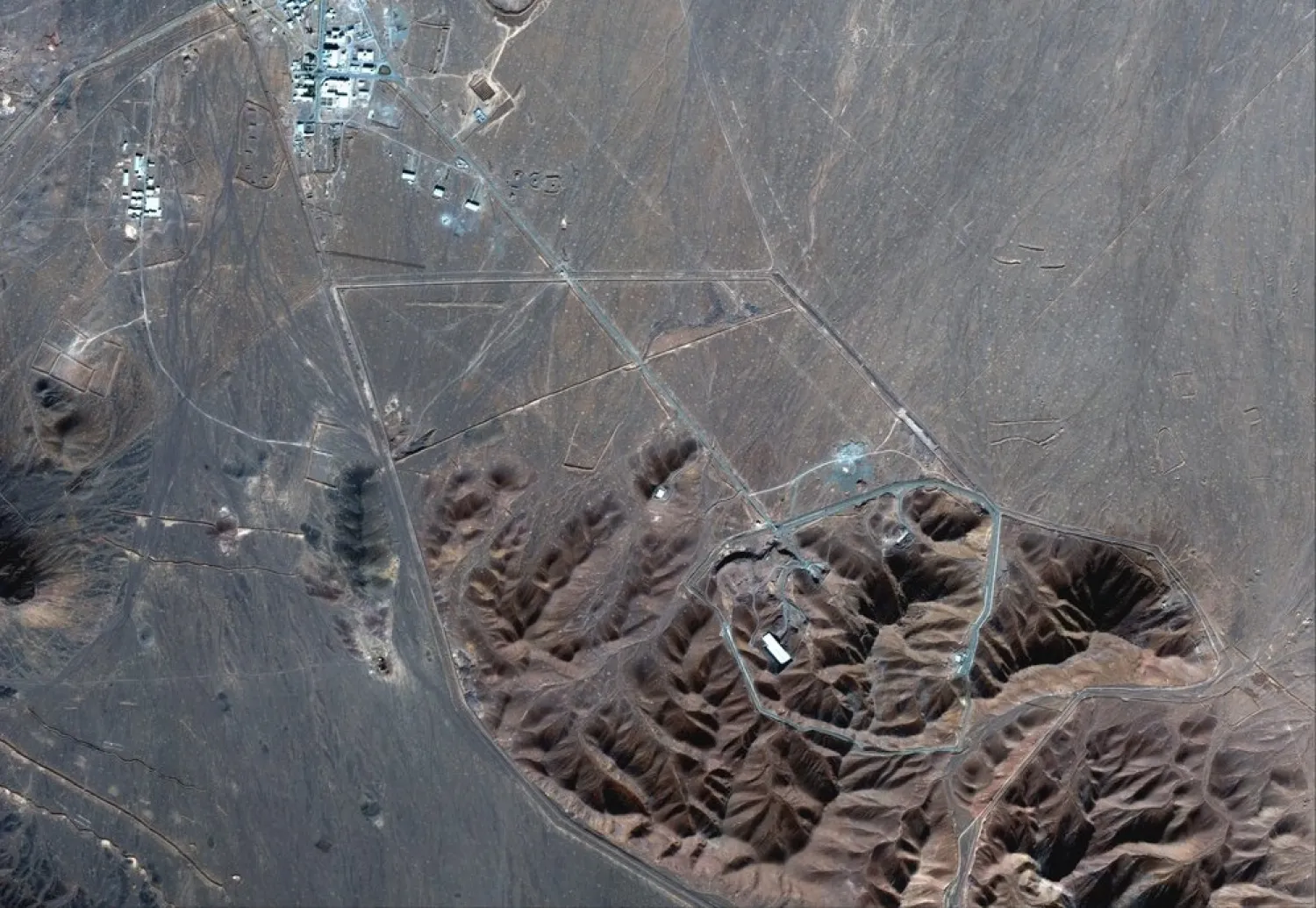

Iran Says it Resumes 20% Uranium Enrichment at Fordow Site

This Nov. 4, 2020, satellite photo by Maxar Technologies shows Iran's Fordow nuclear site. (AP)
TT

Iran Says it Resumes 20% Uranium Enrichment at Fordow Site

This Nov. 4, 2020, satellite photo by Maxar Technologies shows Iran's Fordow nuclear site. (AP)

Iran has resumed 20% uranium enrichment at an underground nuclear facility, the government said on Monday, breaching a 2015 nuclear pact with major powers and possibly complicating efforts by US President-elect Joe Biden to rejoin the deal.

Benjamin Netanyahu, prime minister of Iran’s arch foe Israel, said the move was aimed at developing nuclear weapons and Israel would never allow Tehran to build them.

The enrichment decision, Iran’s latest contravention of the accord, coincides with increasing tensions between Iran and the United States in the last days of President Donald Trump’s administration.

Tehran started violating the accord in 2019 in a step-by-step response to Trump’s withdrawal from it in 2018 and the reimposition of US sanctions lifted under the deal.

The agreement’s main aim was to extend the time Iran would need to produce enough fissile material for a nuclear bomb, if it chose to, to at least a year from roughly two to three months. It also lifted international sanctions against Tehran.

“A few minutes ago, the process of producing 20% enriched uranium has started in Fordow enrichment complex,” government spokesman Ali Rabiei told Iranian state media.

The UN nuclear watchdog confirmed that Iran had started the process of enriching uranium to 20% purity at its Fordow site.

“Iran today began feeding uranium already enriched up to 4.1 percent U-235 into six centrifuge cascades at the Fordow Fuel Enrichment Plant for further enrichment up to 20%,” the IAEA said in a statement on a report that was sent to member states.

The step was one of many mentioned in a law passed by Iran’s parliament last month in response to the killing of the country’s top nuclear scientist, which Tehran has blamed on Israel.

“Our measures are fully reversible upon FULL compliance by ALL (parties to the deal),” tweeted Iranian Foreign Minister Mohammad Javad Zarif.

Tehran insists it can quickly reverse its breaches if US sanctions are removed. Biden, who takes office on Jan. 20, has said the United States will rejoin the deal “if Iran resumes strict compliance” with the pact.

Nuclear watchdog
The Biden transition team declined comment on Iran’s enrichment move. The White House National Security Council had no comment, and referred queries to the US State Department, which did not immediately respond to a request for comment.

Tehran’s move could further hinder efforts to salvage the pact as its breaches have increasingly worried some of the deal’s other parties, which have urged Iran to act responsibly.

In Brussels, a European Union Commission spokesperson said that the “move, if confirmed, would constitute a considerable departure from Iran’s commitments”.

On Jan 1, the IAEA said Tehran had told the watchdog it planned to resume enrichment up to 20% at the Fordow site, which is buried inside a mountain.

“The process of gas injection to centrifuges has started a few hours ago and the first product of uranium hexafluoride (UF6) gas will be available in a few hours,” Rabiei said.

Iran had earlier breached the deal’s 3.67% limit on the purity to which it can enrich uranium, but it had only gone up to 4.5% so far, well short of the 20% level and of the 90% that is weapons-grade.

US intelligence agencies and the IAEA believe Iran had a secret, coordinated nuclear weapons program that it halted in 2003. Iran denies ever having had one.

In Jerusalem, Netanyahu said Iran’s enrichment decision could be explained only as a bid to “continue to carry out its intention to develop a military nuclear program”.

“Israel will not allow Iran to produce nuclear weapons,” he added.

Shielded by the mountains, Fordow is ringed by anti-aircraft guns and other fortifications. It is about the size of a football field, large enough to house 3,000 centrifuges, but small and hardened enough to lead US officials to suspect it had a military purpose when they exposed the site publicly in 2009.

The 2015 deal saw Iran agree to limit its enrichment in exchange for sanctions relief. The accord also called for Fordow to be turned into a research-and-development facility.

Under Iran’s former hardline President Mahmoud Ahmadinejad, Tehran began enrichment at the 20% level. Israel, which has its own undeclared nuclear weapons program, feared Tehran was building an atomic bomb.

After the discovery of Fordow, the US worked on so-called “bunker buster” bombs designed to strike such facilities. As Israel threatened at one point to bomb Iranian nuclear sites like Fordow, US officials reportedly showed them a video of a bunker-buster bomb destroying a mock-up of Fordow in America’s southwestern desert.



Karachi Building Collapse after Blast Kills 16

Rescue workers and people gather at the site of a residential compound following a suspected gas leakage blast in Karachi, Pakistan, 19 February 2026. EPA/REHAN KHAN
TT

Karachi Building Collapse after Blast Kills 16

Rescue workers and people gather at the site of a residential compound following a suspected gas leakage blast in Karachi, Pakistan, 19 February 2026. EPA/REHAN KHAN

A building collapse caused by an explosion in Pakistan's southern megacity of Karachi killed at least 16 people on Thursday, including children, officials said.

More than a dozen people were injured in the incident in the Soldier Bazaar neighborhood of Karachi at around 4:00 am, when Muslim families start preparing Sehri, the pre-sunrise meal eaten during Ramadan.


Australian Police Investigate Threatening Letter to Country's Largest Mosque

FILE PHOTO: A security guard stands outside the Lakemba Imam Ali bin Abi Talib Mosque as people arrive for Friday prayers in Sydney, Australia, December 19, 2025. REUTERS/Hollie Adams/File Photo
TT

Australian Police Investigate Threatening Letter to Country's Largest Mosque

FILE PHOTO: A security guard stands outside the Lakemba Imam Ali bin Abi Talib Mosque as people arrive for Friday prayers in Sydney, Australia, December 19, 2025. REUTERS/Hollie Adams/File Photo

Australian police said on Thursday they had launched an investigation after a threatening letter was sent to the country’s largest mosque, the third such incident in the lead-up to the Muslim fasting month of Ramadan.

The letter sent to Lakemba Mosque in Sydney’s west on Wednesday contained a drawing of a pig and a threat to kill the "Muslim race", local media reported. Police said they had taken the letter for forensic testing, and would continue to patrol ‌religious sites including ‌the mosque, as well as community events.

The latest letter ‌comes ⁠weeks after a ⁠similar message was mailed to the mosque, depicting Muslim people inside a mosque on fire.

Police have also arrested and charged a 70-year-old man in connection with a third threatening letter sent to Lakemba Mosque's staff in January.

The Lebanese Muslim Association, which runs the mosque, told the Australian Broadcasting Corp (ABC) it had written to the government to request more funding for additional security guards and ⁠CCTV cameras.

Some 5,000 people are expected to attend ‌the mosque each night during Ramadan. More ‌than 60% of residents in the suburb of Lakemba identify as Muslim, according to ‌the Australian Bureau of Statistics.

Bilal El-Hayek, mayor of Canterbury-Bankstown council, where Lakemba ‌is located, said the community was feeling "very anxious".

"I've heard first-hand from people saying that they won't be sending their kids to practice this Ramadan because they're very concerned about things that might happen in local mosques," AFP quoted him as saying.

Prime Minister Anthony Albanese ‌condemned the recent string of threats.

"It is outrageous that people just going about commemorating their faith, particularly during the ⁠holy month ⁠for Muslims of Ramadan, are subject to this sort of intimidation," he told ABC radio.

"I have said repeatedly we need to turn down the temperature of political discourse in this country, and we certainly need to do that."

Anti-Muslim sentiment has been growing in Australia since the war in Gaza War in late 2023, according to a recent report commissioned by the government.

The Islamophobia Register Australia has also documented a 740% rise in reports following the Bondi mass shooting on December 14, where authorities allege two gunmen inspired by ISIS killed 15 people attending a Jewish holiday celebration.

"There's been a massive increase post-Bondi," Mayor El-Hayek said. "Without a doubt, this is the worst I have ever seen it. There's a lot of tension out there."


Russia's Lavrov Warns against Any New US Strike on Iran

FILE PHOTO: Russia's Foreign Minister Sergei Lavrov speaks during an annual press conference in Moscow, Russia, January 14, 2025. REUTERS/Evgenia Novozhenina/File Photo
TT

Russia's Lavrov Warns against Any New US Strike on Iran

FILE PHOTO: Russia's Foreign Minister Sergei Lavrov speaks during an annual press conference in Moscow, Russia, January 14, 2025. REUTERS/Evgenia Novozhenina/File Photo

Russian Foreign Minister Sergei Lavrov, in ‌an interview made public on Wednesday, said that any new US strike on Iran would have serious consequences and called for restraint to find a solution to enable Iran to pursue a peaceful nuclear program.

Lavrov's interview with Saudi Arabia's Al-Arabiya television was aired a day after US and Iranian negotiators held indirect talks in Geneva to head off a new mounting crisis between Washington and Tehran, Reuters said.

"The consequences are not good. There have already been strikes on Iran on ‌nuclear sites ‌under the control of the International Atomic ‌Energy ⁠Agency. From what ⁠we can judge there were real risks of a nuclear incident," Lavrov said in the interview, which was posted on his ministry's website.

"I am carefully watching reactions in the region from Arab countries, Gulf monarchies. No one wants an increase in tension. Everyone understands this is playing with fire."

Boosting ⁠tensions, he said, could undo the ‌positive steps of recent years, including ‌improved relations between Iran and nearby countries, notably Saudi Arabia.

A senior ‌US official told Reuters on Wednesday that Iran was ‌expected to submit a written proposal on how to resolve its standoff with the United States after the talks in Geneva.

US national security advisers met in the White House on Wednesday and ‌were told all US military forces deployed to the region should be in place ⁠by mid-March, ⁠the official said.

The United States wants Iran to give up its nuclear program, and Iran has adamantly refused and denied it is trying to develop an atomic weapon.

Lavrov said Arab countries were sending signals to Washington "clearly calling for restraint and a search for an agreement that will not infringe on Iran's lawful rights and ... guarantee that Iran has a purely peaceful nuclear enrichment program".

Russia, he said, remained in close, regular contact with Iran's leaders "and we have no reason to doubt that Iran sincerely wants to resolve this problem on the basis of observing the Nuclear Non-Proliferation Treaty".