


Lebanon: Desperate Hunt for Hospital Beds Amid Spike in Virus Cases

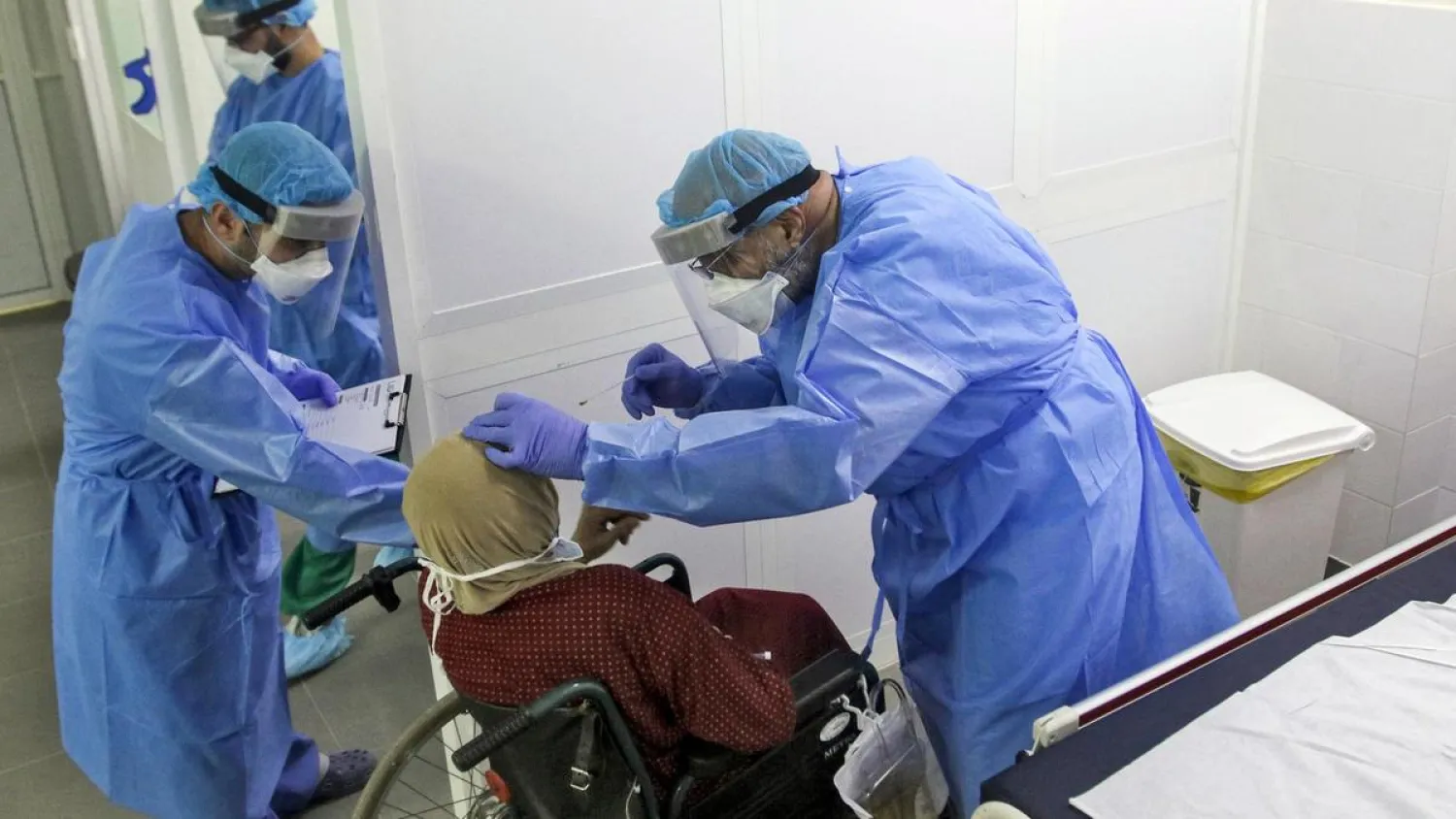
A doctor tests a woman at a hospital in the southern Lebanese city of Nabatieh on April 4, 2020. AFP file photo
TT

Lebanon: Desperate Hunt for Hospital Beds Amid Spike in Virus Cases

A doctor tests a woman at a hospital in the southern Lebanese city of Nabatieh on April 4, 2020. AFP file photo

When Rachelle Halabi rushed her 85-year-old father to a Beirut hospital a few days ago with Covid-19, the doctor sent them home as intensive care was full.

"The ER doctor told us to go back, get him an oxygen machine and give him his treatment from home," she told AFP from the Lebanese capital. "We went with it for several days, but his condition did not improve."

Halabi herself tested positive for Covid-19, one of the thousands of new cases reported in Lebanon following a holiday season where loosened restrictions let infections soar.

With 192,000 reported cases and almost 1,500 deaths, Lebanon is not among the world's worst hit countries.

But its infrastructure is crumbling, and a small surge in infections is enough to take its health sector to breaking point.

The health ministry has in recent weeks urged private hospitals to make more room for Covid-19 patients, but the pandemic is spreading too fast.

"The rise in Covid numbers has outpaced the increase in critical beds," said Firass Abiad, the head of a major public hospital battling the virus.

Lebanese Red Cross president Georges Kettaneh told AFP the service was "transporting around 100 patients in need of hospital treatment a day."

Halabi said she was turned away by several hospitals, and her hunt for a bed eventually took her outside the capital, to a private hospital in the city of Zahle, in the Bekaa valley.

Her father was given a bed in exchange for 15 million Lebanese pounds, equivalent to some $10,000 at the official exchange rate.

"What do you do if you can't afford this amount?" she asked.

Her father had already had a narrow escape earlier this year, when a mammoth blast at Beirut port in August devastated swathes of the capital.

As Halabi waited for her father's transfer to Zahle, producer Jean Nakhoul was scouting for a hospital that would take his 83-year-old grandmother.

"The few hospitals that still have a vacant bed told us priority was being given to younger people, and that she would only be taken in if her condition became critical," he said.

Nakhoul said that in the meantime, he had installed a ventilator and a pulse oximeter to her finger at home, to monitor and regulate oxygen levels.

Social media platforms are full of messages from distressed families pleading for help in finding a hospital bed for relatives.

Lebanon's economy collapsed last year, and political paralysis and corruption are delaying any chance of a recovery.

The holiday season was seen by the government as a chance to inject much-needed foreign currency into the economy.

The government has announced a 6:00 pm to 5:00 am curfew, as well as a raft of other measures that will begin Thursday.

Vaccines are still weeks away from arriving. Lebanon hopes to receive its first shipment of coronavirus jabs in mid-February.

"The situation is catastrophic, both in terms of the number of patients streaming in to the emergencies and how serious their case is when they arrive," said Antoine Zoghbi, head of the emergency department at the Hotel Dieu hospital in Beirut.


Al-Zaidi’s First Visit to Egypt... A Boost to Cooperation Amid Regional Turmoil

Iraqi Prime Minister Ali al-Zaidi meets Egypt's President Abdel Fattah al-Sisi, in Cairo, Egypt, November 23, 2026. (Iraqi Prime Minister's Media Office/Handout via Reuters)
TT

Al-Zaidi’s First Visit to Egypt... A Boost to Cooperation Amid Regional Turmoil

Iraqi Prime Minister Ali al-Zaidi meets Egypt's President Abdel Fattah al-Sisi, in Cairo, Egypt, November 23, 2026. (Iraqi Prime Minister's Media Office/Handout via Reuters)

Iraqi Prime Minister Ali al-Zaidi kicked off on Monday a visit to Egypt - his first since taking office in May - amid escalating regional challenges, in a move experts and analysts described as a boost to cooperation and coordination in light of regional tensions.

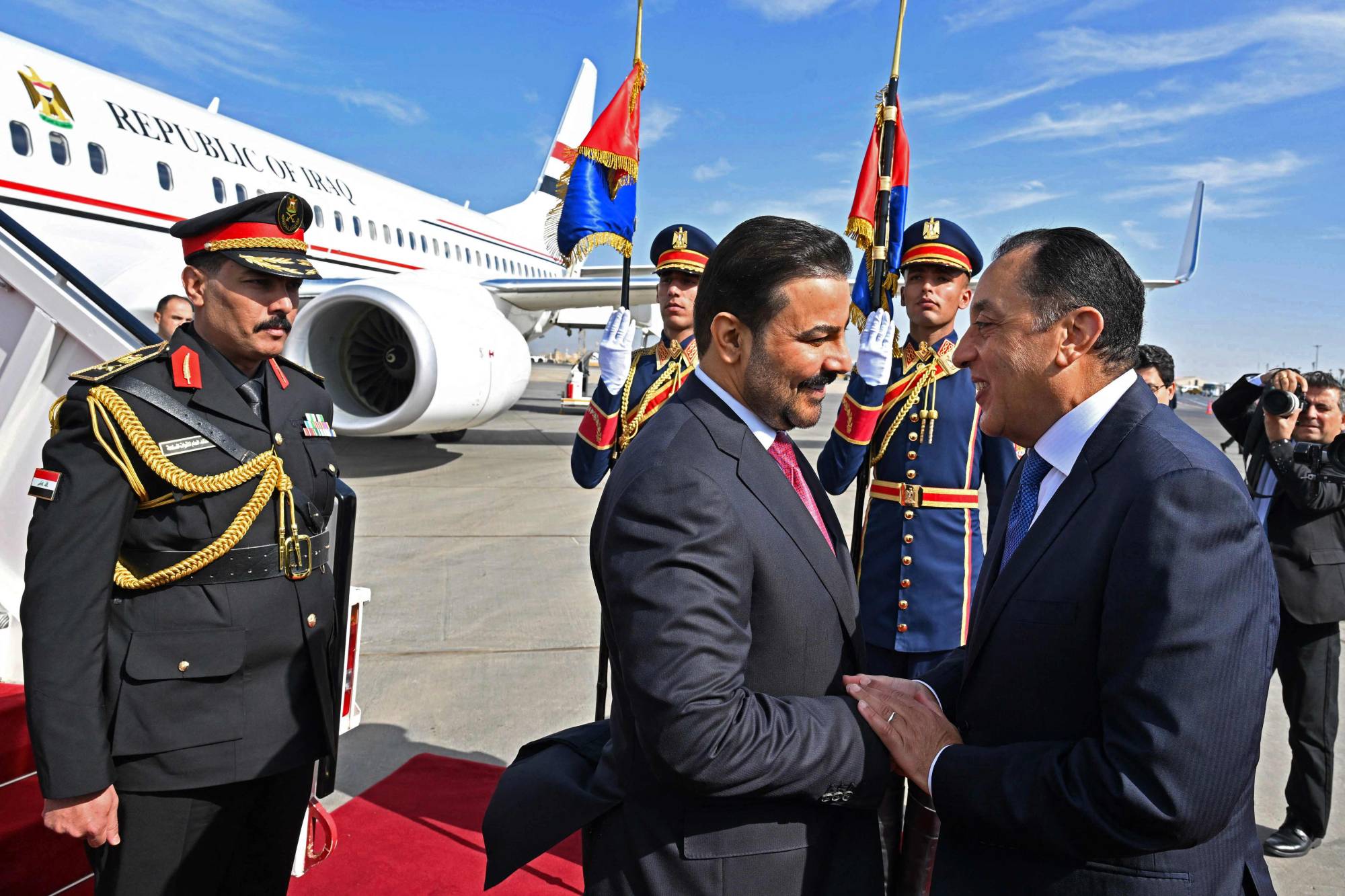
Egyptian Prime Minister Mostafa Madbouly received al-Zaidi at Cairo International Airport before he met with Egyptian President Abdel Fattah al-Sisi.

On Monday evening, al-Zaidi and Madbouly are co-chairing the fourth session of the Joint Higher Committee between the two countries at the government headquarters in the New Administrative Capital.

In a statement, the Egyptian Cabinet said the two sides will witness the signing of several documents across various fields "supporting the enhancement of bilateral cooperation between the two brotherly countries," in addition to attending a business forum to review trade and investment opportunities in both nations.

The visit comes "as both countries seek to open new horizons for joint cooperation, particularly in light of the promising opportunities abundant in Egypt and Iraq across various economic, commercial, and investment fields, with a view to deepening the partnership between the two countries,” it added.

A day earlier, Egyptian Foreign Minister Dr. Badr Abdelatty met his Iraqi counterpart Fuad Hussein on the sidelines of the Aswan Forum, saying he was looking forward to al-Zaidi's visit and the convening of the fourth session of the Joint Higher Committee.

He noted that the visit would give strong momentum to bilateral ties, bolster cooperation across various sectors, and serve the mutual interests of Egypt and Iraq.

The FMs stressed the importance of prioritizing political and diplomatic solutions to resolve crises, and maintaining coordination and consultation on issues of mutual concern to support efforts aimed at achieving regional security and stability.

Region in focus

Al-Zaidi’s first visit to Egypt centers on the regional developments and tensions across the Middle East. His media office said in a statement on Monday that al-Zaidi will discuss ways to confront various challenges in a manner that strengthens regional security and stability.

According to an Egyptian presidential statement, the PM expressed during his meeting with Sisi his appreciation for Egypt’s efforts aimed at easing regional tensions and preserving stability.

He underlined Iraq’s desire to intensify political consultation to prevent renewed regional escalation.

Egypt's Prime Minister Mostafa Madbouly (R) shakes hands with his Iraqi counterpart Ali al-Zaidi upon his arrival at the airport in Cairo on November 23, 2026. (AFP)

On bilateral cooperation, the two sides discussed ways to deepen joint collaboration in energy, investment, trade, and military cooperation.

Sisi reaffirmed Egypt’s steadfast position in support of the security and stability of all Arab countries, saying their security is an extension of Egyptian national security.

He highlighted Egypt’s persistent efforts to resolve ongoing regional crises.

Significance of the visit

Mohammed Hegazy, a member of the Egyptian Council for Foreign Affairs and former assistant foreign minister, said al-Zaidi's visit reflects growing Iraqi recognition of the importance of revitalizing relations with its Arab neighborhood.

Speaking to Asharq Al-Awsat, he added that Iraq, by virtue of its geographical and political standing, as well as its economic weight and resources, "cannot remain detached from the equations of security and stability in the region.”

“Cairo is a key Arab partner for Baghdad with extensive political and diplomatic experience and the ability to engage with various regional and international actors,” he went on to say.

Al-Zaidi’s first visit reflects "a desire to elevate the relationship from routine political coordination to a deeper, more sustainable partnership, and to move toward a policy grounded in national interests, balance, and strengthening the Arab presence in confronting current challenges,” he added.

He noted that Egypt and Iraq have a significant opportunity to expand cooperation, "but its success hinges on moving from agreements and memoranda of understanding to concrete projects with measurable results."

Hegazy believes this momentum should be built upon by identifying priority projects, while expanding opportunities for cooperation in electricity, electrical interconnection, the exchange of expertise in the oil and gas sector, and renewable energy projects.

Egyptian-Iraqi trade exchange reached roughly $1.1 billion in 2024, according to official Egyptian figures.

Hegazy said this remains well below available potential, and therefore the objective should not merely be increasing trade volume, but diversifying it and boosting investment.


Lebanon: Number of Detainees in Al-Qaa Explosives Case Rises to Six

Lebanese soldiers deployed in southern Lebanon. (AP file)
TT

Lebanon: Number of Detainees in Al-Qaa Explosives Case Rises to Six

Lebanese soldiers deployed in southern Lebanon. (AP file)

The number of detainees held in connection with the explosives shipment arriving from Syria, which the Lebanese Army seized in the Mashari al-Qaa area of the Bekaa Valley on Sunday, has risen to six Lebanese nationals.

Security agencies are tracking down two Syrians suspected of having been set to receive the cargo.

Government Commissioner to the Military Court Judge Claude Ghanem ordered the preliminary investigation transferred from the Military Police to the Army's Intelligence Directorate in order to expand the probe and identify the party for which the shipment was intended.

The number of detainees will likely rise as the investigation unfolds.

A judicial source told Asharq Al-Awsat that preliminary information indicates the two Syrians "were supposed to handle transporting the explosives to warehouses in the Bekaa," noting that their arrest is expected to help "uncover the identity of the recipient."

The source confirmed that Judge Ghanem "requested that samples of the seized TNT and C-4 be sent to laboratories for analysis, in an effort to determine their origin and compare them with samples from the Dahr al-Baidar shipment."

He pointed to "similarities between the materials seized in both shipments, with tests awaited to determine whether they are identical."

The Lebanese Army's announcement on Sunday regarding the seizure coincided with a statement by Syrian security forces reporting the confiscation of a cache of weapons in the Damascus countryside that they said was destined for smuggling into Lebanon.

The Lebanese Army had previously intercepted roughly 200 kilograms of explosives near the Syrian border in the Lebanese area of al-Qasr, while the person transporting them fled toward Syria.

A security source told Asharq Al-Awsat that repeated seizures along the eastern and northern borders "call for strengthening field measures and maintaining continuous coordination between Lebanon and Syria to close the loopholes threatening the security of both countries."

The security source stressed "the need to raise the readiness of security agencies to thwart smuggling operations before shipments reach their destinations."


Israel Defense Minister Says Police, Not Army, Should Handle Settler Violence

Palestinians inspect the damage after Israeli settlers set fire to their cars at the West Bank village of Kufr Malik, 22 November 2026. (EPA)
TT

Israel Defense Minister Says Police, Not Army, Should Handle Settler Violence

Palestinians inspect the damage after Israeli settlers set fire to their cars at the West Bank village of Kufr Malik, 22 November 2026. (EPA)

The defense minister in Israel's caretaker government on Monday said the police, not the military, should deal with violent settlers in the occupied West Bank, after Palestinian vehicles and properties were torched over the weekend.

It is not the first time Israel Katz, who serves in the right-wing caretaker government of Benjamin Netanyahu, has spoken about transferring civilian law enforcement over West Bank settlers to the police.

If implemented, the measure could constitute a step towards Israeli annexation of the Palestinian territory.

On Monday, Katz called the "ongoing violence by a handful of rioters... extremely serious in every respect."

The military "should not and cannot deal with civilian law enforcement over the Jewish population in Judea and Samaria" he added, using the biblical name for the West Bank, which Israel has occupied since 1967.

"Therefore, in accordance with my directive, the army has formulated a plan to transfer responsibility for civilian criminal enforcement in the territories to the Israel Police, which will be reinforced and prepared accordingly," Katz said.

"Only in this way will it be possible to normalize reality in Judea and Samaria and enable the settlements to flourish and prosper," he added.

Katz made a call to transfer law enforcement in August, during a siege of Palestinian homes in the northern West Bank, saying the police would "prepare and establish an appropriate force to handle civil matters".

His statement on Monday comes after Israeli authorities said they were investigating the torching of Palestinian vehicles and property in four West Bank villages over the weekend.

Social media posts showed vehicles in flames as well as slogans written on walls, including: "In blood and fire Judea has fallen, in blood and fire Judea will rise again".

At a conference on Monday, Israeli President Isaac Herzog said "violence by Jewish extremists against innocent people... is despicable and deserves strong condemnation," insisting that law enforcement was working "to scour this terrible moral stain".

Violence in the West Bank, occupied by Israel since 1967, has surged since Hamas's October 7, 2023 attack on Israel, which triggered the Gaza war.

More than 500,000 Israelis live in West Bank settlements, which are illegal under international law, in a territory home to around three million Palestinians.
