

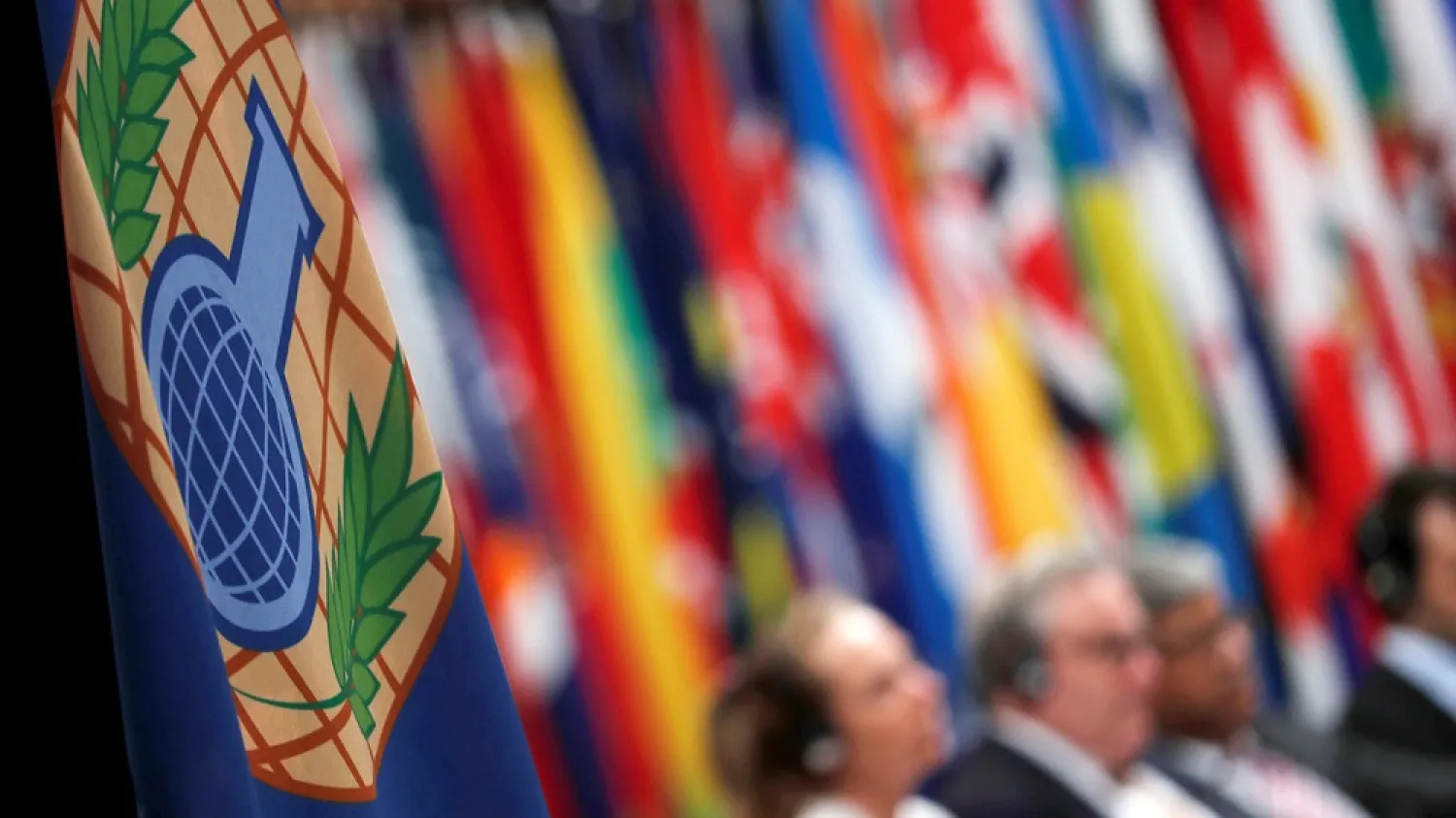

Russia and West Clash over Syria Chemical Weapons Sanctions

A flag with the logo of the OPCW is seen during a special session in the Hague. (Reuters)
TT

Russia and West Clash over Syria Chemical Weapons Sanctions

A flag with the logo of the OPCW is seen during a special session in the Hague. (Reuters)

Syria and ally Russia clashed with the US and other nations Tuesday over a Western initiative to suspend Syria’s voting rights in the global chemical weapons watchdog for failing to provide details of three chemical attacks in 2017 that investigators blamed on president Bashar Assad’s government.

The confrontation in the UN Security Council foreshadowed a showdown when the 193 member states of the Organization for the Prohibition of Chemical Weapons meet in The Hague, Netherlands, in April to consider a French-drafted measure, on behalf of 46 countries, to suspend Syria’s “rights and privileges” in the body.

The French proposal was a response to Syria’s failure to meet a 90-day deadline set in July by the OPCW’s executive council for Damascus to declare the nerve agent sarin and chlorine, which OPCW investigators said last April were dropped by the Syrian air force on the central town of Latamneh in late March 2017.

The Western effort reflects a much broader effort to obtain accountability for Syrian chemical attacks and highlight claims that Assad's government is secretly continuing its chemical weapons program.

Syria joined the Chemical Weapons Convention in September 2013, pressed by Russia after a deadly chemical weapons attack that the West blamed on Damascus.

By August 2014, the Assad government declared that the destruction of its chemical weapons was completed. But Syria’s initial declaration of its chemical stockpiles and chemical weapons production sites has remained in dispute.

Ireland’s UN ambassador, Geraldine Byrne Nason, a new council member, said it was “deeply disturbing” that the OPCW still cannot determine whether the initial declaration was accurate or complete because of gaps and inconsistencies. She said the problems are not “minor” as some would portray, alluding to Russia.

“Over those seven years, the number of issues that need to be addressed has expanded from five to 19,” Byrne Nason said. “There have been 17 amendments to Syria’s declaration including the addition of a production facility, four research and development centers, and doubling of the amount of declared agents and chemicals.”

In addition, she said, there are issues related to “hundreds of tons of missing agents and munitions reported destroyed" before Syria joined the chemical convention as well as recent reports of a production facility that Damascus declared as never having been used, “where there is clear evidence to the contrary.”

Norwegian Ambassador Mona Juul, another new council member, also expressed concern at Syria’s failure to explain an unnamed chemical that can be used in chemical weapons but also has non-weapons uses. It was detected at the Barzah facilities of the Syrian Scientific Studies and Research Center.

Russia’s deputy UN ambassador, Dmitry Polyansky, again accused OPCW investigators of being “unscrupulous” and alleged they used “forgeries” and “manipulations” to blame Syria.

He called the chemical watchdog “seriously ill with politicization.” And he accused a number of unnamed countries of “playing this ‘chemical card’ to step up pressure on the Syrian government that they failed to overthrow in the wake of the so-called Arab Spring.”

As for the initial Syrian declaration, Polyansky said Damascus was not “an extraordinary case,” pointing to amended declarations by Western countries including France and Germany as well as Libya. He accused Western delegations of trying to “inflate agitation” around Syria.

French Ambassador Nicolas De Riviere expressed regret at “the false accusations of those who seek to discredit OPCW” and its findings about Syria's attacks.

“There is simply the reality of the facts,” he said. “We all know them: the regime used weapons of war prohibited by international law against its own population, and since then we have seen chemical weapons reemerge and become commonplace in Syria and elsewhere.”

British Ambassador Barbara Woodward said OPCW investigators, alone and initially with a UN team, determined Syria used chemical weapons on at least six occasions.

“These are not hypothetical issues for the thousands of Syrian civilians who have suffered the horrifying effects on the body of nerve agents and chlorine,” she said.

Syria’s deputy foreign minister and former UN ambassador, Bashar Jaafari, accused some unnamed Western nations of using the OPCW “as a platform to fabricate allegations and then justify an assault and aggression on Syria.”

The aim, he said, is “to frame the Syrian government for the use of chemical weapons and exonerate the terrorists and the sponsors ... and give them the necessary means to escape through the occupied Golan area through Israel to the capitals of Western states where they can live.”

Russia’s Polyansky said Syria could not meet the OPCW’s anti-Syria demands on Latamneh because it “simply doesn’t have” the chemical weapons and facilities the organization is seeking.

“Hopefully, the majority of delegations at the member states’ conference in April will reject this provocation, and the West-initiated decision, which is ‘punitive’ by nature, will not pass,” he said.

US deputy ambassador Richard Mills said neither the Security Council nor the world “is fooled” by Russia’s accelerated campaign to discredit the OPCW.

He urged council members to call on all countries to support the French draft against Syria in April “aimed at promoting accountability for the Assad regime’s actions.”

“It is time that the Syrian people, and indeed all the globe’s people, be allowed to live in a world free of the threat of chemical weapons,” he said.



Lifting of US Sanctions on Syria Could Spur Refugee Returns, Says UN Official

People sit after receiving bread from Ecir Kapici, Turkish humanitarian NGO at Al-Yarmouk Palestinian refugee camp, after Syria's Bashar Al-Assad was ousted, in Damascus, Syria, December 20 , 2024. (Reuters)
TT

Lifting of US Sanctions on Syria Could Spur Refugee Returns, Says UN Official

People sit after receiving bread from Ecir Kapici, Turkish humanitarian NGO at Al-Yarmouk Palestinian refugee camp, after Syria's Bashar Al-Assad was ousted, in Damascus, Syria, December 20 , 2024. (Reuters)

The head of the UN refugee agency in Lebanon said Thursday that the move by the United States to lift sweeping sanctions on Syria could encourage more refugees to return to their country.

The US Senate voted Wednesday to permanently remove the so-called Caesar Act sanctions after the administration of President Donald Trump previously temporarily lifted the penalties by executive order. The vote came as part of the passage of the country's annual defense spending bill. Trump is expected to sign off on the final repeal Thursday.

An estimated 400,000 Syrian refugees have returned from Lebanon since the ouster of former Syrian President Bashar Assad in December 2024 following a nearly 14-year civil war, UNHCR Lebanon Representative Karolina Lindholm Billing said, with around 1 million remaining in the country. Of those, about 636,000 are officially registered with the refugee agency.

The UN refugee agency reports that altogether more than 1 million refugees and nearly 2 million internally displaced Syrians have returned to their homes since Assad’s fall.

Refugees returning from neighboring countries are eligible for cash payments of $600 per family upon their return, but with many coming back to destroyed houses and no work opportunities, the cash does not go far. Without jobs and reconstruction, many may leave again.

The aid provided so far by international organizations to help Syrians begin to rebuild has been on a “relatively small scale compared to the immense needs,” Billing said, but the lifting of US sanctions could “make a big difference.”

The World Bank estimates it will cost $216 billion to rebuild the homes and infrastructure damaged and destroyed in Syria's civil war.

“So what is needed now is big money in terms of reconstruction and private sector investments in Syria that will create jobs,” which the lifting of sanctions could encourage, Billing said.

Lawmakers imposed the wide-reaching Caesar Act sanctions on Syria in 2019 to punish Assad for human rights abuses during the country’s civil war.

Despite the temporary lifting of the sanctions by executive order, there has been little movement on reconstruction. Advocates of a permanent repeal argued that international companies are unlikely to invest in projects needed for the country’s rebuilding as long as there is a threat of sanctions returning.

New refugees face difficulties While there has been a steady flow of returnees over the past year, other Syrians have fled the country since Assad was ousted by Islamist-led insurgents. Many of them are members of religious minorities fearful of being targeted by the new authorities — particularly members of the Alawite sect to which Assad belonged and Shiites fearful of being targeted in revenge attacks because of the support provided to Assad during the war by Iran and the Lebanese militant group Hezbollah.

Hundreds of Alawite civilians were killed in outbreaks of sectarian violence on Syria’s coast in March.

While the situation has calmed since then, Alawites continue to report sporadic sectarian attacks, including incidents of kidnapping and sexual assault of women.

About 112,000 Syrians have fled to Lebanon since Assad’s fall, Billing said. Coming at a time of shrinking international aid, the new refugees have received very little assistance and generally do not have legal status in the country.

“Their main need, one of the things they raise with us all the time, is documentation because they have no paper to prove that they are in Lebanon, which makes it difficult for them to move around,” Billing said.

While some have returned to Syria after the situation calmed in their areas, she said, “Many are very afraid of being returned to Syria because what they fled were very violent events.”


Israel Launches Intense Airstrikes in Lebanon as Deadline Looms to Disarm Hezbollah

TOPSHOT - Smoke rises from the site of a series of Israeli airstrikes that targeted the outskirts of the southern Lebanese village of al-Katrani on December 18, 2025.  (Photo by Rabih DAHER / AFP)
TOPSHOT - Smoke rises from the site of a series of Israeli airstrikes that targeted the outskirts of the southern Lebanese village of al-Katrani on December 18, 2025. (Photo by Rabih DAHER / AFP)
TT

Israel Launches Intense Airstrikes in Lebanon as Deadline Looms to Disarm Hezbollah

TOPSHOT - Smoke rises from the site of a series of Israeli airstrikes that targeted the outskirts of the southern Lebanese village of al-Katrani on December 18, 2025.  (Photo by Rabih DAHER / AFP)
TOPSHOT - Smoke rises from the site of a series of Israeli airstrikes that targeted the outskirts of the southern Lebanese village of al-Katrani on December 18, 2025. (Photo by Rabih DAHER / AFP)

Israel carried out a series of airstrikes on southern and northeastern Lebanon on Thursday as a deadline looms to disarm the militant Hezbollah group along the tense frontier.

The strikes came a day before a meeting of the committee monitoring the enforcement of a US-brokered ceasefire that halted the latest war between Israel and Hezbollah a year ago.

It will be the second meeting of the mechanism after Israel and Lebanon appointed civilian members to a previously military-only committee. The group also includes the US, France and the UN peacekeeping force deployed along the border.

In Paris, Lebanon’s army commander Gen. Rodolphe Haykal is scheduled to meet on Thursday with US, French and Saudi officials to discuss ways of assisting the army in its mission to boost its presence in the border area.

The Lebanese government has said that the army should have cleared all the border area south of the Litani river from Hezbollah’s armed presence by the end of the year.

The Israeli military said the strikes hit Hezbollah infrastructure sites and launching sites in a military compound used by the group to conduct training and courses for its fighters. The Israeli military added that it struck several Hezbollah military structures in which weapons were stored, and from which Hezbollah members operated recently.

Lebanon’s state-run National News Agency said the intense airstrikes stretched from areas in Mount Rihan in the south to the northeastern Hermel region that borders Syria.

Shortly afterward, a drone strike on a car near the southern town of Taybeh inflicted casualties, NNA said.

“This is an Israeli message to the Paris meeting aiming to support the Lebanese army,” Parliament Speaker Nabih Berri said about the strikes.

“The fire belt of Israeli airstrikes is to honor the mechanism’s meeting tomorrow,” Berri added during a parliament meeting in Beirut.

The latest Israel-Hezbollah war began Oct. 8, 2023, a day after Hamas attacked southern Israel, after Hezbollah fired rockets into Israel in solidarity with Hamas. Israel launched a widespread bombardment of Lebanon in September last year that severely weakened Hezbollah, followed by a ground invasion.

Israel has carried out almost daily airstrikes since then, mainly targeting Hezbollah members but also killing 127 civilians, according to the office of the UN High Commissioner for Human Rights.

Over the past weeks, the US has increased pressure on Lebanon to work harder on disarming Hezbollah.


UN: Over 1,000 Civilians Killed in Sudan's Darfur when Paramilitary Group Seized Camp

The Sudanese flag flutters in Omdurman, part of greater Khartoum on December 13, 2025. (AFP)
TT

UN: Over 1,000 Civilians Killed in Sudan's Darfur when Paramilitary Group Seized Camp

The Sudanese flag flutters in Omdurman, part of greater Khartoum on December 13, 2025. (AFP)

Over 1,000 civilians were killed when a Sudanese paramilitary group took over a displacement camp in Sudan's Darfur region in April, including about a third who were summarily executed, according to a report by the UN Human Rights Office on Thursday.

"Such deliberate killing of civilians or persons hors de combat may constitute the war crime of murder,” said the UN High Commissioner for Human Rights Volker Turk in a statement accompanying the 18-page report.

The Zamzam camp in Sudan's western region of Darfur housed around half a million people displaced by the civil war and was taken over by Rapid Support Forces between April 11-13.