

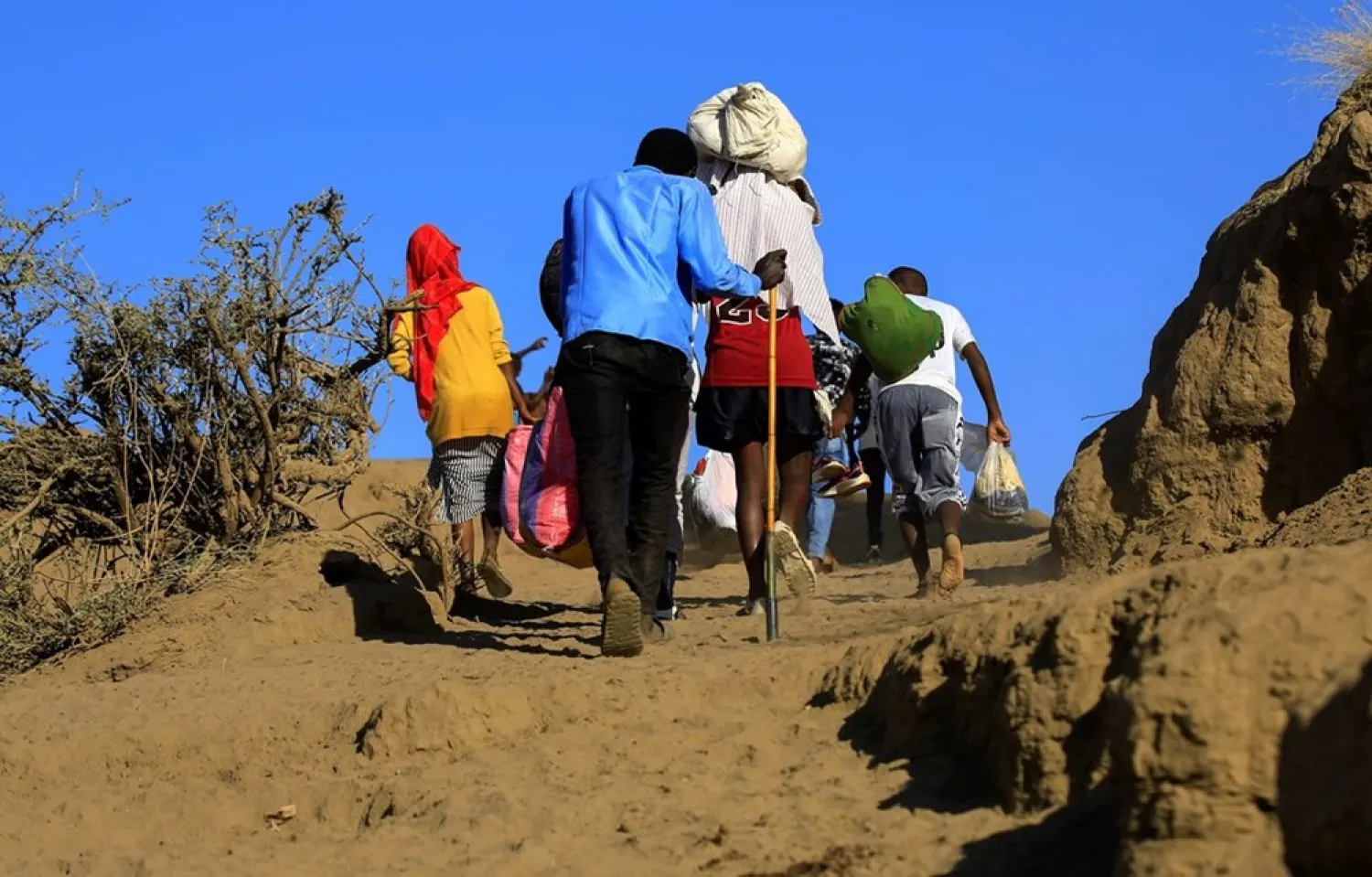

Over 2 Million People Displaced by Conflict in Ethiopia's Tigray Region

Ethiopians, who fled the ongoing fighting in Tigray region, carry their belongings after crossing the Setit River on the Sudan-Ethiopia border, in the eastern Kassala state, Sudan December 16, 2020. (Reuters)
TT

Over 2 Million People Displaced by Conflict in Ethiopia's Tigray Region

Ethiopians, who fled the ongoing fighting in Tigray region, carry their belongings after crossing the Setit River on the Sudan-Ethiopia border, in the eastern Kassala state, Sudan December 16, 2020. (Reuters)

About 2.2 million people have been displaced within Ethiopia’s Tigray region since fighting erupted there in November with about half fleeing after their homes were burned down, a local government official said.

Gebremeskel Kassa, a senior official in the interim administration in Tigray appointed by the federal government, made the comments in an interview broadcast by state-run ETV’s Tigriniya language channel late on Tuesday.

The figure given by the official was more than double a previous estimate for the number of people displaced of 950,000, which included 50,000 who had fled to neighboring countries.

Ethiopia’s federal government restricted access to Tigray after fighting began on Nov. 4 between its troops and the Tigray People’s Liberation Front (TPLF), a political party that was governing the province. The government declared victory in late November though the TPLF has vowed to fight on.

The conflict in Tigray has called into question whether Prime Minister Abiy Ahmed, who won the 2019 Nobel Peace Prize, can hold together fractious ethnic groups in the country.

An official from Ethiopia’s National Disaster Risk Management Commission told Reuters on Wednesday that the figures cited by the administrator in Tigray were not official.

The commission’s Mitiku Kassa said 110,000 people were displaced within Tigray and 1.8 million were in need of assessment, though he said the actual number of displaced was likely to be far higher than its current tally.

A UN refugee agency official also said on Tuesday that Ethiopians were still crossing into neighboring Sudan from Tigray.

“Some 800 people crossed from Ethiopia’s Tigray region into eastern Sudan in just the first few days of the new year,” spokesman Andrej Mahecic told reporters in Geneva.

A spokeswoman for Abiy’s office did not immediately respond to a request for comment on the report that refugees were continuing to cross into Sudan.

More than 56,000 people have now crossed into Sudan from Tigray since the conflict started, according to the UN refugee agency’s latest data.



Türkiye Says Day-trip Crossings Suspended at Iran Border

People wait for transportation to the city center after crossing from Iran into Türkiye at the Kapikoy Border Gate in eastern Van province, Türkiye  March 2, 2026. REUTERS/Dilara Senkaya
People wait for transportation to the city center after crossing from Iran into Türkiye at the Kapikoy Border Gate in eastern Van province, Türkiye March 2, 2026. REUTERS/Dilara Senkaya
TT

Türkiye Says Day-trip Crossings Suspended at Iran Border

People wait for transportation to the city center after crossing from Iran into Türkiye at the Kapikoy Border Gate in eastern Van province, Türkiye  March 2, 2026. REUTERS/Dilara Senkaya
People wait for transportation to the city center after crossing from Iran into Türkiye at the Kapikoy Border Gate in eastern Van province, Türkiye March 2, 2026. REUTERS/Dilara Senkaya

Türkiye and Iran have mutually suspended day-trip crossings at their border, Türkiye's trade minister said Monday as Israeli-US strikes continued to pound the Islamic Republic.

"Same-day passenger crossings at all three customs gates have been mutually suspended," Trade Minister Omer Bolat wrote on X.

But he insisted there was "no extraordinary situation" at the three crossings along their shared 500-kilometre (300-mile) frontier.

"Iran is allowing its own citizens to enter their country via Türkiye ... we are also allowing our own citizens and third-country nationals to enter our country from Iran," he said.

An AFP journalist at the Kapikoy border crossing saw a bit more traffic on Monday but nothing above routine levels.

"Tehran is on fire," said a 22-year-old Iranian student, who studies in Milan but was caught up by the war while on vacation in Iran. They declined to give their name.

Another student, who gave only his first name, Amir, said: "I'm glad to be out of that country", adding that he was heading to China to study medicine.

Zima, an Iranian woman coming from Tabriz, said the city was struck by "constant explosions", adding: "It's scary. But we'll come out stronger from this."

Despite the strikes, which began early Saturday, President Recep Tayyip Erdogan said later that day that Türkiye had not experienced any problems "in terms of border security".

Türkiye currently hosts more than 74,000 Iranians with residence permits and some 5,000 refugees.


IAEA's Grossi Repeats There is No Indication Iran Nuclear Sites Were Hit

(FILES) Buildings of the International Atomic Energy Agency (IAEA) headquarters reflect in doors with the agency's logo during the IAEA's Board of Governors meeting in Vienna, Austria on June 13, 2025, where the IAEA's head Rafael Grossi briefed board members following Israeli strikes on Iran, including on the Natanz uranium enrichment facility. (Photo by Joe Klamar / AFP)
TT

IAEA's Grossi Repeats There is No Indication Iran Nuclear Sites Were Hit

(FILES) Buildings of the International Atomic Energy Agency (IAEA) headquarters reflect in doors with the agency's logo during the IAEA's Board of Governors meeting in Vienna, Austria on June 13, 2025, where the IAEA's head Rafael Grossi briefed board members following Israeli strikes on Iran, including on the Natanz uranium enrichment facility. (Photo by Joe Klamar / AFP)

UN nuclear watchdog chief Rafael Grossi said on Monday that his agency stands by its assessment that there is ‌no indication ‌Iran's nuclear ‌facilities were ⁠damaged or hit ⁠in the US and Israeli military strikes on the country.

Iran's ambassador ⁠to the ‌International ‌Atomic Energy Agency said ‌earlier on ‌Monday a nuclear facility at Natanz had been attacked. ‌So far the agency has seen ⁠nothing ⁠comparable to the attacks on Iran's nuclear sites that Israel and the United States carried out in June, Grossi told a press conference.


Indian Police Clash with Pro-Khamenei Protesters in Kashmir

Demonstrators hold a portrait of Iran's late supreme leader Ali Khamenei in Srinagar on March 2, 2026 after restrictions were imposed amid protests over his death by US-Israel strikes. Habib NAQASH / AFP
TT

Indian Police Clash with Pro-Khamenei Protesters in Kashmir

Demonstrators hold a portrait of Iran's late supreme leader Ali Khamenei in Srinagar on March 2, 2026 after restrictions were imposed amid protests over his death by US-Israel strikes. Habib NAQASH / AFP

Police in Indian-administered Kashmir fired teargas on Monday during clashes with thousands of demonstrators protesting the killing of Iran's supreme leader Ali Khamenei for a second day in a row.

The clashes came a day after tens of thousands of people in the Muslim-majority region joined peaceful street demonstrations against strikes by Israel and the United States that killed the Iranian leader.

On Monday, authorities closed schools and colleges for two days and imposed restrictions on public movement by barricading many arterial roads.

The restrictions were imposed "as a precautionary measure" after a group of organizations headed by the region's chief cleric Mirwaiz Umar Farooq called for a strike, authorities said.

The protesters clashed with security forces when they were stopped from marching to the main square in the main city of Srinagar, which was sealed off.

Demonstrations were also held in other pockets across the Kashmir valley, with protesters displaying portraits of Khamenei, slain Iranian general Qasem Soleimani and Hassan Nasrallah of Lebanese militant group Hezbollah.

They also shouted anti-Israel and anti-US slogans while waving flags associated with Iran and Hezbollah, an AFP journalist at the scene said.

"Minimum teargas shelling was resorted to when they (the demonstrators) did not heed warnings to stop," a police officer told AFP on condition of anonymity as they were not authorized to speak to media.

Kashmir, which has a significant number of Shia Muslims, shares ancient connections with Iran.

Khamenei was given a momentous welcome during his only visit to the territory in the early 1980s.

On Sunday, the territory's chief minister Omar Abdullah -- who does not control the security forces -- said mourners should be "allowed to grieve peacefully" and police should "refrain from using force or restrictive measures".

Khamenei and top military leaders were killed on Saturday, prompting Iranian authorities to retaliate with strikes on Israel and across the Gulf.