

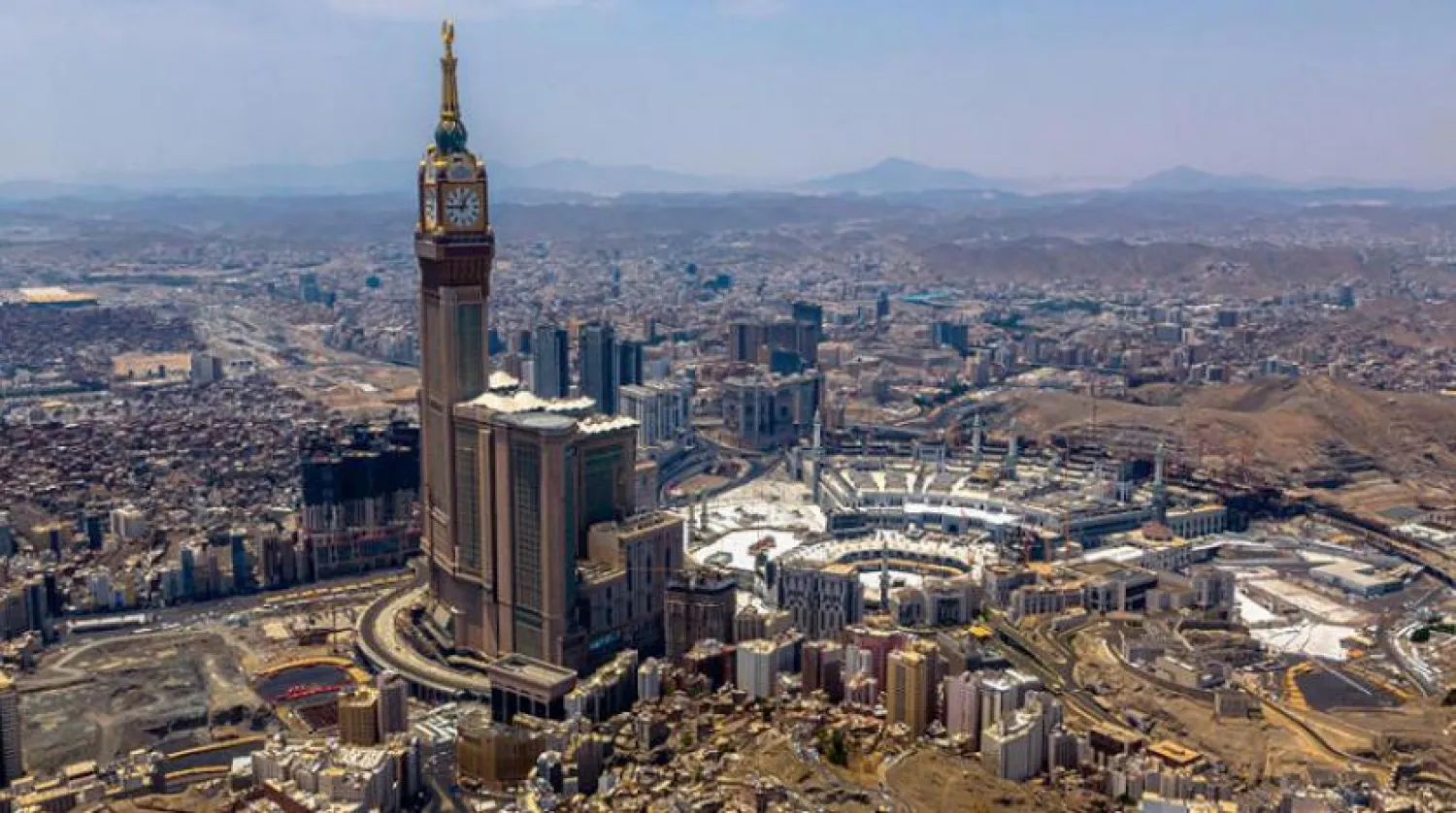

Saudi Arabia Launches $266 mln Company to Develop Holy Sites

The Royal Commission for Makkah Al-Mukarramah and the Holy Sites (RCMC) launches Kidana, Asharq Al-Awsat
TT

Saudi Arabia Launches $266 mln Company to Develop Holy Sites

The Royal Commission for Makkah Al-Mukarramah and the Holy Sites (RCMC) launches Kidana, Asharq Al-Awsat

Saudi Arabia has launched a company with an authorized capital of SR1 billion ($266 million) called “Kidana” to develop holy sites in the Kingdom.

Kidana will be headquartered in Mina and is the first closed joint-stock company owned by the Royal Commission for Makkah Al-Mukarramah and the Holy Sites (RCMC). RCMC made the announcement on Sunday.

Prince Abdullah bin Bandar bin Abdulaziz, chairman of the board of directors at Kidana, explained why it was important to maintain and preserve the two holy cities of Makkah and Madinah.

“The holy cities have received prioritized care and attention from each of the Saudi monarchs since the era of the late King Abdulaziz. The holy sites, may Allah protect them, are the most sanctified symbols of our religion and history,” he said.

Kidana is aiming for long-term sustainability when reconstructing and renovating the holy sites. It seeks to increase the number of pilgrims that the holy sites are able to hold, in line with the country’s Vision 2030 reform plan, and allowing more pilgrims to perform Hajj and Umrah each year.

It also wants to renovate the sites for optimal use throughout the year, creating sustainable urban centers and raising the efficiency of operations during the Hajj season. It plans to increase the quality of services on offer, as well as designing and developing real estate projects close to the holy sites.

Launching Kidana is the first key step in RCMC’s strategy, which was outlined last September, to develop and maintain the holy sites.

RCMC’s future priorities include the activation of the Holy Mosque and Holy Sites Program, as well as the development of a land and real estate program, a transport and transport infrastructure program, a partnerships investments program, and a financial sustainability program supported by the Center for Comprehensive Management.

Hatim Mouminah, a senior adviser at RCMC, was appointed Kidana CEO following the company’s first board meeting.

In other news, Emaar The Economic City (Emaar EC) signed a framework cooperation agreement with the Tourism Development Fund, FTG Development Co., Albilad Investment Co. and Ekofine Holding BV to establish a SAR 1.8 billion closed and private investment fund.

The fund, which will follow the requirements of the Capital Market Authority (CMA), will be responsible for developing and operating a 5-star resort and hotel with a water park and luxury overwater villas under the Rixos brand, one of the trademarks owned by Accor International, the company said in a bourse statement.

The Rixos Emerald Shores project is one of the largest tourist resorts proposed to be established in King Abdullah Economic City. The resort will be constructed on a total land area of 275,000 square meters, a 600-meter Red Sea beach stretch and golf course.

The resort is expected to be one of the largest leisure and tourism destinations in the Kingdom, housing more than 500 rooms and 35 luxury hotel villas with direct views of the Red Sea coast.

The resort also provides an integrated and world-class water park, clubs for children and gyms, in addition to more than 10 varied options of international restaurants and cafes.

The financial impact is expected to be recognized after establishing the fund and signing the relevant agreements, the statement noted.



Trump's Greenland Threat Puts Europe Inc back in Tariff Crosshairs

A worker adjusts European Union and US flags at the EU Commission headquarters in Brussels, November 11, 2013.
TT

Trump's Greenland Threat Puts Europe Inc back in Tariff Crosshairs

A worker adjusts European Union and US flags at the EU Commission headquarters in Brussels, November 11, 2013.

Just as European companies were getting used to last year's hard-won US trade tariff deals, President Donald Trump has put them back in his ​crosshairs with an explosive threat to place levies on nations that oppose his planned takeover of Greenland.

Trump on Saturday said he would put rising tariffs from February 1 on goods imported from EU members Denmark, Sweden, France, Germany, the Netherlands and Finland, along with Britain and Norway, until the US is allowed to buy Greenland, a step major EU states decried as blackmail.

On Sunday, European Union ambassadors reached broad agreement to intensify efforts to dissuade Trump from imposing those tariffs, while also readying a package of retaliatory measures should the duties go ahead, EU diplomats said.

The shock move has rattled through industry and sent shockwaves through markets amid fears of a return to the volatility of last year's trade war, which was only eased with tariff deals reached in the middle of the year.

"This is a very serious situation, the scale of which is unknown," Gabriel Picard, ‌chairman of the French ‌wine and spirits export lobby FEVS, told Reuters.

He said the industry had already seen a ‌20% ⁠to ​25% hit ‌to US activity in the second half of last year from previous trade measures, and new tariffs would bring a "material" impact.

But he said what was happening went far beyond sectoral issues. "It is more a matter of political contacts and political intent that must be taken to the highest level in Europe, so that Europe, once again, is united, coordinated, and if possible speaks with one voice."

STAND-OFF COULD BRING BACK LAST YEAR'S TRADE WAR

In a post on Truth Social, Trump said additional 10% import tariffs would take effect next month on goods from the listed European nations — all already subject to tariffs imposed by the US president last year of between 10% and 15%.

The bloc - which had an estimated $1.5 trillion in goods and services trade with the US in 2024 - looks set ⁠to fight back. Europe has major carmakers in Germany, drugmakers in Denmark and Ireland, and consumer and luxury goods firms from Italy to France.

EU leaders are set to discuss options at an emergency ‌summit in Brussels on Thursday, including a 93 billion euro ($107.7 billion) package of tariffs on ‍US imports that could automatically kick in on February 6 after a ‍six-month pause.

The other is the so far never used "Anti-Coercion Instrument" (ACI), which could limit access to public tenders, investments or banking activity or restrict ‍trade in services, in which the US has a surplus with the bloc.

Analysts said the key question was how Europe responded - with a more "classic" trade war tit-for-tat tariff retaliation, or an even tougher approach.

"The most likely way forward is a return to the trade war that was put on hold in high-level US agreements with the UK and the EU in summer," said Carsten Nickel, deputy director of research at Teneo in London.

COMPANIES WILL LOOK TO TRADE WITH 'LESS PROBLEMATIC NATIONS'

German submarine maker ​TKMS CEO Oliver Burkhard said the Greenland threat was perhaps the jolt that Europe needed to toughen its approach and focus on developing its own joint programmes to be more independent from the US.

"It is probably necessary... to get ⁠a kick in the shin to realise that we may have to suit up differently in the future," he told Reuters.

Susannah Streeter, chief investment strategist at Wealth Club, said the new threat created "another layer" of complexity for firms grappling with an already "chaotic" US market. Firms had little capacity to soak up new tariffs, she added.

"A trade war only creates losers," said Christophe Aufrere, director general of French autos association the PFA.

An official at a French industry association that represents the country's largest firms added the Greenland issue was turning tariffs into a "tool for political pressure", and called for the region to reduce its dependency on the US market.

Neil Shearing, group chief economist at Capital Economics, pointed out that some EU countries - Spain, Italy and others - were not on the tariff list, which would likely see "re-routing" of trade within the EU free trade bloc to avoid the taxes.

Analysts added the new tariffs - if imposed - would likely hurt Trump. They would push up US prices and lead to front-loading of exports before the tariffs kicked in, while encouraging companies to seek new markets.

"For Europe, this is a bad geopolitical headache and a moderately significant economic problem. But it could also backfire for Trump," said Holger Schmieding, London-based chief economist at Berenberg.

"Logic ‌still points to an outcome that respects Greenland's right to self-determination, strengthens security in the Arctic for NATO as a whole, and largely avoids economic damage for Europe and the US."


IMF Upgrades Outlook for Surprisingly Resilient World Economy to 3.3% Growth this Year

FILE PHOTO: A view of the International Monetary Fund (IMF) logo at its headquarters in Washington, D.C., US, November 24, 2024. REUTERS/Benoit Tessier//File Photo/File Photo
TT

IMF Upgrades Outlook for Surprisingly Resilient World Economy to 3.3% Growth this Year

FILE PHOTO: A view of the International Monetary Fund (IMF) logo at its headquarters in Washington, D.C., US, November 24, 2024. REUTERS/Benoit Tessier//File Photo/File Photo

An unexpectedly sturdy world economy is likely to shrug off President Donald Trump's protectionist trade policies this year, thanks partly to a surge of investment in artificial intelligence in North America and Asia, the International Monetary Fund said in a report out Monday.

The 191-nation lending organization expects that global growth will come in at 3.3% this year, same as in 2025 but up from the 3.1% it had forecast for 2026 back in October, The Associated Press reported.

The world economy "continues to show notable resilience despite significant US-led trade disruptions and heightened uncertainty,'' IMF chief economist Pierre-Olivier Gourinchas and his colleague Tobias Adrian wrote in a blog post accompanying the latest update to the fund's World Economic Outlook.

The US economy, benefiting from the strongest pace of technology investment since 2001, is forecast to expand 2.4% this year, an upgrade on the fund's October forecast and on expected 2025 growth — both 2.1%.

China — the world's second-largest economy — is forecast to see 4.5% growth, an improvement on the 4.2% the IMF had predicted October, partly because a trade truce with the United States has reduced American tariffs on Chinese exports.

India, which has supplanted China as the world's fastest-growing major economy, is expected to see growth decelerate from 7.3% last year (when it was juiced by an unexpectedly strong second half) to a still-healthy 6.4% in 2026.


France Says Still Loyal to Syria Kurds, Hails Ceasefire

Syrian army personnel celebrate as government forces enter Raqqa city following the withdrawal of Syrian Democratic Forces, in Raqqa, Syria, January 18, 2026. REUTERS/Karam al-Masri
TT

France Says Still Loyal to Syria Kurds, Hails Ceasefire

Syrian army personnel celebrate as government forces enter Raqqa city following the withdrawal of Syrian Democratic Forces, in Raqqa, Syria, January 18, 2026. REUTERS/Karam al-Masri

France on Monday welcomed a ceasefire between the Syrian government and Kurdish-led forces and stressed it remained loyal to the latter who spearheaded the battle against the ISIS group.

"France is faithful to its allies," the foreign ministry said, urging all sides to respect the ceasefire deal, which will also see the Kurdish administration and forces integrate into the state after months of stalled negotiations.