

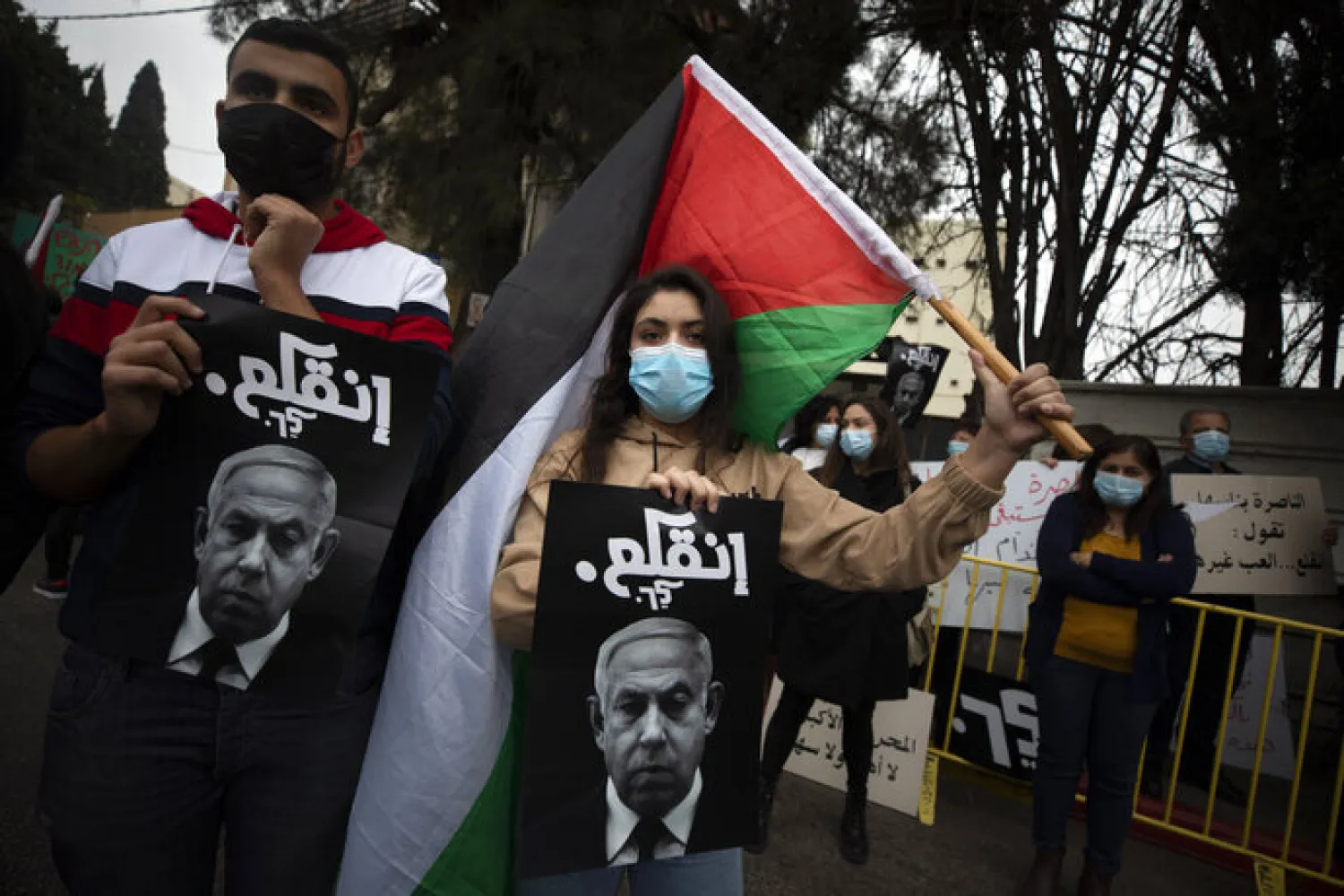

Netanyahu Courts Arab Voters in Election-Year Turnabout

Palestinian protesters hold signs and flags during a demonstration against a visit of Israeli Prime Minister Benjamin Netanyahu to the northern Arab city of Nazareth, Israel, Wednesday, Jan. 13, 2021. Netanyahu, who has spent much of his long career casting Israel's Arab minority as a potential fifth column led by terrorist sympathizers, is now openly courting their support as he seeks reelection in the country's fourth vote in less than two years. (AP Photo/Sebastian Scheiner)
TT

Netanyahu Courts Arab Voters in Election-Year Turnabout

Palestinian protesters hold signs and flags during a demonstration against a visit of Israeli Prime Minister Benjamin Netanyahu to the northern Arab city of Nazareth, Israel, Wednesday, Jan. 13, 2021. Netanyahu, who has spent much of his long career casting Israel's Arab minority as a potential fifth column led by terrorist sympathizers, is now openly courting their support as he seeks reelection in the country's fourth vote in less than two years. (AP Photo/Sebastian Scheiner)

Prime Minister Benjamin Netanyahu, who has spent much of his long career casting Israel's Arab minority as a potential fifth column led by terrorist sympathizers, is now openly courting their support as he seeks reelection in the country's fourth vote in less than two years.

Few Arabs are likely to heed his call, underscoring the desperation of Netanyahu´s political somersault. But the relative absence of incitement against the community in this campaign and the potential breakup of an Arab party alliance could dampen turnout - to Netanyahu's advantage. He might even pick up just enough votes to swing a tight election.

Either way, Netanyahu's overtures have shaken up the Arab community. The Joint List, an alliance of Arab parties that secured a record 15 seats in the 120-member Knesset last March, is riven by a dispute over whether it should work with Netanyahu's right-wing Likud at a time when less objectionable center-left parties are in disarray.

Its demise would leave the community with even less representation as it confronts a terrifying crime wave, coronavirus-fueled unemployment, and persistent inequality. But given the complexities of Israel's coalition system, a breakaway Arab party could gain outsized influence if it is willing to work with Netanyahu or other traditionally hostile leaders.

The struggle was on vivid display last week when Netanyahu traveled to Nazareth, the largest Arab-majority city in Israel, his third visit to an Arab district in less than two weeks. Outside the venue, dozens of people, including a number of Arab members of parliament, protested his visit and scuffled with police, even as the city's mayor welcomed and praised him.

"Netanyahu came like a thief to try to scrape together votes from the Arab street," said Aida Touma-Suleiman, a prominent lawmaker from the Joint List. "Your attempt to dismantle our community from within won´t succeed."

Arabs make up around 20% of Israel's population. They have full citizenship, including the right to vote, and have a large and growing presence in universities, the health care sector and other professions. But they face widespread discrimination and blame lax Israeli law enforcement for a rising wave of violent crime in their communities.

They have close familial ties to Palestinians in the occupied West Bank and Gaza, and largely identify with their cause. That has led many Jews to view them as sympathetic to Israel's enemies, sentiments fanned by Netanyahu and other right-wing politicians.

On the eve of elections in 2015, Netanyahu warned his supporters that Arabs were voting in "droves." During back-to-back elections in 2019, his campaign sent poll observers to Arab districts and pushed for cameras in voting booths, in what critics said was a ploy to intimidate Arab voters and whip up false allegations of election fraud.

Those moves backfired spectacularly.

The Joint List, an unwieldy alliance of Islamists, communists, and other leftists, boosted turnout and emerged as one of the largest blocs in parliament. At times, it looked like it might help deny Netanyahu a majority coalition or even emerge as the official opposition.

But last May, after three deadlocked elections in less than a year, Netanyahu formed a coalition with his main rival, and the Joint List was left out in the cold. In the coming election, polls indicate a coalition of right-wing and centrist parties committed to ending Netanyahu's nearly 12-year rule would be able to oust him without the Arab bloc.

No Arab party has ever asked or been invited to join a ruling coalition.

In Nazareth, Netanyahu claimed his remarks in 2015 were misinterpreted - that he was merely warning Arab voters not to support the Joint List.

"All Israel´s citizens, Jews and Arabs alike, must vote," he said. In other Arab towns, he has visited coronavirus vaccination centers, boasting about his success in securing millions of doses and encouraging residents to get inoculated.

Netanyahu's Arab outreach seems to have given a green light to centrist and left-leaning politicians to do the same, with less concern that their right-wing rivals will use it against them. Opposition leader Yair Lapid, Netanyahu's main center-left opponent, said over the weekend that he was open to forming a government with external support from the Joint List.

The Joint List is meanwhile showing signs of breaking up. Mansour Abbas, the head of an Islamist party, has expressed openness in recent months to working with Netanyahu to address issues like housing and law enforcement. An aide to Abbas declined requests for an interview.

A full-scale breakup of the Joint List could further reduce turnout and potentially leave one or more of its four parties with too little support to cross the electoral threshold.

Thabet Abu Rass, the co-director of the Abraham Initiatives, which works to promote equality among Jews and Arabs, says Netanyahu may attract a small number of Arab voters, but that far more of them would simply boycott the election.

"They are waiting to see if there is going to be a Joint List or not, and if you ask me, it´s not going to happen," he said. "There are a lot of deep differences this time."

A poll carried out in December forecast Arab turnout at around 55%, far lower than the 65% seen last March.

Although Arab parties have historically performed worse on their own, some feel the parties might be more effective individually. In Israel's political system - which requires would-be prime ministers to assemble majority coalitions - small parties often wield outsized influence.

"When we speak about the Palestinian community in Israel, we don´t speak about one bloc, we have different ideologies," said Nijmeh Ali, a policy analyst at Al-Shabaka, an international Palestinian think tank. "Sometimes you need to break up in order to gain power."

Netanyahu appears to be focused on the margins ahead of a tight race that could determine not only whether he remains in office, but whether he secures immunity from prosecution on multiple corruption charges. With only a few seats, a pragmatic politician like Abbas could determine Netanyahu's fate.

"This is the new thing in Arab politics," said Arik Rudnitzky, a research fellow at the Israel Democracy Institute. "They are ready to hold direct negotiations with Likud."

He said it doesn't mean they will be part of a governing coalition, but they could offer outside support to secure benefits for the Arab public. "It might be a win-win situation," he said.



Israel Says US Gaza Executive Board Composition Against its Policy

FILE - A displacement camp sheltering Palestinians on a beach amid stormy weather is seen in Gaza City, Jan. 13, 2026. (AP Photo/Jehad Alshrafi, File)
TT

Israel Says US Gaza Executive Board Composition Against its Policy

FILE - A displacement camp sheltering Palestinians on a beach amid stormy weather is seen in Gaza City, Jan. 13, 2026. (AP Photo/Jehad Alshrafi, File)

Prime Minister Benjamin Netanyahu's office said on Saturday that this week's Trump administration announcement on the composition of a Gaza executive board was not coordinated with Israel and ran counter to government policy.

It said Foreign Minister Gideon Saar would raise the issue with US Secretary of State Marco Rubio.

The ⁠statement did not specify what part of the board's composition contradicted Israeli policy. An Israeli government spokesperson declined to comment.

The board, unveiled by the White House on Friday, includes Turkish Foreign Minister Hakan Fidan. Israel ⁠has repeatedly opposed any Turkish role in Gaza.

Other members of the executive board include Sigrid Kaag, the UN special coordinator for the Middle East peace process; an Israeli-Cypriot billionaire; and a minister from the United Arab Emirates.

Washington this week also announced the start of the second phase of President ⁠Donald Trump's plan, announced in September, to end the war in Gaza. This includes creating a transitional technocratic Palestinian administration in the enclave.

The first members of the so-called Board of Peace - to be chaired by Trump and tasked with supervising Gaza's temporary governance - were also named. Members include Rubio, billionaire developer Steve Witkoff and Trump's son-in-law Jared Kushner.


Sisi Says he Values Trump Offer to Mediate Egypt-Ethiopia Dispute on GERD

FILE PHOTO: US President Donald Trump points as he attends a meeting with oil industry executives, at the White House in Washington, D.C., US, January 9, 2026. REUTERS/Evelyn Hockstein/File Photo
TT

Sisi Says he Values Trump Offer to Mediate Egypt-Ethiopia Dispute on GERD

FILE PHOTO: US President Donald Trump points as he attends a meeting with oil industry executives, at the White House in Washington, D.C., US, January 9, 2026. REUTERS/Evelyn Hockstein/File Photo

Egyptian President Abdel Fattah al-Sisi said he valued an offer by US President Donald Trump to mediate ⁠a dispute over Nile River waters between Egypt and Ethiopia.

In a post on ⁠X, Sisi said on Saturday that he addressed Trump's letter by affirming Egypt's position and concerns about the country's water ⁠security in regards to Ethiopia's Grand Ethiopian Renaissance Dam (GERD).

"I am ready to restart US mediation between Egypt and Ethiopia to responsibly resolve the question of 'The Nile Water Sharing' once and for all," Trump wrote to Sisi in the letter that was also posted on Trump’s Truth Social account.

Addis Ababa's September 9 inauguration of GERD has been a source of anger ⁠in Cairo, which is downstream on the Nile.

Ethiopia sees the $5 billion dam on a tributary of the Nile as central to its economic ambitions.

Egypt says the dam violates international treaties and could cause both droughts ⁠and flooding.

Sudan, another ​downstream country, has expressed concern about the regulation and safety of ⁠its own water supplies and dams.

Sudan's army leader Abdel Fattah al-Burhan also welcomed Trump's mediation offer on Saturday.


Kurds Say Sharaa's Decree Falls Short, Syrian Government Forces Enter Deir Hafer

Syrian army convoys enter the Deir Hafer area in the eastern Aleppo countryside, Syria, after the Kurdish-led Syrian Democratic Forces (SDF) announced the handover of the area west of the Euphrates to the Syrian government, 17 January 2026. EPA/AHMAD FALLAHA
TT

Kurds Say Sharaa's Decree Falls Short, Syrian Government Forces Enter Deir Hafer

Syrian army convoys enter the Deir Hafer area in the eastern Aleppo countryside, Syria, after the Kurdish-led Syrian Democratic Forces (SDF) announced the handover of the area west of the Euphrates to the Syrian government, 17 January 2026. EPA/AHMAD FALLAHA

Syria's Kurds on Saturday said a presidential decree recognizing the minority's rights and making Kurdish an official language fell short of their expectations as Syrian government forces entered the outskirts of a northern town.

In a statement, the Kurdish administration in Syria's north and northeast said the decree issued by President Ahmed al-Sharaa on Friday was "a first step, however it does not satisfy the aspirations and hopes of the Syrian people".

It added that "rights are not protected by temporary decrees, but... through permanent constitutions that express the will of the people and all components" of society.

Al-Sharaa’s decree affirmed that Syrian citizens of Kurdish origin are an integral and original part of the Syrian people, and that their cultural and linguistic identity is an inseparable component of Syria’s inclusive national identity.

The decree commits the state to protecting cultural and linguistic diversity and guarantees Kurdish citizens the right to preserve their heritage, arts, and mother tongue within the framework of national sovereignty.

It recognizes Kurdish as a national language and allows it to be taught in public and private schools in areas where Kurds make up a significant proportion of the population.

It also grants Syrian nationality to all residents of Kurdish origin living on Syrian territory, including those previously unregistered, while ensuring full equality in rights and duties.

The decree further designates Nowruz, celebrated annually on March 21, as an official public holiday.

Syrian government forces entered the outskirts of the northern town of Deir Hafer Saturday morning after the command of Kurdish-led fighters said it would evacuate the area in an apparent move to avoid conflict.

This came after deadly clashes erupted earlier this month between government troops and the US-backed and Kurdish-led Syrian Democratic Forces in the city of Aleppo, Syria’s largest.

It ended with the evacuation of Kurdish fighters from three neighborhoods taken over by government forces.

An Associated Press reporter saw on Saturday government tanks, armored personnel carriers and other vehicles, including pickup trucks with heavy machine-guns mounted on top of them, rolling toward the town of Deir Hafer from nearby Hamima after bulldozers removed barriers. There was no SDF presence on the edge of the town.

Meanwhile, the Syrian military said Saturday morning its forces were in full control of Deir Hafer, captured the Jarrah airbase east of the town, and were working on removing all mines and explosives. It added that troops would also move toward the nearby town of Maskana.

On Friday night, after government forces started pounding SDF positions in Deir Hafer, the Kurdish-led fighters’ top commander Mazloum Abdi posted on X that his group would withdraw from contested areas in northern Syria. Abdi said SDF fighters would relocate east of the Euphrates River starting 7 a.m. (0400 gmt) Saturday.

The easing of tension came after US military officials visited Deir Hafer on Friday and held talks with SDF officials in the area.

The United States has good relations with both sides and has urged calm.